Showing posts with label technology. Show all posts

Friday, December 19, 2025

Notes Toward a Semi-Luddite Manifesto, Part 2

This essay follows Notes Toward a Semi-Luddite Manifesto
Abraham Lincoln

It’s difficult to grasp how large Planet Earth was before petroleum. The most direct driving route across Great Britain from Land’s End to John O’Groats takes about thirteen hours, if roads and traffic allow. Trained endurance walkers, covering twenty miles per day, could walk that distance in two months, assuming conditions cooperate—which, in Britain, they won’t. The Mayflower crossed the Atlantic in 66 days, a distance air travelers today cover in under eight hours.

These distances didn’t just consume time. Travelers needed food, water, and places to sleep. Haulage couriers needed places to reshoe their horses and repair their wagons. This need created work for manual trades: farmers, taverners, wheelwrights, blacksmiths. Agricultural products were mostly consumed locally, by residents, travelers, and livestock. War didn’t only require warriors; it required baggage trains, cooks, farriers, stable-keepers, and more. Maintaining early nation-states required intricate, ongoing coordination between the public and private spheres.

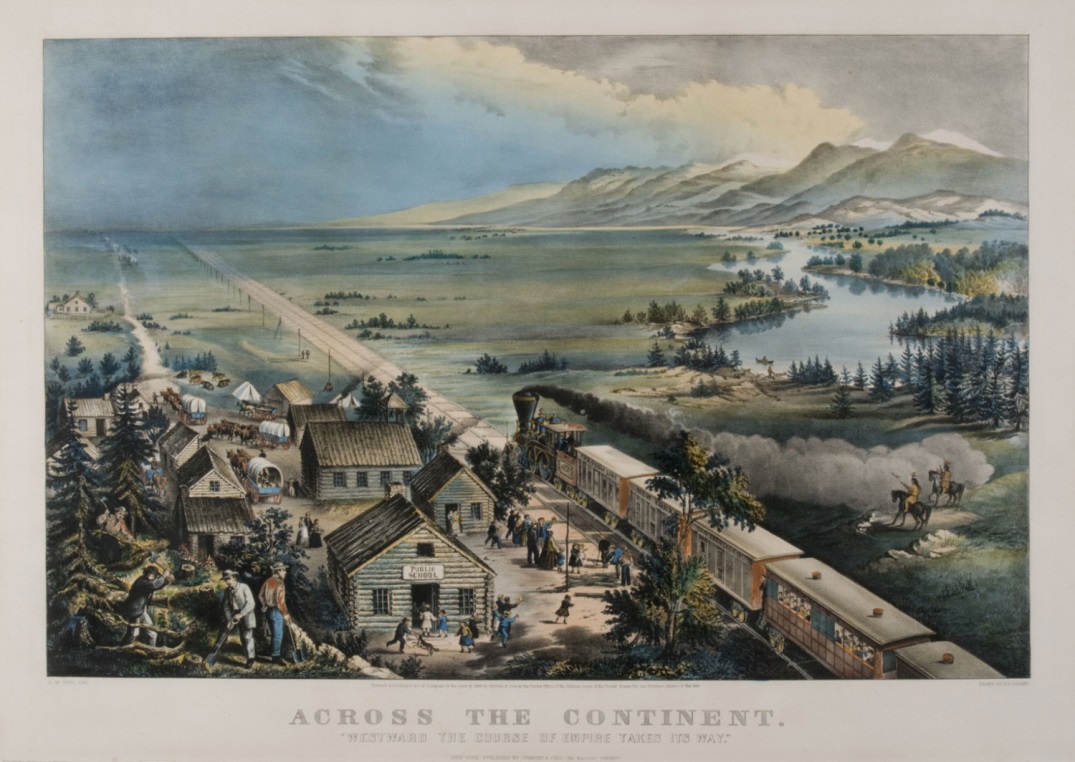
Much of modern history has involved attempts to decouple this coordination. American pioneers on the Oregon Trail needed five months, mostly walking, as their Conestoga wagons mainly hauled cargo. The Trans-Continental Railroad, which President Lincoln initiated to connect California to the more settled East Coast, required four days. That meant not only less time, but less food, fewer services, and no interactions with the physical space. Prairie towns became something travelers whizzed past without stopping.

Consequently, most agricultural output was no longer consumed locally. Farmers produced for distant markets, specializing in crops that shipped safely under harsh conditions without refrigeration. Lincoln signed the bill creating the USDA to stabilize American food supply the same year he inaugurated the Transcontinental Railroad. To this day, the USDA subsidizes the five most shelf-stable crops that best handle shipment and processing: corn, wheat, rice, soybeans, and cotton. (Some lists also include sorghum and peanuts.)

Please note, this subsidy schedule isn’t morally neutral. It rewards farmers who wring the highest possible output from their lands, which in turn rewards ammonia-based fertilizers, heavy equipment, and consolidated ownership. It also discourages crop rotation, diversification, and even letting a field lie fallow occasionally. Farmers must produce maximally, and thrust it onto the market, irrespective of floating prices or consumer demand. Only by keeping outputs high do farmers receive the subsidies they rely upon.

The frontier as depicted by Currier and Ives (click to enlarge)

Children still sing about Old McDonald’s diverse farm animals, but that’s bucolic poppycock. Farming for the long-distance market means abolishing not only traditional American farm autonomy, but also Native American traditions of land stewardship. There’s no separating the massive Nebraska monocropping that famously terrified Stephen King, and the racism that justified Wounded Knee. Nor from the European colonialism that, as I wrote last time, wrecked a 9,000-year stable relationship between humans and nature in Newfoundland.

These changes create short-term convenience, but have massive long-term costs. Oregon Trail pedestrians owned their Conestoga wagons; rail passengers rented access for a few days. We can argue that motorists own their cars, but most are deeply leveraged with debt, and the bank owns the actual note. Today’s industrialized farmers are paper millionaires behind their land holdings and equipment, but their “ownership” is deeply leveraged, and most are one bad season away from losing everything.

Far from making us free, our massive technological do-funnies make us more beholden than the English peasant who needed months to walk Britain. Our hypothetical peasant probably couldn’t travel far from his birthplace because the journey was impractical. We could travel, but mostly can’t, because our car payment, rent or mortgage, student loan debt, utilities, credit card bills, and internet access are coming due. Our peasant owed fealty to one feudal lord; we have dozens.

Please don’t mistake this for naïve nostalgia. We live with amortized debt the way our distant ancestors lived with smallpox, wars of religion, and an infant mortality rate hovering around forty percent. We can’t fight the tyranny of false convenience by embracing cottagecore aesthetics, wearing gingham, and rereading our Little House books. The solution comes in looking forward, not back, and creating something new, not nesting in the store-bought emblems of a beatified, ahistorical past.

Historian Greg Grandin writes that, in America’s early republic, James Madison advocated for westward expansion to hasten continental democracy. Madison asserted that Americans could never expand enough to occupy the continent, giving the state a permanent mission. But Americans occupied the entire continent in scarcely a century. To do so, we wrecked forests, devastated bison habitat, strip-mined Appalachia, and overthrew world governments. Continental convenience wasn’t an accomplishment, it was a mortgage that’s now coming due.

Thursday, November 13, 2025

Breaking Rust: the Final Boss of Country Music

In my father’s household, the only music was country music. And the only country music was honky-tonk. Lefty Frizell, Patsy Cline, and especially Old Hank remained the only benchmark of artistic accomplishment. Dad would permit newer, slightly innovative artists like Alabama or the Oak Ridge Boys into the house, but for all practical purposes, Dad believed good music ended when the Statler Brothers stopped having chart hits.

I remembered Dad’s rock-ribbed loyalty to old-school authenticity this week, when a generative AI song hit number one on Billboard’s Country Digital Song Sales chart. Breaking Rust appears to be an art project combining nostalgic country sounds with still images; music journalist Billy Dukes tried, without success, to track the originating artist. Critics, journalist, and armchair philosophers are debating what Breaking Rust means for future commercial music.

“Walk My Walk” is a pleasant, but undistinguished, Nashville hat-act song. Rhythmically, it’s a prison work song, and the lyrics tap into a White working-class motif of “hard livin’ won’t break me.” The digitally generated voice has a deep bass rumble with a nonspecific Southern accent, a sort of dollar-store Johnny Cash. Its message of facing poverty and setbacks with dignity and grace goes back decades in country music.

We shouldn’t over-interpret the track’s success. It topped a relatively obscure chart, not Country Airplay or Hot Country Songs. Because it exists wholly digitally, and the artist is apparently unsigned to a Big Three label, Breaking Rust’s success probably reflects the Spotify algorithm. It bears repeating, as Giblin and Doctorow write, that half of all music in America gets heard through Spotify, giving one algorithm extreme control of American taste.

That’s saying nothing about whether number one means anything anymore. I’ve written previously that, far from reflecting public taste or artistic merit, as it supposedly did during the heyday of Elvis or the Beatles, Billboard now often reserves the top slot for the blandest, most committedly inoffensive tracks. Far from the best song out there, today’s number one is the song most conducive to playing as background music while studying or commuting.

Breaking Rust is the smoothest puree of recent country music, with its sound, its lyrical themes, and even mid-tempo walking rhythm. I fear I’m repeating myself, as I’ve recently written something similar about AI-generated television. But I’ll repeat myself: AI “art” inevitably results in what mathematicians call “regression toward the mean.” That is, the larger your core sample, the closer your product falls toward dead center.

The AI-generated portrait of Breaking Rust: the ultimate banal Marlboro Man

Yet for algorithm-driven entertainment businesses, regression isn’t a flaw. Country music itself proves this. The genre was founded by hardscrabble people from poor backgrounds, artists who lived the life they described. Hank and Lefty, Jimmie Rodgers and the original Carter Family, were working people who recorded the songs of their friends and communities. Rodgers recorded his final songs literally on his deathbed, because his railroad work had destroyed his lungs.

But around 1963, when the British Invasion caused a sea change in rock music, several former rockers reinvented themselves as country singers. Johnny Cash, Conway Twitty, Jerry Lee Lewis, and even Elvis tapped into the twangy side of their Deep South artistic influences and became country musicians. But in changing their style, they also changed their market: their songs became much more past-oriented and nostalgic.

Growing up, I listened to songs like Cash’s “Tennessee Flat Top Box,” the Statlers’ “Do You Remember These,” and Johnny Lee’s “Cherokee Fiddle,” all of which yearned for a past uncluttered by responsibility, noise, and haste. Country music’s founders sang about working-class rural living—and, in the alt-country enclaves, many still do. But after 1963, naïve yearning for bygone simplicity dominated the radio mainstream.

Even before generative AI, the system reinforced itself. Longing for a simplified past became the soil where new artists grew. Neotraditionalists like Dwight Yoakam, Mary Chapin Carpenter, and Toby Keith built careers around pretending to be older than they were, and wishing they lived in a countrified candyland that only existed in songwriters’ imaginations. Much as I love Johnny and Dwight, their nostalgia became a trap I needed to escape.

In that regard, Breaking Rust is the inevitable outcome. Country music, which began life as White soul music, has been a nostalgia factory since before I was born. Moving out of my father’s house, I had to unlearn the genre’s myths of honest work, stoicism, and White hardship. Other fans chose not to unlearn it, and Breaking Rust has doubled down, becoming the perfect recursive loop of self-inflicted White persecution.

Friday, June 27, 2025

“Poop Cruise” and the Hidden Machines of Modernity

The deck of the Carnival Triumph before the nightmare began

Sometime in the small hours of February 10th, 2013, a diesel generator on board the Carnival cruise ship Triumph caught fire. The incident caused no casualties, and the ship remained intact. But the fire consumed several power conduits, disabling main power and propulsion. Nearly 3000 passengers and over 1100 crew were adrift on the Gulf of Mexico.

Netflix has perfected a content creation system wherein they produce “documentaries” with a combination of existing footage and new interviews. This works in documentaries like Turning Point: the Bomb and the Cold War, where most interview subjects are historians, diplomats, and social scientists. You need specialists prepared to go beyond the obvious. That's what makes Trainwreck: Poop Cruise such a missed opportunity.

When central power failed, the Triumph's kitchen had to discard tons of perishable food, and the ship's interior became unbearably hot. But when passengers contacted loved ones on shore, another fact captured the public's attention. Without power, the ship's plumbing quickly failed. Within hours, the companionways became choked with human feces. Without anywhere to drain, the sewage clung to everyone's feet.

Director James Ross interviews several passengers and crew: a Bachelorette party, a father and daughter, a young bachelor meeting his future father-in-law for the first time. The ship's tour director and head chef. In direct narrative, these survivors describe the sensory overload of the shit-choked interior, while on deck, passengers descended into Gomorrah-like levels of disinhibition.

But at only fifty-five minutes, the documentary doesn't have room to explore beyond this surface level. Yes, being trapped in a confined space with limited food but flowing rivers of poop, sounds like a trip through the depths of squalor. But without further analysis, it becomes superficial, the sensory revulsion of anyone who's used a week-old Porta-John. We don't get much insight into how it happened, or what it can teach us.

Early on, one bachelorette party member talks about the ship resembling a skyscraper. This shouldn't go unremarked. Smarter critics than me have observed that cruise ships produce more pollution than many cities: diesel fumes, plastic and paper waste, food packaging, and especially sewage. Solid waste gets held for disposal on-shore, but the sewage gets discharged into the ocean.

The Carnival Triumph after staterooms became too hot and smelly for human habitation

Cruise companies keep their ships glamorous and fun through an elaborate network of human and mechanical systems. The Triumph's crew complement of over a thousand included mechanics and technicians, cooks and hospitality staff, maintenance workers, and others the passengers never see. That's besides the enormous machines, which consume fuel enough to make your leafy-green Prius look paltry by comparison.

Thousands of workers and hundreds of machines means ships have countless moving parts, all prepared to break. Companies have to prepare for every eventuality, and have supplies for repair ready early, because, as the Triumph's crew discovered, resupply may be days away. The investment in human skills will also be substantial.

Extending the analogy between cruise ships and cities, the technological capacity to house and employ so many people in such proximity is astonishing. Urban designer Jeff Speck contends that cities are environmentally sound because close quarters means less energy expended in transportation and climate control. I won't disagree with Speck, as he isn't wrong. But cities require more energy to get food in, and sewage out.

Humans change the environment wherever we go. Unlike other animals, humans don't instinctively slot ourselves into our ecosystem; scholars dispute whether humans have instincts at all. We must constantly make choices about our food, shelter, and entertainment. Technology has created the illusion that we don't have to make some of those decisions anymore, but that's a phantom. We actually just don't have to see our decisions anymore.

Because it's a closed environment, the Triumph amplifies it when our choices become visible again. If sewage systems in Manhattan or Chicago collapsed, it might take weeks before residents noticed, not the hours needed on cruise ships. But sewage processes haven't advanced meaningfully since Joseph Bazalgette pioneered urban sewers in the 19th century. Researchers suffer from the “poop taboo,” making sewage research a dead-end enterprise.

Perhaps director James Ross expected audiences to draw these conclusions without being prompted. But I only caught it because I've read about urban design. When I've tried discussing the “poop taboo” with friends, they've gagged and silenced me. Creating the Triumph's sensory immersion without discussing what it means for us, lets us continue ignoring the parallels with the human environment. But as the Triumph's passengers discovered, failure to plan for disaster, doesn't prevent disaster from happening.

Saturday, March 8, 2025

The Great Exploding Rocket Debacle Continues

A SpaceX Starship test rocket launch (AP photo)

Back in the 1980s, I remember being a science fiction fanboy, growing disgusted with the American space program’s apparent inaction. Sure, NASA maintained a robust schedule of space shuttle flights and satellite launches that had a certain earthside grandeur. But shuttle crews performed a string of low-stakes scientific experiments that yielded only incremental knowledge gains. Compared to Asimov-era promises, NASA seemed terminally timid.

Fiction countered this ennui with the promise of libertarianism. I’d be hard-pressed to name even one title or author forty years later, but a bevy of science fiction authors proposed the idea of private corporations and rich cowboys taking over where NASA proved timid. Ben Bova certainly hinted at this with his Moonbase novels. Arthur C. Clarke, though no Randian libertine, nevertheless had undertones of privatization in his Thatcher-age novels.

This promise of private-sector space flight seemed promising to my preteen self. I was mature enough to gobble down novels written for adults, a voracious reader hungry for the high-minded themes and promises of adventure which grown-up SF promised. But I wasn’t subtle enough to parse deeper meanings. These novels I greedily inhaled often contained dark implications of privatized space exploration encouraging rapacious behavior and destructive greed.

Watching the news surrounding this week’s SpaceX flight explosion, I can’t help remembering those stories I dimly understood. Elon Musk has spent a decade pitching how his multiple corporations can perform public services more efficiently than public bureaus. Yet his spacecraft’s multiple explosions, including this one which halted East Coast air traffic for hours, have repeatedly embarrassed us ex-scifi kids who still think space is pretty cool.

Elon Musk

Musk’s personal wealth reached nearly half a trillion dollars immediately following the 2024 presidential election, thanks to his connections with President Trump. Everyone assumed, not unreasonably, that Musk’s lucrative government contracts, including SpaceX, would yield heavy dividends in a Trump presidency. Yet in under two months since the election, Musk has seen his wealth fall by a quarter, fueled by his reckless behavior and personal unpopularity.

Importantly, Musk’s wealth has come significantly from government contracts. SpaceX makes some profitable product, particularly its StarLink satellite system, but that profit comes with significant amortized debt, underwritten by government credit securities. Most of SpaceX’s actual operating capital comes from NASA contracts since, following the discontinuation of the space shuttle program, NASA has no in-house launch capabilities anymore.

But this privatized space program has been, charitably, embarrassing. NASA spent much of its house budget creating scientific laboratories and testing facilities, because its budget, circumscribed by Congress, included little room for launchpad errors. SpaceX employs few scientists, but mostly engineers, preferring to build and launch physical prototypes, because even when they explode, they create valuable capital through the medium of name recognition.

In practice, this means NASA was slow-moving and timid, but it produced results: NASA went from President Kennedy promising a moon landing, to actually landing on the moon, in seven years. SpaceX moves quickly and dramatically, but it mostly produces falling debris and lurid headlines in the 24-hour news cycle. Its track record getting actual astronauts into space is spotty, and frequently beholden to the bureaucratic cycle.

Again, this underscores a contradiction in libertarian thinking. This week’s explosion, which scattered debris widely throughout the Caribbean, forced the FAA to halt traffic from major American airports—mere days after Musk’s own chainsaw behavior reduced FAA workforce numbers to critical levels. Musk disparages the public sector that, it turns out, he desperately needs.

Herbert Marcuse postulated, in One-Dimensional Man, that technological society produces intellectual stagnation and a headlong race toward mediocrity. This applies, he wrote, in capitalist and communist societies alike: engineers only reproduce what they know already works. Actual innovation requires government intervention, because only governments willingly embrace uncertainty and the capacity for failure.

SpaceX has proven what 1980s SF writers said, and I failed to understand, that a successful privatized space program requires avaricious ego and casual disregard for consequences. Private space exploration requires a greedy space pirate to eviscerate public resources for private gain, then turn around and trust public servants to keep citizens alive when the engineered product literally explodes. That’s the opposite of innovation.

IMusk’s embarrassing post-inauguration behavior and continuing business disasters probably won’t cure anybody of libertarianism, at least yet. People who ideologically believe in the private sector’s goodness will persevere despite seven weeks of high-profile setbacks. But hopefully at least some will accept that, in a high-tech society, the private sector needs a public sector to survive without killing innocent bystanders.

Thursday, January 30, 2025

Living in the Wallace & Gromit Economy

Wallace unleashes his newest invention, NORBOT, on his hapless pooch Gromit
in the new film Vengeance Most Fowl, now on Netflix

I’m a fan of Nick Park’s Wallace & Gromit films, since I first discovered the original short films on grainy, probably bootleg VHS in the 1990s. The humor operates on the same principle as Mr. Bean or Red Dwarf: a well-meaning but incompetent protagonist bumbles into situations far above their heads. Wallace, Bean, or Rimmer are momentarily embarrassed, but consistently come out ahead, without really learning anything.

The films present Wallace as a garage inventor and shade-tree mechanic. Though the first short film has him successfully build a moon rocket in a weekend, subsequent films consistently harp on the same theme, that Wallace’s inventions create more problems than they solve. They require added steps, break down frequently, get sabotaged by rascally varmints, and otherwise create needless kerfuffles. All just to less efficiently butter his breakfast toast.

Though that theme runs through nearly every film, short or long, I don’t recall it looming as large as in the latest entry, Vengeance Most Fowl. Throughout Act One, Gromit, the wordless dog character who’s secretly the brains behind the operation, keeps indulging Wallace’s invention mania. However, he longs to complete his necessary tasks and switch over to the activities which give his life meaning: gardening and knitting.

Wallace, however, persistently misunderstands Gromit’s need for meaningful work. He sees both gardening and knitting as repetitive work, which automation can eliminate. Therefore he introduces his newest invention, NORBOT, a self-actuating garden gnome that literally takes jobs right out of Gromit’s hands. Though wordless, Gromit’s Claymation facial expressions make clear the disgust he feels without tasks to occupy his hands and brain.

Thing is, I understand, somewhat, Wallace’s motivation. For years, advocates of Fully Automated Luxury Space Communism have claimed that technology will render work obsolete a week from next Tuesday, and we’ll have limitless free time to… well, to do whatever. More recently, TechBro types have extolled what they falsely call “Artificial Intelligence” to take writing, music, and art away from the nerds by strictly automating it.

Such advocates see work as burdensome, something to outsource. Socialists have historically considered work as something imposed by the economic order, something we can abandon because our high-tech do-funnies will absorb the tedium. TechBros, by contrast, see workers and their jobs as an undesirable sunk cost that they’d rather abandon. Either way, work becomes something to abolish, replacing ordinary humans with machines, computers, and heuristics.

NORBOT represents only the comical reductio ad absurdum of this mentality. It snatches the pruning shears from Gromit’s paws and, in mere seconds, transforms his lush English garden into a topiary extravaganza completely devoid of character. It subsequently steals Gromit’s yarn and knits Wallace another outfit exactly like the one he always wears. NORBOT works fast, cheap, and efficiently, but without personality or meaning.

Socialist writer Barbara Garson admits she thought the capitalist class forced workers to work. Only after visiting workplaces and watching the ways employees extract meaning from standardized work, did she realize that work said something about workers’ souls. People don’t work because overseers and debt collectors force it. They work because what we do with our hands, what we create with our brains, defines who we are.

Economist John C. Médaille similarly observes that, if you watch how people spend their free time, it frequently resembles work. Left to their own devices, people might grow vegetables, build Shaker furniture, write novels, perform home improvement, rebuild classic cars, or paint. Although some people certainly drink beer and watch television, complete forfeitures of experience, most people, given the opportunity, seek work to define themselves.

To a limited extent, advancing technology has made such meaning easier to create. Inventions like the steel plow and combine harvester meant that growing crops required fewer workers. In former days, most peasants farmed from sheer necessity. Now, most people can choose whether they want to cultivate the earth, or whether they’d rather make meaning elsewhere. Therefore I’m no absolute Luddite, and embrace technology to a point.

However, I’d contend we’ve surpassed that point. Early Twentieth Century inventions made work more productive, and homemaking more efficient. However, as Research and Development has superseded invention, most “new” technologies simply complexify existing machines. I struggle to imagine any technology that’s improved our lives in the last thirty years. Made us more productive? Sure. But happier, healthier, better developed? I got nothing.

Watching Gromit get his hobbies stolen, I felt the pang of familiarity. We’re all watching capitalists extract meaning from our lives, sometimes without malice. We’re all Gromit now.

Monday, October 7, 2024

We Don't Have to Serve the Network

Elon Musk

On Monday, September 30th, 2024, the Verizon mobile phone and data network failed for millions of Americans in multiple markets. This had obvious immediate effects for personal communications and media consumption. But for innumerable gig-economy workers, such as drivers for Über, Lyft, and DoorDash, the outage impeded their ability to work and make a living.

This follows recent outages for other digital service providers. Since Elon Musk took over Xitter and cut support personnel, the site has suffered periodic site failures. This impedes many companies’ ability to communicate en masse with their customers, but is more an inconvenience than a catastrophe. Far worse is the occasional Meta shutdown, as Facebook is the login portal for numerous other digital services.

And, holy cow, remember how many services wend dark following the most recent Microsoft outage? The post-pandemic remote work boom depends, in no small part, on how Microsoft and Meta have standardized communications and data sharing. Such outages steal workers’ ability to do decentralized, autonomous fundamental jobs. Modernity absolutely requires standardization.

Consider how many documents you’ve stored on the much-vaunted Cloud. Not only virtual data systems, like Google Drive, rely on the Cloud; you can’t even save documents locally in Microsoft Word anymore. Not to disparage the sharing and backup possibilities that the Cloud makes possible, but it also creates unprecedented vulnerabilities, both to data outages and to hackers. Everything you write is possibly exposed to mass attacks.

Bill Gates

How, though, do remediate this? The decentralized post-pandemic intellectual workspace requires standardized data platforms and content sharing, which requires large companies to coordinate our systems. Put another way, there’s no such thing as an artisanal cellphone network. Numerous small businesses—from conventional businesses to spunky Etsy entrepreneurs—need concentrated data sharing.

This creates an interesting tension. We valorize entrepreneurs, freelancers, and the self-employed as economic drivers. But to have any market outside a reasonable driving distance, start-up innovators require massive corporations with thousands, if not millions, of workers. The “gig economy” treats every DoorDasher or Über driver as a separate small business. But without the umbrella corporation coordinatingtheir options, their “businesses” vanish.

As a Distributist, I believe that economics should prize personal autonomy and abjure resource hoarding. When carpenters own their tools, and farmers own their land, they have the freedom to enter fair contracts, or refuse unfair ones. But the Distributist model, first postulated in the 1910s, simply didn’t anticipate today’s industrial complexity or global economy. Our world has become less fair, not more.

Therefore, the Verizon outage forces me to reevaluate my own beliefs. Distributed post-industrial economic power requires reliable communication and data storage standards, only possible when our communications systems share a language and a network. That level of coordination only happens when boosted by large corporations. Distributed freedom for some, requires wage servitude for others.

Mark Zuckerberg

Worse, while the liberty of freelance work hypothetically strengthens individual workers, the coordination necessary to actually find work proves terribly brittle. Your DoorDasher can freely accept or refuse each proffered job, but when the network collapses, every job vanishes, leaving the worker without options. In practice, disaggregated freelancers don’t work for themselves, they work for the network.

One could expand this argument to encompass the entire economy. Capitalism’s defenders claim that market capitalism is small-d democratic because we can accept or reject any transaction. This may hold for each unique transaction, but we cannot opt out altogether. We eventually need food, shelter, and clothing, which inevitably means transactions, which means buying into the economy.

Pure libertarian freedom, therefore, is always an illusion. We’re never independent actors; we rely on networks of trust, industry, and solidarity. Whether that means trusting our employers to deal honestly, relying upon industrial processes to keep us connected, or practicing solidarity with our peers (join the union or perish!), we remain permanently enmeshed in networks. I never exist truly alone, but always positionally, within community.

I’m old enough to have watched Communism collapse live on network television. The retreat of the Eastern Bloc revealed environmental blight, impoverished communities, and personal alienation—the same effects we witness now, in late American capitalism. The conventional economic binary which the Cold War bequeathed us proves massively unprepared for the post-industrial information economy.

When the network leaves us vulnerable, we need to recognize that the economy is a wholly owned subsidiary of our communities, not vice versa. We require new paradigms that organize our economy, technology, and government to serve us. And I’m only just beginning to delve into how that might work.

Wednesday, August 28, 2024

The Forces That Built the World We Live In

Vaclav Smil, How the World Really Works: The Science Behind How We Got Here and Where We’re Going

Something must change, but it’s impossible to untangle the overlapping social, political, and technological forces driving our world. Activists and reform advocates have wanted to change the ways we built cities, generate power, grow food, and distribute money. But every time somebody makes even fiddling procedural changes, it creates a domino effect of unintended consequences. We need a guide with encyclopedic knowledge to organize reforms without creating a cascade.

Despite searching, I can’t determine Vaclav Smil’s original scientific specialization. Every press biography and university write-up calls Smil a “scientist,” and his writing shows definite interdisciplinary background knowledge. He definitely comprehends technical aspects of modernity that well-meaning activists frequently miss. Yet reading him, I noticed that Smil misses something, too: technological whiz-bangs require humans to operate them, and humans make choices.

Professor Smil identifies four synthetic products which he calls “The Four Pillars of Modern Civilization”: cement, steel, plastics, and ammonia (he apparently excludes naturally occurring petroleum). These products create physical stability, economic prosperity, and at least a measure of control over the natural environment. Unfortunately, each also carries environmental and economic prices, some vast. And we cannot remove any without upsetting the architecture of technological modernity.

So far, so good. But Smil’s analysis of these products and their public applications, overlooks that using these products always entails human choices. Sometimes, those choices are private: you individually decide whether to spray weed-n-feed, an ammonia product, on your lawn. But when those choices are scaled to society-wide levels, we call that public policy, and it always involves conscious decisions, by lawmakers or their appointed bureaucrats, about how we’ll direct our public resources.

Because I live in Corn Country, I noticed Smil’s disregard for policy mostly in his passages on agriculture. Start with this: Smil insists that, to adopt an organic agriculture model free of synthetic chemicals and heavy equipment, we’d first have to revert to medieval peasant lifestyles. This is patently ridiculous, because Jethro Tull’s seed drill and its successor, John Deere’s steel plow, displaced agricultural workers long before diesel fuel and ammonia fertilizers existed.

Yes, Jethro Tull and John Deere were real people, before they became brand names.

Smil contends that only modern agricultural output makes modern civilization possible. But in Nebraska, where I live, corn (maize) farmers flail desperately to find or invent markets for their produce. This represents chemical-intensive farming technology, but also government decisions about which crops to subsidize. America regularly unloads surplus corn on chronically impoverished nations as “food aid,” undercutting native agriculture and increasing urban poverty and global dependence.

Vaclav Smil

Similar objections permeate Smil’s technological analyses. Portland cement produces approximately seven percent of Earth’s greenhouse gas emissions, but we can’t manufacture modern roads without it. And we need roads, right? Only somewhat. Roads are an example of what economists call “induced demand,” observed when newly constructed superhighways become congested within five years. Building roads creates the need to use them, especially as Americans refuse to fund public transit networks.

Modernity has produced unprecedented comfort and wealth, as Professor Smil writes, in the aggregate. Yet modernity hasn’t distributed its benefits evenly. Traffic jams represent a manifestation of modern wealth, after all. So did Houston’s inability to drain following Hurricane Irma. Single-use urban design, which necessitates commuting, and slovenly urban design, which causes rainwater to pool and wash away topsoil, are the product of policy choices, not inevitable outcomes.

I cannot find fault with Professor Smil’s technological analyses, especially since he’s more widely informed than me. He makes a persuasive case that living like we to today absolutely requires his Four Pillars, and even minor amendments will inevitably create painful dislocations with broad knock-on effects. We didn’t get into this position of economic inequality and looming environmental collapse overnight, and we won’t escape this position without changes that will overhaul our society.

Yet for all his technological clarity, Smil’s analyses completely omit the public policy and economic considerations which created such material dependency. Notwithstanding a later chapter on “risk analysis,” Smil defines risk in substantially technical terms, excluding nonlinear human variables. The world Smil describes didn’t just happen; bureaucrats, capitalists, and other unelected decision-makers built it, brick by brick.

This book provides valuable insights into the technical qualities of modernity, in plain-English terms for non-specialist readers. But Smil writes checks his analysis can’t cash, because he sees technocracy as an inevitable progression from cause to effect. He completely excludes the human decision-making processes that got is into the situation, thus overlooking the only forces which might get us out.

Friday, July 12, 2024

The Perils of Making Work Go Away

As an avid cyclist, I’ve heard the semi-comical stereotypes. We’re self-righteous, have no personality, and wear ridiculous spandex clothes. But perhaps the most persistent stereotype is cyclists’ casual disdain for stop signs. Which, in fairness, is real. I’ve been bawled out several times for pulling an “Idaho stop” through a clearly posted stop sign—usually by a motorist who just rolled through the same intersection.

Consider, though, why cyclists might treat stops flippantly. First, we aren’t going particularly fast. Only elite cyclists, riding the most high-tech bicycles, can achieve the 35 MPH speed limit common on American residential roads, much less 45 on main roads or 65 on highways. We’re hardly caroming at breakneck speeds, as motorists often do. But the biggest reason is even simpler: once we’ve fully stopped, getting rolling again is serious work.

Stick-shift drivers know this feeling. Once the vehicle achieves a standing stop, nothing makes a bicycle go again except the cyclist’s bodily effort. While motorists heckle me from inside their hermetically sealed capsules, letting the engine do the work, I have only my limbs to make the bike move again. Only when I drove a stick-shift pickup, enacting the nuisance of constant upshifting, did I discover something comparable behind the wheel.

Of course, driving a car doesn’t make the effort of starting from a standing stop go away. The entitled motorist shouting from the comfort of his family sedan, with climate control and an automatic transmission, requires far more work to get that mass of metal rolling. However, where I invest the personal effort to move my bicycle, the motorist delegates the effort to the “other party,’ the car’s engine. The work still happens; somebody else just does it.

The more I look, the more I see this pattern recurring throughout society and history. The desire to offload tedious labor has dominated human development. I’ve read speculations that humans invented cooking, in part, to escape the relentless tedium of chewing raw food. Later, humans tamed horses because riding was easier than walking; our ancestors also invented sails because it was easier than rowing (and because water travel is easier than overland).

Early human technologies involved harnessing animal power. Ox-drawn carts and horse-drawn carriages eliminated the burden of walking large distances, an important advance in ages when twenty miles was a relentless slog. After hand tools replaced broadcasting seed in early agriculture, the next major breakthroughs involved animal-driven technology: Jethro Tull’s seed drill, and its immediate successor, John Deere’s steel plow, both drawn by draft animals.

Then there are attempts to harness the elements. Chinese and Greek inventors separately perfected the water wheel to grind grain; the technology, with fiddling changes, remains common in Amish and poor African communities. This technology wasn’t insignificant, either, as Jack Kelly describes the DuPont family harnessing it to manufacture America’s first commercial-grade gunpowder, inaugurating a chemical manufacturing legacy that persists today.

And, of course, slavery existed: the ultimate effort to offload boring labor.

The technologies of the Industrial Age and after, merely complement this process. Internal combustion engines overtook horses, and nuclear power may soon overtake coal, but the motivation remains unchanged. Then there are the more pessimistic manifestations. Generative AI basically promises to enable everybody to write books, paint portraits, and compose music, without the boredom of learning and perfecting the skills.

Never let anyone say I don’t understand the appeal of offloading labor. I love having central heat without having to bank the fire overnight; I enjoy bunking off on vacation without having to walk over hills and across rivers. But increased ease remains pricy. It’s impossible to have central heat without global warming, just as it’s impossible for me to vacation in Missouri without the soul-sucking ennui of the morning commute.

Also consider what losses we suffer. When I commute to work, or toddle off to Missouri along the Interstate, every drive becomes identical, dominated by repetitive buildings and dun-colored landscapes. On my bicycle, I see things drivers ignore, like subtle outbuildings, wide-eyed pedestrians, and—sadly—overlooked roadkill. Likewise, generative AI “artists” can mass-produce content, but they never develop their unique, inimitable style.

I certainly enjoy modern conveniences, like nutritionally diverse food, pharmaceuticals, and the internet. But when I bike to work, the experience is more complex and nuanced than when I drive. Does anybody really enjoy the feeling of road hypnosis? Is anybody particularly moved by an AI painting? Offloading tedious labor onto others makes life easier, certainly. But it also robs life of meaning.

Wednesday, July 10, 2024

A Brief History of the Explosions of War

Jack Kelly, Gunpowder: Alchemy, Bombards, and Pyrotechnics: The History of the Explosive That Changed the World

The weapons we use to fight wars are, in their own way, tools; and, like any other tools, somebody needs to make them. I remember learning in Ninth-Grade World History that anonymous Chinese scientists invented gunpowder, which subsequently made its way to Europe through means unknown. But high school never taught me who did the laborious work of compounding early handmade gunpowder, or what effect it had on their peoples.

Jack Kelly is both a pop historian and a historical novelist, dedicating his career to glamorizing largely forgotten corners of humanity’s past. His nonfiction works are unified by themes rather than by personalities. This volume traces the arc of gunpowder—known as “black powder” to shooters and historical reenactors, to distinguish it from modern synthetic, “smokeless” powder—from China in the Twelfth Century AD to the early Twentieth Century.

That’s not to say that Kelly doesn’t consider individuals and their influence. He introduces us to the potentates who brought gunpowder into warfare, from nameless Chinese alchemists, through to King Edward III, Sultan Mehmet of Constantinople, and Hernán Cortés (gunpowder and imperialism are inextricable). But also the early gunsmiths who fashioned the weapons these potentates used: early cannons were so elaborate, and so individual, that armies gave their guns individual, usually feminine, names.

Rather, with each personality that utilized gunpowder and improved guns, the themes of power and technology advance. To give just one example, artisanal workers needed to collect black powder ingredients and compound the powder manually. The need to standardize gunpowder and bring prices down helped princes kick-start the industrialization that defined rising capitalism. Besides a weapon, gunpowder was also a technological and economic driver.

It's probably uncontroversial to say that gunpowder, always a weapon, was never morally neutral. In Kelly’s telling, however, it also isn’t administratively neutral. Scaling up gunpowder production sufficiently to make it useful, required massive bureaucratic organization. The number of saltpeter farms, charcoal burners, and artisanal powder-makers necessary required massive advancements in government administration. Gunpowder arguably contributed to the development of the modern technocratic state.

Jack Kelly

Similarly, Kelly sees gunpowder as advancing the development of modern science. Artisanal powder-makers didn’t really understand how their product worked, and experimented casually with manufacturing techniques. But early chemists like Hooke and Boyle tested gunpowder and its ingredients to better understand how physical reality works. As “natural philosophy” gave way to experiment and documentation, black powder seems present at every stage. Gunpowder, Kelly suggests, was instrumental to Boyle’s discovery of oxygen.

These claims may seem far-fetched, and indeed, Kelly frequently performs the pop historian’s fallacy of assuming everything is explainable through whatever lens he currently employs. For instance, his history of chemistry overlooks the influence of those newfangled hydrocarbons that England found so valuable in rising heavy industry. His descriptions of lurid Renaissance theatre pyrotechnics overlooks that other period-specific innovation, gaslight. Kelly is somewhat overfond of the totalizing narrative, that seeks one cause for multiple effects.

However, he does support his claims with evidence and documentation. Sometimes that documentation is sketchy—the scanty records of Sultan Mehmet, to give one example, teem with mythmaking and hindsight bias. But Kelly uses the best available sources to construct a story supported by facts and evidence. That famous unlocked door might’ve made the fall of Constantinople inevitable, but the siege was powered by Mehmet’s cannons.

Kelly’s narrative continues through to modernity. Multiple technological advances stemmed from attempts to both use gunpowder, and protect against it. Engineers redesigned cities to withstand cannon fire. Industrial-age inventors like Samuel Colt (a textile maker) and Richard Gatling (an agronomist) are more famous for their improvements to firearms manufacture. DuPont Chemical was founded as a mass-scale powder mill driven by a water wheel.

Unsurprisingly, since Kelly doubles as a novelist, his history has a narrative through-line, the epic sweep of novelists like John Jakes and James Clavell. It’s difficult to avoid wondering if Kelly hasn’t somewhat sanded off false starts and simplified events to keep the story moving. Yet within that standard, Kelly does tell an engaging, well-sourced story. Even if events weren’t this morally concise, Kelly at least illuminates the trends.

It’s difficult to avoid noticing the quantity of “history” being written today by journalists, novelists, and attorneys, rather than credentialled historians. Much as I appreciate historians like Kevin M. Kruse or Greg Grandin, they aren’t producing the bulk of today’s accessible history. Timothy Egan, Richard Gergel, and now Jack Kelly present history as comprehensible, fast-moving, and relevant to today’s audiences, and that’s something modern readers need.

Friday, January 26, 2024

How To Write in the Middle of the Road

As the website formerly known as Twitter continues its slide into irrelevance, posts like this one have become more common. Don’t, says the would-be teacher, whose name was removed from their post before I encountered it, ever begin a sentence with the word “so.” Similar posts rehash Stephen King’s notorious demand to excise every possible adjective or adverb. Others include some variation on Quiller-Couch’s orphan injunction: “Kill your darlings.”

I acquired my distrust of gnomic advice early. In grade-school creative writing, teachers warned students to avoid the word “said” in dialog tags, lest our writing become monotonous through repetition. Somewhere between there and college, the zeitgeist shifted. Now writing teachers admonish us to avoid any word other than “said” in dialog tags, lest we become overblown, adjectival, and show-offy. Thus I realized that writing advice is faddish and insubstantial.

Stephen King warns writers to avoid adjectives and adverbs, and to remove all unnecessary content, advice he notably doesn’t follow. His books are often so overwritten, they’re physically difficult to hold. Matching advice to trim supporting characters, side plots, and world-building digressions, aim to reproduce the terse, telegraphic prose famous from Ernest Hemingway or Elmore Leonard. In other words, it’s about following the crowd to bestseller status.

This week, as I contemplated how to rebut these specious proverbs, seemingly designed to produce work that authors and audiences inevitably hate, news came down the pike. According to The Chronicle of Higher Education, Arizona State University has launched a pilot program with OpenAI, owner of ChatGPT, to tutor freshman composition students. This becomes another opportunity to trim boring old teachers, with their salaries and demands, from the education process.

Despite the popular rhetoric, ChatGPT isn’t artificial intelligence; it’s a computer learning heuristic, a dynamic program designed to let computers learn from existing material. In particular, ChatGPT browses existing prose content, and teaches itself how to construct content passably similar. Technology philosophers argue whether it has any capacity to understand the content it reads or creates, but it doesn’t matter. ChatGPT is essentially a high-tech mynah bird.

Stephen King

Therefore, if we expect ChatGPT to teach college-level writing, we can at best anticipate that it will encourage students to write sentences and paragraphs which fit the program’s heuristic. It will regard individual voice, unique narrative, or personal interest as distractions. Just as ChatGPT itself only produces prose that satisfactorily resembles existing prose, it’ll demand likewise from students. This will produce bland, unoriginal writing that its own writers hate.

Much like the rules-based writing taught on Xitter.

Learning heuristic writing defies the purpose of college writing. It presents prose not as an attempt to explore the human condition, convey valuable information, or spin a constructive line of bullshit, but as a product to extract, like coal from a mine. If extracting text from human writers proves too costly, time-consuming, and laborious, fire them; outsource it to machines. Human writers are dangerous anyway, and use excessively big words.

Elaborate, oppressive writing rules share the same message. Excising adjectives and adverbs, the words that give nouns and verbs their flavor, or trimming side quests to create a sparse narrative that translates to film, all declare authors the enemies of prose. Anything that shows individual personality or a spark of character impedes slick commercial prose, which should roll out like cars from a Detroit assembly line.

Please understand, I’m not exaggerating. I’ve used this example repeatedly, but it remains relevant: according to Charles Duhigg, record label executives expected Outkast’s single “Hey Ya” to become a runaway hit. Not because they particularly liked it, but because in-house software declared it sufficiently like previous hits that passive listeners would devour it. When it initially struggled, industry insiders gamed the market to achieve the software’s projected outcomes.

Now we’re applying similar principles to writing. By making new prose sufficiently similar to existing prose, and excising any spark of character or enjoyment, we ensure readers can consume writing passively, like they consume petroleum. It matters not one whit whether writers craft novels, scripts, business reports, or journalism. We expect everyone to read as submissively as if they’re doomscrolling Xitter.

As a teacher, I cajoled students to use their own voices; several of them succeeded. Several youths who grew up resenting reading and writing found an unanticipated joy when they discovered writing wasn’t just crinkum-crankum grammar exercises. But now forces want to walk this progress back. Whether it’s human-made rules or computer learning heuristics, some forces would make writing as bland and joyless as possible.

Tuesday, December 19, 2023

Another Product of the Armageddon Factory

From left: Mahershala Ali, Myha’la, Jula Roberts, and Ethan Hawk

Netflix’s apocalyptic thriller Leave the World Behind is subdivided into six roughly equal parts by interstitial title cards, like TV episode titles. While many creators behind streaming “television” have tried to position their series as multi-episode movies, this film feels like a compressed treatment for a later TV serial. This comparison becomes extremely pointed by the indecisive cliffhanger ending which resolves nothing, as though punting to the next season.

Overworked preppies Amanda and Clay Sandford (Julia Roberts and Ethan Hawke), burned out in Manhattan, spontaneously book a Long Island holiday cottage. They’re somewhat distressed to find unreliable internet and cell service, but hey, it’s an adventure. Except, on the first night, G.H. Scott and his daughter Ruth (Mahershala Ali and Myha’la) arrive, claiming to own the cottage. New York’s under blackout, they explain; can they borrow their house back?

This movie has few speaking characters. Besides the Sandfords and Scotts, we see the Sandfords’ teenagers, Archie and Rosie (Charlie Evans and Farrah Mackenzie). Archie’s defining characteristic is he checks out girls; Rosie obsesses over 1990s pop culture, especially the sitcom Friends. Very late, Kevin Bacon appears as a survivalist neighbor; besides a brief appearance by a Spanish-speaking hitchhiker, Bacon is the only evidence that working-class Long Islanders exist.

Writer-director Sam Esmail bases this movie on Rumaan Alam’s novel. Therefore I wonder who exactly, Esmail or Alam, dropped the ball so badly. This movie reads like a masterclass in how to alienate your audience. Though different plotlines frustrate in different ways, we could summarize the magnitude of disappointment thus: the creative team introduces interesting questions, then ignores them. They expect us, the audience, to do the heavy lifting.

First, we never know exactly what’s happening. Apart from isolated flashes of information dropped without context, all we know is that we know nothing. The Sandfords and Scotts are trapped inside the house, reliant on outdated information and a noncommunicative government. Every attempt to leave the house ends in one catastrophe or another. It’s impossible to read this separate from the COVID-19 lockdowns that ended shortly before principal photography began.

Both the Sandfords and the Scotts are relatively well-off. Throughout the movie, their cottage never loses electricity or running water. Their supplies of coffee and alcohol remain limitless. Yet living in proximity brings out prominent tensions, fueled substantially because the Sandfords are White, and the somewhat richer Scotts are Black. Amanda even engages in frustrated, self-pitying monologues that reveal her poorly sublimated racism.

Oh, and the monologues! This movie consists primarily of conversations, but they aren’t really conversations. Every character has a thesis statement, and apart from the occasional bread-n-butter dialog to move the story along, the characters mainly discourse at one another. This is a Very Important Message Movie, and the characters remind us of that constantly. They don’t even interrupt the action to discourse; they interrupt discourse with occasional action.

As we approach the movie’s culmination, both Amanda and G.H. offer up monologues that, in another movie, might’ve come before the climactic confrontation. Except there’s no climactic confrontation. We reach the moment where experienced genre authors would’ve brought the families’ braided narratives together to unlock the secrets, and… the movie stops. Rather than resolving the manifold threads it’s introduced, the movie halts. Sad trombone noises.

I already anticipate counterarguments. Life is frequently disappointing, and lacking in resolution. In the technocratic apocalypse depicted herein, most people would never receive meaningful explanations. But this isn’t real life. Novelists and screenwriters make decisions—or, in this case, don’t make decisions. I’m reminded of “deep literature” I read in college, and wrote chin-pulling considerations of moral themes, when I really wanted to ask: “Why did the author stop mid-story?”

One suspects that Esmail and/or Alam raised interesting questions, then thought their responsibility done. This often happens in self-consciously “literary” writing, which often treats resolute answers as facile. The author ends with a discordant note, sometimes mid-action (as here), and expects the audience to contemplate the unresolved questions. I suspect the creative team wants us to ask ourselves: “What’s left when our machines, entertainments, and busywork disappear?”

Instead, I ask: “What screenwriting workshop did these guys drop out of?” Esmail made his reputation on similar morally ambiguous TV series, like Mr. Robot and Homecoming. TV audiences accept unresolved themes, expecting they’ll resume next episode or next season. In feature films, it simply feels like the creative team expects the audience to finish what the writers started. That’s a disappointing, rage-inducing conclusion to a good start abandoned.

Friday, November 24, 2023

Lights, Camera, Inaction

1001 Movies To Watch Before Your Netflix Subscription Dies, Part 50
Andrew Niccol (writer-director), S1m0ne

Veteran movie director Victor Taransky has grown disillusioned with Hollywood: with demanding actors, interfering producers, and insatiable audiences. He got into movies to create art, but he’s become beholden to the money. Then one day, a computer programmer approaches Taransky with a priceless invention: a completely digital actress. Taransky thinks he’s found his artistic salvation. But controlling the perfect actress simply creates new problems he never anticipated.

This movie garnered lukewarm reviews and barely broke even upon release in 2002; it lacked studio support, and never found an audience until its home media release. Yet it’s received a new lease on life with recent developments, real and proposed, in computer learning heuristics. Promises which this movie made in 2002, Hollywood wants to fulfill today. It’s almost like the studios didn’t understand this movie’s parable of artistic control.

Simulation One, whom Taransky rechristens Simone, is the filmmaker’s ideal: a beautiful, graceful, and infinitely adaptable actress who makes no demands. She exists entirely as she is and follows Taransky’s directions without question. Her human costars, who have frequently grown indolent in their fame, find themselves inspired to resume improving themselves. Studio executives count their receipts. Nobody ever questions why they’ve never met Simone, who gets inserted in postproduction.

Al Pacino plays Victor Taransky much like he played Sonny Wortzik in Dog Day Afternoon, as a frazzled wreck whose failures push him to take extreme measures. Like Wortzik, Taransky doesn’t know how to control the monster he’s created. (For purely plot reasons, the programmer who wrote Simone’s code is excluded from the story.) He simply wants to finish his latest big-screen extravaganza after his designated star abandons the set.

Canadian model Rachel Roberts plays Simone as an Anglo-American icon of fair-skinned beauty. Roberts had done some advertising campaigns, but had no prior acting credits, making her, like Simone, a complete cypher. To enhance the illusion, the theatrical release didn’t include Roberts’ name; she wasn’t added to the credits until the home media release. Perhaps learning from this movie’s message, Roberts chose to avoid stardom, pursuing only occasional guest roles.

Rachel Roberts in her only starring role, as the title character in Andrew Niccol's S1m0ne

Simone salvages not only Taransky’s picture, but his foundering career. Audiences, costars, and studio execs love her. Taransky struggles to handle the sudden demand for his newest discovery, whom he cannot admit is phony. Managing Simone’s career quickly becomes his full-time job, one that keeps him away from the family whom he already barely knows. Taransky invented Simone to control her, but before long, she controls him.

Everyone seemingly loves Simone. But the longer we watch, the clearer it becomes that nobody really loves Simone; they imbue her with their favorite virtues, and idolize the myth they’ve created. The movie includes a post-credits scene, a relative rarity pre-MCU, encapsulating this perfectly: a moon-eyed fan watches rigged footage of Simone and locks onto one insignificant detail. From that, he deduces they’re star-crossed, if only he could meet her.

Again, Taransky initially loves Simone because she makes no demands whatsoever. Contrast this with his snippy studio-chosen star, played by Winona Ryder, whose ever-shifting demands become costlier than his actual shooting budget. But the fewer demands Simone makes, the more demands Taransky starts receiving from other stakeholders. Everyone wants something from her: money, art, public morals. Taransky, the only one who knows how to operate her program, has to deliver.

These aren’t fiddling issues. The exact reasons Victor Taransky initially loves Simone are the exact reasons the AMPTP recently threatened to replace background extras with scanned images. Hollywood wants compliant actors who don’t expect to be paid, respected, or kept safe. Lucasfilm, a Disney subsidiary, owns James Earl Jones’ voice, ensuring he’ll continue performing Darth Vader, for free, long after he’s laid in clay.

The whole point of Simone is that the Hollywood mogul thinks he’ll control her; the whole lesson is that he’s wrong. The traits of compliance and adaptability which Taransky loves, increase the demands laid upon him. His attempts disavow Simone only create new problems, as not only do studio execs resent the lost revenue, but audiences resent the lost icon who saw their own supposed virtues in her.

Writer-director Andrew Niccol’s previous filmography includes Gattaca and The Truman Show, movies about the futility of chasing perfection and control. This is Niccol’s first attempt at comedy, which perhaps threw reviewers, who didn’t always grasp his dry, understated style. Though Niccol offers only occasional laugh-out-loud moments, his deft irony underscores the absurdity of his situation. And it presciently foreshadows the path Hollywood has taken since.

Wednesday, December 7, 2022

Digital Art and Human Development

Art produced by Dall-E (my collection)

Friends widely embraced the Lensa AI art app this week for one simple reason: it could create faces. This year has seen remarkable advances in computer-drawn art, beginning with Dall-E, which took social media by storm this summer. But Dall-E couldn’t draw faces. Human likenesses came out pinched, distorted, with nightmarish proportions. Dall-E’s immediate successor, Midjourney, did better faces, but they were cartoon-like and whimsical.

Lensa, by contrast, could read users’ selfies, and the program could return artistic renderings. Though the pictures aren’t yet realistic, the computer was capable of making value choices which presented finished portraits that emphasized certain features like trained artists would. My friends uploaded their selfies, knowing they were relinquishing rights to a massive AI clip-art pool, because the reward was painterly renderings of themselves as wizards, spacemen, and cats.

Pushback began almost immediately. Not only did Lensa pinch your uploaded images, the claims read, but it also pinched legitimate artists’ hand-made work. The app created painterly renderings because it modeled itself on actual painters, the techniques they used, the decisions they made. AI programs are already putting human artists out of work, though not yet in huge numbers. The ethics were already creating headaches, and it’s likely to get worse.

I’d like to focus on a different ethical consideration. Yes, the human economic challenge is serious: just as American industrial jobs moved to Japan and China, where labor was cheaper and supply lines were shorter, AI art is likely to displace human artists because the renderings are nearly instantaneous. People are unlikely to pay more for slower human-made art just because doing so is right. But the problem begins much earlier than the point of sale.

Art produced by Midjourney
(Wikimedia Commons)

Many schools begin teaching art in preschool. We teach children to draw with charcoal and Conte crayon, to play “Alouette” on a plastic recorder, and to sing in unison, because these represent important developmental milestones. Art and music teach children important skills of hand-eye coordination, the ability to sit still, and patient dedication to tasks where the reward isn’t always immediately obvious. Children need all these skills in multiple disciplines.

As I’ve gotten older, though, and spent time on both sides of the classroom, I’ve realized students learn even more from art. When drawing, students learn what to include, and what to omit. The entire process begins by reducing the forms we’re rendering—landscapes, buildings, human bodies—to a few essential lines. Then the artist makes choices about which shapes, colors, and textures to incorporate. These are important value choices.

Anybody who’s witnessed the products of a freshman life-drawing class knows that a roomful of art students will produce very different images of one model. Photographers may get slightly different images from the same model, depending on choices like shutter speed, angle, light saturation, and Photoshop aftereffects. But human artists, looking at the same model, can produce wildly divergent paintings of the same base human form.

These choices are subjective, but not value-neutral. The proportions of the human form, like the proportions of musical notes in a composition, have mathematical relationships, and artists make choices about how much they value harmony, synchrony, and continuity. These choices speak to the artist’s inner process. But they’re also external, and speak to what kind of reaction the artist hopes to produce in the chosen audience.

Art produced by Lensa (promo image)

Someone must make similar choices with AI art. The person writing Lensa’s prompts, of course, chooses whether they like the image produced. But some programmer deep within the bowels of a Silicon Valley industrial park also chooses what proportions, textures, and colors the program will emphasize. That programmer made these choices months, even years, before the artwork was produced. But that person made these choices, on your behalf.

We already know that recommendation algorithms on streaming services like Netflix and Spotify both empower and circumscribe our choices. We receive access to more musicians and filmmakers whose work we might never have discovered. But we also wind up encountering fewer kinds of artists, and wind up watching or listening to the same genres repeatedly. Our tastes become deeper, but narrower.

If programs replace artists, which seems likely, these AI art generators are likely to have similar effects on students’ ability to make choices. As art becomes instantaneous, and not a process, students are likely to truncate their ability to even see the choices being made, much less implement them in their own work. Their worlds will become narrower. If choices are instantaneous, why make any choices at all?

Saturday, September 10, 2022

Time and Relative Dimension in Space

When Picasso debuted Les Demoiselles d’Avignon in 1916, it provoked outrage; critics called it hideous, pornographic, and “a loss to French art.” It’s now considered a pathbreaking work of Twentieth Century modernism. But it’s also somewhat overshadowed by time and familiarity. Like me, you’ve probably seen it reprinted in countless art history texts, coffee-table books, and cheap reproductions. It’s become comfy, bland.

Earlier this year, the artificial intelligence program Dall-E Mini, and its altogether more intricate cousin Midjourney, began shilling computer-drawn art online. I scoffed at both, not only because I disbelieved an AI program could make innovative artistic choices, but also because the programs kept getting clogged by users. Like disco or Bill Gates, anything that becomes too popular too quickly usually becomes toxic just as quickly.

However, I’m also curious, and when by happy coincidence I landed on an opportunity to use Dall-E, I grabbed it. As a fan of the British TV series Doctor Who, I decided to test-drive Dall-E by inputting an easy keyword: TARDIS. Then, just to see what would happen, I connected a second keyword: Picasso. Just to see what might’ve happened if the notorious Pablo Picasso had painted Britain’s most famous time and space capsule.

The experiment didn’t disappoint.

In Les Demoiselles, Picasso reduced the female form to its most rudimentary, stripping the niceties which art inherited from Renaissance realism. Though artists like Leonardo had rendered human forms in unprecedented detail, his successors had cheapened realism; art had descended from Renaissance verisimilitude, through Rococo frippery, and into cheapjack schlock by the early Twentieth Century. Picasso purged that habit of fake realism from his work.

But more important, in stripping artifice from painting, Picasso stripped artifice from his subjects. His Demoiselles were prostitutes, resident at The Avignon, a Barcelona brothel. Though these women tried to look enticing for men, Picasso captured the feeling beneath their erotic finery; they gaze through their audience with angle-eyed contempt that contrasts with their poses, exposing their scorn for the clientele upon whom the depend for their living.

Except, as I said, that meaning has become murky through familiarity. Picasso spent months perfecting this one painting; by his later career, he cranked out large-scale paintings at a breakneck pace of one canvas per day, hoping to recapture the magic he demonstrated in classics like Les Demoiselles or The Blue Guitar. He became an artistic assembly line, producing the artistic equivalent of wallpaper for a lucrative audience.

When Doctor Who returned to television in 2005, it enjoyed vastly improved technology over how it last appeared, in 1989. Producers could merge shots, allowing the TARDIS to materialize into tracking shots, or permitting the camera to follow Rose from an ordinary London street into the otherworldly TARDIS interior. I remember watching those first episodes, wide-eyed with childlike wonder. The show was as perfect as it possibly could’ve been.

But like Picasso, the BBC had to repeat the wonder of that first impression forever. It needed to constantly create more elaborate monsters, more apocalyptic catastrophes for the Doctor to avert, and more life-altering consequences for the Doctor’s companions to endure. Early story arcs, like Bad Wolf or Harold Saxon, turned into ridiculous multi-season extravaganzas like the Cracks in Time or Missy’s Redemption. Wide-eyed wonder turned to eye-rolling cynicism.

Dall-E’s renderings of the TARDIS in Picasso’s style are crude, especially compared to the detailed realism which Midjourney is capable of producing. Yet in their crudeness, in their simplicity, they reveal Doctor Who in terms I remember from watching low-tech Tom Baker episodes on PBS in 1982. Sweeps of pattern and color, of hard lines against soft contours, remind me why I first loved this series.

Art that once moved us eventually becomes familiar and banal. Mondrian’s Composition series, once a shocking demonstration of color and line, has become so commonplace that it’s used as a literal wallpaper pattern. The same happens with popular art—and I’d consider television “art” in those terms. Doctor Who, like Law & Order or Gunsmoke, used to feel trailblazing and dangerous. But the need to keep producing reduces them to gimcracks.

I sincerely doubt Dall-E or Midjourney can create innovative art. Both programs work from existing algorithms, and replicate choices which previous human artists have made; they don’t make new choices of their own. But, in combining disparate influences, they can nevertheless have a real emotional impact on the audience. Most important, they can remind us why the familiar art with which we’ve grown tragically comfy, once mattered so much.

Monday, August 15, 2022

The Art Machine, on Netflix

Gwendoline Christie as Lucifer and Tom Sturridge as Morpheus in Netflix's Sandman

I can’t binge-watch TV shows online like some people can, so it took me an entire week to watch Netflix’s new blockbuster Sandman adaptation. Not because I didn’t enjoy it, but because I needed to sit with each episode and ruminate over it, like a poem. Like art. Because that’s what it was, with its intricate sets, elaborate costumes, and lush Pre-Raphaelite background vistas: it was self-consciously art.

Like Stranger Things 4, which I also required longer than average to watch, Sandman is notable for its massive, sweeping visual design. Whenever Morpheus, the Dream of the Endless, walks through his Borges-inspired library, or stands on the beach outside his palace to survey his domain, the artistic accomplishments of the landscape behind them is awe-inspiring. Same with Vecna moving through the Upside-Down: it’s plain visual beauty.

For a while.

After the third or fourth scene on that same dreamland beach, I started to notice something: all the action took place very close to the camera. Despite the huge, sweeping vistas behind them, Morpheus and his major-domo, Lucienne, stayed very front-and-center. While the Dreaming moved with the wobbly, fractal energy of human dreamscapes behind them, the principal characters never strayed more than a few feet apart— or a few feet from the camera.

Same with Vecna’s Upside-Down. When Steve’s intrepid heroes wander through immense Dali-inspired forests and dry lakebeds, they’re never pictured more than a few feet apart. In the season’s final, feature-length episode, young Henry Creel, the future Vecna, stands on a hillock in the foreground, constructing the Mind Flayer in the background from raw material and his own will. Both shows have massive landscapes, with which the characters scarcely interact.

The longer I watch, the more conscious I become of actors performing on sound stages, against featureless backdrops, expecting landscapes to be matted in later with chromakey separation. Our screen image presents awe-inspiring landscapes, but eventually, I start noticing that characters don’t look at anything specific in them. They simply gaze into the middle distance, because they’re actually in a twenty-foot room with a greenscreen backdrop.

Matthew Modine and Millie Bobby Brown in Stranger Things 4

Anybody who’s been to the Rocky Mountains, or Oregon’s Pacific Coast, knows the visceral emotional reaction which the show creators want to recreate. Standing away from humankind’s built environment and watching, in silent awe, the grandeur of creation, can change us. Not for nothing did Buddhist monks, Taoist mendicants, or Christian Desert Fathers seek divinity and enlightenment in wild places, separate from civilization.

But anybody who’s actually visited these wild places knows the vast sweep isn’t the grandeur. It’s also the climate and breezes, the grass or sand between one’s toes, and even the unglamorous parts, like mosquitoes and sand fleas. Vast grandeur is built from thousands of individual moments, countless sensory experiences. It isn’t unitary, and just as important for digital landscape artists, it isn’t physically separated from us individually.

Consider other famous landscapes from genre fiction. Did Tatooine, Middle Earth, or Planet Vulcan appear less real because they were shot in, respectively, Tunisia, New Zealand, or Utah? I’d say not. Furthermore, actors could interact with the space: Luke Skywalker could drive his landspeeder through streets that actually existed. The Fellowship could ascend mountains and sail rivers in the middle, not the foreground, of the shot.

If I’m being completely fair, the creative teams behind these series knew that, too. Though I criticized shots of Morpheus’ library, which, in long angles, are composited together to look even more vast, close-in shots were done at Lincoln’s Inn Library, London. Indeed, nearly all city scenes (even those nominally in America) were shot in London, mainly Canary Wharf. Real places allow actors to interact with the space.

Throughout both Sandman and Stranger Things 4, the digitally composited shots I’m complaining about were relatively rare, and probably expensive. Even locations like Vecna’s exploded house, which could only be completed on a soundstage, were large enough to move around in. Only a small minority of establishing or payoff shots, intended to make the audience reel back and mutter “Woah,” were digitally composited in this way.

However, enough such shots exist that, at least for me, the awe and grandeur wore thin. The longer these shots continued, the more conscious I became of the process, slipping outside the moment. In actual dreams, only the lucky or skilled few ever achieve sufficient awareness to realize they aren’t real. In digital landscapes, though, the observant quickly become aware of the design. And soon, like a drug, we become immune to it.