This essay follows Notes Toward a Semi-Luddite Manifesto
 |
| Abraham Lincoln |
It’s difficult to grasp how large Planet Earth was before petroleum. The most direct driving route across Great Britain from Land’s End to John O’Groats takes about thirteen hours, if roads and traffic allow. Trained endurance walkers, covering twenty miles per day, could walk that distance in two months, assuming conditions cooperate—which, in Britain, they won’t. The Mayflower crossed the Atlantic in 66 days, a distance air travelers today cover in under eight hours.
These distances didn’t just consume time. Travelers needed food, water, and places to sleep. Haulage couriers needed places to reshoe their horses and repair their wagons. This need created work for manual trades: farmers, taverners, wheelwrights, blacksmiths. Agricultural products were mostly consumed locally, by residents, travelers, and livestock. War didn’t only require warriors; it required baggage trains, cooks, farriers, stable-keepers, and more. Maintaining early nation-states required intricate, ongoing coordination between the public and private spheres.
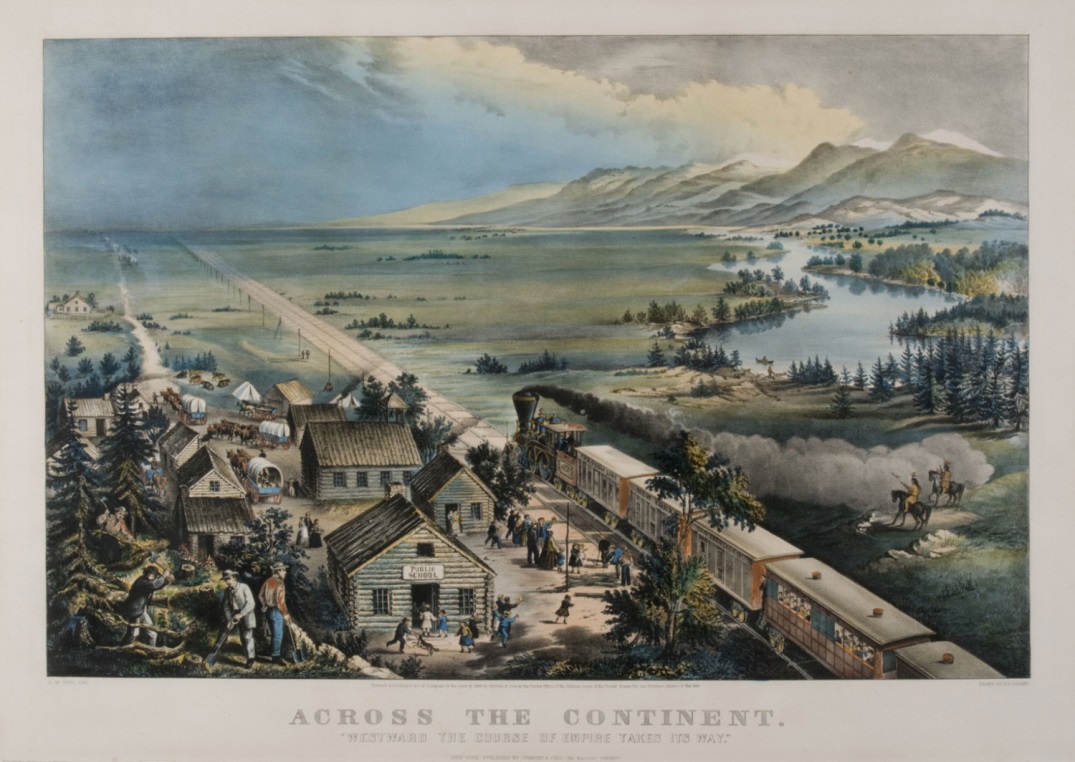
Much of modern history has involved attempts to decouple this coordination. American pioneers on the Oregon Trail needed five months, mostly walking, as their Conestoga wagons mainly hauled cargo. The Trans-Continental Railroad, which President Lincoln initiated to connect California to the more settled East Coast, required four days. That meant not only less time, but less food, fewer services, and no interactions with the physical space. Prairie towns became something travelers whizzed past without stopping.
Consequently, most agricultural output was no longer consumed locally. Farmers produced for distant markets, specializing in crops that shipped safely under harsh conditions without refrigeration. Lincoln signed the bill creating the USDA to stabilize American food supply the same year he inaugurated the Transcontinental Railroad. To this day, the USDA subsidizes the five most shelf-stable crops that best handle shipment and processing: corn, wheat, rice, soybeans, and cotton. (Some lists also include sorghum and peanuts.)
Please note, this subsidy schedule isn’t morally neutral. It rewards farmers who wring the highest possible output from their lands, which in turn rewards ammonia-based fertilizers, heavy equipment, and consolidated ownership. It also discourages crop rotation, diversification, and even letting a field lie fallow occasionally. Farmers must produce maximally, and thrust it onto the market, irrespective of floating prices or consumer demand. Only by keeping outputs high do farmers receive the subsidies they rely upon.
 |
| The frontier as depicted by Currier and Ives (click to enlarge) |
Children still sing about Old McDonald’s diverse farm animals, but that’s bucolic poppycock. Farming for the long-distance market means abolishing not only traditional American farm autonomy, but also Native American traditions of land stewardship. There’s no separating the massive Nebraska monocropping that famously terrified Stephen King, and the racism that justified Wounded Knee. Nor from the European colonialism that, as I wrote last time, wrecked a 9,000-year stable relationship between humans and nature in Newfoundland.
These changes create short-term convenience, but have massive long-term costs. Oregon Trail pedestrians owned their Conestoga wagons; rail passengers rented access for a few days. We can argue that motorists own their cars, but most are deeply leveraged with debt, and the bank owns the actual note. Today’s industrialized farmers are paper millionaires behind their land holdings and equipment, but their “ownership” is deeply leveraged, and most are one bad season away from losing everything.
Far from making us free, our massive technological do-funnies make us more beholden than the English peasant who needed months to walk Britain. Our hypothetical peasant probably couldn’t travel far from his birthplace because the journey was impractical. We could travel, but mostly can’t, because our car payment, rent or mortgage, student loan debt, utilities, credit card bills, and internet access are coming due. Our peasant owed fealty to one feudal lord; we have dozens.
Please don’t mistake this for naïve nostalgia. We live with amortized debt the way our distant ancestors lived with smallpox, wars of religion, and an infant mortality rate hovering around forty percent. We can’t fight the tyranny of false convenience by embracing cottagecore aesthetics, wearing gingham, and rereading our Little House books. The solution comes in looking forward, not back, and creating something new, not nesting in the store-bought emblems of a beatified, ahistorical past.
Historian Greg Grandin writes that, in America’s early republic, James Madison advocated for westward expansion to hasten continental democracy. Madison asserted that Americans could never expand enough to occupy the continent, giving the state a permanent mission. But Americans occupied the entire continent in scarcely a century. To do so, we wrecked forests, devastated bison habitat, strip-mined Appalachia, and overthrew world governments. Continental convenience wasn’t an accomplishment, it was a mortgage that’s now coming due.


No comments:
Post a Comment