Showing posts with label values. Show all posts

Saturday, July 4, 2026

American State Myth in the Living Era

Today’s quarter-millennium anniversary of American independence is purely formal, if you read history. The document signed on July 4th, 1776, merely clarified the terms of the Continental Congress’s July 2nd resolution of Independence; the signatories famously didn’t begin signing the Declaration of Independence until August. Besides, the Battles of Lexington and Concord, generally considered the start of the American Revolution, occurred on April 19th, 1775.

What, then, does America celebrate today? We celebrate a story, a myth. Like the Christian Nativity, which almost certainly didn't happen on December 25th, Independence Day celebrations hang a neat date on the otherwise vague, shapeless division between the Before Times and the Age of Salvation. Such divisions create clarity, sequence, and an almost catechistic transition from benightedness to true vision.

The parallels between Christianity and American state mythology deserve further consideration, because they speak to our national identity. I've written before about how the official Thanksgiving story serves the same role in America that the Genesis creation narrative serves in the Bible. But if Jamestown and Plymouth commence America's Hebraic “wandering in the wilderness” epoch, the Declaration of Independence is definitely Christmas in the American story. For good or ill.

Like Christ's ministry, the American “Experiment” involves reams of teachings. John Locke, Patrick Henry, and Thomas Paine serve the same role as the Sermon on the Mount and the Parables. These teachings come from an era, not an individual, so the parallels are imperfect. But American schools teach simplified, bowdlerized versions of these texts just as Sunday School teaches a paraphrased Bible for kids.

But Sunday School elides the contradictions and nuances that make the Bible frequently difficult, even for scholars. Likewise, schoolbook history removes the conflicts, doubts, and often slippery moral center surrounding the Revolution and what came after. Like reformers today, the Founders fought each other as much as the enemy. But you wouldn't know that from most official schoolbooks.

The Book of Acts records that, without Christ around to resolve questions, the Apostles fell to infighting. But they resolved the most important debates at the Council of Jerusalem. Likewise, Jill Lepore records how the American Constitution represents the Founders’ best available solution to their internal divisions. The Council of Jerusalem has no published proceedings; we know only the conclusions printed in the Bible. The Founders tried to achieve the same effect by refusing to publish the proceedings of the Constitutional Convention until all participants had died.

Then the parallels become loaded. The Gospels record Jesus preaching, teaching, and giving theological interpretations. But when crowds started clamoring for him personally, or tried to make him king, Jesus fled. Only after Jesus was absent, and Paul's Epistles became scripture, did the person of Jesus, rather than his teaching, become prime in Christianity.

Likewise, while the Founders lived, they argued about principle and procedure. How direct should popular control be? How strong can the Executive Branch become before it threatens the nation? Only after the Founders’ deaths do we start seeing the personal veneration of Washington, Jefferson, Madison, and latterly Lincoln. The individuals, not the philosophic process, become the source of capital-T Truth.

As Jason Stanley writes, when we venerate old texts and dead persons, debate about how to apply their Truths becomes impossible. Too much American political discourse today focuses on the Founders’ words and persons, the fallacy of Originalism. Changing how we apply the Founders’ principles to real life, becomes seen first as decline, then as blasphemy. Truth becomes a fixed, oracular artifact, not a function of how we live.

The idea that we can Make America Great Again relies on the principle that greatness derives from the past, not from how we live now. Change can never happen, since change grants primacy to the present. Our living, breathing needs become a barrier to Truth, which the dead uncovered in 1776, and which must be treasured and preserved, never used.

Jesus himself hated this veneration of the dead. When challenged on “marriage at the resurrection” in Matthew 22, Jesus replied, “God is lord of the living, not the dead.” Even without a literal God, American state mythology should follow the same values. America is a living nation, not a graveyard of ideals. Any moral Truth that impedes living Americans is a contravention of the philosophic process that Washington, Jefferson, and Paine put in motion.

If today is a day to celebrate the dead, then who cares. But if we recommit ourselves to living Americans, we truly remember what this day is about.

Monday, June 15, 2026

Trek vs. Wars, or, Who's the Better Star?

The original Star Trek bridge crew, sitting comfortably with their moral certainty

Throughout my lifetime, one defining debate in niche culture has been: which is better, Star Wars or Star Trek? Which franchise reflects what we latterly call “nerd culture” in the most practical, incisive way? I’ve always disagreed with the question, because it seemed to me that the two franchises served different purposes. Arguing which was better seemed like debating whether you loved your pancreas or liver more, as though removing one would kill you less.

Star Trek always tried to be more concrete, humane, and values-driven. The structure always featured a new encounter with an alien species, rampant technology, or breakaway sect. And each conflict was, each in different ways, solved by the characters applying Gene Roddenberry’s humanist philosophy. Exactly what that means changed over time—the original series was more swaggering and colonial than TNG, for instance—but it was built to change. It was designed to remain open-ended.

By contrast, George Lucas designed Star Wars to end. It intended to encompass Luke Skywalker’s transition from provincial peasant to galactic hero, and at least as Lucas outlined, it would then end. Whether we want that “original” ending to be the medal ceremony at the conclusion of the first movie, or the destruction of the Empire at the conclusion of the third, either way, the story intended to resolve with Luke assuming his mature role.

So Roddenberry wrote one franchise to continue, while Lucas wrote the other with an arc that resolved. Yet time hasn’t allowed either outcome. The recent release of The Mandalorian and Grogu, the twelfth canon Star Wars feature film, accords it with the MCU and James Bond for stories that just continue, long after the cultural milieu that created them has ended. And Star Trek has, if anything fared even worse, at least in fan accounting.

Recent Star Trek outings like Strange New Worlds and Starfleet Academy have received pummelings from fan critics. Admittedly, the internet has given cranky fans a nearly limitless platform to complain about virtually everything. Especially with popular franchises, new entries have suffered in the ratings because of advance fan opposition; outings like Captain Ake or the Fifteenth Doctor have been lame ducks before their episodes even appeared, because of closed-minded, hostile, and even violent fan reactions.

The Abrams movies resurrected Yoda, because Luke wasn't allowed to finish growing up

Put another way, Star Trek’s core audience doesn’t experience the show anymore, they revere it. Most current Star Trek fans weren’t alive when the original series aired, and even first-generation TNG fans are in their fifties and up. The most vocal and committed audience base didn’t experience Star Trek in its cultural context on Cold War belligerence and America’s struggle with its own imperialist history. Star Trek wasn’t an abstraction, it manifested America’s fraying conscience.

Like holy texts, like the Bible or the Koran, Star Trek seems (falsely) to speak for itself. The cultural conflicts it commented upon have become fodder for historians and schoolbooks, not something the audience is steeped in. You could say something similar about Star Wars, which certainly commented upon the post-Vietnam landscape. But Star Wars held itself aloof, a willingly timeless goulash of space wizards, samurai movies, and Flying Tigers splendor that pretended to neutrality.

J.J. Abrams, who sanded Roddenberry’s humanist morals off Star Trek, also snipped off Star Wars’ Jungian roots. He turned the Starship Enterprise into a Lucasian circus, while he rendered the Millenium Falcon into a time capsule that, somehow, must keep fighting. Admittedly, he didn’t do that alone. Besides the connivance of producer Kathleen Kennedy, the process included Lucas himself, who licensed new content in 1990 and flooded the market with novels, comics, and canon movies.

In other words, Star Wars, like LotR or Narnia, was always supposed to end. But, controlled by America’s largest media conglomerate, it can’t; not while money exists to wring from audiences. For thirty-six years (as I write), Skywalker and company have been forced to re-fight their original battles, amended only by meaningless set dressing. They never get to govern the galaxy they liberated, because they’re busy constantly resisting another apocalyptic empire that, somehow, never dies.

Meanwhile, Star Trek had no limiting arc. It had little canon continuity until The Wrath of Khan; it simply responded to surrounding culture. This fluidity reflects in how the franchise constantly moves Khan Noonien Singh’s birthdate: Trek isn’t designed to be consistent, it’s designed to be current. Yet fan reverence for its roots keeps the most strident audiences from seeing the story in the present, reducing it into a lifeless artifact, a fly in amber.

Thursday, April 30, 2026

Obsolete Men vs. Shrinking Women

This essay is a follow-up to my previous essay Obsolete Men and the Gendered Violence Epidemic
Sabrina Carpenter

If, as I stated previously, modern masculinity means rejecting anything feminine in the self, what then is modern femininity? This matters as women’s appearances have come in for renewed criticism. Louis Theroux, in Inside the Manosphere, followed several men whose male reinforcement routines involve obsessive exercise and bodybuilding, making their bodies huge and brawny. Simultaneously, we’ve witnessed the recent rise in demand for feminine smallness.

Smarter critics than me have commented upon the rise in Ozempic bodies. Celebrity women who once tied their public personas to their larger frames, like Amy Schumer and Adele, recently lost weight so rapidly that it’s essentially impossible without synthetic pharmaceuticals. Large women gaining small bodies requires expensive drugs and full-time exercise routines, so it’s obviously impractical for most women. Yet it’s widespread enough recently to appear normative.

Some time ago, I read an essay—now lost—critiquing gender roles in “romantasy” fiction. The author noted a recurrent theme she called “size gaps,” presented as almost equally reprehensible as age gaps. Many romantasy novels feature hulking, muscular leading men, basically walking slabs of uncooked steak. Their leading women are dainty flowers, maybe skilled swordswomen, but usually small enough to ride piggyback on their lovers’ shoulders.

This underlines part of my problem: we define gender in our society oppositionally. Men are large, tall, and muscular; women are small, slight, and shouldn’t have muscles. Standards of feminine beauty have changed little since 1925, when Lewis & Young praised a woman for being “five foot two, eyes of blue.” A century later, feminine beauty icon Sabrina Carpenter (five foot zero) omitted trousers from a custom Louis Vuitton suit, specifically because of her height.

Not to criticize Carpenter personally; she had no more control over her height than I had over becoming exceptionally tall. But her social icon role, beautiful and sexy but not necessarily for men, includes her body type: short, buxom, with large facial features. We see similar behavior from other women who sway cultural standards. Lizzo, Melissa McCarthy, and Kathy Bates, all celebrated large women, recently lost weight with GLP-1 drugs.

Criticizing Hollywood bodies is nothing new. Women on camera have long been expected to maintain teenage proportions well into adulthood, a standard only possible for those who can afford personal assistants and pricy gym regimens. But the recent rise in waif-like women, coupled with the concomitant visibility of ox-like men, reflects a brutal reality: men must not look like women. And women must not look like men.

Braden Peters

Such attitudes have very real consequences. One of the best actors I ever shared the stage with, a beautiful woman with dynamic range and powerful singing chops, also stood over six feet tall. This made her too tall to gaze up soulfully into most men’s eyes, which precluded her from substantial roles. She bounced through some insulting comic relief roles that reduced her to a function of her unusual height, before leaving the industry altogether.

Switching genders, I see the culmination of this trend in the male “looksmaxxing” influencer Braden Peters, stage name Clavicular. Peters put himself through grotesque paces to achieve his appearance goals: drug injections, day-long bodybuilding runs, even beating himself with a hammer to maximize his jawline. The regimen has arguably worked, because he looks like an exaggerated caricature of a midcentury Hollywood leading man.

But he’s achieved his goals at a catastrophic price. By his own admission, Peters began injecting himself with synthetic testosterone supplements at age 14 to hasten adult characteristics. Within five years, he’d consumed so much fake testosterone that his body stopped producing the natural stuff. In essence, Clavicular chemically castrated himself. He maintains the external appearance of a sexy man, but his (ahem) primary sexual characteristic no longer works.

Sabrina Carpenter and Braden Peters are opposite sides of the same coin, and I do mean opposite. If women are shorter than men, then Carpenter’s exceptionally slight height becomes aspirational. If men are harder-featured then women, then Peters literally beating his face with a hammer to maximize his jawline becomes an acceptable price. Influencers define both binary genders by looking as little as possible like the other.

I’m using external appearance, like height and build, as metaphors here. The problem is much more pervasive. As American society generally becomes more accepting of alternate gender presentations, our cultural gatekeepers have become even more rigid and restrictive. This is still currently a fringe issue, mercifully. But then, so was the alt-right, until it conquered the government. Left untended, these positions risk becoming mainstream.

Saturday, February 14, 2026

Lee Brice in Country Music’s Nostalgia Pits

Lee Brice (promo photo)

Lee Brice debuted his new song, “Country Nowadays,” at the TPUSA Super Bowl halftime show on February 8, and it was… disappointing. Brice visibly struggled to fingerpick and sing at the same time, and gargled into the microphone with a diminished rage that, presumably, he meant to resemble J.J. Cale. The product sounded like an apprentice singer-songwriter struggling through an open-mike night in a less reputable Nashville nightclub.

More attention, though, has stuck to Brice’s lyrics. The entire show ran over half an hour, but pundits have replayed the same fifteen seconds of Brice moaning the opening lines:

I just want to cut my grass, feed my dogs, wear my boots
Not turn the TV on, sit and watch the evening news
Be told if I tell my own daughter that little boys ain’t little girls
I’d be up the creek in hot water in this cancel-your ass-world.

Jon Stewart, that paragon of nonpartisan fairness, crowed that nobody’s stopping Brice from cutting his grass, feeding his dogs, or wearing his boots. Like that’s a winning stroke. Focusing on Brice’s banal laundry list misses the point, that Brice actively aspires to be middle-class and nondescript. But he believes that knowing and caring about other people’s issues makes him oppressed in a diverse, complex world.

One recalls the ubiquitous 2012 cartoon which circulated on social media with its attribution and copyright information cropped off. A man with a military haircut and Marine Corps sleeve stripes repeatedly orders “Just coffee, black.” A spike-haired barista with a nose ring tries to upsell him several specialty coffees he doesn’t want. Of course, nobody’s ever really had this interaction, but many people think they have.

Both Lee Brice and the coffee cartoonist aspire to live in a consistent, low-friction world. If your understanding of the recent-ish past comes from mass media, you might imagine the world lacked conflict, besides the acceptable conflict of the Cold War. John Wayne movies, Leave It to Beaver, and mid-century paperback novels presented a morally concise and economically stable world, in which White protagonists could restore balance by swinging a fist.

The coffee cartoon, with its unreadable
signature (click to enlarge)

By contrast, Brice and the coffee cartoonist face the same existential terror: the world doesn’t center me anymore. Yes, I said “existential terror.” What Brice sings with maudlin angst, and the cartoon plays for yuks, is a fear-based response, struggling to understand one’s place in the world. We all face that terror when becoming adults, of course. But once upon a time, we Honkies had social roles written for us.

I’ve said this before, but it bears repeating: “bein’ country,” as Brice sang, today means being assiduously anti-modern. Country music’s founders, particularly the Carter Family and Jimmy Rogers, were assiduously engaged with current events in the Great Depression. This especially includes A.P. Carter, who couldn’t have written his greatest music without Esley Riddle, a disabled Black guitarist. Country’s origins were manifestly progressive.

But around 1964, when the Beatles overtook the pop charts, several former rockers with Southern roots found themselves artistically homeless. Johnny Cash, Conway Twitty, Jerry Lee Lewis, and others managed to reinvent themselves as country musicians by simply emphasizing their native twang. But their music shifted themes distinctly. Their lyrics looked backward to beatified sharecropper pasts, peacefully sanded of economic inequality and political friction.

In 2004, Tim McGraw released “Back When,” a similar (though less partisan) love song to the beatified past. McGraw longs for a time “back when a Coke was a Coke, and a screw was a screw.” I don’t know whether McGraw deliberately channeled Merle Haggard’s 1982 song “Are the Good Times Really Over,” in which he sang “I wish Coke was still cola, and a joint was a bad place to go.”

Haggard notably did something Brice and McGraw don’t: he slapped a date on the “good times.” He sang: “Back before Elvis, or the Beatles.” That is, before 1954, when Haggard turned 17 and saw Lefty Frizzell in concert. Haggard, like McGraw or Brice, doesn’t yearn for any specific time. He misses stage of personal development when he didn’t have to make active choices or take responsibility for his actions.

Country musicians, especially men, love to cosplay adulthood, wearing tattered work shirts and pitching their singing voices down. Yet we see this theme developed across decades: virtue exists in the past, when life lacked diversity or conflict, and half-formed youths could nestle in social roles like a hammock. Lee Brice’s political statement, like generations before him, is to refuse to face grown-up reality.

Friday, January 30, 2026

Toxic Work Ethic in America, Part Three

This essay follows from Toxic Work Ethic in America, Part One and Toxic Work Ethic in America, Part Two.

We humans intensely comprehend our own limitations, fears, and psychological twinges, because we’re all passengers inside our own heads. We can never truly understand other people’s mental states from outside. In my last two essays, I made sweeping generalizations about working-class and upper-class mindsets, but I’m no scientist. I simply constructed a tentative hypothesis from personal experience, conversations, and observing public figures.

To recap, I suggested that most people have conditioned inner narratives driving their workplace habits, and “work ethic” is the benign manifestation of malignant inner trauma. I attribute this trauma to fathers, perhaps because my sources, both personal and public, are men. Maybe women learn more workplace habits from mothers; leave an informed comment. Either way, our “work ethic” is an external tool to paper over inner damage.

But this carries deeper implications: if I’m right, then work ethic, and workplace habits generally, orient toward the past. We appease the voices which exposed our inadequacies as children, constantly trying to silence condemnations that, as adults, only exist in our own heads. Addiction treatment specialist Gabor Maté says something similar about substance users, that they mostly want to assuage pain which their brains keep inflicting on themselves.

(As an aside, many friends have warm, supportive relationships with their fathers. I largely did, too, before his memory started failing. I don’t disparage fathers, but observe how they sustain patterns which they themselves don’t realize have caused harm.)

Contra this past orientation, most spiritual traditions favor a mindful orientation toward the present. Buddhist meditation, Christian centering prayer, and Taoist wandering all encourage supplicants to exist in the present, attuned to each moment, listening for the universe’s subtle call. The workplace of capitalist accrual reminds us of past voices and future rewards. But spiritual practice calls us to exist here, now, as we are.

Bringing spirituality into a workplace ethics discussion is, I realize, risky. Many True Believers insist their spiritual tradition is uniquely true, which could split my audience. Yet bear with me. For all their manifold differences, the religions I’ve studied share a core proposition that the person before us, the community around us, or the conflict buffeting us, holds primacy in our spirituality. Here. Now.

Overcoming the inherent “work ethic” trauma means attuning ourselves to the present. It means listening to instructions, not in fear of punishment or longing for reward, but as they are. It means recognizing our bosses as humans, with the foibles and needs that entails, and not as manifestations of engrained father images. It requires being attuned enough to our own bodies and limitations to say, without malice or fear, “No.”

Humans find ourselves torn between our carnal condition, driven substantially by past traumas and future needs, and our spiritual nature, which faces the present. What’s worse, our spiritual leaders, themselves facing the same tension, encourage this divide. When a millennia-old textbook becomes more important than the immediate person, conflict, or community, then spiritual leaders sink to the level of employers and politicians.

Moreover, the worldly forces which profit from our “work ethic” trauma, already know this. That’s why they barge into our spiritual domains. Billionaires and politicians have transformed Christianity into a nationalist front, reduced “self-care” to retail therapy, and taught us to see mindfulness as a professional strategy. Developing a spiritual discipline will entail purging the anti-spiritual influences from your tradition.

The spiritual equanimity I describe has no single path. Despite me mentioning prayer and meditation, I’ve found these disciplines of limited personal value. But I’ve achieved something comparable by writing poetry: listening to each moment, and selecting the most appropriate word which exists, has helped me attune myself to the present. Whatever removes you from past traumas and future mirages may be your path toward spiritual balance.

This conclusion probably feels abstruse, distant from my starting premise. Yet I believe it holds together. Whether it’s my father chastising me for slowing down, or Errol Musk chastising Elon for not collecting enough accomplishment tokens, that condemning voice comes from the past. The past thus can’t save us, nor the future, which doesn’t yet exist. Only in the present, the spiritual center, can we escape that conditioning.

Elon Musk and I learned incompatible messages from our fathers, which produce wholly divergent outcomes. Yet the harm those messages continue to produce have made us smaller, spiritually less developed beings. And we could both escape by reorienting ourselves away from those messages. But that means stopping seeing ourselves as economic actors, and redefining ourselves as human.

Thursday, January 29, 2026

Toxic Work Ethic in America, Part Two

This essay follows from Toxic Work Ethic in America, Part One.
Elon Musk

Elon Musk, currently likely to become America’s first trillionaire, has a conflicted history with his father, South African entrepreneur Errol Musk. Elon tries to deny Errol’s part-ownership of an emerald mine, for instance, but Errol calls that pure mythology. Even if Errol didn’t bankroll Elon’s earliest ventures, his wealth allowed Elon freedom to pursue an education, experiment with technology, and start several businesses in his early twenties.

If, as I said previously, people arrogant enough to become billionaires and presidents aren’t conditioned in childhood to be self-effacing, that doesn’t mean they’re unconditioned. And like me, their conditioning comes heavily from fathers. My father conditioned me, mainly by yelling, to maintain a self-destructive work ethic, pushing myself to the brink of collapse, then returning home too depleted to do housework. Elon’s father conditioned him to… well.

Like Elon, Errol was a serial entrepreneur, who also used his wealth to buy out enterprises that piqued his interest. Like Elon, Errol married a glamorous, accomplished wife, but seemingly paid her little attention, letting Maye Musk pursue her interests without support or awareness. Like Elon, Errol is sexually voracious: Elon has fourteen children by four women that we know about, while Errol had a child with his own stepdaughter.

Where my father taught me to deny myself and disappear entirely into my role as an employee, student, battalion member, or whatever, Errol Musk taught Elon to elevate himself, and his desires, over other people. Errol conditioned his son to be constantly self-seeking, always aware of ways he falls short or looks small. My father conditioned be to be self-abnegating, while Errol conditioned Elon to be self-centered.

I don’t know Elon’s full story, partly because Elon often contradicts himself regarding his biography. So I’ll draw an analogy. Joe Plumeri, former CEO of the Willis Group, opens his memoir by describing his father showing him the luxurious houses around his New Jersey hometown. Describing himself later as a “workaholic” who loves showing his father around his accomplishments, it becomes clear: Plumeri has spent his life appeasing his father.

Sigmund Freud

One could extend the comparison. Consider the American Presidents and presidential candidates who considered the Presidency their birthright: John Quincy Adams, Benjamin Harrison, George W. Bush. George H.W. Bush and Al Gore were both sons of senators. The Kennedy family exists. John McCain, whose father and grandfather were both four-star admirals, had his military career stall because of his POW status; he ran for President partly to outrank his ancestors.

Developmental psychologists describe human behavior as “highly conditioned.” In plain English, this means our past circumstances shape our present options. We cannot make a completely original decision, but rather see our opportunities defined by our life experiences. Many of the conditioning agents that shape our ability to see fall into two broad categories: standards we want to live up to, and mistakes we want to live down.

Again, for many of us, fathers (or father figures) shape our perceptions. My father taught me to see myself as part of a unit: whether a workplace, a classroom, or a military battalion, I needed to diminish. If I took an unscheduled break, yawned loudly, or even slowed down notably, my father volubly reminded me that I wasn’t just shirking my individual duties. I was letting the entire group down.

Meanwhile, billionaire fathers teach their sons to seek themselves. Sometimes this self-seeking is a doom spiral, as Cornelius Vanderbilt failed to teach his sons business acumen, and the Vanderbilt fortune eventually disappeared. Other times, this self-seeking accrues wealth and power. We can see this in how billionaires treat others: Elon’s multiple divorces and President Taco’s Epstein Island adventures show they see women as consumable resources, not people.

My military analogy recurs. Rank-and-file soldiers internalize an ethos of self-sacrifice, and learn to see heroic death as the ultimate virtue. And I do mean “learn”: cult expert Daniella Mestyanek Young writes that basic training doesn’t teach military skills, it teaches self-abnegation and the primacy of the unit. As a collective, the military survives by teaching its members that their individual lives aren’t worth saving.

Elon Musk claims to work 100 hours per week. This feels specious, since he also claims to be a world-class competitive videogame player, while recently tweeting nearly 100 times per day. But even if it’s true, Musk doesn’t work those soul-breaking hours because he’s disappeared into his job. Instead, he’s made his companies an instrument of his ego, something to inflate himself, though it will never leave him full.

Thursday, January 22, 2026

Toxic Work Ethic in America, Part One

I sometimes literally hear my father’s voice when he isn’t there. Not in a jolly metaphorical way, either, but in a terrifying, often humiliating way. I first noticed this when I worked at a medical components factory during my hiatus between college and graduate school. If I slowed down, slacked off, or simply paused to chat with my co-workers, I heard my father shouting angrily, demanding to know why I wasn’t working until I bled.

Because of this terrifying voice which chased me throughout the workday, I moved faster, took shorter breaks, and got more done than people who had worked there far longer than me. Supervisors took notice, too. They often praised my work ethic, telling me that they wished they had an entire shift full of laborers as “dedicated” as me. Because they weren’t passengers in my head, as I was, they took my terror as committed professionalism.

Management often mistakes being “busy” with productivity. I noticed this often while working in construction: management would schedule marathon hours, especially in the final crunch. But management only deluded themselves. Fatigue, boredom, and resentment created new problems, while workers spent most of every morning ripping out the mistakes they made the previous evening, when they were tired. Team supervisors micromanaged workers’ every decision, because site superintendents micromanaged the supervisors. Everyone was tired all the time.

Literally every blue-collar job I’ve worked has faced some version of this. If food service workers find themselves caught up with tables, they’re given cleaning tasks to do, or refilling table caddies. I’ve worked in two car parts factories, where we were ordered to sweep and clean if the machines even briefly went down. Every moment is policed, every action judged, and companies demand constant maximum productivity; unscheduled pauses are justifications for reprimands, often stern.

Meanwhile, I’ve worked only two white-collar jobs, as a freshman composition teacher and a marketing copywriter. In both positions, I’ve been astounded by how much scheduled work time gets consumed by non-work activities. Chatting, dithering, side projects, day drinking, and even napping are anecdotally common. While hourly wage earners have their hours aggressively monitored for unsanctioned yawns, resulting in paranoid, often manic work, managers have so much discretion that they want for things to do.

My father spent most of his military career as a rank-and-file enlisted man. If you’ve ever spent time on a military installation, you know how aggressively the enlisted men’s time is regulated. Every barracks, parade ground, warship, and hangar is the epitome of cleanliness, with every plank sanded, hinge oiled, bolt painted, and floor scrubbed. Especially for unmarried recruits living on-post, twelve-hour workdays of constant, regulated motion are common, and labor outputs are closely quantified.

Simultaneously, a peer whose father was a career officer told me that officers cultivate the attitude of men of leisure. (We met in school off-post, because even officers’ and enlisted men’s children are discouraged from mingling.) Not that officers don’t work, because they too have pervasive regulations and readiness standards. Rather, they achieve their dictated goals at measured, deliberate speeds. Humans with autonomy, not checklists and rubrics, measure officers’ outputs. Rules are discretionary, not absolute.

This pattern applies broadly. Matt Taibbi wrote (before becoming a culture war spokesmodel) that every SNAP benefit applicant gets treated like incipient fraud, while almost nobody was held responsible for the 2008 financial collapse. Since then, we’ve seen how the only people indicted for the January 6th, 2021, Capitol insurrection, were the foot soldiers at the door, and they got pardoned. Those who incited the crime not only got ignored, but they also got reelected.

America cultivates a socioeconomic narrative in which the poor, the laborer, the voter—the enlisted men of civilian society—hear their inadequacies repeated endlessly. Nor is this accidental. The wealthy and powerful—our officers—want us to suffer the constant loop of condemnation for even momentary weakness, like I heard, and sometimes still hear, my father. The psychological harm which this repetition causes individuals doesn’t matter, because to our “officers,” the outcome is “work ethic.”

But it also enables unbridgeable gaps in American social structure. This is why laborers seldom become management, classroom teachers rarely become administrators, and most citizens have little chance of getting elected to higher office. We numpties cannot lead because we’ve been conditioned to rehearse our inadequacies, real or imagined, constantly. Only those without that conditioning have the arrogance necessary to become presidents, billionaires, and other captains of society. “Work ethic” is the opposite of advancement.

This essay continues in Toxic Work Ethic in America, Part Two

Friday, December 19, 2025

Notes Toward a Semi-Luddite Manifesto, Part 2

This essay follows Notes Toward a Semi-Luddite Manifesto
Abraham Lincoln

It’s difficult to grasp how large Planet Earth was before petroleum. The most direct driving route across Great Britain from Land’s End to John O’Groats takes about thirteen hours, if roads and traffic allow. Trained endurance walkers, covering twenty miles per day, could walk that distance in two months, assuming conditions cooperate—which, in Britain, they won’t. The Mayflower crossed the Atlantic in 66 days, a distance air travelers today cover in under eight hours.

These distances didn’t just consume time. Travelers needed food, water, and places to sleep. Haulage couriers needed places to reshoe their horses and repair their wagons. This need created work for manual trades: farmers, taverners, wheelwrights, blacksmiths. Agricultural products were mostly consumed locally, by residents, travelers, and livestock. War didn’t only require warriors; it required baggage trains, cooks, farriers, stable-keepers, and more. Maintaining early nation-states required intricate, ongoing coordination between the public and private spheres.

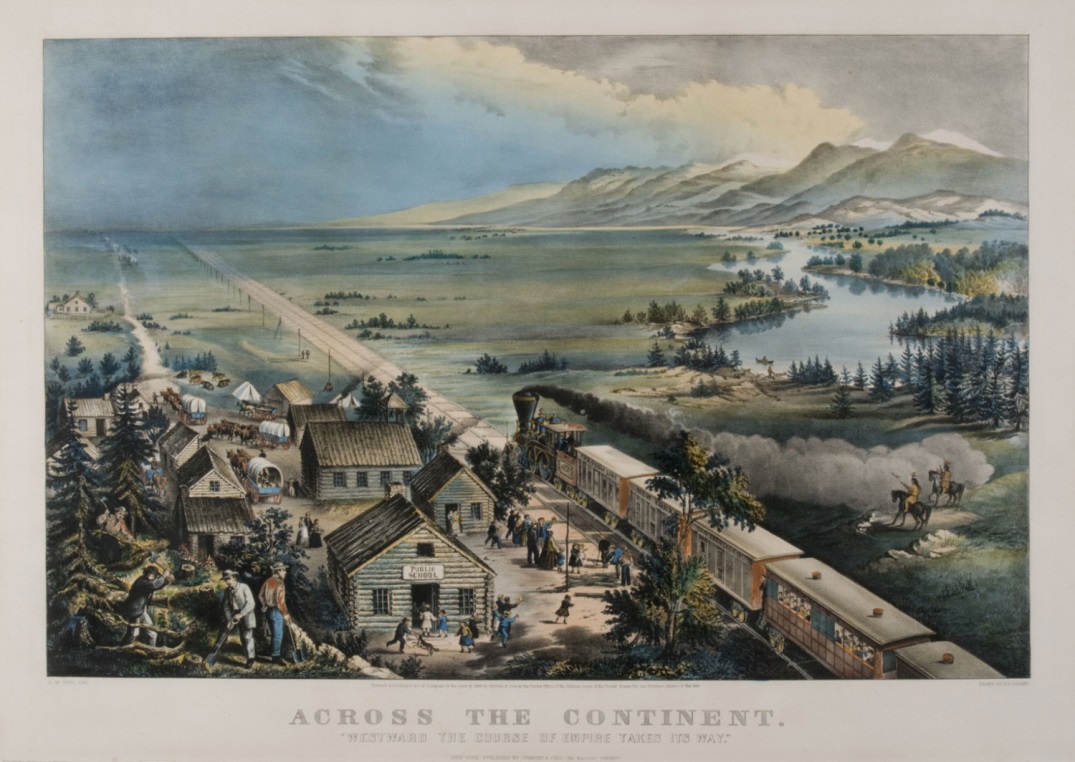
Much of modern history has involved attempts to decouple this coordination. American pioneers on the Oregon Trail needed five months, mostly walking, as their Conestoga wagons mainly hauled cargo. The Trans-Continental Railroad, which President Lincoln initiated to connect California to the more settled East Coast, required four days. That meant not only less time, but less food, fewer services, and no interactions with the physical space. Prairie towns became something travelers whizzed past without stopping.

Consequently, most agricultural output was no longer consumed locally. Farmers produced for distant markets, specializing in crops that shipped safely under harsh conditions without refrigeration. Lincoln signed the bill creating the USDA to stabilize American food supply the same year he inaugurated the Transcontinental Railroad. To this day, the USDA subsidizes the five most shelf-stable crops that best handle shipment and processing: corn, wheat, rice, soybeans, and cotton. (Some lists also include sorghum and peanuts.)

Please note, this subsidy schedule isn’t morally neutral. It rewards farmers who wring the highest possible output from their lands, which in turn rewards ammonia-based fertilizers, heavy equipment, and consolidated ownership. It also discourages crop rotation, diversification, and even letting a field lie fallow occasionally. Farmers must produce maximally, and thrust it onto the market, irrespective of floating prices or consumer demand. Only by keeping outputs high do farmers receive the subsidies they rely upon.

The frontier as depicted by Currier and Ives (click to enlarge)

Children still sing about Old McDonald’s diverse farm animals, but that’s bucolic poppycock. Farming for the long-distance market means abolishing not only traditional American farm autonomy, but also Native American traditions of land stewardship. There’s no separating the massive Nebraska monocropping that famously terrified Stephen King, and the racism that justified Wounded Knee. Nor from the European colonialism that, as I wrote last time, wrecked a 9,000-year stable relationship between humans and nature in Newfoundland.

These changes create short-term convenience, but have massive long-term costs. Oregon Trail pedestrians owned their Conestoga wagons; rail passengers rented access for a few days. We can argue that motorists own their cars, but most are deeply leveraged with debt, and the bank owns the actual note. Today’s industrialized farmers are paper millionaires behind their land holdings and equipment, but their “ownership” is deeply leveraged, and most are one bad season away from losing everything.

Far from making us free, our massive technological do-funnies make us more beholden than the English peasant who needed months to walk Britain. Our hypothetical peasant probably couldn’t travel far from his birthplace because the journey was impractical. We could travel, but mostly can’t, because our car payment, rent or mortgage, student loan debt, utilities, credit card bills, and internet access are coming due. Our peasant owed fealty to one feudal lord; we have dozens.

Please don’t mistake this for naïve nostalgia. We live with amortized debt the way our distant ancestors lived with smallpox, wars of religion, and an infant mortality rate hovering around forty percent. We can’t fight the tyranny of false convenience by embracing cottagecore aesthetics, wearing gingham, and rereading our Little House books. The solution comes in looking forward, not back, and creating something new, not nesting in the store-bought emblems of a beatified, ahistorical past.

Historian Greg Grandin writes that, in America’s early republic, James Madison advocated for westward expansion to hasten continental democracy. Madison asserted that Americans could never expand enough to occupy the continent, giving the state a permanent mission. But Americans occupied the entire continent in scarcely a century. To do so, we wrecked forests, devastated bison habitat, strip-mined Appalachia, and overthrew world governments. Continental convenience wasn’t an accomplishment, it was a mortgage that’s now coming due.

Thursday, November 20, 2025

Party Politics and the Art of Forgiveness

Rep. Marjorie Taylor Greene (R-GA)

This weekend, Congressman Jamie Raskin (D-MD) called the Democrats “a big tent…. that’s got room for Marjorie Taylor Greene.” This statement deserved the immediate blowback, as Greene’s history of race-baiting, antisemitism, and harassing school shooting survivors doesn’t just go away. But it exemplifies two problems with American politics. First, that our parties have been reduced to the Trump and anti-Trump parties, without underlying principles. Second, we keep steadily eroding the relationship between forgiveness and repentance.

Raskin’s invitation is only the latest Democratic effort to dilute their brand. The Democrats continue providing a nurturing cocoon to aggressive nationalists like Liz Cheney and Adam Kinzinger, simply because they personally refuse President Taco. Former Representative Joe Walsh, who holds truly noxious views, has become a resistance leader. Yet the party leadership, including Hakeem Jeffries and Chuck Schumer, still haven’t endorsed Zohran Mamdani, even after he won the party primary and the majority vote.

Throughout the last decade, we’ve watched America’s mainstream parties reorganize themselves around one man. Republicans, who had legitimate policies in the 1990s when I was one of them, have become the party that endorses whatever dribbles out of President Taco’s mouth. Those who disagree, the party deems “traitors.” Meanwhile, Democrats, once the party of Civil Rights and the New Deal, have jettisoned all principles to pursue whatever and whoever opposes this President. This isn’t sustainable.

To accomplish their agenda, Democrats have ushered their onetime opponents up the leadership ladder. Although professional pundits claimed Kamala Harris lost last year’s election behind issues like queer, trans, and racial rights, Harris actively avoided those issues. Instead, she spent the campaign’s final weeks touring as a double-act with Liz Cheney, whom observers have described as “arch-conservative.” Democrats have pivoted away from their base, including labor, minorities, and queer voters, to chase the ever-shifting center.

Democrats have made conservatives like Cheney, Walsh, and now Greene their preferred leaders, despite their voting base’s opposition. This rush to promote former enemies makes sense if, like I suspect many Democrats did, you read Clausewitz in high school, without prior context. Many military strategists contend that former enemies make the best allies. Which is probably true, if your only interest is winning. But because the Democratic base has certain principles, winning alone isn’t enough.

Rep. Jamie Raskin (D-MD)

“Forgiveness” has become the defining stain of contemporary American life. News reeks with commentators who demand forgiveness, not as a culmination of a penitent journey, but as a precondition. From ordinary criminals who want forgiveness without facing consequences, to widespread abuse in religious congregations, to loyalists eager to excuse treason, we’ve witnessed a reversal of the forgiveness process. It’s become something powerful people demand from their perches, not something the wronged offer from God-given mercy.

I can’t unpack the full underpinnings of forgiveness in 750 words. In brief, “forgiveness” is half of the continuum, one face of a coin. The other half is “repentance,” the process of taking account and changing one’s life. This isn’t merely verbal contrition, as I learned in White Protestant Sunday school. Repentance, or metanoia in Greek, means literally walking a new path. We know somebody’s repented, not by their words, but by their changed life.

Cheney, Walsh, and especially Greene have shown no inclination toward changed lives. Though Greene has verbally apologized for past violent rhetoric, observant critics claim her manner hasn’t shown signs of authenticity. More important, this change in Greene’s loyalties has happened too suddenly to reflect in her actions. Perhaps Greene has literally reversed herself, and she’ll demonstrate a more cooperative, nonviolent, and restrained manner. But it’s too soon to know whether her words match her actions.

Please don’t misunderstand me: verbal apologies matter. Humans are language-driven creatures, and speaking with one another is a necessary part of bond-building. But who among us hasn’t known somebody who says they’re sorry, while showing no acts of repentance? This may be innocent—small children think “I’m sorry” is a blanket ticket to forgiveness—or malicious—abusive spouses love voicing their regrets. But only when words and actions come together do they make a difference.

Part of repentance includes asking whether one will handle power better in the future. Current or former elected officials, including Greene, Walsh, and Cheney, want the Democratic Party to offer them unconditional leadership, like they had before. But from my vantage point, they’ve shown no signs that they’ll use that leadership to uplift the downtrodden, heal the hurting, or support large-D Democratic principles. They haven’t shown a new life, so they haven’t yet earned forgiveness.

Tuesday, July 8, 2025

The Meaning of Life in “The Life of Chuck”

Mike Flanagan (director, from a Stephen King novella), The Life of Chuck

Albie Krantz (Mark Hamill) explains the harsh truth to Chuck, in The Life of Chuck

Late in this movie, title character Charles “Chuck” Krantz (Benjamin Pajak) has a heart-to-heart with his grandfather. Albie Krantz (Mark Hamill), an accountant, does that terrible thing adults inevitably seem to do: he urges Chuck to abandon his dreams and get a “real” job. He doesn't mean anything malign. Albie just wants the grandson he raised to have a future that doesn't include poverty and a career-ending injury.

This encapsulates the moral ambiguity underlying the movie. More than the apocalyptic opening act, in which the universe's existence balances on adult Chuck's survival, this admonition dives into why Chuck makes the decisions he does. The movie unfolds in reverse sequence, and what happens in each act only makes sense from what we see next-- which is actually what Chuck experienced previously.

Grampa Albie, whom Chuck calls by the Yiddish term Zaydie, sees accountancy as more than a job. He describes the complex numerical relationships in his clients’ finances as the distilled, clarified maps of their lives. He has the same nigh-divine attitude to bookkeeping that Galileo had to astronomy: the numbers show us how God moves in our lives and illuminates our way.

Chuck, a middle-school dance prodigy, has the power to stir audiences’ souls with his body movements. For him, dance is communication. He tells his audience a story, and dance is a conversation with his dance partner, a tall eighth grader named Cat. He became the first kid in school to master the Moonwalk because, while dancing, his body was so thoroughly attuned to his mind. A survivor of childhood trauma, Chuck only feels completely integrated with himself while dancing.

In other words, Albie sees the world as a scientific relationship of mathematical forces. Chuck sees it as emotional truth. But the joy in Albie's eyes announces an emotional bond with his numbers, while Chuck has mastered the physical calculus of dance. On some level, each understands the other's sentiments. But Chuck has only one life, and can't do both.

Every dancer, actor, musician, and author has faced the question: is this all worth it? Most of us, sooner or later, say “no.” Rent and groceries cost too much, and we're getting old. Dancers are especially vulnerable to this, because they're susceptible to disabling injuries that rock stars and novelists never face. Even those rare few working artists, who get paid for a while, quit because they can't buy a house or raise kids.

Chuck Krantz (Tom Hiddleston) cuts a rug on the streets of Boston, in The Life of Chuck

In that light, urging kids to relinquish high-minded dreams early, can feel like an act of mercy. Why let them linger in false hope when they could make a living, earn equity, and join a community? This goes double for dancers, who are about as likely to retire because of disabling injuries as NFL players. If you can spare kids from disappointment and disfigurement, perhaps you should.

Yet it's impossible to convey that message to children without telling them something else: “You're going to fail.” And because children are children, deaf to nuance and the exigencies of time, they hear that as “You are a failure.” Protecting kids from a heartless, hostile world causes them to internalize a message of self-abnegation and defeat. Parents don't mean it, but almost inevitably, they teach kids to dream small.

The movie hedges on when Chuck bifurcates into the artist and the accountant. Yet this is clearly a step on this route. At various points, Chuck re-learns the lesson that demonstrating autonomy is equal to disappointing his Zaydie. Like many Stephen King stories featuring child protagonists, this one carries the moral that becoming an adult means becoming small enough to fit this world's demands.

Except, in reverse order, it doesn't.

Adulthood, for Chuck, means accepting small, fiddling responsibility. By the time we see Zaydie warning Chuck to dream small, we've already seen that he becomes an accountant and gets married. But dance as an act of communication remains part of him. His climactic dance with Cat repeats itself on the streets of Boston when circumstances remind adult Chuck's (Tom Hiddleston) that he's most truly himself while using his brain to control his body.

Because even when adults accept small dreams in exchange for security, that dreaming child survives. Kids yearn to be artists, or builders, or heroes, not only for ourselves, but because these are social roles. Big dreams aren't selfish, they tie us to our people and communities. Chuck and Zaydie aren't really at odds, even when they disagree. They just have different routes to the same goal.

Friday, June 6, 2025

Don’t Pretend To Be Stupid, Dr. Oz

Americans used to like Dr. Mehmet Oz

The same day I posted about Senator Joni Ernst’s faulty rhetoric surrounding Medicaid cuts, Dr. Mehmet Oz claimed that uninsured people should “prove that you matter.” The cardiac surgeon, Oprah darling, and failed Senate candidate is now Centers for Medicare and Medicaid Services Administrator, meaning he administers decisions for who receives assistance in paying medical bills. His criterion for proving one matters? “Get a job or at least volunteer or … go back to school.”

Last time, I got Aristotelean and dissected Senator Ernst’s rhetoric, noting that she changed the “stasis of argument” mid-sentence. That is, she pretended to misunderstand the core dispute, sanding off nuance while condescending to her constituents.. When someone said people would die unnecessarily, Ernst pretended they meant people would die at all. She thought it appropriate to remind constituents that humans are mortal—and, in her tone-deaf follow-up, sound an altar call for Jesus Christ.

While Ernst’s constituent wanted to argue the morality of preventable death, and Ernst veered dishonestly onto the fact of mortality, a friend reminded me this argument skirted an important issue. Who will die first? When the government makes decisions about paying medical bills, the outcomes aren’t morally neutral: chronically ill, disabled, and elderly Americans stand the most to lose. The same bloc of Americans whom, you’ll recall, certain politicians permitted to die during the pandemic.

Dr. Oz said what Senator Ernst only implied, that hastening human mortality is okay for certain undesirables. This administration, and indeed conventional American conservatism throughout my lifetime, has tied human worth to economic productivity, and especially to productivity for other people. If someone needs assistance, America’s authorities won’t help you create a business, learn a skill, or otherwise evolve to benefit your community. Their imagination can’t expand beyond getting a job working for someone else.

Nor was this subtext. Oz said aloud: “do entry-level jobs, get into the workforce, prove that you matter.” This correlation between “you matter” and “you work for others” has lingered beneath much of America’s work ethic throughout my lifetime—and, as an ex-Republican, I once believed it, or anyway accepted it. But as anybody who’s faced the workforce recently knows, today’s working economy isn’t a source of meaning or dignity; it often actively denies both.

Even laying aside demi-Marxist arguments like “owning the means of production” or “the surplus value of labor,” employment spits in the human face. Minimum wage hasn’t increased in America since 2009, and as anybody who’s worked a fast food dinner shift knows, employers who pay minimum wage definitely would pay less if the law permitted. Even if the workers receive enough hours to qualify for employer-provided health insurance, they mostly can’t afford the employee co-pay.

Lest anybody accuse me of misrepresenting Dr. Oz, let’s acknowledge something else: he lays this onus on “able-bodied” Americans. We might reasonably assume that he expects healthy, young, robust workers to enter the workforce instead of lollygagging on the public dime. But even if we assume they aren’t doing that already (and I doubt that), the pandemic taught many workers important lessons about how America values labor. Specifically, that it doesn’t, except through empty platitudes.

In 2020, executives, attorneys, bureaucrats, and others went into lockdown. Americans laughed at highly skilled professionals trying to do business through Zoom, thus avoiding the virus. Meanwhile, manual trades, retail jobs, construction, and other poorly paid positions were deemed “essential” and required to continue working. These jobs are not only underpaid and disdained, but frequently done by notably young or notably old workers, disabled, chronically ill, required employment to qualify for assistance, or otherwise vulnerable.

As a result, the workers most vulnerable to the virus, faced the most persistent risk. Sure, we praised them with moralistic language of heroism and valor, but we let them get sick and die. Americans’ widespread refusal to wear masks in restaurants and grocery stores put the worst-paid, most underinsured workers at highest risk. Many recovered only slowly; I only recently stopped wheezing after my second infection. Many others, especially with pre-existing conditions, simply died.

Dr. Oz has recapitulated the longstanding belief that work is a moral good, irrespective of whether it accomplishes anything. He repeats the myth, prevalent since Nixon, that assistance causes laziness, citation needed. And despite hastily appending the “able-bodied” tag, he essentially declares that he’s okay with letting the most vulnerable die. Because that’s the underlying presumption of Dr. Oz, Senator Ernst, and this administration. To them, you’re just a replaceable part in their economic machine.

Tuesday, May 20, 2025

Architecture and American Values

Nottaway Plantation in its salad days, in a promo photo from Explore Louisiana

The recent online brouhaha over the fire which destroyed Nottaway Plantation is revealing more than I wanted to know about American priorities. Billed as the largest antebellum mansion in the American south, at 64 rooms and 53,000 square feet, it stood intact from its completion in 1859 until last Thursday. Following the Emancipation Proclamation, the Louisiana plantation house served mainly as a resort hotel, convention center, and tourist trap.

Social media reaction has split along predictable lines. Some respondents, mostly White, have insisted that the mansion’s historical significance and its elaborate architecture make it a legitimate destination, a piece of Louisiana heritage, and a massive loss. Others, a rainbow coalition, have rallied behind the plantation’s slaveholding heritage and called it a monument to American racism. Each side accuses the other of viewing the destruction through partisan political lenses.

Wherever possible, I prefer to assume that all debate participants, even those I disagree with, start from a good-faith position. I don’t want to believe that those who don’t spotlight the slaveholding heritage are, perforce, celebrating racism. And I hope those who center slavery as the building’s heritage, don’t covertly cheer for destruction. Though my sympathies lie strongest with the anti-slavery caucus, I’d rather believe everyone starts from good faith.

If that’s true, it follows that those mourning the loss of historic architecture, believe the building’s structural significance and its socioeconomic significance, exist in different compartments. They segregate different aspects of the building’s history into beehive-like cells, and assume the separate qualities don’t influence one another. Social media commenters have written words to the effect that “Slavery was terrible, but the building matters in its own right, too.”

This argument holds some water. Nottaway Plantation was, until last week, a surviving example of a mid-19th Century architectural ethos. Not a reconstruction, a replica, or an homage, but an actual piece of physical history, a primary source. We shouldn’t discount that significance, regardless of who built the building; a physical artifact of American history existed for 166 years, until it didn’t. America is arguably poorer for the loss.

However, compartmentalizing that history from the circumstances which created it, is itself ahistorical. I worked in the construction industry, and I can attest that the largest ongoing cost is human labor. Nowadays, construction involves copious large costs, including power tools, diesel-burning equipment, and transportation. But these are, usually, fixed-term costs. Human labor is ongoing and requires infusions of money, if only because workers get hungry.

Nottaway Plantation during the fire, in a photo from CBS News

Much labor is especially valuable because it’s rare. Framing carpenters, brickmasons, metalworkers, and other skilled laborers demand a premium because their skills require years of honing. Nottaway Plantation was built during the days of gaslamps and outdoor toilets, but nowadays, electricians, plumbers, and HVAC installers command competitive rates. Building such a massive mansion required skilled labor from workers who, being enslaved, couldn’t float their terms on the open market.

Many conditions also depend on the time and place. Anybody who’s lived in Louisiana knows that most of the state stands on spongy, wet soil. Building a multistory mansion requires sinking foundational pilings deep, possibly down to the bedrock, to prevent the building submerging under its own weight. Today, such pilings require diesel-burning machinery, sump pumps, and cast iron. In 1859, those pilings required many, many humans.

Therefore, the building’s architectural significance—which is real and valuable—relies upon the labor employed. Large-scale monumental construction always requires somebody able to pay the army of skilled workers whose labors make the building possible. This problem isn’t uniquely American, either. European monuments, like Notre Dame and the Vatican, were first built before Europe reintroduced chattel slavery, but the buildings wouldn’t be possible without the poverty of serfdom.

Too many accomplishments of human activity, rely on a small sliver of society having too much money. Without rich people willing to pay skilled workers, we wouldn’t have the White House, the Venice canals, legendary artwork like the Mona Lisa and Michelangelo’s David, and other monuments of human capability. If Leonardo or Pierre L’Enfant needed day jobs to subsidize their crafts, they’d never have accomplished the potential within them.

So yes, Nottaway Plantation reflects architectural history and artistic movements. But it also reflects economic inequality and the labor conditions of antebellum Louisiana. It’s impossible to separate the two spheres of influence, no matter how much the privileged few wish it. Nottaway was an artifact of physical beauty and a community gathering place. But it emerged from specific conditions, which we cannot compartmentalize from the building itself.

Friday, May 9, 2025

The Ultimate Meaninglessness of “Crime”

We’ve seen an increasing number of anecdotes trickling out about once-loyal voters rejecting the Administration’s ham-handed deportation policies. Though it’s hard to derive meaningful data from isolated anecdotes, the number of stories like this one and this one about Trump voters getting burned by the administration they once supported. Many stories share a theme: “we” thought the Administration would only deport “criminals,” and we don’t consider ourselves criminals.

On one level, they’re correct: under American statutes, immigration falls under civil, not criminal, law. “Illegal” immigration is a non-category, because the word illegal refers only to crimes, not civil violations. But on another level, this reveals something uncomfortable for many Americans, that “crime” itself isn’t a fixed concept. Many undocumented immigrants don’t consider themselves criminals because they’ve committed no violent or property crime; so the Administration simply redefines “crime.”

Much American political discourse centers on “crime,” especially when Democrats hold the Oval Office. As sociologist Barry Glassner writes, fear of crime is a powerful motivator for tradition-minded voters, a motivator Republicans employ effectively. Glassner writes about how rabble rousers used fear of crime to shanghai the Clinton Administration, but the same applies broadly whenever Democrats hold majority power. We saw it during the Obama and Biden years too.

However, exactly what constitutes crime depends on who does the constituting. My core readership probably remembers John Erlichman, former White House Counsel, who admitted the Nixon Administration simply fabricated the War on Drugs as pretext to harass anti-war and Civil Rights protesters. The notorious Comstock Laws channeled one man’s sense of injured propriety to criminalize porn, contraception, pharmaceutical abortion, and the kitchen sink. Moral umbrage beats harm in defining “crimes.”

This doesn’t mean harm doesn’t exist or states should repeal every law. Murder, theft, and sexual assault are clearly wrong, because they cause manifest harm and devalue victims’ lives, bodies, and labors. But these transgressions only become “crimes” when governments pass laws against them. Legal philosophers might debate whether decriminalizing murder would make murder happen more often. Personally, I doubt it; neither Prohibition nor its repeal affected drinking numbers much.

Prohibition, therefore, proves the moral fuzziness of crimes. Both the Al Capone-style Prohibition, and contemporary drug prohibition, arose not from obvious harm (most pot-heads are too lethargic to hurt anybody), but from moral panic and public outrage. Governments made laws against substances lawmakers found abhorrent, then assumed citizens would avoid those substances, simply because they’re illegal. Then they act surprised when drinking or drugs persist.

This happens because these things aren’t innately crimes; they become crimes because lawmakers make laws. Similarly, while it’s clearly harmful if I steal money from your wallet, other property “crimes” have squishier histories. Squatting, for instance: once legal, it became illegal in America, as James Loewen writes, largely to circumscribe where Native Americans were allowed to hunt and camp. Lawmakers created laws, where none previously existed, to punish transgressors.

Immigration law follows similar patterns. Abrahamic scripture urges the faithful to welcome immigrants because, in that time, borders didn’t really exist. People moved freely, and provided they followed local laws and customs, largely changed nationhood liberally. Though serfdom tied workers to lands and lords in the late medieval period, modern concepts of the nation-state and international borders existed only as legal abstractions. Only during wartime did states enforce borders much.

This Administration can redefine civil infractions, like undocumented immigration, as crimes, because that’s how things become crimes. States will borders into existence by legal legerdemain, then demand that people remain permanently circumscribed by these fictional lines. Perhaps that’s why “the Wall” looms so large in MAGA mythology: because borders don’t really exist, so we need something manifest and palpable to make borders real.

These MAGA voters who feel betrayed because the Administration deported their loved ones, assumed that they weren’t “criminals” because they used a broad, popular definition of criminality. They didn’t perform acts of violence or property destruction, they reckoned, so therefore they weren’t criminals. They didn’t anticipate the Administration using crime’s fuzzy, amorphous nature against them, and therefore were caught unprepared when the definition of “crime” moved to surround them.

Civil society has two responses available. We could eliminate self-serving, avaricious laws, and allow people more discretion. There’s no objective reason people must live within certain borders, except that lawmakers need to control despised minorities. But we know society probably won’t choose that response. More likely, our lawmakers will write harsher, more draconian laws to eliminate this flexibility. Which will then be used against us ordinary people.

Tuesday, April 15, 2025

Is the Law a Dead Letter Now?

Back in the 1990s, when I was a teenage Republican, I believed humanity would find a legal system so self-sustaining, we could eventually exclude humans from the equation. We could write laws, then deploy the bureaucratic instruments necessary to enforce those laws, without bias or favor, essentially forever. The machine would support itself without inputs from nasty, unreliable humans. We only needed to trust the modernist small-L liberal process.

Okay, we hadn’t written such laws to implement such systems, but that only proved we hadn’t written such laws yet. Because individuals only enforced laws as written, I reckoned, such self-sustaining systems would preclude individual prejudice or demographic bias. (I didn’t realize, for years, that laws themselves could contain bias.) Divisions, disadvantage, and destitution would eventually wither as laws enforced baseline ethical standards which encompassed everyone, everywhere, equally.

Watching the meltdown surrounding Kilmar Abrego Garcia, I’m seeing underlined something I gradually realized in my twenties, but never previously needed to say aloud: all laws are doomed to fail. Even laws written with altruistic intent and thorough legal support, like the 14th Amendment, work to the extent that those entrusted to enforce them, actually do so. America’s current executive regime is demonstrating no intention to enforce the law justly.

The regime first deported Abrego Garcia in March, despite him having legal residency status and never having been convicted of any crime. Initially, the regime acknowledged that they’d expelled Abrego Garcia mistakenly, and based on that acknowledgment, the Supreme Court—dominated by Republican nominees and one-third appointed by the current president—unilaterally demanded his return. So the regime flippantly changed the narrative and refused to comply.

This refusal, stated unambiguously in an Oval Office press conference where the American and Salvadoran presidents shared the lectern, demonstrates why the law will inevitably fail. America’s system, predicated on the government’s adherence to the principles laid out in the Constitution, absolutely requires that all participants share a prior commitment. Simply put, they must believe that nation, government, and law, are more important than any individual. Even the president.

Kilmar Abrego Garcia (AP photo)

We must strike a balance here, certainly. Individuals write our laws, even individuals working collectively, and our legislators are individuals. The “buck stops here” president, an individual, must balance power with the nine SCOTUS justices and the 535 members of Congress, who are all individuals, even when working jointly. But those individuals all work for a shared vision, and when they don’t, their whimsy becomes antithetical to state organization.

Please don’t misunderstand me. Any individual may call the nation wrong, as for instance Dr. King did, and may organize to redress such wrong. Indeed, only such public, organized call-out may sway the nation’s conscience sufficiently to enact change or improve a dysfunctional system. The primacy of the nation doesn’t mean citizens must meekly accept arbitrary or unjust directions from a unitary state. That would basically invite autocracy.

Simultaneously, however, those who seek official state power must submit themselves to something larger than their individuality. Dr. King never ran for office, and the tactics he employed when crossing the Edmund Pettis Bridge would’ve been inappropriate in Congress. Indeed, his deputy, John Lewis, who became a Representative, used Dr. King’s tactics to mobilize voters, but submitted himself to forms of order when writing and voting on legislation.

My regular readers, who mostly share my sociopolitical views, may think I’m saying something obvious here. But as I write, the current president’s approval ratings hover between 41% and 49%. That’s negative, and substantially underwater, but at least two in five Americans look at what’s currently happening, and don’t mind. They voted for his tariffs, immigrant roundups, and rollbacks of civil rights law, and five months later, they remain unchanged.

A satisfactory fraction of American voters approves of, or at least don’t mind, a president placing himself above either Congress or SCOTUS. This president, like Andrew Jackson before him, thinks he’s empowered to force lawful residents off their land, unless someone has guns enough to stop him. Essentially, he’ll continue ignoring baselines of justice until someone, presumably Congress, does something to stop him.

Our entire Constitutional structure requires those elected to power, to agree that America is more important than themselves. That means both America, the human collective, and America, the structures of government. If laws require them to act correctly, then they must abide by those laws without threats of force. If they can’t do that, well, that’s what checks and balances are for. If that fails, We the People step in.

Tuesday, March 18, 2025

Chatterbox Jazz and the White Victim Complex

This TripAdvisor photo shows a gay pride flag above the front window
of the Chatterbox Jazz Club in Indianapolis, Indiana (source)

Late last week, a woman video-recorded herself being ordered out of the Chatterbox Jazz Club in Indianapolis, Indiana. When she asks why, the bartender specifically says “because you’re a Trump supporter,” apparently referencing a red MAGA ballcap. When the woman stalls, the bartender retrieves a short-handled baseball bat from behind the bar and says “I’m not fucking around.” The 36-second clip went viral before Monday.

Other commentators note the contradiction between this woman demanding her right to be served, and the Republicans who spearheaded a lawsuit to the Supreme Court letting businesses refuse commerce with gay customers. The case, Masterpiece Cake Shop v. Colorado Civil Rights Commission, didn’t actually legalize anti-gay discrimination. It did, however, redefine “religious neutrality” when writing anti-discrimination law. It also basically kicked the lawsuit back down the ladder, leaving it essentially unresolved today.

I’d rather avoid rehashing that, not because it isn’t legitimate, but because I’m unqualified. Instead, let’s consider the medium. This woman didn’t just get ejected from a hostile venue; she recorded herself getting ejected. She recorded the confrontation on a cellphone camera held vertically, indicating her intention to distribute the footage online, probably on TikTok. Therefore this confrontation didn’t just happen; she probably engineered it.

The woman herself doesn’t appear in the footage. She verbally admits she’s wearing a “Trump hat,” but we never see it; she certainly doesn’t dispute the accusation that “you’re a Trump supporter.” Based on that fact, it seems irrefutable that she did or said something pro-Trump inside the bar. Management released a statement claiming that her party “intentionally misgendered and harassed a Chatterbox employee.”

In the video, the bartender arguing with the video creator appears gender-ambiguous and is coded nonbinary. Some unofficial websites describe the Chatterbox Jazz Club as a gay bar; the Chatterbox’s website takes no discernable position, but shows a trans-rights flag in the front window. The likelihood that accuser Elise Hensley, who describes herself as a repeat customer, didn’t know this before Friday night, is vanishingly small.

Therefore, if Hensley’s party entered this club wearing MAGA hats, they didn’t do so innocently. Unless they specifically said something about their intention to create conflicts or inflame tensions, it’s difficult to prove intent in court. However, their intent to start a fight seems highly likely, even almost certain. For our non-courtroom purposes, it seems clear that Hensley and her party intended to start a fight.

Moreover, because the bartender keeps a bat within reach behind the bar, they’ve probably faced previous challenges. Survivors generally buy weapons after they’ve been robbed or assaulted, not before. Hensley entered the bar spoiling for a fight, and bar staff appeared prepared to give her one. And she filmed the confrontation in process. Therefore, clearly, this happened not for Hensley’s benefit, nor the Chatterbox’s, but for our benefit.

Hensley clearly wants the world to see her suffering some oppression. We have this underscored when she says, “You know that this is, like, discrimination, right?” Other patrons reply with jeering laughter, but Hensley appears serious. In that moment, she perceives herself as suffering discrimination, as being the oppressed party in an unequal power dynamic. She sees herself as the victim in this confrontation.

American conservatives, especially the MAGA variety, occupy an ontological dilemma. They claim their opinions and actions represent most American citizens, that they’re merely saying aloud what everyone else really thinks. Simultaneously, they call themselves an oppressed minority, silenced by overwhelming forces. The Trump administration’s anti-DEI policies embody this duality of White authority and White victimhood: Whites are hypercompetent, but suppressed by incompetent minorities.

Hensley almost certainly recorded this confrontation because she thought it would make her look oppressed, victimized, put-upon. To those who share her prior suppositions, it probably does. The resort to cusswords and threats of violence implies victimhood. Maybe Hensley thought, in the largest city of an overwhelmingly Red state, she could make herself a celebrity victim and parlay that into a leadership position in the long-awaited conservative uprising.

But even the slightest context awareness demonstrates that the patrons laughing at Hensley, not Hensley herself, have the greatest command of the facts. Hensley, like so many in today’s hyperconnected world, has confused being a content creator with being a newsmaker, and as a result, she makes herself look ridiculous. Conservatives love trying to enter themselves in the oppression Olympics.

Elise Hensley will be remembered alongside Amy Cooper, the Central Park woman who turned herself into a synonym for racism, ignorance, and media manipulation. And that’s all she deserves.

Follow-up: Chatterbox Jaxe and the Victim Complex Part 2