Showing posts with label history. Show all posts

Thursday, July 9, 2026

White Supremacy Has Shown Its Real Face

The now-infamous photo of an unidentified woman surrounded by
Patriot Front members, captured by Reuters stringer Cheney Orr

By now we’ve all seen the photo taken on July 4th, 2026, of a lone Black woman on a Washington, DC, commuter train. She’s surrounded by White men in matching polo shirts, balaclavas, ballcaps, and wraparound shades: Patriot Front members heading for a White supremacist march through the capital streets. The woman looks not quite into the camera, not quite at us, the picture of determination and despair.

From the photo’s publication, it struck me that not one White person looked at the Black woman. Though their philosophy relies on the presumption that they are better than her, or at least more deserving of life’s protections, they apparently can’t face her while pushing that agenda. Even on the commute, they remain in uniform, shrouded in comfy anonymity. Imagine  construction workers refusing to remove their hard hats and PPE.

I’ve written about this before, but it bears restatement. Harper Lee presented lynchings, the once-common act of racial supremacy through violence, as an overflowing of po’ White trash hatred in a moment of moralistic outrage. Lee’s “Old Sarum boys” rushed the county prison fueled by indignation and moonshine—but, importantly, they retreated as soon as Scout Finch recognized one and called him by name. Losing anonymity broke their momentum.

Except that’s not how it happened. Anybody who’s read American race history knows that lynchings were almost always planned, usually for days in advance, and frequently took place in broad daylight. Perpetrators photographed themselves with the victims, both before and after the murder, and often sold the resulting pictures as penny postcards. Perpetrators of racial violence didn’t feel obliged to conceal their identities.

This wasn’t coincidental. As theologian James Cone wrote, American lynchings served the same role as Roman crucifixions, an official reminder that the dominant population didn’t just run the country, they owned the underclass. Perpetrators showed their faces, both during and after the violence, not only because they feared no consequences, but to ensure the targeted population knew they feared no consequences. Racial oppressors were brazenly, monumentally unperturbed.

I already anticipate the counterargument: didn’t the KKK wear masks and sheets as uniforms? Yes and no. D.W. Griffith’s silent movie Birth of a Nation popularized the image, but that popularity was commodified by racist huckster D.C. Stephenson, according to journalist Timothy Egan. The Klan hood was an image sold to American racists by a former door-to-door salesman, who wanted to monetize American bigotry.

The Greensboro, North Carolina, sit-in at a Woolworth’s lunch counter, February
1960. Note that the participants on both sides aren’t afraid to show their faces. (Source)

My point is, racism used to happen in broad daylight. The counterprotesters who opposed the Woolworth’s counter sit-ins or the Freedom Riders, not only didn’t cover their faces, but they didn’t even mind being photographed. They openly put their faces and names to their violence; the white hood existed mainly for weekend pageantry. These historic bigots would’ve scoffed at needing to hide their faces from anyone, particularly a Black individual.

Saturday’s bigots, by contrast, concealed their whole faces. Other than the occasional nose poking out, all identifying characteristics are sanded off. The matching beige ballcaps with identical patches, the matching polos with Betsy Ross flag decals, the matching Oakley wraparounds: any of these men could be any other. They’ve erased their identities because, as participants discovered in Charlottesville in 2017, the consequences of being identified are now severe.

Indeed, because their faces and facial expressions are whitewashed away, there’s only one way of spotting how these men feel about their situation: none of them, not one, looks at the woman. They avoid even the possibility of meeting her gaze, even through the armor of their mirrored shades. People generally avoid meeting others’ eyes for two reasons. First, they might believe the other is more powerful or of higher standing.

Second, because they’re ashamed.

Patriot Front members might yearn for a beatified past where their melanin-deficient skin would’ve provided them with protection in America. But they know America’s cultural currents have moved on without them. Not that racism has receded; as Derrick Bell taught, racism has a nearly infinite ability to adapt itself to changing cultural conditions. But we’ve reached a point where their outright bigotry and cross-burning theatrics have become pathetic, not terrifying.

But more importantly, society hasn’t just changed; they’ve internalized that change. These men conceal their faces because they know they’ll never recover if they’re identified on camera. They know that we’re not afraid of them anymore, they’re afraid of us. They hide their faces where their ancestors didn’t, because they know they’re doing wrong. And that knowledge won’t just go away, not during their lifetimes anyway.

Friday, May 15, 2026

Living on Planet Gout

My gout-infested left foot, photographed
in the ER on May 6th, 2026

In 19th-Century literature, gout, the disease, signals seedy characters: cruel landlords, rapacious capitalists, maiden aunts judging your choice in men. Both Austen and Dickens used “gout” as shorthand to indicate that this character didn’t understand current mores, because this character couldn’t walk out of the house without excruciating pain. In 21st-Century literature, gout barely exists. Like malaria, it’s become something Anglophone writers no longer mention.

That’s why, when I was diagnosed with gout last week, my first thought was: I’ve become an anachronism. Based on the Availability Heuristic, a logical fallacy, gout seems rare today because it’s mainly mentioned in older literature. But gout remains, indeed, remarkably common. It’s not that the disease doesn’t exist anymore, it’s that we’ve stopped talking about it. As I’ve needed to think about it recently, I’ve reached some conclusions.

Austen and Dickens used gout as a moralistic shorthand which their intended audiences simply understood. That context has drifted away. We can consider why this happened by what causes gout. Though the underlying cause is usually medical, like kidney disease or cancer, the proximate cause to symptom flares is usually lifestyle-related, and reflects the foods we eat. It’s common after consuming salt and sugar, but especially animal proteins and alcohol.
When Austen and Dickens wrote, meat agriculture and brewing were still labor-intensive processes that racked up costs which knocked onto consumers. Not that people didn’t eat meat or drink alcohol in older times; venerable traditions like Christmas hams and Saturday booze-ups preceded these authors. But they were less common indulgences. Only when automation streamlined production did most people consume red meat and liquor regularly.

Victorian authors wrote when most ordinary citizens subsisted on diets composed mainly of cheap carbohydrates. As Paul Graham writes, before the 20th Century, most people’s diets consisted more than half of bread, not because it was highly nutritious, but because it left people feeling full. More nutritionally dense foods, like vegetables, protein, and seeds, kept humans alive, but weren’t very filling. Also, without salt and spices, they often tasted bland.

Humans evolved in conditions where vital nutrients like magnesium, calcium, and zinc were abundant, but sodium, protein, and sugar were rare. These latter three are necessary in appropriate quantities. However, because they’re rare in nature, our bodies retain them greedily, while our kidneys process away the more abundant nutrients in our urine. As Dr. Janet Bond Brill writes, modern diets after automated agriculture are backward to our bodies’ processing abilities.

A Victorian cartoon of the capitalist
hierarchy (click to enlarge)

The landlords, capitalists, and sexually repressed older relatives who populated Victorian moral fables, were therefore coded as having the resources to consume steak, wine, and dessert. In a time when these foods were uncommon and expensive, simply having gout meant these characters had enough money to spend it on themselves, not their families or communities. Marx would later shorthand such characters as “the bourgeoisie.”

But economic conditions have changed. Not only do more of us have more money, but a combination of extractive farming, automated production, and government subsidies have made once-expensive foods downright cheap, in constant dollar terms. Red meat and wine, once occasional indulgences, have become snacks we gobble without thinking. Convenience foods, the staple of poverty diets, are flush with sodium and protein that only the rich could once afford.

Gout is, therefore, no longer a moral judgement on individuals; it represents a consumer society. While not everyone has gout, we who do are more likely to have painful flares earlier and more often than our ancestors did. In Victorian times, switching to a gout-resistant diet meant eschewing self-indulgent goodies which most people couldn’t afford. Today it means pricier, unsubsidized fresh ingredients. Gout has become the default, not the exception.

Maybe that’s partly why the anti-bourgeoisie revolution Marx predicted never occurred. Not because we aren’t disfranchised like our ancestors during the Industrial Revolution, but because our society buys our loyalty with cheap treats. Marxist revolutionary art often specifically depicts the bourgeoisie class overeating and drinking. Nowadays, excessive rich food is a sign of poverty, not wealth. Time and capitalism have overturned Marx’s economic equilibrium.

If you’ve never had gout, I don’t wish it upon you. The excruciating pain is often poorly placed; I could barely walk for a week, as putting any weight on my left foot caused nearly the worst pain I’ve ever experienced. However, statistically, you’re more likely to have flaming gout flares than virtually any generation ever. And preventing that won’t be possible through good individual moral choices; it requires amending an indulgent economic system.

Saturday, April 25, 2026

How To Build and Destroy an Empire

1001 Books To Read Before Your Kindle Battery Dies, Part 122
Adam Hochschild, King Leopold's Ghost: A Story of Greed, Terror, and Heroism in Colonial Africa

Belgium’s King Leopold II aspired to become one of Europe’s great powers, although Belgium, a loose regional federation, didn’t exist before 1830. Becoming a colonial empire, on par with Britain and France, allowed Leopold a quick, cost-effective way to achieve greatness. It certainly helped that he didn’t care who he hurt, and saw native peoples on colonized land as a treatable nuisance. So he set eyes on the Congo.

Journalist Adam Hochschild previously covered South Africa’s waning apartheid government, a beat that put him in contact with CIA and MI6 officials and their off-the-record stories. One such story involved the CIA’s multiple slapstick efforts to overthrow Patrice Lumumba, the only democratically elected leader of the post-colonial Congo. Further investigation led Hochschild to a colonial history that, in the 1990s, was largely forgotten in Europe and America.

Using primary source documents, including eyewitness testimony and elaborate government and business records, Hochschild reconstructs Leopold’s process. Europeans in the 19th Century desperately wanted to see themselves as heroes. They bankrolled adventurers l ke Henry Morton Stanley, whose wanderings in Africa’s interior were polished to conceal his actual violent tendencies. Europeans also moralistically raged against Arab slave trading, despite having barely ended the Triangle Trade themselves.

Leopold managed his age’s three great influences—moralism, adventurism, and industrialism—to build support for Belgian intervention in Africa. Except not in Belgium, which cared more about building a reliable domestic state. So Leopold sold bonds overseas, got lucrative British and Prussian loans, and mortgaged royal properties to subsidize his plans. They paid off, too, as Stanley inked treaties with Congolese nations that gave Leopold massive territorial control.

Territory that, incidentally, he never visited.

But, burdened with debt obligations and international prestige, Leopold quickly needed to show profits. He hired agents who cared little for rules, armed them with newfangled carbine rifles, and set quotas. This turned out to be an excellent formula for lucrative export markets, provided nobody cared about the human cost to native peoples. Several state agents made a mint, while Leopold became fabulously rich. Natives fled the bloodshed.

Adam Hochschild

Then as now, money and property became their own justifications. Agents of the state corporation didn’t care whom they hurt, provided they got paid. Those forced to do the actual work never saw the rewards, and indeed were punished severely for even minor noncompliance; casual maiming was common, and company soldiers destroyed entire villages when quotas weren’t met. Africans lived as slaves in their ancestral homeland.

Not everything in Hochschild’s telling is bleak, though. As Leopold’s hybrid of military, government, and capitalism grew to unprecedented power and violence, others began resisting. While many state agents reveled in violence, others were sickened, and carried their stories back to Europe. One such disillusioned state agent was Joseph Conrad, whose novella Heart of Darkness continues telling the resistant story long after Leopold’s colony ended.

Two other resisters were E.D. Morel and Roger Casement. A journalist and a state bureaucrat respectively, they carried news of Leopold’s brutal government to the very countries that owned Congolese bonds and debt instruments. Leopold attempted a PR campaign in Europe and America to assure Whites everywhere of Belgium’s moral valor. But Morel and Casement shone lights on how Leopold’s administration governed, and who got rich of African labor. World sentiment finally turned.

Hochschild writes history without moral sentiment. Those who resisted Leopold’s imperial experiment often had their own racist lenses, and sometimes preserved power as much as they resisted it. While Leopold’s Congo may have been exceptionally violent, Morel and Casement overlooked British and French abuses in adjacent colonies. And Conrad, though conscious of the damage empire caused, never had courage enough to abandon his privileges.

Of all problems in writing this history, though, Hochschild acknowledges the greatest himself: Africans left few primary sources. Even oral history wasn’t coordinated until the survivors of Leopold’s terror were aged and vanishing. Congo historiography winds up being a heavily European narrative; Africans become somebody Europeans speak with, or speak for, not autonomous individuals who speak for themselves. History is as much a matter of what’s missing as what’s known.

Despite these yawning gaps, Hochschild’s history is thorough and enlightening. It’s also timely. When it appeared in 1998, it was revolutionary and even dangerous, but Hochschild’s broad themes have become intrinsic to the modern narrative of resistance. Because, although company agents aren’t massacring villages or cutting off hands, the underlying parallels are way too visible. History is never about the dead; it’s about we who live in the aftermath.

Tuesday, April 21, 2026

The Other King James Version

Gareth Russell, The Six Loves of James I

James Stewart (Stuart) was crowned King of Scotland, probably illegally, at only ten months old, inheriting from Mary, the mother he barely met. He was raised under spartan conditions, with the expectation that he’d eventually command in battle against the English, the French, or his own barons. But by disposition, he was better suited to scholarship, theology, and poetry. Desperate and lonely, he sought companionship wherever he could find it.

Anglo-Irish author and historian Gareth Russell has written multiple biographies of European monarchs’ private lives. Russell admits he chose the “six loves” angle as a deliberate parallel to Henry VIII’s six wives, but pinning down exact numbers is difficult. He has to reconstruct James’ private life through diaries, letters, and other contemporary documents, many written in coded language. Because unlike Henry, James’ multiple dalliances were with men.

Russell describes James’ strict, cloistered education, under Presbyterian clerics who despised anything even slightly feminine. They taught him to distrust his mother’s legacy, women’s advice, and anything nurturing or fair within himself. (Poetry, back then, was highly manful, and James became an accomplished lyricist.) They also mostly denied him any friends his own age. His childhood seems bleak and lonely; no wonder he rebelled when he came of age.

Even before reaching adulthood, James began the royal prerogative of keeping “favorites.” These were all men; he showed little interest in women, either erotic or platonic. Rumors of James’ relationships ran rampant, though his contemporaries described them only obliquely, as addressing them directly would’ve been unseemly. Courtiers described James’ male favorites as “minions,” a word that had judgmental connotations that modern English has largely lost.

Understanding James’ relationships in modern terms is difficult. In early modern Scotland and England, sexuality was an action, not a state of being; the word “homosexual” wouldn’t be coined for centuries. Russell includes a detailed appendix on the processes of translating Jacobean-era social descriptions into modern English, because like race, sexual identity is a social construct, one which James’ contemporaries, like ours, often deployed maliciously.

In this book, Russell attempts to write a strict biography of James’ private life, not a history of his political reign. This proves difficult. Back when monarchs had actual political power, it was often difficult to separate kings’ private and public lives, especially when kings like James plied his favorites with the one gift a chronically cash-strapped monarch could give: aristocratic titles. Private life and public power were inextricably entwined.

Gareth Russell

James broadly favored good-looking men in their early to middle twenties. Most shared his scholarly inclinations, though in Russell’s telling, at last one favorite was a doofus whom James thought he could rehabilitate. At this late date, it seems painfully naïve to pretend James didn’t have sexual relationships with men, though his association with the King James (Authorized) Bible has made admitting that difficult for some commentators.

But again, James wasn’t homosexual in the current sense. He apparently never loved his queen consort, Anna of Denmark, though he certainly respected and trusted her. Sometimes he seems to have even liked her. They had seven children, and when Anna died, James was legitimately grief-stricken. Russell also identifies at least one, possibly two women James had as mistresses, affairs noted for their passion but not depth or durability.

From the monarchy of Scotland, James graduated to the monarchy of England. The English crown had less power under constitutional standards, but more prestige, and becoming King of England entangled James in European power politics. James’ willingness to trust male favorites with court authority left him vulnerable to aristocratic criticism, especially as he disfavored foreign wars, which contemporaries disparaged as terminally feminine.

Then as now, calling a man “feminine” was the highest insult.

In Russell’s telling, James’ private life seems a balance of contrasts. His strict Calvinist upbringing, with its disdain for women and femininity, probably influenced his relationships with men, in ways his teachers never intended. He wrote extensively on theology, but was ambivalent toward faith. He was proudly Scottish, but barely visited the nation after becoming King of England. He loved his favorites so deeply that he jeopardized his kingdom.

Most important, there’s no separation between King James and James Stewart. He trusted his wife, his lovers, and his sons with remarkable power. He experienced passionate love but jealously guarded the royal prerogatives, eager not just to be king, but to be seen as majestic. All subsequent British monarchs have descended from James, through a distaff line. He wasn’t always prudent, but he was always King.

Wednesday, March 25, 2026

How To Read the Constitution Like a Scholar

Jill Lepore, We the People: A History of the U.S. Constitution

When the militants behind the American Revolution wanted to build a government, the idea of a “constitution” already existed, but was mainly abstract. European countries like France and Spain derived constitutions from scattered law, tradition, and judicial practice; to this day, the British constitution remains unwritten, and high court proceedings often include debates about what, exactly, the constitution is. America’s Founders pioneered another idea: writing the constitution down.

Harvard historian Jill Lepore has written about the social and political forces which shape American politics. With this volume, she focuses specifically on the forces which shape our Constitution: not only the text itself, but legal interpretations, public debates, and amendment process. Though Lepore doesn’t say it, she tacitly acknowledges that America’s constitution far exceeds the document, comprising also the institutions and handshake conventions created to make the document enforceable.

Americans once loved the constitutional process, Lepore writes. Not only the national, but the local. Ratification of the current Constitution was the subject of lengthy, sometimes combative public discussions, and the original text as written satisfied nobody, though it became the text Americans could live with. Meanwhile, for over two centuries, state constitutional conventions happened, on average, once every eighteen months, and state governments almost aggressively amended themselves.

Then we stopped. America hasn’t seen a state constitutional convention since 1986 and, although the states ratified the 27th Amendment in 1992, it was a procedural asterisk; the federal Constitution hasn’t been meaningfully amended since 1971. Certainly we can’t say that the need for developing institutions has dwindled; if anything, events of the 2010s and 2020s revealed how fatally outdated and unresponsive our Constitution has begun. What caused the change?

Lepore answers that question through the debates which surrounded the original Constitution and its amendments, successful and unsuccessful. The Founders, mostly Enlightenment rationalists, believed government could operate smoothly as a machine if removed from frail human hands, and when the original Articles of Confederation proved unsuccessful, the 1787 Convention proceeded with the attitude of social engineers. Lepore compares the 1787 Convention with concurrent developments in clockwork technology.

Dr. Jill Lepore

Almost immediately, though, Americans began demanding amendments. The original Constitution was almost entirely procedural, and omitted the moral imperatives which drove the Revolution and Shays’ Rebellion. The first Congress wanted to shepherd through a Bill of Rights, but Article V didn’t even include instructions for “correct” amendments: should changes be incorporated into the original text, or tacked on as appendices? Congress chose the latter, after some contention.

As written, the amendment process proved cumbersome. Savvy news and history readers already know this. But Lepore delves into procedural hurdles that well-meaning lawmakers, Left and Right, have faced, and how they overcame them. Sadly, one tool for overcoming intransigence is, apparently, war. After the first twelve amendments ironed out procedural and rights quirks, subsequent amendments have mostly happened in clusters surrounding the Civil War, World War I, and Vietnam.

Despite the Founders’ vision, the state machine didn’t prove immune to human influence. Lepore describes how intervening events, like the Civil War or the annexation of Hawaii, changed the Constitution’s meaning. The text didn’t vary, except where amended, but as circumstances made Americans reevaluate themselves, we also reevaluated our unifying text. America’s political leaders changed their constitutional reading to allow, say, annexing Hawaii whole, which changed our shared identity.

Likewise, powerful people—mostly unelected—changed the Constitution by changing relevant practice. Supreme Court cases like Plessy and Roe read certain interpretations into procedure; Brown and Dobbs read them back out. Philosophies like “Originalism,” which arose in tandem with changing opinions about abortion, created interpretive lenses which courts used to create or abolish rights, until they didn’t. The text hasn’t changed in 55 years, but the Constitution has changed wildly.

Reading this book, I recall constitutional scholar Mary Anne Franks, who compared constitutional adherence to religious fundamentalism. If the Constitution has become holy writ, then Lepore’s telling reads like a history of hermeneutics, the processes of scriptural interpretation. Just as Christians have read and reinterpreted the Bible considering surrounding cultural influences, Americans have reinterpreted the Constitution to reflect the conditions in which our country lives.

This religious comparison isn’t flippant. Late in the book, Lepore writes that nations treat new constitutions as tools, but old constitutions, not just America’s, become venerated. The American Constitution was once esteemed so lightly that the original sheepskin parchment got misplaced; now it’s a sacred relic of state sacrament, hardened against nuclear attack. If Americanism is a religion, then changing hermeneutics deserves serious, almost monastic study.

Friday, December 19, 2025

Notes Toward a Semi-Luddite Manifesto, Part 2

This essay follows Notes Toward a Semi-Luddite Manifesto
Abraham Lincoln

It’s difficult to grasp how large Planet Earth was before petroleum. The most direct driving route across Great Britain from Land’s End to John O’Groats takes about thirteen hours, if roads and traffic allow. Trained endurance walkers, covering twenty miles per day, could walk that distance in two months, assuming conditions cooperate—which, in Britain, they won’t. The Mayflower crossed the Atlantic in 66 days, a distance air travelers today cover in under eight hours.

These distances didn’t just consume time. Travelers needed food, water, and places to sleep. Haulage couriers needed places to reshoe their horses and repair their wagons. This need created work for manual trades: farmers, taverners, wheelwrights, blacksmiths. Agricultural products were mostly consumed locally, by residents, travelers, and livestock. War didn’t only require warriors; it required baggage trains, cooks, farriers, stable-keepers, and more. Maintaining early nation-states required intricate, ongoing coordination between the public and private spheres.

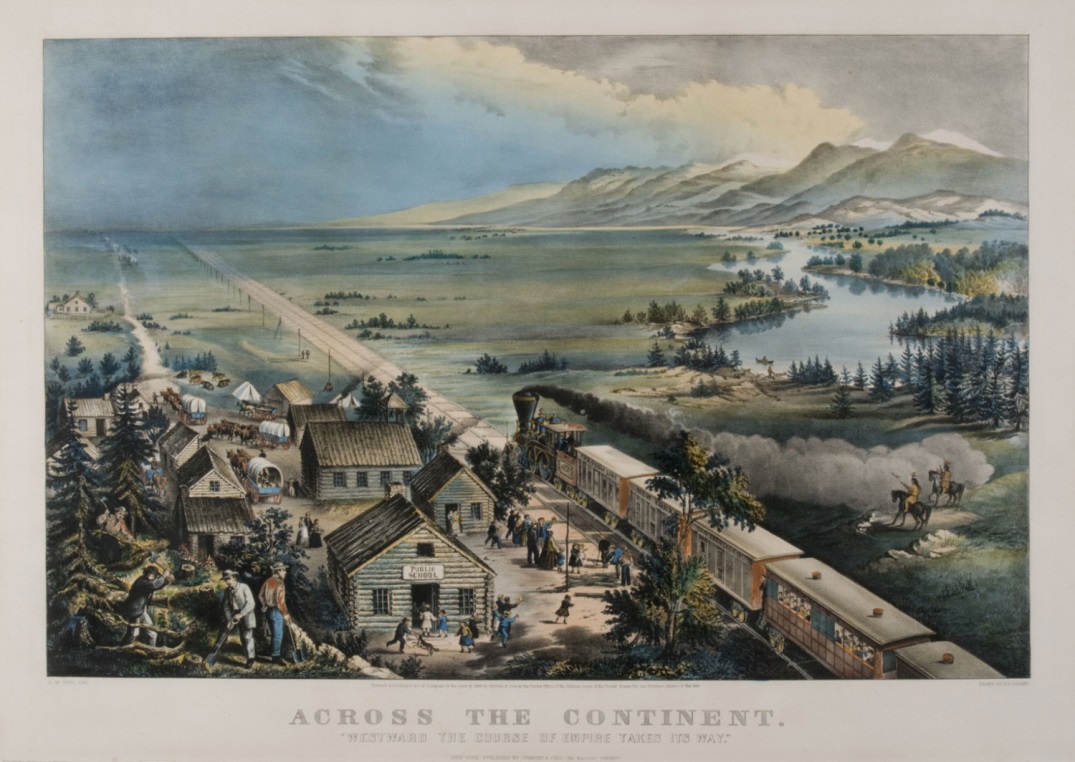
Much of modern history has involved attempts to decouple this coordination. American pioneers on the Oregon Trail needed five months, mostly walking, as their Conestoga wagons mainly hauled cargo. The Trans-Continental Railroad, which President Lincoln initiated to connect California to the more settled East Coast, required four days. That meant not only less time, but less food, fewer services, and no interactions with the physical space. Prairie towns became something travelers whizzed past without stopping.

Consequently, most agricultural output was no longer consumed locally. Farmers produced for distant markets, specializing in crops that shipped safely under harsh conditions without refrigeration. Lincoln signed the bill creating the USDA to stabilize American food supply the same year he inaugurated the Transcontinental Railroad. To this day, the USDA subsidizes the five most shelf-stable crops that best handle shipment and processing: corn, wheat, rice, soybeans, and cotton. (Some lists also include sorghum and peanuts.)

Please note, this subsidy schedule isn’t morally neutral. It rewards farmers who wring the highest possible output from their lands, which in turn rewards ammonia-based fertilizers, heavy equipment, and consolidated ownership. It also discourages crop rotation, diversification, and even letting a field lie fallow occasionally. Farmers must produce maximally, and thrust it onto the market, irrespective of floating prices or consumer demand. Only by keeping outputs high do farmers receive the subsidies they rely upon.

The frontier as depicted by Currier and Ives (click to enlarge)

Children still sing about Old McDonald’s diverse farm animals, but that’s bucolic poppycock. Farming for the long-distance market means abolishing not only traditional American farm autonomy, but also Native American traditions of land stewardship. There’s no separating the massive Nebraska monocropping that famously terrified Stephen King, and the racism that justified Wounded Knee. Nor from the European colonialism that, as I wrote last time, wrecked a 9,000-year stable relationship between humans and nature in Newfoundland.

These changes create short-term convenience, but have massive long-term costs. Oregon Trail pedestrians owned their Conestoga wagons; rail passengers rented access for a few days. We can argue that motorists own their cars, but most are deeply leveraged with debt, and the bank owns the actual note. Today’s industrialized farmers are paper millionaires behind their land holdings and equipment, but their “ownership” is deeply leveraged, and most are one bad season away from losing everything.

Far from making us free, our massive technological do-funnies make us more beholden than the English peasant who needed months to walk Britain. Our hypothetical peasant probably couldn’t travel far from his birthplace because the journey was impractical. We could travel, but mostly can’t, because our car payment, rent or mortgage, student loan debt, utilities, credit card bills, and internet access are coming due. Our peasant owed fealty to one feudal lord; we have dozens.

Please don’t mistake this for naïve nostalgia. We live with amortized debt the way our distant ancestors lived with smallpox, wars of religion, and an infant mortality rate hovering around forty percent. We can’t fight the tyranny of false convenience by embracing cottagecore aesthetics, wearing gingham, and rereading our Little House books. The solution comes in looking forward, not back, and creating something new, not nesting in the store-bought emblems of a beatified, ahistorical past.

Historian Greg Grandin writes that, in America’s early republic, James Madison advocated for westward expansion to hasten continental democracy. Madison asserted that Americans could never expand enough to occupy the continent, giving the state a permanent mission. But Americans occupied the entire continent in scarcely a century. To do so, we wrecked forests, devastated bison habitat, strip-mined Appalachia, and overthrew world governments. Continental convenience wasn’t an accomplishment, it was a mortgage that’s now coming due.

Saturday, October 25, 2025

The East Wing and America’s Disposable Economy

An NBC News photo shows the East Wing demolition in process this week

Although a majority of Americans reportedly disapprove of this week’s demolition of the East Wing, exact disapproval follows largely partisan lines. The White House extension, first built in 1902, stood between the president and his long-sought “ballroom,” and approval of the new replacement largely tracks with personal support for the president. Less interesting than exact details to me, though, is the underlying beliefs exposed by the demolition.

I cannot help perceiving the president’s actions through my seven years in the construction industry. Unlike the president, who comes from the moneyed, white-collar end of property development, I worked the jobsites, cordless impact driver in hand, tape measure hanging off my belt. The president works with schematic drawings, models, and CAD renderings. For each of us, the other’s perspective is an abstraction, separate from our particular job.

To architects, contractors, and project managers, only the finished product matters. The process is as ephemeral as pixie dust. Management wants to complete construction on time and under budget; everything else serves that goal. Existing structures, built with outdated technology and, probably, with hand tools, are an impediment. To the property developer, historic preservation is a costly nuisance that impedes progress, while demolition is cost-efficient.

Historic preservation is, ultimately, an expression of sentimentality. The Democratic-aligned objection to the East Wing demolition has focused heavily on historic photographs taken among the picturesque colonnade, or memories of the officials—especially First Ladies—who conducted White House business in those offices. They revere the now-lost East Wing for the same reason you’d rather see the church where your parents were married be restored than razed.

But American economics doesn’t place dollar values on sentiment. The president ran all three of his campaigns on rhetoric of cost efficiency, profitability, and business acumen. The philosophy of shareholder value, which has dominated American economics since at least the 1970s, sees ordinary people not as moral agents, but as arbiters of price. Historic buildings are worth exactly as much as one can outbid the developer who’d rather flatten it.

The president with one of the hand-sized architectural models of his grandiose
monuments, which he loves waving around for journalists

My first construction industry job involved building a new city high school to replace the nearly seventy-year-old existing building. The city’s cost-benefit analysis deemed the existing building too expensive to save. This decision distressed many people who’d lived in town their entire lives, and had deep-seated formative memories associated with the existing building. But their feelings weren’t sufficient to absorb the tax bill necessary for costly restorations.

Many public and municipal buildings, including schools, government offices, and universities, still have exterior facades built from slab marble, sandstone, and other valuable materials worth preserving. But those are merely cosmetic. The rise of steel-frame architecture means that a small number of girders carry the building’s weight. Interiors are built from tin studs, gypsum drywall, and poured concrete, materials with a maximum life expectancy of about fifty years.

Commercial buildings and houses are even worse. Most such buildings constructed after the Eisenhower Administration need significant restoration after around thirty years, because cinder block masonry, OSB underfloors, and aluminum HVAC systems, will just rot. Several American suburbs, once desirable and exclusive, are now saddled with the blight of abandoned malls and big-box retail stores: too decrepit to use, too expensive to restore, and too dangerous to demolish.

Nor is this accidental. Since the Levittown building boom of the 1950s, architecture’s core principles, as a field, have shifted away from durability, onto cost reduction. The White House’s facade hasn’t been much amended since George Washington laid the cornerstone in 1793. My city’s former high school, by contrast, decayed so spectacularly that I broke pieces off the seventy-year-old face by kicking them with a steel-toed boot.

Our president claims the East Wing demolition became necessary after discussion with architects, but I don’t believe that. After seven years in the industry, I know that, to the bean counters who control modern design and construction, demolition is always the first choice. Unless government agencies or private conservationists step in to prevent it, contractors regard old buildings as a private cost, not a community asset.

To America’s capitalist class, everything is as disposable as an aluminum soda-pop can. People like our president measure buildings’ value not by their historic legacy, but by their cost efficiency. The East Wing was worth less, to him, than whatever supposed value he can extract from his extravagant “ballroom.” The same will apply, eventually, to your historic downtown, your local schools, or your house.

Nothing, anywhere, is safe from the bulldozers and grandiosity of America’s ruling class.

Tuesday, May 20, 2025

Architecture and American Values

Nottaway Plantation in its salad days, in a promo photo from Explore Louisiana

The recent online brouhaha over the fire which destroyed Nottaway Plantation is revealing more than I wanted to know about American priorities. Billed as the largest antebellum mansion in the American south, at 64 rooms and 53,000 square feet, it stood intact from its completion in 1859 until last Thursday. Following the Emancipation Proclamation, the Louisiana plantation house served mainly as a resort hotel, convention center, and tourist trap.

Social media reaction has split along predictable lines. Some respondents, mostly White, have insisted that the mansion’s historical significance and its elaborate architecture make it a legitimate destination, a piece of Louisiana heritage, and a massive loss. Others, a rainbow coalition, have rallied behind the plantation’s slaveholding heritage and called it a monument to American racism. Each side accuses the other of viewing the destruction through partisan political lenses.

Wherever possible, I prefer to assume that all debate participants, even those I disagree with, start from a good-faith position. I don’t want to believe that those who don’t spotlight the slaveholding heritage are, perforce, celebrating racism. And I hope those who center slavery as the building’s heritage, don’t covertly cheer for destruction. Though my sympathies lie strongest with the anti-slavery caucus, I’d rather believe everyone starts from good faith.

If that’s true, it follows that those mourning the loss of historic architecture, believe the building’s structural significance and its socioeconomic significance, exist in different compartments. They segregate different aspects of the building’s history into beehive-like cells, and assume the separate qualities don’t influence one another. Social media commenters have written words to the effect that “Slavery was terrible, but the building matters in its own right, too.”

This argument holds some water. Nottaway Plantation was, until last week, a surviving example of a mid-19th Century architectural ethos. Not a reconstruction, a replica, or an homage, but an actual piece of physical history, a primary source. We shouldn’t discount that significance, regardless of who built the building; a physical artifact of American history existed for 166 years, until it didn’t. America is arguably poorer for the loss.

However, compartmentalizing that history from the circumstances which created it, is itself ahistorical. I worked in the construction industry, and I can attest that the largest ongoing cost is human labor. Nowadays, construction involves copious large costs, including power tools, diesel-burning equipment, and transportation. But these are, usually, fixed-term costs. Human labor is ongoing and requires infusions of money, if only because workers get hungry.

Nottaway Plantation during the fire, in a photo from CBS News

Much labor is especially valuable because it’s rare. Framing carpenters, brickmasons, metalworkers, and other skilled laborers demand a premium because their skills require years of honing. Nottaway Plantation was built during the days of gaslamps and outdoor toilets, but nowadays, electricians, plumbers, and HVAC installers command competitive rates. Building such a massive mansion required skilled labor from workers who, being enslaved, couldn’t float their terms on the open market.

Many conditions also depend on the time and place. Anybody who’s lived in Louisiana knows that most of the state stands on spongy, wet soil. Building a multistory mansion requires sinking foundational pilings deep, possibly down to the bedrock, to prevent the building submerging under its own weight. Today, such pilings require diesel-burning machinery, sump pumps, and cast iron. In 1859, those pilings required many, many humans.

Therefore, the building’s architectural significance—which is real and valuable—relies upon the labor employed. Large-scale monumental construction always requires somebody able to pay the army of skilled workers whose labors make the building possible. This problem isn’t uniquely American, either. European monuments, like Notre Dame and the Vatican, were first built before Europe reintroduced chattel slavery, but the buildings wouldn’t be possible without the poverty of serfdom.

Too many accomplishments of human activity, rely on a small sliver of society having too much money. Without rich people willing to pay skilled workers, we wouldn’t have the White House, the Venice canals, legendary artwork like the Mona Lisa and Michelangelo’s David, and other monuments of human capability. If Leonardo or Pierre L’Enfant needed day jobs to subsidize their crafts, they’d never have accomplished the potential within them.

So yes, Nottaway Plantation reflects architectural history and artistic movements. But it also reflects economic inequality and the labor conditions of antebellum Louisiana. It’s impossible to separate the two spheres of influence, no matter how much the privileged few wish it. Nottaway was an artifact of physical beauty and a community gathering place. But it emerged from specific conditions, which we cannot compartmentalize from the building itself.

Tuesday, April 15, 2025

Is the Law a Dead Letter Now?

Back in the 1990s, when I was a teenage Republican, I believed humanity would find a legal system so self-sustaining, we could eventually exclude humans from the equation. We could write laws, then deploy the bureaucratic instruments necessary to enforce those laws, without bias or favor, essentially forever. The machine would support itself without inputs from nasty, unreliable humans. We only needed to trust the modernist small-L liberal process.

Okay, we hadn’t written such laws to implement such systems, but that only proved we hadn’t written such laws yet. Because individuals only enforced laws as written, I reckoned, such self-sustaining systems would preclude individual prejudice or demographic bias. (I didn’t realize, for years, that laws themselves could contain bias.) Divisions, disadvantage, and destitution would eventually wither as laws enforced baseline ethical standards which encompassed everyone, everywhere, equally.

Watching the meltdown surrounding Kilmar Abrego Garcia, I’m seeing underlined something I gradually realized in my twenties, but never previously needed to say aloud: all laws are doomed to fail. Even laws written with altruistic intent and thorough legal support, like the 14th Amendment, work to the extent that those entrusted to enforce them, actually do so. America’s current executive regime is demonstrating no intention to enforce the law justly.

The regime first deported Abrego Garcia in March, despite him having legal residency status and never having been convicted of any crime. Initially, the regime acknowledged that they’d expelled Abrego Garcia mistakenly, and based on that acknowledgment, the Supreme Court—dominated by Republican nominees and one-third appointed by the current president—unilaterally demanded his return. So the regime flippantly changed the narrative and refused to comply.

This refusal, stated unambiguously in an Oval Office press conference where the American and Salvadoran presidents shared the lectern, demonstrates why the law will inevitably fail. America’s system, predicated on the government’s adherence to the principles laid out in the Constitution, absolutely requires that all participants share a prior commitment. Simply put, they must believe that nation, government, and law, are more important than any individual. Even the president.

Kilmar Abrego Garcia (AP photo)

We must strike a balance here, certainly. Individuals write our laws, even individuals working collectively, and our legislators are individuals. The “buck stops here” president, an individual, must balance power with the nine SCOTUS justices and the 535 members of Congress, who are all individuals, even when working jointly. But those individuals all work for a shared vision, and when they don’t, their whimsy becomes antithetical to state organization.

Please don’t misunderstand me. Any individual may call the nation wrong, as for instance Dr. King did, and may organize to redress such wrong. Indeed, only such public, organized call-out may sway the nation’s conscience sufficiently to enact change or improve a dysfunctional system. The primacy of the nation doesn’t mean citizens must meekly accept arbitrary or unjust directions from a unitary state. That would basically invite autocracy.

Simultaneously, however, those who seek official state power must submit themselves to something larger than their individuality. Dr. King never ran for office, and the tactics he employed when crossing the Edmund Pettis Bridge would’ve been inappropriate in Congress. Indeed, his deputy, John Lewis, who became a Representative, used Dr. King’s tactics to mobilize voters, but submitted himself to forms of order when writing and voting on legislation.

My regular readers, who mostly share my sociopolitical views, may think I’m saying something obvious here. But as I write, the current president’s approval ratings hover between 41% and 49%. That’s negative, and substantially underwater, but at least two in five Americans look at what’s currently happening, and don’t mind. They voted for his tariffs, immigrant roundups, and rollbacks of civil rights law, and five months later, they remain unchanged.

A satisfactory fraction of American voters approves of, or at least don’t mind, a president placing himself above either Congress or SCOTUS. This president, like Andrew Jackson before him, thinks he’s empowered to force lawful residents off their land, unless someone has guns enough to stop him. Essentially, he’ll continue ignoring baselines of justice until someone, presumably Congress, does something to stop him.

Our entire Constitutional structure requires those elected to power, to agree that America is more important than themselves. That means both America, the human collective, and America, the structures of government. If laws require them to act correctly, then they must abide by those laws without threats of force. If they can’t do that, well, that’s what checks and balances are for. If that fails, We the People step in.

Monday, March 24, 2025

The Stains of Politics Don’t Wash Off

1001 Books To Read Before Your Kindle Battery Dies, Part 120
Lawrence O’Donnell, Playing with Fire: The 1968 Election and the Transformation of American Politics

Those of us born afterward—which, over half a century later, is most of us—probably know the 1968 presidential election for LBJ’s abrupt withdrawal, or for Bobby Kennedy’s assassination. As this highly contested election recedes from living memory, we risk losing important context that helped define a generation’s relationship with politics. Just as important, without that knowledge, we’re vulnerable to those who would exploit weaknesses that still exist.

Lawrence O’Donnell is a journalist, not an historian; but some of the best history for mass-market readers in recent years has come from journalists. Names like David Zucchino and Joe Starita have returned lost history to Americans, sometimes redefining our self-image in the process. Unconstrained by the necessities of academic writing, journalists can deep-dive into primary sources and spin them into vernacular English. Which is exactly what O’Donnell does here.

As 1968 began, the Democratic party split over Lyndon Johnson. The President’s civil rights legislation alienated old-line conservative Dixiecrats, but his deepening commitments in Vietnam left White progressives politically homeless. This led not one, but two sitting senators to challenge Johnson in the Democratic primary. Bobby Kennedy, son of a political dynasty, moved slowly and strategically, but Eugene McCarthy, a former professor, mustered the enthusiasm of college students and Yippies.

Republicans faced substantially similar problems. George Romney, a center-right maven, failed to muster much enthusiasm, so the question became whom the Republicans would embrace. That old anti-communist firebrand Richard Nixon told Cold War Americans what they wanted to hear, and whom they should fear. But New York governor Nelson Rockefeller offered a relatively optimistic, liberal option. 1968 would be the final knell for Republican liberalism.

But then as now, the presidential election wasn’t only about the political maneuvering. In 1968, Martin Luther King, Jr., was ramping his “Poor People’s Campaign” to new heights. That fateful day in Memphis, he’d visited to help organize the city’s striking sanitation workers. When an assassin’s bullet struck him, it basically exposed an entire generation’s bottled rage. The resulting nationwide explosion redefined the terms for would-be presidential candidates.

Lawrence O’Donnell

Back then, the primary system didn’t matter like it does now. Kennedy, McCarthy, Rockefeller, and Ronald Reagan led aggressive ground campaigns to garner votes, but Nixon and Democratic Vice President Hubert Humphrey played internal party politics. Their aggressive gladhanding secured party nominations for two candidates who didn’t necessarily have deep grass roots. Both parties would have to change future nominating processes to address this injustice.

Even more than the individual candidates, 1968 would redefine party identities. Before the Sixties, party loyalty had more to do with community and geography than issues and platforms. That’s why Johnson, a Democrat from Texas, could shepherd multiple civil rights bills through a historically divided Congress. It’s also why a liberal like Rockefeller, and moderate like Romney, and a conservative like Nixon could compete for the Republican nomination.

But new alignments based on domestic issues changed these alignments. Over the course of 1968, the Nixon contingent, backed by that old segregationist Strom Thurmond, squeezed the liberal Republicans out. Meanwhile, as two anti-war candidates vied for the Democratic nomination, party regulars closed ranks to preserve the Johnson wing’s privilege. Thus, throughout the 1968 primary campaign, the Republican Party became increasingly conservative, and so did the Democrats.

O’Donnell wrote this book directly after the 2016 election, and comments liberally on how the Nixon/Humphrey contest presaged the Trump presidency. As always, history is about what happened, but it’s also about us, the contemporary readers. Presidential campaigns, once scholarly affairs based on debate and communication, became increasingly oriented toward television. Vibes became more important than policies—and Democratic Party vibes were so authoritarian, they made Nixon look amiable.

At the same time, O’Donnell omits information his audience could learn from. He never names the assassins who killed Dr. King and Bobby Kennedy, and never mentions their motivations; James Earl Ray and Sirhan Sirhan don’t even merit index entries. Therefore, Ray’s connection to organized bigotry gets erased, as does Sirhan’s anger over the Six-Day War. O’Donnell pores over living candidates’ policies extensively, but assassins’ bullets apparently just happen.

In O’Donnell’s telling, the 1968 election serves as a fable to explain Trump-era politics. By examining the partisan extremes that calcified during this campaign, we gain the vocabulary to understand what happened in 2016. And though O’Donnell couldn’t have anticipated it, his words became more necessary, his vocabulary more trenchant, after the disaster of 2024. It’s often difficult to examine the present dispassionately, but the past offers us useful tools.

Saturday, March 22, 2025

Why Ostara?

A 19th century engraving depicting
Ostara (source)

Each year during Lent, social media surges with claims that Easter derives its name and mythology from the Anglo-Saxon fertility goddess Ostara. These memes often include claims about how Ostara gives us numerous Easter myths: that rabbits and eggs were her sacred symbols, that her worship involved sexual rituals which early Christians suppressed, even that Ostara died and rose again. These claims are largely fictional; Ostara’s actual mythology is lost.

Less interesting than what Anglo-Saxons believed, or didn’t, about Ostara, is the eagerness with which online critics invent Ostara mythology. No information about Ostara, beyond her name, survives, yet commentators assert a panoply of just-so stories, many beginning with “it’s said” or “the story goes,” variations on the folkloric “Once Upon a Time.” Some such stories are pilfered from Germanic or Near Eastern religions; others seem to be purely fabricated.

Such attempts to revive otherwise lost pre-Christian religions seem counterintuitive. The so-called New Atheists, like Sam Harris and Richard Dawkins, claim that scientific modernity doesn’t need creation myths and just-so stories to organize society. Yet even as Christianity seems ever-further removed from today’s culture, at least a vocal contingent seeks moral justification, not in science, but in ancient myth. The very antiquity of pre-Christian myth gives it exotic appeal.

Multiple factors contribute to why Christianity, and its myths and practices, are fading in Western Civilization. Clergy abuses, past and present, surely contribute. Christianity’s association with warlike, nationalistic, and racist factions doesn’t help. Even its ancient texts, unchanged since the Iron Age, makes it seem weighted with antique baggage. But I’d suggest one important reason Christianity seems distant from modern culture: the religion focuses heavily on death.

Why does Jesus’ suffering and death dominate Christian theology? The Apostle Paul highlights Christ’s crucifixion and resurrection, far beyond Jesus’ moral lessons. Christianity originally spread amid conditions where death was commonplace; most people died, not in hospitals, but at home, surrounded by family. Funerals were massive public gatherings signified by music, food, and other festival trappings. Such events still sometimes happen in rural areas, but have become uncommon elsewhere.

A 19th century Easter card (source)

Rather, modern death has become aberrant. The most common causes of death throughout history—tuberculosis, malaria, bubonic plague, polio, tetanus, whooping cough—have become rare in the last century, the time when Christianity saw its fastest decline. Even industrial accidents and war wounds are treatable in ways past generations didn’t know. Death, once so ever-present that people discussed their funeral preparations over family dinner, has become rare, distant, and distasteful.

Theologians have created convoluted justifications for Christ’s death and resurrection. As Fleming Rutledge writes, virtually no such justifications withstand scrutiny. But for early Christians, no justification was necessary; Christ died because we’ll eventually die, probably sooner rather than later. That camaraderie with God brings comfort. I’ve known two atheist friends who embraced faith and prayer when loved ones were dying, then returned to unbelief when the crisis passed.

But death doesn’t define Ostara. Though some online stories claim she dies and is resurrected every spring, these stories are peripheral. The made-up myths generally highlight fertility, growth, planting, and sex. Concocted myths prioritize life, flourishing, and birth, which seem closer to modern daily experience. In a culture where death seems abnormal, a unifying spiritual narrative privileging birth and life arguably makes sense. Penicillin rendered Christianity obsolete.

This stumbles on one important problem: we’re still going to die. As someone who recently watched a loved one struggle on life support before the merciful end, I find the Easter narrative of God’s mortality comforting in new ways. But we’ve made death distant and antiseptic, hidden inside hospital or nursing home walls, no longer present with daily life. Death has become atypical, but we’re still going to die.

Speaking personally, in past years, I’ve found the romantic mythmaking of Ostara merely treacly. This year, it’s become something more pointed, something harsher. It’s become an active denial of human inevitability, and a shared refusal to accept the human condition. Modern technological society hides death, and dying persons, in antiseptic conditions, pretending they don’t exist. Life has become an eternal present, a permanent now.

I’ve written about this before: myths are ultimately not about the truth, they’re about the people who create them. But in this case, the attempt to invent new “ancient” myths about a lost folk religion aren’t just explanations. They reveal a way modern society denies an important aspect of life, and hides our mortal end like a shameful thing. These myths look cute, but they’re subtly dangerous.

Friday, March 14, 2025

How To Invent a Fake Pop Culture

I don’t recall when I first heard the song “Sally Go ’Round the Roses.” I know I first heard Pentangle’s folk singalong arrangement, not the Jaynetts’ Motown-tinged original. Like most listeners my age, who grew up with the mythology of Baby Boomer cultural innovation, I received that generation’s music out of sequence; the 1960s appeared like a single unit, without the history of cultural evolution that define the decade.

Therefore I didn’t understand how influential the Jaynetts’ original version really was. Its use of syncopated backbeat, gated distortion effects, and enigmatic lyrics were, in 1963, completely innovative. The British Invasion hadn’t hit America yet, with the inventive tweaks that the Beatles and the Kinks experimented with. The original label, Tuff, reportedly hated the song until another label tried to purchase it, causing Tuff to rush-release the record.

Eventually, the track hit number two on the Billboard Hot 100 chart. More important for our purposes, though, a loose collective of San Francisco-based musicians embraced it. Grace Slick recorded a rambling, psychedelic cover with her first band, The Great Society, and tried to recreate its impact with classic Jefferson Airplane tracks like “White Rabbit” and “Somebody To Love.” Much of her career involved trying to create that initial rush.

Once one understands that “Sally” came first, its influence becomes audible in other Summer of Love artists, including the Grateful Dead, Creedence Clearwater Revival, Moby Grape, and Big Brother and the Holding Company. These acts all strove to sound loopy and syncopated, and favored lyrics that admitted of multiple interpretations. Much of the “San Francisco Sound” of 1966 to 1973 consisted of riffs and jams on the “Sally” motif.

That’s why it staggered me recently when I discovered that the Jaynetts didn’t exist. Tuff producer Abner Spector crafted “Sally” with two in-house songwriters, an arranger who played most of the instruments, and a roster of contract singers, mostly young Black women. The in-house creative team played around and experimented until they created the song. It didn’t arise from struggling musicians road-testing new material for live audiences.

Grace Slick around 1966, the year she
covered “Sally Go ’Round the Roses”
with the Great Society

A New York-based studio pushed this song out of its assembly-line production system, and it became a hit. Like other bands invented for the studio, including the Monkees and the Grass Roots, the Jaynetts didn’t pay their dues, the studio system willed them into existence. They produced one orphan hit, which somehow travelled across America to create a sound-alike subculture, back when starving musicians could afford San Francisco rent.

Culture corporations, such as the Big Three labels which produce most of America’s pop music, and the Big Five studios which produce most of America’s movies, love to pretend they respond to culture. If lukewarm dribble like The Chainsmokers dominate the Hot 100, labels and radio conglomerates cover their asses by claiming they’re giving the customers what they want. Audiences decide what becomes hits; corporations only produce the product.

But “Sally’s” influence contradicts that claim. Artists respond to what they hear, and when music labels, radio, and Spotify can throttle what gets heard, artists’ ability to create is highly conditional. One recalls, for instance, that journalist Nik Cohn basically lied White disco culture into existence. Likewise, it’s questionable whether Valley Girl culture even existed before Frank and Moon Zappa riffed in Frank’s home studio.

It isn’t only that moneyed interests decide which artists get to record—a seamy but unsurprising reality. Rather, studios create artists in the studio, skimming past the countless ambitious acts playing innumerable bar and club dates while hoping for their breakthrough. This not only saves the difficulty of having to go comparison shopping for new talent, but also results in corporations wholly owning culture as subsidiaries of their brand names.

I’ve used music as my yardstick simply because discovering the Jaynetts didn’t exist rattled me recently. But we could extend this argument to multiple artistic forms. How many filmmakers like Kevin Smith, or authors like Hugh Howey, might exist out there, cranking out top-quality innovative art, hoping to become the next fluke success? And how many will quit and get day jobs because the corporations turned inward for talent?

Corporate distribution and its amplifying influence have good and bad effects. One cannot imagine seismic cultural forces like the Beatles without corporations pressing and distributing their records. But hearing Beatles records became a substitute for live music, like mimicking the Jaynetts became a substitute for inventing new culture. The result is the same: “culture” is what corporations sell, not what artists and audiences create together.

Friday, November 15, 2024

For the Kingdoms of the Earth

“And you will cry out on that day before the king you chose for yourselves and he will not answer you on that day.”
—1 Samuel 8:18, Robert Alter translation
Artistic representation of King David

Samuel, the Hebrew leader who oversaw Israel’s transition from the age of judges to the age of prophets, specifically warned Israel what would happen if they selected a king. The monarch would seize and redistribute the best farmlands, a massive injustice to an agrarian society. He would seize Israel’s farm implements to reforge them into weapons of war. Kings would spend tax revenue on palaces while farmers squatted in huts.

This maintains a pattern recurrent throughout the Bible, the declaration that power hierarchies are inevitably unjust. To theistic minds of the post-Bronze Age Levant, human hierarchies seize power that belongs uniquely to God. As Robert Alter writes in his extensive footnotes, the God of Samuel was explicitly a Hebrew deity, and had literal political dominion over Israel and Judah. Power belonged to God; humans could only act as God’s deputies.

God’s sovereignty worked well while Israel remained poor, agrarian, and simple. A loose confederation of hill-dwelling tribes working the land with bronze implements, Israel needed little, and God provided commensurately. But the Levant witnessed the rise of political empires like Assyria, Babylon, and Egypt. Straddling the footbridge between Africa and Asia, the Levant became a necessary possession for any empire hoping to expand.

It's easy to forget, centuries removed from the “Divine Right of Kings,” that king isn’t originally a political title, it’s a military rank. Kings occasionally made and enforced laws, time permitting. But civilian laws basically existed to organize the population for military purposes: strong sons for recruitment, tradesmen to make arms, crops to resupply the front lines. As I’ve written before, the political state exists fundamentally to bolster the military.

We’re witnessing this in our time. As Israel’s pummeling of Gaza continues after over a year, international Jews loom large among those protesting the violence. While the Israeli state channels national resources toward killing despised outsiders, those who define themselves according to Jewish traditions and values are among the state’s most vocal opponents. The cleft falls along loyalty to the state versus loyalty to Judah.

As Samuel prophesied, King Saul became tyrannical and paranoid—but not without reason. As his military needs became increasingly prominent, he needed constant resupply of resources. Though Saul didn’t undertake many significant military adventures away from the Israelite homeland, his defenses against Egyptians, Philistines, and other flatlander empires became increasingly costly. In the end, Saul died defending the homeland.

Benjamin Netanyahu, acolyte
of his country's secular Priesthood

Meanwhile, as Saul became increasingly despotic, David became increasingly popular. The description of young David in 1 Samuel seems remarkably like a combination of Robin Hood and Joan of Arc, a folk hero rallying common folk against the occupying despot. David roams the Levant, gathering followers, but notably never attacking God’s anointed king. Only when Saul’s own overreach gets him killed, does David’s rabble army seize power.

My childhood Sunday School tracts always depicted this David: not necessarily rebellious, but certainly young, a friend to commoners, active and popular. The David described in 2 Samuel barely exists, because the longer David holds power in Israel, the more he resembles Saul. He’s arguably worse than Saul, because at least Saul died manning the fortifications. David instead sends others to fight, staying home himself and having sex with generals’ wives.

International Jews lived in diaspora for two millennia before Zionists reestablished the state of Israel. Jewish tradition holds that, eventually, the Israelite homeland will return, but throughout scripture, that’s always in the future. Diasporic Jews suffered massive oppression for centuries, and in places still do; but they didn’t have to absorb the moral compromise of governing an earthly kingdom. Now some do, and that’s made them massively unpopular.

Consider other world leaders chosen for their outsider status. Barack Obama and Boris Johnson both achieved national power by promising to break with stultifying political conventions. Both accomplished mere shadows of what they promised. In America, Republicans running on anti-statist platforms, like Kevin McCarthy, Paul Ryan, and Donald Trump, all needed to compromise their values to actually govern.

Oh Samuel, you warned us. Kings may require power to defend us, but power will always turn the powerful into the instruments they hated. And now it’s too late, we can’t return to our hill-country farms and our uncomplicated agrarian lifestyles. Because we, too, have become what we once hated: subjects of an occupying force that values only itself.

Sunday, November 10, 2024

Autopsy for an Institution

Vice President Kamala Harris

Conventionally, political parties conduct postmortems following every Presidential election. These self-reflections especially matter after a loss. If parties and their voters can accurately identify what led to the outcomes, they can reverse their losses later. When Mitt Romney failed to unseat Barack Obama in 2012, the Republican National Committee determined their message was insufficiently inclusive. How that led to the pugnacious, bigoted Donald Trump, I cannot figure.

In 2024, Democrats lost the Presidency and the Senate. The House of Representatives remains uncalled, but a Democratic upset appears unlikely. After a campaign anchored on promises to hurt POC, queer people, and dissidents, American voters decided they preferred that over a Democrat with a proven, but workmanlike, track record. With a stranglehold on American government, Republicans stand poised to unleash epoch-making pain on ordinary citizens.

Democrats probably won’t begin their postmortem until January, between the Congressional and Presidential inaugurations. However, I believe it’s necessary to commence now, while feelings remain high. Why, with so much at stake, did millions of Democratic voters stay home? Trump gained almost no absolute numbers following 2020; his majority margin apparently consists of Biden voters who sat out the Harris campaign and didn’t vote at all. How did that happen?

(There’s no concrete evidence of voter fraud; the difference apparently consists entirely of voter apathy.)

Edit: in light of new evidence, it appears that Trump did not win an outright majority. Though he came first in the popular vote, continuing counts indicate that he fell short of the 50% threshold.

Though every election has its own character, one recurrent thread remains evident throughout my lifetime: Democrats desperately want to prevent another 1968 Democratic National Convention. Bipartisan anger at Lyndon Johnson’s mishandling of the Vietnam War, coupled with Hubert Humphrey’s general unpopularity, caused streets to erupt in violence. The brutality made the Democrats look slovenly and dangerous, which handed the general election to Richard Nixon.

Former President Jimmy Carter

Beginning arguably with Jimmy Carter, the Democrats began fleeing their legacy with FDR’s New Deal and Johnson’s Great Society. Teddy Kennedy primaried Carter from the Left for exactly this reason. Unfortunately, this challenge fractured the Democratic coalition and helped hold the door for Ronald Reagan. In autopsying their 1980 drubbing, Democrats decided their lesson was that they needed to tack harder to the center and abandon the New Deal.

Thus commenced the Democrats’ centrist fixation, beginning with Walter Mondale’s historically milquetoast 1984 campaign. 1988 should’ve been Gary Hart’s year, until he imploded following the notorious Monkey Business photo, kicking the nomination to Michael Dukakis. But Mikey-D proved inept and subjected himself to multiple humiliations, giving us the only time since World War II that the same political party won three consecutive Presidential elections.

Dukakis, a self-identified “liberal,” tanked in 1988, but centrist Bill Clinton won in 1992. To this day, many Democrats insist that this proves voters prefer centrists. Democrats decided they needed, again, to chase the center and abandon the New Deal. I’d contend that Democrats’ 1992 victory reflects less a centrist at the top of the ticket, than the absence of Lee Atwater from inside the Republican National Committee.

Moreover, though Bill Clinton won twice, he never carried a majority. He probably wouldn’t have carried the plurality if Ross Perot, a former leading Nixon donor, hadn’t split the fiscal conservative vote twice. Facing a visibly fatigued George H.W. Bush in 1992 and an unsmiling Bob Dole in 1996, Clinton was less the popular choice of the 1990s than the candidate Americans could live with. Which isn’t saying much.

Failed candidate Michael Dukakis

Al Gore won a razor-thin plurality in 2000, but lost the procedure. But like Clinton, Gore never got the majority. Both Gore in 2000 and John Kerry in 2004 appeared starchy and joyless on camera, which shouldn’t matter, but does. Since campaigns today are highly visual endeavors, driven by television and YouTube, candidates need visual dynamism, which Barack Obama, for all his many faults, had.

Obama, another centrist, won two straight majorities, the first Democrat to do so since FDR. But consider his opponents: John McCain and Mitt Romney, who ran two of history’s greatest room-temperature campaigns. Hillary Clinton, another centrist, got more airtime for her frequent verbal gaffes than her policies. Clinton lost to the more entertaining Donald Trump, who only lost reelection after shitting in the metaphorical swimming pool on national TV.

2024 could offer Democrats the opportunity to shed the illusion of the phantom centrist voter, but it probably won’t. The party squandered precious momentum chasing crossover voters who have probably never existed. So here’s my postmortem, not only for the Democrats, but also for the entire United States:

Doing what we’ve done for fifty-six years hasn’t worked. Let’s change course before it’s too late.

Saturday, November 9, 2024

Anatomy of the Un-Free Mind

Jason Stanley, Erasing History: How Fascists Rewrite the Past to Control the Future

Fascists, of both the small-f and large-F varieties, have a curiously adversarial relationship with history. Their entire political movement depends on myths of past national greatness, which is almost always presented as lost, but which they promise to restore. But they generally despise historians, and attempt to squelch nuanced or conflicting narratives. Briefly, they adore the idea of history, but despise the practice, especially if it requires any self-reflection.

Yale philosophy professor Jason Stanley has written multiple books about how fascists, propagandists, and spin doctors use language and knowledge to strangle public discourse. This book’s title appears to promise a look at how authoritarian regimes rewrite history generally, but in practice, it focuses primarily on academia. Stanley examines how regimes inculcate a spirit, not only of ignorance, but also incuriosity, among citizens at a formative age.

First, tempting though it might be, Stanley stays substantially clear of large-F Fascists. He talks somewhat about Hitler, less about Mussolini. But he mainly focuses on current strongman authoritarian regimes, especially Putin’s Russia and Netanyahu’s Israel. He spends some time on the British colonial empire in Africa and India, his father’s scholarly specialization. And he unambiguously aims his harshest criticisms as Donald Trump’s American brand of anti-intellectualism.

In Stanley’s telling, fascists begin by constructing the purpose of historical education. Their reasoning starts from an intended conclusion—instilling a love of country and an adherence to hierarchy—and retrospectively determines how to achieve that goal. This means having institutional control of textbooks, administration, and personnel. Conservatives have made firing educators and replacing trustees a cornerstone of their recent campaigns.

The process of controlling the historical narrative closely resembles the process of creating imperial colonies; this isn’t coincidental. Autocrats create a hierarchy that, they contend, has always existed. They instill a central imperial language, and make it illegal to speak indigenous languages; not for nothing did British colonialists force the Kikuyu of Kenya onto reservations, exactly as America did to its native population. Because indigeneity is necessarily anti-authoritarian.

Jason Stanley

Here, I wish Stanley went more into how administrations silence history among adults. He describes how administrations use schools to prevent passing local autonomy and traditional identities onto the next generation. But how, other than armed force, do autocrats control adults? Stanley is vaguer here, perhaps because academics began committedly studying the process only after the atrocities of World War II. Traditional knowledge disappeared quickly, and I’m unsure how.

Mythical history looms large. That might mean presenting Germans as the genetic descendants of ancient Greece, as the Reich did (they’re not), or how schoolbook history presents George Washington as blameless, honest, and certainly not a slaveholder. Either way, it presents an innocent past that enthrones the dominant population as necessarily deserving power. This mythic past presents history as a constant decline from prelapsarian goodness, which politics must promptly reclaim.

Many critics respond by insisting that “classical education” counters authoritarian overreach. But Stanley insists that there’s no single magic machine. Classical education can empower intellectual curiosity and resistance to tyranny, if teachers focus on the questions the ancients raised, and if teachers address ways that our morality has changed. But authoritarians love using “classical education” to teach mindless adoration for the dead, which only compounds state-centered mythological ignorance.

Although Stanley focuses on history, he acknowledges this applies to all disciplines. He quotes Toni Morrison, who wrote that choosing the canon of literature is very much about choosing the national culture. When science serves the purpose of politics and industry, rather than inquiry and discovery, scientists always arrive at state-sponsored conclusions. The conventional liberal arts can improve human experience, or it can tie us to autocrats. Fascists know this.

Stanley makes no bones about his motivation. Donald Trump used executive authority to propound a national history curriculum that elided slavery, native extermination, and crackdowns on organized labor. The most extreme forms of American conservatism use the same techniques of historic erasure used to justify Putin’s imperialism or Britain’s conquest of India. Informed, politically invested citizens have a responsibility to reclaim history, both its glories and its tragedies, for the commonwealth.

This breakdown is chilling, certainly for those of us who believe in learning and inquiry, but hopefully also for anyone who just has kids, or loves a free society. Knowing history isn’t just a moral good, it’s a commitment to liberty and democracy; when governments decide what citizens may know, they control electoral outcomes. But the darkness notwithstanding, Stanley’s breakdown assures us that ignorance can be resisted. If we try.