Showing posts with label science. Show all posts

Thursday, June 11, 2026

Life in the New Protein Carnival


We already know that public standards in food consumption are deeply fad-driven. From the grapefruit diet of the 1930s to “organic” food in the 1970s—a concept that means something very different now than it did then—to low-carb diets in the 2000s, mass-marketed ideas of healthy diets rise and, usually, fall. We’ve all experienced serious dietary regimes in our own lives or those of loved ones, usually dressed in the ceremonial robes of science.

Currently, high-protein diets apparently dominate. Health-conscious eaters, especially men, seem obsessed with ensuring every meal includes a source of protein. (Speaking anecdotally, of course.) For most people, “protein” is synonymous with red meat, which results in people gorging on beef and pork. Of course, we can ask who benefits from this, especially in America’s highly subsidized meat growing system, with its network of often inhumane confined animal feeding operations. But how does this diet affect humans?

A recent stumble through the grocery store showed me significant numbers of foods bolstered with protein. High-protein breakfast cereals and breads. High-protein granola and pretzels. High-protein cheese and yogurt. Okay, those last two might just be opportunistic marketing, because cheese and yogurt are just dairy products fermented to bring out the protein, which is the substance that makes them more solid than milk. But even where “high protein” is cynical marketing, it’s become ubiquitous.

Then I saw high-protein water. Okay, it was sparkling water, which is already fortified with ingredients like sugar, fruit juice, and herbal supplements. But seriously, folks, high-protein water? Whose diet is so lacking in basic nutrition that they have to supplement it with faux soda-pop? At some point, these markers become an indication that the market has become saturated, and that it’s nothing but an advertising niche, intended to part the gullible from their money.

In fairness, I’m a biased source. Doctors recently diagnosed me with a disease caused by my body’s inability to eliminate proteins, which my liver turns into uric acid, and deposits in my joints. Early last month, gout left me in such disabling pain that I could barely walk for days, and spent weeks relying on a cane. This reflects my diet, and my mother taught me several recipes, all of which started by browning the meat.

For some people, gout also comes from drinking alcohol. Not me, though; I don’t drink often enough for that. Though determining the exact culprit would require expensive lab work that I can’t afford, my doctor and I decided, based on best available evidence, that my gout was most likely caused by overconsumption of animal protein. Alleviating my symptoms means reducing my meat and cheese consumption, so I basically have to relearn how to cook.

Not everyone has gout, certainly. But approximately one in 25 American adults has it, enough to count as medically “common.” Nor is gout the only protein-related disease, despite it currently looming large in my life. Excess protein can cause kidney and liver diseases, cardiovascular problems, digestive inflammation, and plain old weight gain. That’s saying nothing of nutritional insufficiency when eaters fill up on meat, and the protein crowds out vegetables, fiber, and other diverse foods.

Some people need (or want) higher protein for legitimate reasons. Bodybuilders and weightlifters need protein to achieve the useful, photogenic muscles that pay their bills. Patients suffering from certain nutritional insufficiencies or malabsorption issues may need more protein than most people. But these are specialized cases and, especially for the bodybuilders, a temporary state necessary to achieve clearly defined goals with end dates. Nobody ought to eat like this for the rest of their lives.

Yet the popularity of ketogenic and low-carb diets have people loading on proteins in hopes of looking like fashion models well into their fifties. The American diet is already the most meat-rich on Earth, and the health risks have been visible for years. Jordan Peterson famously put himself on an all-red meat diet, claimed extravagant health benefits—and has almost vanished from public view over the last year as his body lapsed into catastrophic collapse.

Please don’t misunderstand me: I don’t advocate complete vegetarianism. I tried that in graduate school, and discovered that the human body simply can’t replace certain nutrients that come from meat. But like in most of life, health comes through balance. Gorging ourselves on proteins has only temporary, nominal effects. Putting proteins in places they don’t belong, like fizzy beverages, isn’t healthy, it’s a sign of deep cultural imbalance that will warp our bodies and health.

Saturday, March 8, 2025

The Great Exploding Rocket Debacle Continues

A SpaceX Starship test rocket launch (AP photo)

Back in the 1980s, I remember being a science fiction fanboy, growing disgusted with the American space program’s apparent inaction. Sure, NASA maintained a robust schedule of space shuttle flights and satellite launches that had a certain earthside grandeur. But shuttle crews performed a string of low-stakes scientific experiments that yielded only incremental knowledge gains. Compared to Asimov-era promises, NASA seemed terminally timid.

Fiction countered this ennui with the promise of libertarianism. I’d be hard-pressed to name even one title or author forty years later, but a bevy of science fiction authors proposed the idea of private corporations and rich cowboys taking over where NASA proved timid. Ben Bova certainly hinted at this with his Moonbase novels. Arthur C. Clarke, though no Randian libertine, nevertheless had undertones of privatization in his Thatcher-age novels.

This promise of private-sector space flight seemed promising to my preteen self. I was mature enough to gobble down novels written for adults, a voracious reader hungry for the high-minded themes and promises of adventure which grown-up SF promised. But I wasn’t subtle enough to parse deeper meanings. These novels I greedily inhaled often contained dark implications of privatized space exploration encouraging rapacious behavior and destructive greed.

Watching the news surrounding this week’s SpaceX flight explosion, I can’t help remembering those stories I dimly understood. Elon Musk has spent a decade pitching how his multiple corporations can perform public services more efficiently than public bureaus. Yet his spacecraft’s multiple explosions, including this one which halted East Coast air traffic for hours, have repeatedly embarrassed us ex-scifi kids who still think space is pretty cool.

Elon Musk

Musk’s personal wealth reached nearly half a trillion dollars immediately following the 2024 presidential election, thanks to his connections with President Trump. Everyone assumed, not unreasonably, that Musk’s lucrative government contracts, including SpaceX, would yield heavy dividends in a Trump presidency. Yet in under two months since the election, Musk has seen his wealth fall by a quarter, fueled by his reckless behavior and personal unpopularity.

Importantly, Musk’s wealth has come significantly from government contracts. SpaceX makes some profitable product, particularly its StarLink satellite system, but that profit comes with significant amortized debt, underwritten by government credit securities. Most of SpaceX’s actual operating capital comes from NASA contracts since, following the discontinuation of the space shuttle program, NASA has no in-house launch capabilities anymore.

But this privatized space program has been, charitably, embarrassing. NASA spent much of its house budget creating scientific laboratories and testing facilities, because its budget, circumscribed by Congress, included little room for launchpad errors. SpaceX employs few scientists, but mostly engineers, preferring to build and launch physical prototypes, because even when they explode, they create valuable capital through the medium of name recognition.

In practice, this means NASA was slow-moving and timid, but it produced results: NASA went from President Kennedy promising a moon landing, to actually landing on the moon, in seven years. SpaceX moves quickly and dramatically, but it mostly produces falling debris and lurid headlines in the 24-hour news cycle. Its track record getting actual astronauts into space is spotty, and frequently beholden to the bureaucratic cycle.

Again, this underscores a contradiction in libertarian thinking. This week’s explosion, which scattered debris widely throughout the Caribbean, forced the FAA to halt traffic from major American airports—mere days after Musk’s own chainsaw behavior reduced FAA workforce numbers to critical levels. Musk disparages the public sector that, it turns out, he desperately needs.

Herbert Marcuse postulated, in One-Dimensional Man, that technological society produces intellectual stagnation and a headlong race toward mediocrity. This applies, he wrote, in capitalist and communist societies alike: engineers only reproduce what they know already works. Actual innovation requires government intervention, because only governments willingly embrace uncertainty and the capacity for failure.

SpaceX has proven what 1980s SF writers said, and I failed to understand, that a successful privatized space program requires avaricious ego and casual disregard for consequences. Private space exploration requires a greedy space pirate to eviscerate public resources for private gain, then turn around and trust public servants to keep citizens alive when the engineered product literally explodes. That’s the opposite of innovation.

IMusk’s embarrassing post-inauguration behavior and continuing business disasters probably won’t cure anybody of libertarianism, at least yet. People who ideologically believe in the private sector’s goodness will persevere despite seven weeks of high-profile setbacks. But hopefully at least some will accept that, in a high-tech society, the private sector needs a public sector to survive without killing innocent bystanders.

Sunday, November 24, 2024

RFK Jr. is Maybe, Slightly, Right

Robert F. Kennedy, Jr.

It’s a matter of time before Robert F. Kennedy, Jr., and Elon Musk create an insuperable rift within the upcoming Trump administration. Musk believes that engineers and their technology will solve society’s problems with efficiency beyond anything government can accomplish, a philosophy called cyberlibertarianism. RFK, by contrast, distrusts science and technology, and wants to rescind 200 years of progress in physiology and medicine.

Left-leaning quarters of the internet have begun mocking RFK as part of our routine anti-Trump rhetoric. We ridicule his disdain for vaccines in the immediate wake of a pandemic made absurdly worse by an administration that hampered any efforts to curtail the spread. We disparage his fear of pharmaceuticals as indicative of his now-infamous brain worm, which maybe could’ve been prevented by medicine. Everything RFK says is automatically tainted.

Yet I suggest there’s something to his persistent appeal. People like RFK, and those like him who automatically distrust science, because he isn’t entirely wrong. RFK taps a fertile vein of public sentiment that realizes we’ve heard lies from people and institutions for years, clothed in the vestments of science, technology, and mathematics. Americans have become distrustful of authority, and not without reason. RFK simply identifies that distrust.

We’ve witnessed how industrialized pharmaceutical companies, the storied “Big Pharma,” have yanked patients’ chains for years. Nearly a decade ago, so-called “Pharma Bro” Martin Shkreli increased prices on life-saving diabetes medications, which weren’t rare or proprietary, simply to boost his own shoddy past investments. Malcolm Gladwell writes how Purdue Pharma created the “opioid epidemic” by targeting, not patients in pain, but doctors desperately lonely for human validation.

These highly visible forms of public manipulation only remain in public memory because they’re uncomplicated. More nuanced issues, like the sale of over-the-counter amphetamines as diet aides, or the whole fen-phen debacle, are harder to understand, and therefore harder to remember. We’ve wondered at shifting standards for diet and exercise: a few years ago, doctors told us small quantities of red wine were healthful. Now we’re told no quantity of alcohol is safe.

Elon Musk

What’s more, many of RFK’s concerns about food additives and processing reflect our own concerns. Many packaged and convenience foods are fortified with synthetic preservatives and wheat flour base to remain shelf-stable. Many are also fortified with synthetic flavor compounds, because the processing leaches out natural flavor. As Rampton and Stauber write, these additives are presumed safe only because they haven’t been proven unsafe, and are only lightly regulated.

And our government kowtows to the companies which produce these foods, pharmaceuticals, and other substances we put into their bodies. Across many years and both major parties, administrations have let industrial conglomerates like Pfizer, Unilever, Con-Agra, and Bayer run roughshod, only occasionally constrained when public outrage grows vocal enough to jeopardize politicians’ reelection chances. Almost like representatives care more about their donors’ demands than their constituents’ health.

This isn’t new, of course. Anybody who even fleetingly reads American history knows that, before the rise of antitrust regulation, the companies that manufactured drugs fortified their patent medications with arsenic, cocaine, and opium. Before Congress created the FDA, food companies stretched their packaged foods with sawdust and urine. Government stepped in to enforce baseline safety standards, but now hides behind regulations as opaque as the companies they purportedly regulate.

So yeah, RFK actually understands an important thread in American political discourse: the terror Americans feel at how much power these opaque corporations and government institutions have in our lives. We fear these corporate conglomerates, many of which own significant shareholder stakes in one another. We likewise fear the regulatory institutions which often appear as likely to protect as prosecute the corporations hurting us.

That doesn’t mean RFK is right, of course. His belief in the superiority of “natural immunity” over vaccines, to cite just one example, suggests he thinks people once shrugged off polio, smallpox, and the plague. This is goofy. Like belief in homeopathy or crystal resonances, belief in “natural immunity” only makes sense with a complete unawareness of the history of science and medicine. Thus RFK Jr. is worse than ignorant.

However, progressives ignore RFK’s underlying message at great political cost. Just as we disparaged the Wuhan Labs hypothesis simply because Trump said it, we’re now ignoring a history of institutional abuse of science, simply because RFK says it. If progressives want to reclaim these voters from the kooks who have hijacked it, we need to start by acknowledging their concerns. Because they aren’t wrong; powerful people have lied to us.

Tuesday, October 29, 2024

“Chemicals,” Food, and You

“3-methyl butyraldehyde is a compound in a blueberry. Think about that.”

Somebody threw this into the ether recently in an argument about whole foods. You know how wise and restrained online debaters are. This person seriously believed they’d made a meaningful point about why people who insist on whole foods and minimal processing were wrong. Because whole foods have chemical compositions which are difficult to pronounce, this person apparently believed all arguments for plant-based whole foods are, a priori, wrong.

In full fairness, the other person in this debate (not me) said something equally unfounded. “If you can’t pronounce an ingredient,” the other person wrote, “DON’T EAT IT!” This person apparently believed in the honest wholesomeness of “natural” ingredients, presuming that naturally occurring, plant-based substances must necessarily be healthful. The other person responded with complete trust in science and technology.

I’ve written about this before; this double-sided fallacy doesn’t bear another unpacking.

However, the 3-methyl butyraldehyde argument deserves some exploration. This person, hidden behind an anonymous sign-on handle and a cartoon avatar, claims that abstruse chemical constituents within whole foods are essentially equal to additives used in manufacturing processed foods. 3-methyl butyraldehyde, which has both naturally occurring and synthetic forms, is found in many commercial foods, both whole and processed.

Blueberries have several naturally occurring chemical constituents. Some are easy to pronounce, including protein, fat, and especially water. Others are more abstruse, such as hydroxylinalool, linoleic acid, and terpinyl acetate. Though most of these chemical compounds are harmless in naturally occurring proportions, some can be harmful if isolated and hyperdosed. Like most organisms, blueberries comprise a subtle, nuanced combination of substances.

However, no combination of these substances, in any quantity, will come together and form a blueberry, not with current science or technology. One can only grow a blueberry by carefully cultivating a blueberry bush, a commitment of time and effort, as blueberry bushes only produce fruit after two or three years. Chemical fertilizers can sometimes hasten fruiting, but at the cost of starchier fruit, which displaces both nutrients and flavor.

One recalls the common counterargument whenever hippies complain about “chemicals.” Some wag, occasionally but not often a scientist, responds: “Everything is chemicals!” To take this argument seriously, the respondent must not know (or pretend not to know) that people say “chemicals” as a synecdoche for synthetic chemicals of an unknown provenance, which, under America’s light-touch regulatory regime, are assumed safe until proven otherwise—cf. Rampton & Stauber.

Though the FDA tests and regulates pharmaceuticals (for now), many food additives, cosmetics, chemicals used in haircare products and clothes, and other things we put on our bodies, are presumed safe. This despite years of evidence that this isn’t good practice. Ethelyne glycol, cyclamate, and several food dyes were regularly used in American foods before being demonstrated as unsafe.

Even beyond safety concerns, the reduction of whole foods to their chemical constituents preserves a dangerous idea. Futurists once posited that food scientists would eventually isolate the basic nutrients in food, and effectively replace the tedium of cooking and eating with the simplicity of gelatin capsules. One finds this reasoning behind the mythology of vitamin supplements, now known to be useless for most people most of the time.

Human digestion doesn’t simply extract chemical nutrients from food like a Peterbilt burning diesel. We require the complexity of food, including fats, fiber, roughage, and limited amounts of sugar. I generally side with Michael Pollan’s ubiquitous advice: “Eat food, not too much, mostly plants.” Food doesn’t mean chemical constituents. You don’t make a blueberry smoothie by adding 3-methyl butyraldehyde, you make it by adding blueberries.

Please don’t misunderstand. I want to avoid the trap of assuming that “natural” equals good. Reasonable adults know you shouldn’t pick wild mushrooms or handle poison ivy. That’s an exaggeration, but the point remains, that nature requires respect, like any other tool. But human agronomists have selectively bred food crops for 5,000 years to maximize healthful content, and apart from occasional allergies, agriculture is broadly trustworthy.

And pretending that food only consists of its chemical compounds is bad-faith argument. You wouldn’t describe your friend by listing his tissues and internal organs, because humans are more than the sum of our parts. The same applies to food, including fresh ingredients. Cooking natural ingredients, then processing them with synthetic additives to make them tasty and shelf-stable, does change the food.

Pretending not to understand the other person is smarmy and disrespectful, and if your argument requires it, your argument is probably bad.

Monday, November 6, 2023

Free Will, Determinism, and Time Travel Fiction

DC Iris Maplewood discovers one of the titular bodies in Netflix's Bodies

Something about science fiction makes writers feel compelled to break down the story’s speculative core somewhere around the halfway mark. Though Obi-Wan Kenobi introduces Luke to the Force early, halfway is when he explains its principles of mindfulness and flow. Similarly, though Kyle Reese has introduced Sarah Connor to his dystopian future, only around the halfway mark does he explain it to Dr. Silberman in any detail. Same applies to Netflix’s recent limited series, Bodies.

In episode four (of eight), the breakdown comes in two increments. First, we witness physicist Gabriel Defoe’s (Tom Mothersdale) lecture summation, describing the hypothetical Deutsche Particle, which simultaneously exists forward and backward in time. Later, speaking privately with Detective Constable Iris Maplewood (Shira Haas), Defoe extrapolates that, if the future already exists, free will is illusory. Maplewood demurs. Though structurally, Bodies is a police procedural, this science fiction rumination of liberty drives the series premise.

Recent philosophy has seen the resurgence of a previously endangered idea: determinism. Medieval Thomist philosophy contended that everything which happens in the material world has a prior cause. Yet every cause is, itself, an effect of a prior cause. Thus, reality exists in a causal chain descending through history to what Thomists call the First Cause. As Christians grounded in Aristotelean philosophy, Thomists correlated this First Cause with God, who set all reality in motion.

Determinism, this belief that all reality was set in predeterminate motion at the moment of creation, came under conflict during the Reformation, when many reformers contended that humans have the capacity, within our sensory limits, to accept or reject God. (Replace “God” with “philosophy” if that streamlines your thinking.) Reformers called this capacity “free will.” By the Enlightenment, free will became the operant European philosophy, mutatis mutandis, and arguable remains so through to the present.

Free will has recently come under fire from prominent atheists and sceptics. John Gray and Sam Harris are probably the most prominent, but an entire subthread of philosophy of science contends that free will is an illusion. Because our choices are conditioned by outside events and circumstances, most of which we cannot possibly comprehend, choice therefore isn’t real. (It’s more complicated than that, but bear with me.) This philosophy has limited traction outside narrow circles.

Sarah Connor (Linda Hamilton) and Kyle Reese (Michael Biehn)
near the culmination of their journey, in The Terminator

Okay, our choices are conditioned; anybody who’s had a job or otherwise interacted with complex human society will accept this. But to what degree are our choices determined? Philosophers consistently fail to close this gap. In Bodies, Defoe himself leaps that gap, even within himself; though he argues verbally that our choices are determined, we discover, eventually, that he attempts to change their conditions. (No spoilers; this is about Bodies’ philosophy, not its story.)

In the early seasons of the resurrected Doctor Who in the mid-2000s, the Doctor avoided intervening in history with two arguments. Sometimes he couldn’t revisit preceding actions, claiming that “we’re part of events now.” (This was mainly the Tenth Doctor, who couldn’t stomach contradictions or paradox. The Eleventh Doctor actively sought paradox.) Other times he claimed “a fixed point in time,” something so important that, even if it was terrible, intervening would create something far worse.

James Cameron’s first Terminator movie ends withSarah Connor’s realization that, though she and Reese defeated the monster, the monster’s creation was inevitable. Time, in the first movie, is circular, and attempts to alter it instead create it. But Cameron couldn’t stomach that forever, and reversed himself in the second movie. History can change; no fate but what we make. Cameron, like Bodies, initially accepts that we’re trapped in a causal loop, but finally resists such fatalism.

Thus, time travel fiction manifests a recurrent theme: history is contingent, without necessarily being inevitable. Just because events occurred in a certain way, doesn’t mean they had to occur that way. We cannot always know what contingencies define our actions, and some contingencies we can never know. Yet that doesn’t mean our choices are determined. Humans aren’t inevitable products of physics. We have the unique capacity to pause, think, and change our minds.

Bodies is, essentially, an allegory of the human capability to change our minds. Professor Defoe’s lecture on determinism stems from the assumption that, because time exists both forward and backward, the entire past and future already exist in fixed forms. But DC Maplewood realizes, as James Gleick has written elsewhere, that the laws of physics are a description of reality, not reality itself. We can accept our contingencies, she reveals, without our contingencies owning us.

Friday, October 13, 2023

The Simple Joy of Being Wrong

Tom Baker as the Fourth Doctor

In elementary school, when people asked me what I wanted to be when I grew up—that wheezy childhood standard—I consistently answered: “A scientist.” I didn’t know what that involved, but it definitely looked cool in classic Doctor Who episodes. The Doctor collected evidence, tested hypotheses, and by Act III, he inevitably found a solution that saved humanity from itself. What could be cooler than that?

By middle school, I discovered that my giddy childhood enthusiasm didn’t match the process. Science class consisted significantly of memorizing lists, performing “skillz drillz” exercises, and satisfying state-mandated competency checklists. My brief dive into seventh grade Science Club also showed me one of science’s less-appealing aspects: fundraising. We spent most of the academic year trying to pay down debts the club ran up the previous year.

This left me profoundly discouraged. There was no messianic world-saving going on! We didn’t even stick with any program long enough to understand it. One week, we’d demonstrate the states of matter by applying heat to an ice cube until it melted, then evaporated; the next, we’d dissect a pickled frog. Our teacher, with deadlines imposed by the state Department of Education, couldn’t linger on anything enough to spark understanding.

Because of this, I lost interest in “science.” I understand, as an adult, why teachers needed to imbue students with a satisfactory corpus of knowledge, because to operate common technology and participate in modern society, I had to have a basic understanding of thermal dynamics, biology, and meteorology. But I never understood any subject better than necessary to parrot answers back on the test, and I promptly forgot everything afterward.

Science fiction usually depicts rococo science. Star Trek often implied that Spock and McCoy could pull an all-nighter to invent a vaccine and instantly stop a pandemic. Nevertheless, it conveyed that science wasn’t memorized lists and data tables, it was a systematized version of “let’s try something reckless.” But the “science” I learned in school had no reckless experimentation. Every “experiment” had a pre-ordained conclusion, and a scripted take-home lesson.

Instead, I found my long-sought experimentation and recklessness in writing and literature. Sure, every English class expected me to savvy part of the literary canon, so some prescriptive learning still happened. But in writing particularly, I could try something new, and succeed or fail on my own terms. This adolescent Shakespearean sonnet clunks badly? Heigh-ho, into the bin, and I’m already trying the next fracas!

Richard Feynman

Paul Lockhart complains that students studying math in public (state) schools never have an opportunity to be truly wrong. They never have an opportunity to face a problem, self-indulgently play with potential solutions, and ultimately find the answer themselves. Schoolbook math, in Lockhart’s view, has become desiccated and lifeless, a mere husk. “Math is not about following directions,” he writes, “it’s about making new directions.”

I often wonder how my life would’ve differed, had I discovered the unsolved, and possibly unsolvable, problems underlying scientific thought. I discovered physics at age twenty-five, in the person of Nobel Prize-winning physicist Richard Feynman. His writings, many of them surprisingly comprehensible to outsiders, emphasize how much physics relies on metaphor, analogy, and imprecision—the fun, dangerous qualities I found in poetry.

Parenthetically, I realize that Feynman, personally, was more fraught than his mythology implied. That’s a topic for another time.

Feynman’s approach to physics was characterized by irresolution, play, and risk. Sometimes literal risk: he tested his hypothesis that a vehicle’s windscreen was sufficient to deflect the glare of a nuclear explosion by watching the Trinity test from a pickup truck’s cab. Feynman exemplified the sensory immersion of just trying something that I wanted from science, but found in literature. What if I’d discovered physics sooner?

My science teachers, dedicated educators all, nevertheless taught me that science is known and precise, and nothing is worse in classroom science than being wrong. But being wrong—stepping beyond the limits of knowledge which state contractors can write into Scantron tests—is the heart of science. And that’s what school denied me: the opportunity to experience the unmitigated joy of writing my own hypothesis, testing it, and maybe being wrong.

How many others like me exist? How many would-be historians got discouraged by pop quizzes laden with names and dates, when they’d rather discover the contingencies that made history happen? How many poets who never found their voices because somebody compared them unfairly to Robert Frost? How many people never got to just try something, and maybe be wrong?

Friday, September 15, 2023

No, Don’t Give Up Your Dogs and Cats

My cat Max. Does this floofy face look like it could survive in the wild?

Do dogs exist? This may sound like a frivolous question, but hear me out. Because of selective breeding and other human intervention in canine genomics, the word “dog” refers to a panoply of domesticated creatures. It’s difficult to devise a definition of “dog” expansive enough to include breeds like chihuahuas and huskies, French poodles and St. Bernards, while also excluding closely related species, like wolves, foxes, and coyotes.

This week, former lifestyles editor Ellie Violet Bramley wrote an essay for The Guardian entitled The case against pets: is it time to give up our cats and dogs? Bramley, a dog owner herself, admits pet ownership brings humans great satisfaction and wellbeing. However, the relationship is unequal: pets descended from predator species are unable to roam, hunt, and otherwise fulfill their biological imperatives. Bramley considers these restrictions cruel.

I appreciate Bramley's point. As a cat dad, I know my boys feel cribbed when kept indoors, and have lost their natural predatory instincts; the pigeons living in the tree outside my door apparently enjoy taunting my boys when I permit them outdoor time. Imagine every rottweiler kept as apartment pets by city dwellers, who think taking them to the dog park on Saturdays is sufficient exercise time. These animals atrophy for lack of natural environment.

However, Bramley relies on what rhetoricians call an “essentialist” argument, that members of some group have some shared essence that we can’t define, but we know exists. In Bramley’s view, cats and dogs haven’t become essentially separate from their ancestors. Dogs remain, in essence, wolves, while housecats remain African wildcats. This is why evolutionary biologist Richard Dawkins rails against essentialist arguments: they blunt our ability to see change.

Bramley’s essentialism becomes visible if we even briefly imagine releasing our household pets. Will your teacup maltipoo crossbreed successfully bag enough prey to survive, breed, and integrate into the wild? Doubtful. Though Jack London romanticized dogs’ untamed nature in The Call of the Wild, most pet owners know their beloved critters have the survival instincts of a cabbage. They’ve adapted to live with human companionship and support.

I’ve written about this before. First, “nature” doesn’t really exist; humans shape every environment we encounter, for good or ill. Simultaneously, though, “nature” is remarkably resilient, rushing into niches humans leave vacant and creating their own adaptable ecosystems. Household animals have become what James Paul Gee calls man-made monsters, biological entities adapted to live with and serve human needs. Other man-made monsters include pigeons, racoons, and… humans.

My cat Pele, trying to channel his ancestral African wildcat

A popular internet meme describes cats as “apex predators” trapped in cute, fluffy bodies. But examinations of feral cats’ stomach contents reveal they mostly survive on garbage, not prey. That’s why feral cats proliferate in cities and towns, but scarcely exist in wilderness environments: because without humans, they’re helpless. With proper veterinary care and nutrition, household cats frequently live twenty years, but feral cats’ life expectancy is about three years.

Dogs, especially mutts, are somewhat more adaptable, but not much. The numbers speak for themselves: Britannica estimates there are approximately 65,000–78,000 wolves in North America, while best estimates indicate around ninety million household dogs in the United States alone. Friendly dogs flourish in human companionship, while standoffish wolves suffer. If boredom is the price of prosperity, well, millions of human cube farmers can appreciate that.

If Americans, just Americans, turned their pets loose, most wouldn’t flourish. Millions would stand outside their former owners’ doors, howling to come back inside where the food and water bowls live. Those that accepted their fate would, mostly, get devoured by coyotes, raptors, and other predators, which would cause predators’ numbers to swell, and would distort the ecosystem. The few surviving pets would become predators or scavengers themselves.

Human intervention in animal genomics made these changes, and these changes cannot be unmade. Our pets, livestock, and scavenger species exist, regardless of Ellie Violet Bramley’s moral qualms. Because humans created these man-made monsters, we have a responsibility to steward them. This means spaying and neutering, as Bob Barker insisted, but also making sure cute fuzzy animals have the exercise, mental stimulation, and pack companionship they need.

Our ability to steward our domesticated animals parallels our ability to steward the entire environment. Our pets suffer from the same late-capitalist demands currently causing rapid global warming: exorbitant working hours, habitat destruction, and a carbon-dependent economy. Relinquishing our responsibilities to our pets won’t make anyone happier, and could blunt our ability to comprehend the pressures destroying the world outside of our man-made doors.

Thursday, June 22, 2023

The Human Desire to Dominate Nature

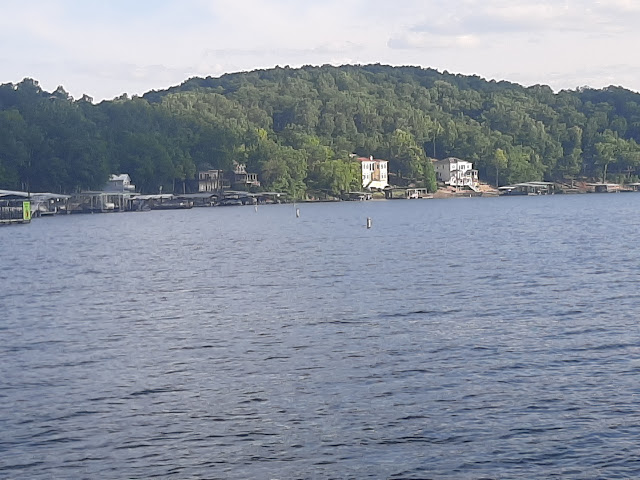
A boater chews up the water near the top of this photo

Sarah and I sat on the docks, watching the waves on the Lake of the Ozarks and listening to birdsong from the forested shore. The floating dock bobbed gently with the waters of Missouri’s largest tourist attraction. With over eleven hundred miles of shoreline, most of it privately owned, Lake of the Ozarks attracts vacationers from the American midlands who want to relax on the water without the time and expense of flying to the coasts.

Then some nincompoop in a pontoon boat shot by at absurd speeds, creating a wake that sent our floating dock reeling. As Sarah gripped her seat with both hands, waiting for the turbulence to subside, she rolled her eyes over at me. “It’s like some people want to be on the water,” she said, in tones of long-suffering patience, “and others want to dominate the water.”

Something in Sarah’s comment struck me as both apropos, and ironically jarring. Lake of the Ozarks is a man-made reservoir, created when the Bagnell Dam stopped the Osage River back in 1931. It exists because the Union Electric Company sought to dominate the water. From our position, perched between lush forested shore and the flat, picturesque water, it’s easy to mistake the lake for “nature,” but its very existence represents human industry and artificiality.

Yet simultaneously, we’re witnessing different reactions. Sarah and I struggle to attune ourselves to the forests, the water, to “nature.” Sure, the lake is artificial, but nature has adapted itself to humankind’s influences, and now we’re adapting ourselves to nature. We bring only our clothes to the shoreline, dangle our feet in the water, and attempt to exist entirely as we are, in this place and moment, without making demands.

Meanwhile, others bring industrial modernity onto the water. Speedboats, water skiers, pontoon boats, and floating party platforms crisscross the water throughout the daylight hours. Most have noisy gas-burning outboard motors; many blast loud rock or country music from elaborate onboard speaker systems. Their passengers want the dopamine hit deriving from bright sunlight, loud sounds, and fast speeds. They consider “nature” a negative space onto which they draw their experiences.

Traditional religions require humans to adjust their mental rhythms away from worldly tempos. Sung hymns, chants, and unison prayers force congregants to slow their mental wavelengths, while silent prayers and mindfulness meditations require congregants to practice sitting still and listening. Traditional religions believe that God, the spirits, or Truth exists at a tempo different from commerce, industry, and work.

Private vacation homes along the shores of the Lake of the Ozarks

Capitalism, by contrast, forces people to accelerate their internal rhythms. Assembly lines, retail outlets, and high-value finance require us to think, speak, and act quickly. This acceleration spills into non-working life. Consider drivers who get onto rural highways and attempt to achieve speeds only possible on the Bonneville Salt Flats. Lake of the Ozarks, at over ninety miles long, lets boaters reach and maintain speeds usually reserved for the open ocean.

This constant, almost Sonic the Hedgehog-like demand that we “Gotta Go Fast” has deleterious consequences. Capitalist America has the world’s highest rates of clinical depression, stress ulcers, and Type-II diabetes. While slowing down wouldn’t magically remove these facts, the tendency to carry our demand for machine-like speed into our off hours and vacations reflects the ways capitalism changes our brains, even when we’re not working.

Meditating in forests and lakes, while pleasant, isn’t necessary to find our inner rhythms. Cities have rhythms, reflected in the ways people walk the streets, and how they stop to converse or shop. London’s or Boston’s notorious winding pedestrian byways bespeak this inner rhythm. Capitalists naturally colonize our cities by sequestering us in hermetically sealed cars, and razing pedestrian-friendly neighborhoods and ethnic enclaves in the name of “urban renewal.”

Watching speedboaters crisscross the lake at absurd speeds, I can’t help wondering whether their “vacations” will return them to workaday life any better prepared for capitalism’s punishing paces. Instead of resting, recovering themselves, and finding their inner rhythms, they’ve dragged modernity’s breakneck industrial pace onto the water. No wonder they’re blasting classic rock from their speakers: despite their numbers, I suspect they’re lonely.

As the boaters’ wake subsided, Sarah and I returned to the rhythm of the water. The smell of rich organic loam filled our noses and permeated our clothes. Birds that had paused in their singing returned, and a cool northeast wind rustled the leaves. “Nature” doesn’t exist, as I’ve written before, but nature always reestablishes balance after humans quit disturbing it. All humans have to do is listen.

Friday, February 10, 2023

The Quest for the Elusive “Fact”

A Montana state Legislature bill floated this week would forbid science teachers in public schools from teaching anything other than “facts.” The bill is doomed to fail for multiple reasons: like North Dakota’s recent attempt to define “gender,” the bill is unenforceable, and has no visible support besides its sponsor. Further, the bill’s language apparently provides no meaningful definition of “facts,” something philosophers of science have debated for generations.

The bill itself is beneath contempt and wouldn’t deserve commentary on its own. But situated in context, alongside the North Dakota gender bill and Florida’s ongoing efforts to purge entire disciplines of “ambiguity,” a pattern becomes visible. One political party wants to engineer an educational system completely devoid of debate, complexity, or doubt. All subjects become lists of facts, answers are either right or wrong, and entire disciplines become foregone conclusions.

Smarter commentators have spilled copious ink over the current right-wing push to ban books and censor classroom discussions. Yet as new fronts in the battle become visible, a pattern emerges. These accusations aren’t directed at any individual fact or discipline, despite the attention paid to science or African American studies. Rather, taken together, they show a desire to produce a generation too uninformed to formulate questions or demonstrate rudimentary curiosity.

This desire makes itself most visible in studying topics where clearly right answers exist. The mass removal of books from Florida classrooms has reportedly swept up anything dealing, even tangentially, with sexuality, religion, and race; baseball icons Roberto Clemente and Jackie Robinson are too controversial for Florida today. But as I’ve noted elsewhere, absolute facts are seldom interesting. Only the controversial dynamics of controversy make facts worthwhile.

Science, including both the physical and social sciences, reveal the importance of controversy. If I drop a baseball, it will fall. This claim isn’t controversial. But why does it fall? Not until Isaac Newton did anybody formulate an answer that withstood scrutiny, without relying on God or a circular claim of “Because it does, duh.” Newton’s theory of gravitation created models which other scientists could replicate, and therefore could verify or disprove. That’s what a theory is.

When legislators reduce science to memorizable facts, they strip science of meaning. We don’t care about science as a description of obviously true events; we care about science because it permits informed and testable predictions. When Newton’s theories accurately forecast the location of the planet Neptune, his theory was considered credible. When his theories inaccurately described the orbit of Mercury, Albert Einstein formulated a new theory.

Anybody who remembers the tedium of grade-school arithmetic “skillz drillz” can easily imagine how stultifying an education based around only facts would be. Especially when those facts come pre-filtered to protect White parents’ tender sensibilities. Without enough knowledge of controversy to test opposing sides, and without enough awareness at times to even realize a controversy exists, students are reduced to memorizing lists, a task kids famously hate.

In other words, an entirely fact-based education seems designed to make kids mentally check out early. Without questions to solve, without patterns to identify, without friction to resolve, students predictably become bored and stop caring. Anything that students can correctly identify on a Scantron sheet, still the hallmark of standardized tests, probably is also boring. As this pervasive boredom slowly overtakes academia, one wonders if this isn’t deliberate.

Although the Montana bill makes science central here, the same principles apply to all topics. Paul Lockhart writes that many freshers enter college thinking they’re good at mathematics, when they’re actually good at following directions. (Replace “good at” with “bad at” where appropriate.) Ron DeSantis’ attempts to whitewash history only make explicit what James Loewen claims has always been implicit in schoolbook history.

Taken together, the pattern emerges: students don’t learn to ask questions. They learn topics only shallowly, reduce all subjects to memorized lists, and mostly forget everything after the standardized test. The system creates deeply incurious graduates who comply with authority simply to make the moment go away. Students emerge perfectly suited for essentially robotic industrial jobs that, ironically, don’t much exist in America anymore.

As a sometime teacher myself, I don’t like these conclusions, but I can’t avoid them either. I remember spending months trying to reignite students’ innate childhood curiosity, but by the time they reached me, the system had already squelched it. Bills and laws like these serve neither teachers nor students. But they do serve to create a permanent underclass of supposedly schooled graduates forever dependent on arbitrary authority.

Wednesday, February 8, 2023

Death of the American Expert

Dr. Steven Hayne giving testimony in an undated photo (source)
This essay is a follow-up to Southern Comfort and Down-Home Injustice

For over a quarter century, Dr. Steven Hayne and Michael West, DDS, made healthy paychecks as “expert witnesses” for Mississippi prosecutors. As Balko and Carrington describe, the two doctors maintained a robust schedule of medical examinations, written and oral testimony, and full-time medical practices. Radley Balko himself has been key in bringing national attention to Hayne and West’s quackery, and the injustice they precipitated.

However, reading Balko and Carrington, I felt distinct discomfort. The authors wrote before the COVID-19 pandemic, which brought dueling definitions of expertise, and high-profile media debates about who to trust. Anti-mask and anti-vaccine advocates used almost exactly the same language to disparage Anthony Fauci as Balko and Carrington use to disparage Steven Hayne. This backs me into a difficult corner regarding how we identify and use experts.

Our authors describe the Daubert standard, the current rule of evidence in American courtrooms, which authorizes judges to determine expertise. Essentially, judges make rulings on whether expert witnesses have sufficient standing in an accredited field to voice opinions that mean anything. This requires opposing counsel to be sufficiently well-informed (and sufficiently lucrative) to actually challenge expertise, and judges to know enough to make such rulings.

However, as we’ve seen since COVID, public officials frequently aren’t sufficiently well-informed to make such decisions. The perception of “scientific consensus” may swing on the Availability Heuristic: that is, if a field like Michael West’s bite-mark analysis gets media attention, judges will know of it, and therefore deem it plausible. Bite-mark analysis helped bring Ted Bundy to justice, and still holds water in courts, but is widely regarded as pseudoscience today.

In Balko and Carrington’s telling, Hayne’s biggest sin was probably maintaining an autopsy and testimony schedule that makes no sense. One autopsy can take four hours, plus weeks of preparation for testimony; but Hayne, at his peak, claimed to complete five or six autopsies per day. The numbers simply strain plausibility.

West, by contrast, apparently invented scientific disciplines from whole cloth. He pioneered an ultraviolet bite-mark identification system that supposedly provided ironclad evidence. However, nobody but West ever successfully replicated his process. Then, his process involved damaging the supposedly already-damaged tissue, ensuring no third party could either verify or dispute West’s findings. Because only West could do it, and nobody could possibly contradict him, his claims were implausibly self-sealing.

Michael West, DDS (Netflix photo)

Without meaningful peer review of Hayne and West’s techniques, they could claim anything, no matter how extravagant. Which, of course, is exactly what Balko and Carrington assert. Hayne and West’s lucrative “expertise” mainly involved courtroom acclamation, not studied give-and-take. In practice, these doctors’ scientific expertise involved oodles of laboratory jargon that mainly served to confuse jurors.

No wonder, when COVID hit America, that so many heel-draggers thought they could answer the Centers for Disease Control with (and I paraphrase) “Nuh-uh!” In this environment, science isn’t a process of inquiry; science is what scientists do. When Anthony Fauci presented steps for preventing disease spread—and importantly, when those prescribed steps changed with new information—his opponents, including the President, challenged his person, not his evidence.

A recurrent social media meme asserts that “if you can’t question it, it isn’t science.” Which is true as far as it goes, but this often reduces to the most ridiculous possible minimum. Popular anti-mask spokespeople, like Judy Mikovits or Stella Immanuel, engaged in fault-finding missions, conflated dissimilar facts to bolster a flimsy narrative, or simply made stuff up. These “questions” were treated seriously by credulous politicians and media giants.

One knock against Fauci was a March 2020 60 Minutes clip where he specifically said mask-wearing wasn’t necessary, at a time when there weren’t enough quality masks to go around. Months later, new information, and more widespread mask availability, led Fauci to endorse mask-wearing. But Facebook and Twitter exhumed that original claim, asserting that Fauci was inconsistent. If a scientist’s claims are inconsistent, his science is disproved, Q.E.D.

Hayne and West emerged from a system wherein expertise was accorded by authority figures, not refined through testing and verification. Courts deemed their statements scientific because they themselves were deemed scientists—and, not coincidentally, because they told state prosecutors whatever they wanted to hear. This wasn’t just bad for individual cases; it redefined “expertise” in ways that privilege individuals over the scientific method.

In that environment, I can’t fault Americans for failing to recognize legitimate science, even when ignorance caused human death. COVID, global warming, and industrial pollution are serious concerns supported by serious evidence. But Americans need responsible individuals to translate that evidence for us, and our credentialed experts act in bad faith. We’re left paying the price.

Monday, November 7, 2022

On Losing and Regaining My Love For Science

Tom Baker as the Fourth Doctor

I first wanted to become a “scientist” in second grade, not long after discovering Doctor Who reruns on PBS. I’m sure it wasn’t a coincidence. The Doctor, then played by Tom Baker, presented himself as a scientist, and frequently expounded on difficult scientific topics in layman’s language to advance the story. But for him, science was a journey, an opportunity to meet new people and have new experiences and, frequently, confront injustice at the root.

Whenever anybody asked grade-school Kevin what he wanted to be when he “grew up,” he continued insisting he wanted to be a “scientist” for years. I read books on science history for kids, which often presented science in metaphor: Louis Pasteur’s early vaccination experiments, for instance, were presented as armed soldiers posting pickets around a weakened body and defending it against an invading army. Science became a source of adventure.

Not until middle grades did I actually study science as a distinct discipline. Then, we began performing “experiments” demonstrating important concepts like, say, the states of matter, the function of liquid capillarity, or the complexity of vertebrate vascular systems. Fun stuff, in isolation. Except we performed each “experiment” one time, and if we didn’t achieve the preordained outcome, we flunked. This “science” was remarkably rote and cheerless.

Where, I wondered, was the adventure which The Doctor encountered, and equally importantly, the moral purpose? We weren’t venturing into unknown countries to gather new evidence and fight the scourge of ignorance that kept entire populations enslaved. We were repeating experiments so crinkum-crankum that the results were absolute. While we individually definitely learned new facts, the facts we learned were vetted and ratified in advance by authority figures.

Before going further, let me emphasize: I don’t blame individual teachers for this. Teachers must face bureaucratic intransigence, work with textbooks pre-approved by those same authority figures, and teach to the test. As Dana Goldstein writes, America’s school systems are organized around cost efficiency, not learning outcomes. Many top-tier teachers resist monolithic book learning, but can only accomplish so much when fighting the system.

Louis Pasteur, discoverer of multiple
medical procedures

But the effect was the same: the sense of moral adventure which Doctor Who promised came sideways against an educational system which only permitted experimental results which were absolutely true. There was no venturing off the map in school science. I now know, as I couldn’t have known in middle school, that this wasn’t accidental. Powerful people, and the legislators they purchase, want all “learning” to result in predictable outcomes which discourage questions.

In my childhood, science was the battlefield to control the public discussion. Important religious leaders actively torpedoed any inquiry which would verify the theory of evolution (and, in some places, still do). Today, that battle has shifted to history, where teachers are required to teach bland myths and scrub history of any ambiguity or fault. In both cases, the underlying philosophy remains unchanged: prevent questions by excluding doubt.

During college, I discovered physics, and felt jolted. Before college, my limited understanding of “science” basically bifurcated into either chemistry or biology, both of which deeply disappointed me. Physics, by contrast, held the same qualities I found in science fiction adventure stories: degrees of uncertainty, reasoning through analogy, and an element of faith. In physics, all explanations are provisional, and failure is embraced in ways high school chemistry rejects.

Had I discovered physics earlier, my life might look different today. Surely some teacher somewhere introduced the discipline, but amid the crush of mandatory points which state boards required them to hit, the information got lost. By college, I’d shifted to literature, the discipline which promised the moral purpose which “science” no longer offered. Also, without a scientific goal, my math scores had languished beyond repair.

Mathematician Paul Lockhart writes about teaching middle-school math by ripping away students’ reliance on absolutely correct answers. When uncertainty becomes common again, students reinvest themselves in the process, and fall in love with learning as an adventure. A history teacher I know does something similar, capping his course with a role-play about rebuilding civilization after an EMP. Doubt becomes central to students’ intellectual investment.

I embraced the idea of “science” in childhood because it seemed bold and adventurous. But by eighth grade, I’d abandoned that ambition because it became tedious and repetitive. Only in adulthood did I discover how that tedium was engineered by powerful people to support their own power. We citizens need to reject the narrative, in any discipline, that questions are bad. Because bad people profit from our lack of answers.

Thursday, October 21, 2021

Belief, Unbelief, and Disbelief

I don’t believe in gravity. Yes, I realize that if I drop my sandwich, it’ll splatter all over my shoes; but that doesn’t require my assent to happen. Equally important, if I refuse my assent, if I actively disbelieve in gravity, my disbelief won’t influence the outcome. My willingness to grant intellectual credence to gravity doesn’t change that rain falls downwards, that planets orbit stars in predictable patterns, and that gravity is constant and calculable.

Right-wing media generation has recently turned heavily toward propagating politics based on “belief,” as in this image. One could make spirited arguments about what “belongs” means regarding Hilary Clinton’s legal culpability, Joe Biden’s health, or Donald Trump’s probity to lead. But this image short-circuits all such arguments by removing them from the domain of evidence, and redefining them as “beliefs.” Nothing has to have truth value anymore, or meet legal definitions; “belief” alone is sufficient.

This isn’t new. Over two years ago, Dr. Ibram Kendi wrote that then-President Donald Trump used “belief” language to exempt himself from evidence-based discussions. Faced with evidence that Earth’s climate is disastrously warming, a conclusion which faces almost no scientific dispute, or that police demonstrably use force against Black Americans disproportionately, Trump responded equally: “No. No. I don’t believe it.” Facts didn’t matter, only his individual belief. Reality, in Trumplandia, required the executive’s personal assent.

Unfortunately for this approach, evidence contradicts belief. Even as the former President vocally disbelieved in global warming or systemic racism, our 24-hour news cycle bombarded us with images of forest fires, withering droughts, crippling economic inequality, and police standing on Black Americans’ throats. Like my hypothetical sandwich, scattered all over my previously shiny Reeboks, this evidence proved that racism and global warming, like gravity, is real, whether I give it my intellectual assent or not.

That’s the problem with belief. We believe when there’s an absence of evidence: we believe that there is, or isn’t, a God, for instance. I find the idea of a sublime and transcendent organizing intelligence more persuasive than the Law of Very Large Numbers. But by definition I don’t know, and neither do you. Sometimes we believe despite evidence: I believe democracy is better than tyranny, but arch-segregationist George Wallace was democratically elected, so… meh.

Perhaps it helps to think religiously. “Faith,” the apostle Paul (or whoever) wrote, “is the substance of things hoped for, the evidence of things not seen.” This means belief in a transcendent source of justice which will repay loyalty someday. But one needn’t have religion to understand this; people with no hope of transcendence believe religiously in concepts like liberty, fairness, and art. We disagree on what these truths mean, but we believe in them.

We don’t, repeat don’t, “believe” facts. Objective, measurable reality isn’t contingent upon our assent: I don’t believe in maps, for instance, I simply trust their authority. Likewise, I have strong opinions about science and technology, but I don’t believe in them, I simply acknowledge that skilled professionals have tested them. Certainly scientists, cartographers, and other experts are sometimes wrong. But experienced critics test their beliefs constantly, ensuring false facts are purged, regardless of others’ beliefs.

We’re witnessing this become truly absurd in our lifetimes. It’s one thing when journalists ask powerful people in decision-making positions whether they “believe in” Keynesian economics, Just War Theory, or God. These are areas where we must make decisions in the absence of verifiable facts. But our politicians get asked, straight-faced, whether they “believe in” global warming, vaccines, resource depletion, and the economic roots of war. That’s literally asking them whether they agree reality exists.

As I was writing this essay, I received news that several Nebraska state senators are petitioning for a special session to “debate” vaccine mandates. One senator, Dave Murman of District 32, claimed that “Despite what has been in the news lately, these particular vaccines have not been approved by the FDA.” Per the FDA’s own website, this is altogether false. Senator Murman, his vision circumscribed by beliefs, officially asserts something that goes against testable reality.

I recall scientists forecasting the disastrous consequences of global warming at least as far back as 1988. In my lifetime, the evidence has gotten only more robust and ironclad. Yet we remain paralyzed from action because some people refuse to “believe” the evidence presented by experts and analysts. They think facts stand waiting for approval. Meanwhile, our democracy, our health, and our planet continue rotting, because like gravity, these facts don’t care about official approval.

Wednesday, September 15, 2021

Some Thoughts On “Do Your Research”

Cast your memory back to the “research” papers you wrote in high school and college. The hours spent in libraries, the days spent reading sources. If your education was anything like mine, you spent precious little time with primary sources and laboratory-grade investigation until you were in graduate school, assuming you went that far. “Research,” for most of us, involved compiling citations from acknowledged experts to create a consensus.

Watching the debate unwind over vaccine “research,” I’m noticing two opinions arise. Those reluctant to trust new and innovative mRNA vaccines have scolded: “Do your research!” By this, they mean searching publicly available sources for evidence which confirms or contradicts the widely accepted narrative. The “research” they exhort resembles high school research papers, which often consisted of compiling lists of expert testimony to support a chosen thesis.

This version of research, of course, suffers because it’s vulnerable to confirmation bias, the tendency to only accept evidence which supports what one already believes. The wide availability of testimony, and low barriers to “expert” status, mean the Internet and cable news are awash in putative evidence for every position. One needs only modest patience and a little “Google-fu” to support any position, no matter how pseudoscientific or outlandish.

Contra this attitude, I’ve witnessed vaccine True Believers insisting that, unless you’ve established a laboratory, conducted double-blind studies, run statistical regressions, and published in a peer-reviewed journal, you haven’t really done “research.” To these people, only original research, conducted in rigorous laboratory conditions, counts for debate. Everyone else should defer to the experts in their respective fields, who have actually studied the topic.

This may alienate fellow Leftists, but I find this attitude dangerous. Beyond the elitist attitude that only those who have research grants and official standing should “do science,” this mirrors other important American trends. Consider legislation written by lawyers, so arcane that only other lawyers can comprehend it. Chances are, your car is currently in violation of some road laws, and you’ll never know unless the police stop you.

I appreciate my fellow Leftists’ desire to assert that one evening browsing Google isn’t serious research, that too many “skeptics” merely seek confirmation for whatever fish-eyed opinion they already have. But the opposite of lousy research isn’t relinquishing everything to credentialed experts and demanding general obedience. We don’t rescue science from the numpties and full-time professional ignoramuses, by decreeing only the chosen few voices really count.

Consider the parallels. We’ve witnessed the damage caused by legislators making laws without consulting the electorate, artists creating art without thought for the audience, theologians making religious pronouncements that alienate hurting souls, and engineers building appliances we mostly don’t want and can’t use. This has given us a blighted atmosphere, bureaucratic intransigence, intractable spiritual malaise, and long, joyless trips to unpleasant theatres and art museums.

Don’t misunderstand me. I appreciate expertise, in its place: if I have a medical emergency, I definitely want a doctor, not some rando off the street. But I’ve also experienced painful and disheartening interactions with doctors who make snap decisions, disregard their patients, and prescribe treatments for illnesses this individual doesn’t actually have. I’ve watched conditions go untreated for years, because experts considered themselves immune to consultation.

Even serious researchers don’t think only new research counts. Universities and laboratories conduct metastudies frequently, because only taken collectively do scientific studies yield insights. As Thomas Kuhn has written, science is the process of discovering new information, but it’s also the process of putting that information in a narrative context. Science is about fact-checking, certainly, but it’s also about story-telling.

“Skeptics” Googling information are only seeking the story that unifies the evidence around them. I agree that they generally accept thin evidence and don’t scrutinize the source. Maybe, when our middle-school teachers assign “research papers,” they need to dedicate a unit to evaluating sources, and not deferring that until graduate school, as happened to me. But barring that, Google researchers just want the narrative that ties everything together.

Certainly, we need better discussions about what constitutes “evidence,” who really is an “expert,” and why “science” sometimes changes its mind. Skeptics make bank harping on minor inconsistencies, or on people reversing track following new evidence, which shows a lack of process understanding. But the solution isn’t telling unbelievers to shut up and obey state-sanctioned authority. This shouldn’t be a choice between ignorance and subservience.

People do their “research” because they want to understand. That deserves respect, not mockery, and they deserve a better class of experts.

Wednesday, July 14, 2021

But What If the Billionaire Spaceships are a GOOD Idea?

The three faces of the Billionaire Space Race: Richard Branson, Jeff Bezos, and Elon Musk

Watching the current Billionaire Space Race, I have multiple reactions. I grew up reading science fiction, so privatized spaceflight isn’t new to me. But depending on whose interpretation you favor, we could be facing a massive dystopian folderol—the position favored by much of Blue Twitter—or the dawning of a new Golden Age. Unfortunately, there’s too much at stake to gamble now.

I remember reading, clear back in the 1980s, thrilling narratives of privatized spaceflight and the potential risks and benefits. Ben Bova springs immediately to mind, though countless other authors whose names I’ve forgotten also addressed the topic. Many saw privatized space travel as a libertarian extravaganza, the opportunity for flourishing human ingenuity. Bova’s Welcome To Moonbase fired my imagination with its ambitious public-private partnership.

Yet I cannot remember this vision, without remembering the other great libertarian space spitball: Star Wars. Though George Lucas depicts an autocratic one-party state, replete with Nazi-fetish costumes and ominously clicking heels, he depicts a remarkably hands-off economy. Darth Vader’s relationships with Lando Calrissian, Boba Fett, and Jabba the Hutt bespeak his galaxy’s defining economic ethos: don’t cross the state, and we’ll let you do whatever you want.

To emphasize the Star Wars economy, consider The Last Jedi, when Finn and Rose visit Canto Bight, the Monte Carlo-like carnival that dominates the movie’s middle third. Finn is initially besotted with public displays of wealth, and almost forgets his mission. Rose sees through the grotesquerie and demonstrates the planet’s moral bankruptcy. The movie not-so-subtly encourages us to see the parallels between that scene, and today’s widespread inequality.

Conventional leftist commentators have carped how today’s Billionaire Space Race proves American and EU capitalists have too damn much money. The three billionaires competing for bragging rights, Elon Musk, Jeff Bezos, and Sir Richard Branson, have so much combined wealth that they could literally defeat world hunger without even noticing the outlay. Why, the commentariat asks, aren’t they competing to accomplish that?

Compelling as this argument seems, I can’t wholly support it. Because of the amortized cost of research and development, many large-scale technological innovations start out prohibitively expensive. Cars, airplanes, television, even the computer or smartphone you’re using to read this essay, were once exclusive playthings of the obscenely wealthy, condemned by populists as dangerous disruptors of good, honest values. The complaints have a redundant quality.

The three faces of the Star Wars economy: Darth Vader, Lando Calrissian, and Boba Fett

Equally importantly, the pressing terrestrial concerns which our Space Racers are purportedly ignoring—global warming, mass poverty, resource depletion, and authoritarian violence—will also be punishingly expensive. Currently, the American and British governments (where our Space Racers live) are bogged in partisan arguments about whether global warming even exists, while huge tracts are literally on fire. Conventional centralized solutions aren’t exactly forthcoming.

During the Cold War, America took pride in its research universities, scientific think tanks, and NASA. We considered spending taxpayer dollars and private grant money on these pursuits worthwhile. Then the Cold War ended, and we changed our minds about science. Capitalists decided they’d rather keep their money, and their pet legislators agreed. Now our economy resembles Bespin, rather than Moonbase.

Changing our economic presumptions would be time-consuming. We didn’t arrive at today’s economy with one tax bill or regulatory scheme, and we won’t fix today that way either. Our Star Wars protagonists didn’t bother fixing Bespin’s economy, and made only symbolic gestures on Canto Bight. Sure, the underlying system was a problem, but it wasn’t what was attempting to kill civilians at that exact moment.

Instead, like President Kennedy did when rallying America around the proposed moonshot, we have the potential to unify world citizens around flashy, high-profile technological wonders, like putting a billionaire on Mars. Perhaps, the spectacle will subsidize the necessary but unsexy quest for other solutions, too. Like how DARPA invented the Internet, and me becoming a blogger was merely a side effect.

Don’t misunderstand me. Trusting and utilizing these billionaires and their private empires might be expedient, but we can’t expect them to deliver us salvation. We have to address our problems, collectively, through economics, philosophy, and the state. Piggybacking our hopes for technological solutions on the Amazon moonshot doesn’t preclude us demanding reforms to our badly broken system.

But, like our parents and grandparents, why not tie this moonshot to other attempted remedies? Things could turn out awful, but things are awful now, and wishing for better background noise is wasteful when we have challenges right here. Maybe everything will turn into Star Wars. But maybe, just maybe, it’ll turn into Moonbase.

Wednesday, September 2, 2020

Denial, and the Comorbidities of Politics


I won’t waste time debunking the bullshit claim that COVID-19 deaths have been inflated, and only six percent of reported deaths are authentic. Smarter critics than me have already done this. I’m more interested in what this denialism says about Americans collectively, that so many people willingly reshare this message. Why are we so reluctant to accept that this disease even exists, much less do anything about it?

Marxist critic Slavoj Žižek compares the global COVID-19 crisis to Elisabeth Kübler-Ross’ celebrated Five Stages of Dying. He postulates on ways we’ve passed through Denial, through Anger and Bargaining, and into Depression. How, he wonders, will society behave when we reach the Acceptance stage? But Žižek apparently overlooks one important point: the stages aren’t sequential. We can slide backward, as the Six Percenters prove we’ve backslid into Denial.

Change is hard. Changing our ways hurts, because our habits are instantiated on our brains, and changing our ways forces us to rewire our bodies, just as exercise rewires our muscles. That's why demanding people do the right thing simply because it’s right, does no good. Because people will continue doing what they do as long as they can, desperate to avoid the pain which change inevitably brings.

In life, as in dying and grief, we work desperately to avoid pain. We keep events as simple and mechanical as possible, letting ourselves think as little as necessary. But COVID-19 rejects that. America currently has a 9/11-level mortality event every two days, and our refusal to act hasn’t made it go away, just kicked the issue down the road. We’re like a patient deferring a cancer diagnosis, refusing to change the ways that made us sick.

I don’t make the cancer comparison lightly. I currently have three friends facing cancer treatment, and have witnessed, at different levels, the pain and indignity which cancer therapies force on patients. Cancer therapies are painful, degrading, and costly, but the cost of doing nothing is mortality. That’s what we’re facing collectively right now: fixing our problems will hurt, probably a lot, but avoidance will cause massive suffering and death.

Like COVID-19, cancer patients suffer comorbidities that hasten death. Looking around, it’s clear America suffers pervasive comorbidities. Racism, like cancer, turns certain parts of our bodies against one another. Likewise climate change, where our shared body, the earth, is developing a fever strong enough to broil out the infectious agent. Like chemotherapy, our various comorbidities are trying to kill us just enough to destroy the infection, and save the body.

President Trump and Dr. Fauci obviously differ on how to face the problem.

That’s why we need systemic change. Like the infected body, we cannot expect one organ to heal itself in isolation, and have it make any difference. We can’t ask individuals to not be racist, while official policies keep disadvantaged populations down. We can’t ask people to think environmentally, while our economy lives and dies based on selling and consuming hydrocarbons. Our entire body is diseased together, and needs systemic treatment.

Because change hurts. Exercise is painful, like education, like chemotherapy. And as individuals avoid cancer diagnosis, or even a prostate or gynecological exam, we collectively have deferred future social pain by avoiding facing our suffering right now. Climate change and racism and pandemic are rampant, but doing anything about them is painful, and always will be. Like an oncologist, we need to force the change, even when it hurts.

Systemic change, though, requires a functional system. Our system is dominated by two parties which effectively avoid problems for literally decades. The Democrats shun meaningful reforms for fear of causing offense, while Republicans tell their emotionally rabid base anything they want to hear. Our elected officials, fearful of losing power, are unwilling to face the near-term pain necessary to prevent the cancer spreading and killing us later.

We’ve heard the words “Constitutional Crisis” ballyhooed so much during the current administration that they’ve become banal. But the collision of racism, state violence, plague, and global warming shows us that our current Constitution, devised for a much smaller nation, just can’t address the problems we have now. We’ve lost the plot because our system no longer works, as we see demonstrated in the streets of Kenosha today.

Our administration’s response to COVID-19 has literally been to deny there’s a problem. That denial, like a patient’s refusal to accept mortality, make is more likely that we’ll die sooner. That’s compounded by our collective denial that the problem runs deeper than one administration. We need to fix the system, before it kills us all.