Showing posts with label philosophy. Show all posts

Thursday, January 8, 2026

Venezuela, and the Death of Old-Fashioned Romance

Deposed Venezuelan President Nicolas Maduro being extradited in handcuffs

You already know that, in the small hours of January 3rd, 2026, American forces invaded Venezuela and arrested President Nicolas Maduro. The situation immediately got worse when Taco Administration spokespeople hinted darkly that this was a test run. Other states, including Cuba and Greenland, are potentially next. This action announces both a disdain for United Nations treaties, and America’s potential withdrawal from NATO.

Three days later, a young Threads user with the sign-on handle “josselocks” posted a query. It read, in part, “Do guys like even talk to girls in real life anymore? Like you see them in bookstore and decide to go up and start a conversation.” The poster’s bio indicates she’s 19, and therefore prime age to search for a spouse or long-term partner, perhaps yearning for the old-fashioned “meet cute” that populates romance novels and romantic comedy movies.

Poor “josselocks” got quickly ratioed. Multiple posters, mostly men, including me, reminded her that a decade of public messaging has asserted that women are sick of unsolicited male attention, and that men shouldn’t approach women unprompted in public places. The discussion was more nuanced, of course. But the consensus held that social mores have shifted, and approaching women in public has become insuperably risky for many men.

These two events seemingly exist in different spheres, a Venn diagram with no overlap. Yet upon consideration, I spotted more going on than my initial, flippant response admitted. These two events represent a breakdown in shared social values that makes trust between strangers possible. With it, this failure of trust threatens more than one country or one big-hearted teenager’s ability to audition a mate. Western civilization is threatened.

I’ve written recently that our understanding of social organization has evolved. Nation-states were once the private property of their monarchs, or whatever warlord could hold the throne against challengers, foreign or domestic. Since the Enlightenment, philosophers have attempted to assign moral purpose to states retrospectively. But these attempts are always provisional, changing, and inconsistent. We agree what role states serve for now.

Less obviously, but more pertinent for daily life, we’ve likewise reevaluated what families are for. No longer do people marry to ensure legitimate inheritance, as medieval aristocrats did, or to bind working families in mutual indebtedness, as peasants did. We choose voluntarily when and whether to marry or procreate. Men choose wives, not for the likelihood of hardy offspring, but because relationships serve moral values and bring emotional satisfaction.

young couple on a date

Families and nations thus serve concrete purposes. These purposes may be economic, moral, social, or whatever, but in organizing societies or households, we start by understanding that all participants agree on that purpose. We needn’t agree on everything constantly, but we at least share core principles. For instance, a relationship might flourish over a love of books. A state might flourish over a commitment to hemispherical peace.

Somehow, too many Americans seem surprised that a President elected on his supposed merits as a billionaire, thinks America should exist to serve billionaires. While we’ve watched Republicans kick the poor for their poverty, and Democrats fold like wet rags, the Taco Administration has invaded an OPEC nation without Congressional authorization. They’ve shown paltry interest in Venezuelan democracy or civil rights, but are aggressively expropriating its oil reserves.

For this Administration, “trust” exists only between the wealthy and the strong. The greatest masses of people, American or international, don’t deserve respect, consideration, or trust. This administration regards poverty protection, labor rights, and public schools as theft from the wealthy, and strength as the only moral imperative. So they’ve deployed troops into their own cities while invading abroad.

This top-level dick-swinging machismo corresponds with the rise of “masculinity influencers” like Andrew Tate, flexing their literal muscles performatively. The entire MeToo movement happened because some men proved themselves untrustworthy. Sure, not all men, but how many does it need to be? But the counter-push has been real: the ubiquity of TikTok “creep-shaming” videos altered the landscape so men can’t trust women who can’t trust men.

Taken together, on the personal and national levels, we’ve created a culture that no longer includes trust. From national borders to personal boundaries, from checks and balances to love and marriage, all our social arrangements have relied on the expectation that we can trust one another to behave honorably without constant supervision. Right now, all around us, in real time, we’re witnessing that trust wither on the vine.

Without that trust, all social philosophy is empty talk, and the experiment of freedom fails.

Wednesday, December 4, 2024

Capitalism and the Winners’ Society

Jeopardyhost Ken Jennings

I just did something I used to do frequently, but haven’t done for years: I watched a full episode of Jeopardy. Television has lost its allure in recent years, and Jeopardy’s appeal to shallow knowledge of inconsistent topics has become an emblem of modern society. Too many people know surface-level flotsam about nearly everything, giving us all a false sense of expertise on topics where we’re profoundly ignorant.

One player, working with speed and confidence, managed to rack up the largest cash haul on the stage, then he hit a Daily Double. He decided to risk it all on a question about corporate ad slogans. Yes, he risked it all--and lost it all. He went from being in the lead, to having nothing.

American capitalism loves winners. I’ve witnessed journalists, economists, and social media stans tripping over their own packers to lavish praise on billionaire CEOs. It’s often unintentionally hilarious to watch White boys without two dimes to rub together, invent phony narratives to explain why Elon Musk, Jeff Bezos, and Mark Zuckerberg are epoch-making geniuses, not just winners of America’s greenback lottery.

Business writers I've reviewed on this blog have lavished praise on society's winners. They will perform seriocomic contortions to justify why, say, Jack Welch or Sam Walton are intrepid adventurers and the epitome of moneyed masculinity. To critics like me, these paragons of capitalism are highway robbers and guttersnipes who hoard the wealth created by others. But their fluttering groupies insist their favorite CEOs generated their wealth by rubbing two sticks together in the woods.

Elon Musk

Among these praises, one seems pointedly recurrent: billionaires deserve their riches because they risked their own seed capital. Risk looms large in billionaire mythology. Michael J. Sandel quotes philosopher Robert Nozick as saying that all wealth is the product of bold risk-taking and unique innovation, the outcome of intrepid individuals who somehow exist in an economic vacuum.

However, even if we accept the risk mythology, it fumbles on one level: we evaluate risks by their success. It's easy to praise Bill Gates or Steve Jobs for their success, when we don't simultaneously evaluate why the founders of Sun Microsystems and Commodore International flopped so ignominiously. When we only look at those who risked and won, it's easy to think risk leads to reward.

But for every world-renowned success, there are uncountable failures. Eighty percent of American companies fail within five years. A handful of actors become million-dollar stars, but most limp along on day jobs before leaving the industry altogether. For every Facebook, there's a bloodbath of MySpaces, Geocities, and Friendsters. Failure, not success, is the usual outcome for risky courage.

Watching Jeopardy, that one player who lost everything didn't give up. He slowly won back the money he lost, then in Final Jeopardy, gambled everything again. He turned out to be the only player to recognize a question about Dashiell Hammett, and finished the game with almost four times as much as the second-place finisher. In under thirty TV minutes, he went from wearing egg on his face, to becoming the reigning champion.

Bill Gates

But that outcome wasn't inevitable. He won, not only because of his own wide-ranging knowledge, but because the rules called a halt to the game before he had a chance to lose everything again. He benefited from writers who corresponded with his backlog of trivia knowledge. And he handled the buzzer effectively--something many past players have said isn't easy.

When Elon Musk and his giddy evangelists call him a self-made billionaire, they overlook the environment that created his wealth. As Giblin and Doctorow write, the monopsony economy that makes Musk's companies possible results from public policy and social order. Regulations written to prevent past economic abuses, become barriers to entry for small start-up entrepreneurs. Inequality festers unchecked.

This doesn't mean risk-takers don't deserve reward. Musk, Bezos, Gates, and others did indeed risk their, or their investors’, seed capital, and could've eaten dust. But that doesn't mean they work alone. They used others’ skills, labor, and time. They benefited from technicians trained in state schools. Many, like Musk, received direct government subsidies to offset the costs which their risks carried.

American rhetoric in support of capitalism emphasizes the goodness of taking a risk. But in practice, our economy doesn't reward those who take a risk, but those who win. And victory is always socially conditioned. Success means what customers pay for, not what billionaires prefer. There's literally no difference between Microsoft and Sun Microsystems, except that one guessed right.

Wednesday, August 14, 2024

Introduction to the Psychology of Doing

1001 Books To Read Before Your Kindle Battery Dies, Part 119
Victor E. Frankl, Man's Search For Meaning

Austrian psychologist Victor Emil Frankl spent three years in German concentration camps, mostly Dachau. His survival sometimes depended, by his own admission, on blind luck and circumstance. But he also witnessed something perplexing: some people survived, while others surrendered, dying long before the Gestapo executed them. What made some people persevere, and others die before they died?

Frankl divides this volume into three sections. The first is his memoir of the labor camps, a single exhaustive narrative undivided into chapters or other smaller, more digestible segments. Like Frankl, we must consume the experience without guidance, an exercise in existential absurdity. Frankl quotes generously from Kierkegaard and Nietzsche, emphasizing that survival comes from meaning, and meaning comes from one’s interior mental landscape, not from outside.

The second section provides a plain-language introduction to “logotherapy,” Frankl’s version of psychotherapy. Opposed to fellow Viennese psychologist Sigmund Freud, who believed healing came from resolving past conflicts, Frankl finds healing in the future, in giving patients something to live for, something to work toward. Frankl believes meaning doesn’t exist objectively, within either the world or the self, but is something people make, sometimes at great cost.

His third, and shortest, section is a lecture revising and updating his therapeutic approach with new discoveries made in the 1970s and early 1980s.

According to Frankl, humans find meaning, and therefore something to live for, when they see something to strive after in the world. For him, this means either work or relationships. (I say “relationships” where Frankl says “love,” but a century of pop songs has tainted that word.) Meaning comes not from some list of principles, but from the work we do and the people we care about. This, for Frankl, is highly existentialist, in the Kierkegaardian sense.

Thus Frankl’s philosophy harbors a contradiction. We create meaning internally, but we create it outside ourselves, in our actions and relationships. Viewed another way, meaning is necessary, but it doesn’t objectively exist; it dwells in the realm of Platonic ideals. Though Frankl isn’t hostile to religion (and was, by reports, an observant but private Jew), his philosophy doesn’t require subsuming oneself into an external God. Meaning is, and isn’t, in the material world..

Victor E. Frankl

Calling this “philosophy” isn’t accidental. Frankl utilizes the scope of Western philosophy, but through a medical scientist’s eyes. Though his autobiographical section describes how he tested and defined his philosophy in the violent laboratory of Dachau, his therapeutic section contains practical applications, mostly questions for patients to ponder. Frankl doesn’t demand a closed loop, but neither does he require every student to reinvent philosophy, as Plato does.

Perhaps most importantly, his philosophy steers us away from abstractions and buzzwords. We don’t find happiness by seeking happiness, Frankl writes, nor do we find healing by seeking healing. Rather, we find both by seeking something that gives our lives definition; happiness and healing are ancillary benefits of meaning. And again, meaning comes either from doing productive work, or pursuing nurturing relationships.

The points Frankl makes in technical terms in his second section, he demonstrates in practice in his first section. He survived the labor camps because he had a wife waiting and research to complete. (His wife died in another camp, but he didn’t know that for years.) Others survived because they had art to create, children to raise, or houses to build. Those who survived believed they had something waiting outside, and strove to remain connected with it.

Admittedly, Frankl’s narrative has garnered criticism. Historians dispute his labor camp memoir as somewhat fictionalized, as though no autobiographer ever streamlined events for clarity and readability. More fair are criticisms directed at specific details. Frankl repeatedly describes Auschwitz as though he faced extended internment there, though it was merely a layover; he mostly stayed at Dachau. This is slovenly and misleading, but doesn’t undo his message.

More important is the contrast between internal psychological meaning, and external nihilism. From King Solomon to Jean-Paul Sartre, thinkers have agreed that this world is chaotic, violent, and antithetical to human wellbeing. Yet like those thinkers, Frankl agrees we have control over only our own responses. We must at accordingly.

Victor Frankl wrote multiple volumes on the process of finding and making meaning. But this brief, plain-language book contains probably the most accessible and most widely read introduction for non-psychologists. He proffers a useful guide for finding meaning in a world suffused with despair. Only in seeking meaning through work or relationship, he contends, do we find happiness and healing within ourselves.

Monday, May 6, 2024

The Matrix and the Messianic Lie

Much of the advance publicity surrounding The Matrix Resurrections focused on Act One’s satirical nature. The movie mocked the production house, Warner Bros., by name, for their demand for a lucrative sequel, whether the art demanded it or not. Warner, in a remarkable show of grace, leaned into that mockery and included it in the PR packet. Sounds cool, I remember thinking, but not compelling; I’ll wait for home video.

Now that it’s streaming, I find myself struck by what the PR omitted: a much more fatalistic tone, admitting that the original trilogy’s prophecies fell flat. The original movie remains relevant and talked-about a quarter century after its release, but its messianic promise of deliverance from corporatized autocracy seems naïve now. We haven’t escaped the machine, this movie warns us. If anything, it’s stronger now than it appeared in 1999.

The movie begins with Neo, having returned to his pre-liberation name of Thomas, working a soulless corporate job, like he did in the first movie. Instead of toiling in the anonymous cube farm, however, he now occupies the corner office, and has personal confabs with the corporate straw-boss. But he’s profoundly dissatisfied, treating his malaise by chronically overdosing psychiatric medications. Then word comes that Warner wants a sequel.

Fans embraced the first movie for two defining characteristics: cutting-edge visual effects, and long, maundering philosophical monologues. We who are old enough to remember the first movie, without the historical baggage that followed thereafter, probably remember feeling almost vindicated by the Wachowskis’ take on the decade between the Cold War and 9/11. That decade was slick, shiny, and frequently fun, but also stultifyingly boring in its safety.

Thereafter, some aspects of the first movie seemed downright prophetic. Scenes of urban destruction and gun violence looked eerily like footage of both 9/11 and the War on Terror. It’s hard to watch Neo and Trinity piloting a helicopter gunship into a skyscraper, without remembering the street-to-street fighting of the Siege of Fallujah. The videogame-like violence would become only worse as footage of American drone strikes became cable news fodder.

Unfortunately, if the first movie evidently recognized the boredom of safety, and the violence which boredom begets, the sequels fell flat. They pushed heavily on images of neo as messianic deliverer, whose unique person promises to challenge the system. As Agent Smith increasingly possesses everyone and everything, remaking the Matrix in his self-serving image, the movie promises that Neo, operating alone, will reset the changes and release the captives.

Christians worldwide have, certainly, believed their singular messiah would bring that promised deliverance. But often, instead of acting boldly in trust that Christ would vindicate the just, Christians used the promise of future deliverance to sit idly by, expecting Jesus to fix everything. Christians tolerated, if not outright participated in, war, slavery, exploitation, and empire. Molding ourselves to the world is okay, if the Messiah will triumph eventually.

Mass media in the post-Matrix decades has embraced the Chosen One myth. Rey Skywalker, Captain America, Katniss Everdeen, and even Keanu Reeves’ own John Wick have raced headlong into pits of vipers which seems insuperably large, and emerged triumphant. Despite occasional interludes, like the cinematic Les Misérables, American corporate media keeps promising a singular messiah that will redeem us from… well, from America, mostly.

Meanwhile, The Matrix Resurrections acknowledges directly that conditions have gotten worse. English-speaking conservative parties repeatedly promise to actively make oppression more oppressive, while progressive parties limply pledge that, under their supervision, things won’t get much worse. War, disease, and poverty have gotten worse, not better, since 1999. As Ian Haney López writes, the machinery of oppression proves infinitely capable of adapting to every direct challenge.

This movie takes that adaptability literally. A machine learning heuristic seizes the heroes that previously challenged the Matrix, and turns them into the Matrix’s driving engines. It uses the very human embodiment of justice to fuel injustice—shades of Republicans appropriating one orphan MLK quote to proclaim themselves the real arbiters of fairness. This movie admits that we who believe in freedom must adapt faster than the oppressors.

Hovering over San Francisco streets, Neo realizes something the original trilogy missed: if he hoards the power of salvation, then he’s already failed. The messianic impulse may begin with one individual, but unless it radiates outward, unless others join the kingdom as priests and kings themselves, messianic deliverance will never arrive. Humans, even messiahs, eventually die. The final shot abjures the sequels, and restores the “we”-centered salvation the first movie promised.

Monday, November 6, 2023

Free Will, Determinism, and Time Travel Fiction

DC Iris Maplewood discovers one of the titular bodies in Netflix's Bodies

Something about science fiction makes writers feel compelled to break down the story’s speculative core somewhere around the halfway mark. Though Obi-Wan Kenobi introduces Luke to the Force early, halfway is when he explains its principles of mindfulness and flow. Similarly, though Kyle Reese has introduced Sarah Connor to his dystopian future, only around the halfway mark does he explain it to Dr. Silberman in any detail. Same applies to Netflix’s recent limited series, Bodies.

In episode four (of eight), the breakdown comes in two increments. First, we witness physicist Gabriel Defoe’s (Tom Mothersdale) lecture summation, describing the hypothetical Deutsche Particle, which simultaneously exists forward and backward in time. Later, speaking privately with Detective Constable Iris Maplewood (Shira Haas), Defoe extrapolates that, if the future already exists, free will is illusory. Maplewood demurs. Though structurally, Bodies is a police procedural, this science fiction rumination of liberty drives the series premise.

Recent philosophy has seen the resurgence of a previously endangered idea: determinism. Medieval Thomist philosophy contended that everything which happens in the material world has a prior cause. Yet every cause is, itself, an effect of a prior cause. Thus, reality exists in a causal chain descending through history to what Thomists call the First Cause. As Christians grounded in Aristotelean philosophy, Thomists correlated this First Cause with God, who set all reality in motion.

Determinism, this belief that all reality was set in predeterminate motion at the moment of creation, came under conflict during the Reformation, when many reformers contended that humans have the capacity, within our sensory limits, to accept or reject God. (Replace “God” with “philosophy” if that streamlines your thinking.) Reformers called this capacity “free will.” By the Enlightenment, free will became the operant European philosophy, mutatis mutandis, and arguable remains so through to the present.

Free will has recently come under fire from prominent atheists and sceptics. John Gray and Sam Harris are probably the most prominent, but an entire subthread of philosophy of science contends that free will is an illusion. Because our choices are conditioned by outside events and circumstances, most of which we cannot possibly comprehend, choice therefore isn’t real. (It’s more complicated than that, but bear with me.) This philosophy has limited traction outside narrow circles.

Sarah Connor (Linda Hamilton) and Kyle Reese (Michael Biehn)
near the culmination of their journey, in The Terminator

Okay, our choices are conditioned; anybody who’s had a job or otherwise interacted with complex human society will accept this. But to what degree are our choices determined? Philosophers consistently fail to close this gap. In Bodies, Defoe himself leaps that gap, even within himself; though he argues verbally that our choices are determined, we discover, eventually, that he attempts to change their conditions. (No spoilers; this is about Bodies’ philosophy, not its story.)

In the early seasons of the resurrected Doctor Who in the mid-2000s, the Doctor avoided intervening in history with two arguments. Sometimes he couldn’t revisit preceding actions, claiming that “we’re part of events now.” (This was mainly the Tenth Doctor, who couldn’t stomach contradictions or paradox. The Eleventh Doctor actively sought paradox.) Other times he claimed “a fixed point in time,” something so important that, even if it was terrible, intervening would create something far worse.

James Cameron’s first Terminator movie ends withSarah Connor’s realization that, though she and Reese defeated the monster, the monster’s creation was inevitable. Time, in the first movie, is circular, and attempts to alter it instead create it. But Cameron couldn’t stomach that forever, and reversed himself in the second movie. History can change; no fate but what we make. Cameron, like Bodies, initially accepts that we’re trapped in a causal loop, but finally resists such fatalism.

Thus, time travel fiction manifests a recurrent theme: history is contingent, without necessarily being inevitable. Just because events occurred in a certain way, doesn’t mean they had to occur that way. We cannot always know what contingencies define our actions, and some contingencies we can never know. Yet that doesn’t mean our choices are determined. Humans aren’t inevitable products of physics. We have the unique capacity to pause, think, and change our minds.

Bodies is, essentially, an allegory of the human capability to change our minds. Professor Defoe’s lecture on determinism stems from the assumption that, because time exists both forward and backward, the entire past and future already exist in fixed forms. But DC Maplewood realizes, as James Gleick has written elsewhere, that the laws of physics are a description of reality, not reality itself. We can accept our contingencies, she reveals, without our contingencies owning us.

Thursday, June 22, 2023

The Human Desire to Dominate Nature

A boater chews up the water near the top of this photo

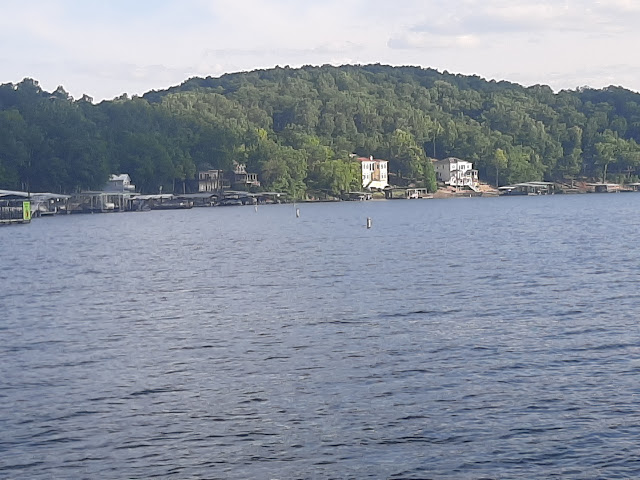
Sarah and I sat on the docks, watching the waves on the Lake of the Ozarks and listening to birdsong from the forested shore. The floating dock bobbed gently with the waters of Missouri’s largest tourist attraction. With over eleven hundred miles of shoreline, most of it privately owned, Lake of the Ozarks attracts vacationers from the American midlands who want to relax on the water without the time and expense of flying to the coasts.

Then some nincompoop in a pontoon boat shot by at absurd speeds, creating a wake that sent our floating dock reeling. As Sarah gripped her seat with both hands, waiting for the turbulence to subside, she rolled her eyes over at me. “It’s like some people want to be on the water,” she said, in tones of long-suffering patience, “and others want to dominate the water.”

Something in Sarah’s comment struck me as both apropos, and ironically jarring. Lake of the Ozarks is a man-made reservoir, created when the Bagnell Dam stopped the Osage River back in 1931. It exists because the Union Electric Company sought to dominate the water. From our position, perched between lush forested shore and the flat, picturesque water, it’s easy to mistake the lake for “nature,” but its very existence represents human industry and artificiality.

Yet simultaneously, we’re witnessing different reactions. Sarah and I struggle to attune ourselves to the forests, the water, to “nature.” Sure, the lake is artificial, but nature has adapted itself to humankind’s influences, and now we’re adapting ourselves to nature. We bring only our clothes to the shoreline, dangle our feet in the water, and attempt to exist entirely as we are, in this place and moment, without making demands.

Meanwhile, others bring industrial modernity onto the water. Speedboats, water skiers, pontoon boats, and floating party platforms crisscross the water throughout the daylight hours. Most have noisy gas-burning outboard motors; many blast loud rock or country music from elaborate onboard speaker systems. Their passengers want the dopamine hit deriving from bright sunlight, loud sounds, and fast speeds. They consider “nature” a negative space onto which they draw their experiences.

Traditional religions require humans to adjust their mental rhythms away from worldly tempos. Sung hymns, chants, and unison prayers force congregants to slow their mental wavelengths, while silent prayers and mindfulness meditations require congregants to practice sitting still and listening. Traditional religions believe that God, the spirits, or Truth exists at a tempo different from commerce, industry, and work.

Private vacation homes along the shores of the Lake of the Ozarks

Capitalism, by contrast, forces people to accelerate their internal rhythms. Assembly lines, retail outlets, and high-value finance require us to think, speak, and act quickly. This acceleration spills into non-working life. Consider drivers who get onto rural highways and attempt to achieve speeds only possible on the Bonneville Salt Flats. Lake of the Ozarks, at over ninety miles long, lets boaters reach and maintain speeds usually reserved for the open ocean.

This constant, almost Sonic the Hedgehog-like demand that we “Gotta Go Fast” has deleterious consequences. Capitalist America has the world’s highest rates of clinical depression, stress ulcers, and Type-II diabetes. While slowing down wouldn’t magically remove these facts, the tendency to carry our demand for machine-like speed into our off hours and vacations reflects the ways capitalism changes our brains, even when we’re not working.

Meditating in forests and lakes, while pleasant, isn’t necessary to find our inner rhythms. Cities have rhythms, reflected in the ways people walk the streets, and how they stop to converse or shop. London’s or Boston’s notorious winding pedestrian byways bespeak this inner rhythm. Capitalists naturally colonize our cities by sequestering us in hermetically sealed cars, and razing pedestrian-friendly neighborhoods and ethnic enclaves in the name of “urban renewal.”

Watching speedboaters crisscross the lake at absurd speeds, I can’t help wondering whether their “vacations” will return them to workaday life any better prepared for capitalism’s punishing paces. Instead of resting, recovering themselves, and finding their inner rhythms, they’ve dragged modernity’s breakneck industrial pace onto the water. No wonder they’re blasting classic rock from their speakers: despite their numbers, I suspect they’re lonely.

As the boaters’ wake subsided, Sarah and I returned to the rhythm of the water. The smell of rich organic loam filled our noses and permeated our clothes. Birds that had paused in their singing returned, and a cool northeast wind rustled the leaves. “Nature” doesn’t exist, as I’ve written before, but nature always reestablishes balance after humans quit disturbing it. All humans have to do is listen.

Friday, February 3, 2023

What Marie Kondo Means To Me

Marie Kondo (Netflix photo)

The internet collectively lost its mind last week at the revelation that home management guru Marie Kondo has largely abandoned tidying up. Now a mother of three, Kondo simply has other priorities. The online response has been an embarrassing pile-on, in which I bashfully admit I participated. Millions worldwide felt validated by the revelation that Kondo’s household management strategy doesn’t work if you have kids, a job, or a life.

Now the heat of excitement has largely dissipated, I’d like to consider what Kondo’s admission really means. Because I don’t think it means we have permission to live sloppy, chaotic lives. Though I can’t confirm it, I’d imagine that the messiest parts of Kondo’s apartment probably look more orderly than the cleanest parts of my bachelor pad. She practiced habits of cleanliness long before real life derailed that ethic.

We humans enjoy seeing the mighty brought low. The public schadenfreude demonstrated whenever Elon Musk finds another way to mismanage Twitter is just one current example. We feel gratified knowing “the great” are fragile like us. Unfortunately, I know something about falling short of goals. As a Christian, an American, and a progressive, I’m a member of several groups that are historically bad at living up to our own standards.

Rhetoricians speak of the “Fundamental Attribution Error,” a fallacy of informal logic. Briefly put, we assume our own misbehavior is a consequence of circumstances, but we assume other people’s misbehavior stems from their personality. When I personally fail to uphold my voiced values—my religious morals, intellectual standards, or just proper etiquette—I’ll tend to blame something outside myself. But when someone else fails, they’re personally culpable.

I see something similar happening with Marie Kondo currently. People who previously rushed to defend themselves against criticism for haphazard housekeeping because they have demanding jobs, small children, or whatever, now see Kondo having to schedule her life around her kids, and construing it as a failure of her philosophy. People who would never blame their politics or religion for their own failings, cast the same aspersions on Kondo.

But I’d contend that no philosophy ever encompasses every possible circumstance. The entire point of Marie Kondo’s tidying philosophy wasn’t to live permanently inside a Better Homes & Gardens display; it was to practice in moments of limited pressure, training yourself how to think. Because when the pressure hits, when you have kids demanding your time and attention, it’ll be too late to learn how to maintain your house.

Previous moral scandals have erupted because people thought their religion or philosophy protected them from failure. Famed televangelist Jimmy Swaggart preached against sexual indiscretion, then got caught with a hooker. Swaggart wept on television, pleaded for believers’ forgiveness, and then… got caught with another hooker. Because he believed his faith didn’t just direct him from sin, he believed it made him invulnerable to sin.

Other examples accumulate. We know teenagers who sign “virginity pledges” are no less likely than the general population to actually have premarital sex. However, because they believe they’re morally immune to premarital sex, they’re less likely to have birth control available when it actually happens. Because these teenagers didn’t practice their moral responses in low-pressure conditions, they had no response when the pressure was on.

Paging Bristol Palin, stat.

Moral philosophies, whether Christianity or pragmatism or Marie Kondo’s systematic cleanliness, aren’t intended to last forever. One doesn’t rest on moral accomplishments like a fat puppy. Rather, we need to exercise our moral positions in safe environments of controlled pressure, just as athletes practice weight training in the gym between bouts on the field. Practice doesn’t make perfect; rather, I’d say that practice makes prepared.

Permit me to overextend the athletic metaphor. Anybody who’s worked out knows the person able to lift the heaviest gym weights isn’t necessarily the strongest person. Rather, somebody with practiced form and moderate strength can outlift somebody with sloppy form and great strength. That’s what Marie Kondo, and other philosophers, should offer us: not strength, but form. Because we still have form even when our strength inevitably fails us.

We haven’t seen Marie Kondo’s post-kids house. But I’d bet money that we’d enter and, while she blushed and apologized for the mess, we’d gawk at nearly everything in its place and free of dust. Because through years of practice, she’s learned the habits of making good decisions about what to keep or discard. She knows what she values. And unlike us, she knows the right way to get it.

Monday, January 30, 2023

Humanity as a Man-Made Phenomenon

James Paul Gee, What Is a Human?: Language, Mind, and Culture

Like “freedom” or “democracy,” most people think we have a working definition of “humanity” in our heads, and it works adequately most of the time. But this loosey-goosey approach to human essentialism has caused negative outcomes throughout history. War and slavery have let powerful people strip the social designations of humanity from strangers, while belief in human exceptionalism currently threatens humanity’s very existence through anthropogenic climate change.

In his youth, James Paul Gee initially trained for the priesthood, but after losing his faith, he earned a Ph.D. in linguistics. This duality probably influenced the interdisciplinary nature of his subsequent activities, such as the tacitly public nature of literacy, or the social interpretation of video games. This book, written as Gee retired from active academia shortly before the pandemic, is the culmination of his life’s work.

Gee identifies human nature through a balance of extremes. Each human is utterly unique, he writes, but unique human attributes manifest themselves mainly through social context. Therefore we are separate, circumscribed by the limits of our senses in the world, but we’re never truly separate, as we rely utterly on relationships with other humans and the natural world. We lack “free will,” a sludgy and imprecise term, but that lack doesn’t justify determinism.

Past attempts to define humanity have fallen down on the lack of nuance inherent in brevity. Recall Plato defining a human as a “featherless biped,” and Diogenes responding by brandishing a plucked chicken. Gee makes no such mistake here. His definition of humanity sprawls over 200 pages, sometimes narrowly focused on precise scientific outcomes, other times expanding to encompass philosophic maunderings and autobiographical anecdotes. Brevity isn’t Gee’s weakness.

Humans, to Gee, exist in community; he uses termite mounds as his metaphor (sometimes stretched to breaking). Obviously we rely upon others to divide labor, collaborate on labor, and amplify our thought processes. But we don’t just exist in community; we are ourselves communities, what Gee calls “transacting swarms,” made up of our microbiomes and our relationship with the earth. We live in termite mounds, and we are termite mounds.

James Paul Gee

But Gee distrusts the mechanistic materialism of Richard Dawkins and Daniel Dennett. Just as humans have organic biomes, we have “spiritomes,” the complex nest of spiritual realities in which humans dwell, individually and collectively. Though Gee, a lapsed Catholic, flinches from capital-T Truth claims, he believes human spiritual subjectivity is real enough to matter in making life-altering decisions. We all have relationships with evidently noncorporeal realities.

To this point, Gee’s thesis draws heavily on research from other thinkers academically grounded in the physical sciences. Not surprisingly, as a linguist, Gee’s anthropology becomes most dense and detailed when discussing how language shapes the human mental structure. Gee admits coming from a Chomskian generative linguistic background—fascinating but often abstruse. But exactly how his linguistic background shapes humans may surprise you.

Gee admits never reading poetry until after achieving his doctorate. How he studied linguistics without at least a historical survey of poetic metaphor eludes me, but whatever. Gee waxes rhapsodic about what a revelation it was discovering poetry in adulthood, unclouded by state-school “skillz drillz.” The unsullied joy he describes bespeaks a wonder that we who still read poetry often struggle to recapture. I’m downright jealous.

Despite his sometimes scientistic mindset, the humanities offer Gee’s greatest insight into the relationship between our outside, communal world, and the strictly internal neural landscape of senses and higher reasoning. We perceive the world according to our senses, and also according to our ability to describe it to others. His lavish fondness for poetry, especially Emily Dickinson, bespeaks a worldview in which subjectivity isn’t a weakness, but a defining trait.

To his credit, Gee doesn’t pretend his definition is more binding or global than it actually is. He acknowledges that any definition of humanity is provisional and circumscribed by the author’s background and prior knowledge. His language is colored by nuance and the frequent need to walk a tightrope between seemingly contradictory positions. He invites informed readers to challenge and refine his definition of humanity; he doesn’t just stand pat.

Now past seventy, Gee clearly writes with one eye angled toward how posterity will remember him. He clearly intends this volume as a capstone of his academic career. He finished writing in the months leading up to the pandemic, and one wonders how this book might’ve looked just six months later. Yet as a prolegomenon to future humanistic studies, Gee offers an exciting, readable, and purely joyful philosophic consideration.

Wednesday, December 14, 2022

Hello Darkness, My Old Friend

When I was a kid, I was afraid of the dark, as kids frequently are. My father sneered at this fear and refused to give me a nightlight. “There’s nothing there in the dark that isn’t there in the light,” he declared, insisting this ended the discussion. I asked him to prove this; he did so by turning on the light. The disjunction there apparently never occurred to him.

Back in 2019, short-story writer Amber Sparks wrote an engaging essay about the recent rise in credence given to magical thinking, particularly among women. If astrology, divination, and Wicca aren’t more popular lately, they’re certainly more talked about. To Sparks, scientistic thinking is an outreach arm of the patriarchy. Magical thinking may not necessarily be “true,” but to Sparks, it empowers the chronically disenfranchised, and that’s what matters.

Thinking about fear of darkness, I see a more literal manifestation of this exact premise. Fear of darkness is common among those who lack power in our society. This may mean metaphorical power: children and the poor, for whom being out of sight of others makes them vulnerable to abuse. I’ve also seen paralyzing fear of darkness among well-off adults who’ve been subject to violence, especially relationship violence.

But absence of power can be more literal, too. Without electric light, the night swarms with forces eager to kill you, or anyway cause you harm. Ordinary able-bodied humans receive the largest fraction of information about the world through our eyes, which don’t work in the dark. Without light, the night could be riddled with wolves, bats, bears, and more. Campfires aren’t only for warmth; they keep predators away, too.

Amber Sparks (see also)

Think about it: fear of darkness is most aggressively sneered at by people with access to light. Adults subject ourselves to degrading work conditions to keep the electric bill paid. City dwellers flood every corner of their communities with light. We frown-ups punish children for being afraid of the dark, but permit darkness into our lives only under controlled circumstances; I can’t rise to pee at midnight without turning numerous lights on.

Amber Sparks notes accurately that, for most people, most of the time, scientific truths don’t matter much. “Knowing about how a hand moves doesn’t stop it from covering your mouth.” The same applies to darkness. I know, intellectually, that darkness doesn’t invite monsters into my closet. But only shining light into dark corners proves that definitively. My father turned on the light to prove darkness wasn’t scary, apparently without irony.

Because, seriously, maybe there’s nothing present in the darkness that isn’t there when you turn the light on. But without light, how would you know? Even inside my own house, with modern central climate control and light, I’ve ventured out without turning the light on and stepped on prickly burs, cat barf, and a garter snake that got inside somehow. Darkness didn’t put them there, but it caused me to find them with my feet.

Modernist thinking tells us that science, reason, and limitless electric light have banished fears of darkness, fears they call superstition. Neither the wolves of the primordial forest, nor the demons of medieval folklore, can withstand modernity and its intellect. If we simply swallow our base animal fears, and live in the glorious light of modernity, we have nothing to fear. Wisdom, reason, and manmade light rebound everywhere.

Except we know that modernity’s benefits haven’t been distributed equally. Modernism has traveled hand-in-glove with patriarchy, racism, and war. The German pogroms in Poland, and Soviet pogroms in Ukraine, demonstrate how those who think of themselves as thoroughly hip and modern are willing to inflict massive devastation on poor and powerless peoples in order to continue propagating their diseased vision of modernity.

Nearly three years ago, I spent one night trapped in darkness and cold beside a rural Nebraska highway. Afterward, I waxed rhapsodic about my various insights, because I had nothing but my brain for company. But then, I returned to modernity, to electric light and central heat, and within days, forgot nearly everything I’d learned. I resumed abasing myself before my boss, to avoid spending another night in the dark.

My message being: fear of darkness is natural, even good. Just as Amber Sparks claims magical thinking empowers women amid patriarchy, fear of darkness empowers the poor. Those who would chastise your fear, are the same people who’d demand your subservience to capitalist hierarchies, and that isn’t coincidental. Fear is your source of power; don’t let “them” steal it.

Wednesday, December 7, 2022

Digital Art and Human Development

Art produced by Dall-E (my collection)

Friends widely embraced the Lensa AI art app this week for one simple reason: it could create faces. This year has seen remarkable advances in computer-drawn art, beginning with Dall-E, which took social media by storm this summer. But Dall-E couldn’t draw faces. Human likenesses came out pinched, distorted, with nightmarish proportions. Dall-E’s immediate successor, Midjourney, did better faces, but they were cartoon-like and whimsical.

Lensa, by contrast, could read users’ selfies, and the program could return artistic renderings. Though the pictures aren’t yet realistic, the computer was capable of making value choices which presented finished portraits that emphasized certain features like trained artists would. My friends uploaded their selfies, knowing they were relinquishing rights to a massive AI clip-art pool, because the reward was painterly renderings of themselves as wizards, spacemen, and cats.

Pushback began almost immediately. Not only did Lensa pinch your uploaded images, the claims read, but it also pinched legitimate artists’ hand-made work. The app created painterly renderings because it modeled itself on actual painters, the techniques they used, the decisions they made. AI programs are already putting human artists out of work, though not yet in huge numbers. The ethics were already creating headaches, and it’s likely to get worse.

I’d like to focus on a different ethical consideration. Yes, the human economic challenge is serious: just as American industrial jobs moved to Japan and China, where labor was cheaper and supply lines were shorter, AI art is likely to displace human artists because the renderings are nearly instantaneous. People are unlikely to pay more for slower human-made art just because doing so is right. But the problem begins much earlier than the point of sale.

Art produced by Midjourney
(Wikimedia Commons)

Many schools begin teaching art in preschool. We teach children to draw with charcoal and Conte crayon, to play “Alouette” on a plastic recorder, and to sing in unison, because these represent important developmental milestones. Art and music teach children important skills of hand-eye coordination, the ability to sit still, and patient dedication to tasks where the reward isn’t always immediately obvious. Children need all these skills in multiple disciplines.

As I’ve gotten older, though, and spent time on both sides of the classroom, I’ve realized students learn even more from art. When drawing, students learn what to include, and what to omit. The entire process begins by reducing the forms we’re rendering—landscapes, buildings, human bodies—to a few essential lines. Then the artist makes choices about which shapes, colors, and textures to incorporate. These are important value choices.

Anybody who’s witnessed the products of a freshman life-drawing class knows that a roomful of art students will produce very different images of one model. Photographers may get slightly different images from the same model, depending on choices like shutter speed, angle, light saturation, and Photoshop aftereffects. But human artists, looking at the same model, can produce wildly divergent paintings of the same base human form.

These choices are subjective, but not value-neutral. The proportions of the human form, like the proportions of musical notes in a composition, have mathematical relationships, and artists make choices about how much they value harmony, synchrony, and continuity. These choices speak to the artist’s inner process. But they’re also external, and speak to what kind of reaction the artist hopes to produce in the chosen audience.

Art produced by Lensa (promo image)

Someone must make similar choices with AI art. The person writing Lensa’s prompts, of course, chooses whether they like the image produced. But some programmer deep within the bowels of a Silicon Valley industrial park also chooses what proportions, textures, and colors the program will emphasize. That programmer made these choices months, even years, before the artwork was produced. But that person made these choices, on your behalf.

We already know that recommendation algorithms on streaming services like Netflix and Spotify both empower and circumscribe our choices. We receive access to more musicians and filmmakers whose work we might never have discovered. But we also wind up encountering fewer kinds of artists, and wind up watching or listening to the same genres repeatedly. Our tastes become deeper, but narrower.

If programs replace artists, which seems likely, these AI art generators are likely to have similar effects on students’ ability to make choices. As art becomes instantaneous, and not a process, students are likely to truncate their ability to even see the choices being made, much less implement them in their own work. Their worlds will become narrower. If choices are instantaneous, why make any choices at all?

Friday, September 16, 2022

Modern Life, and the False Yearning For “Inspiration”

Like many writers, I have wasted countless hours staring at blank pages or flickering screens, waiting for inspiration to overcome me. All writers know this doesn’t work. Though most of us can recount the occasional moment of overwhelming afflatus, when an idea emerges fully formed and we run with it, these are the outliers. Usually, inspiration only happens after the creative act begins: we become inspired after, not before, we write.

I discovered years ago that, to make that supposed magic of inspiration happen, I simply needed to start writing. I set a ten-minute timer, force myself to type with the urgency of a prisoner writing his confession, and somewhere around minute seven or eight, I surprise myself by discovering whatever hidden message I secretly wanted to write all along. I know this, I’ve “discovered” it several times. Yet I keep forgetting, and needing to relearn this important lesson.

How many of us, I wonder, spend our lives wandering largely aimlessly, waiting for inspiration to overtake us? Waiting for God, the universe, or the shared unconscious to speak some message we need, and provide our lives direction? When I watch people trudging through jobs that pay well, but provide no larger satisfaction, or sticking with hobbies, relationships, religions, and other activities they clearly hate, this question always emerges again.

Wandering is a useful activity, I’ll acknowledge. Elijah, the Buddha, Jesus, and Mohammed all needed to spend time wandering, searching for that higher message they’d eventually bring back to the nations. An entire world religion, Taoism, is dedicated to attentive wandering, to finding one’s place by encountering new experiences without a schedule. So I never want anyone to accuse me of disparaging the act of wandering.

However, there’s a difference between wandering purposefully, with an attentive mind seeking answers, and traipsing aimlessly through life, hoping something might emerge, fully formed, and give our lives meaning. Modernity has stripped most people of purpose, whether they find that purpose through religion— which continues retreating from daily life— or through worldly pursuits like work, which is increasingly automated. We meander, today, because there’s no destination left.

In my childhood, my parents told me writing wasn’t a pursuit for grown-ups. Most people who aim to become writers flail about and never make a profit, they warned me; so act like a responsible adult and learn a trade. Because they provided no guidance in finding a trade, but also no support in becoming an artist, I became neither. Though I think I’m a pretty good writer, I’ve never made my bones in the field, because I never learned the business aspects of art.

(Full disclosure, my parents eventually reversed themselves and said I was a natural-born artist, and should pursue that. But not until I was nearly forty, and my habits had calcified.)

From a political perspective, progressives and leftists like speaking of systems. You’ll hear them harping relentlessly on systemic racism, systemic poverty, systemic injustice, and the systemic kitchen sink. Conservatives condemn them for this, using the language of individualism and autonomy, but their actual policies swap systems for hierarchies, and urge everyone to find their place on the pyramid. Systems or hierarchies: either way, shut up and comply.

I could continue listing ways modernity fails us. Education, by dividing life into discrete subjects, separates art from business, philosophy from science, and pits these disciplines in gladiatorial combat. Therefore too many aspiring artists never learn the fiduciary responsibilities of art-making, while, as we learned in 2008, too many business professionals overlook the human aspects of finance. Then artists and economists both crash.

As in writing, life doesn’t provide ready-made inspiration. Jesus didn’t promise anyone salvation through abstract belief; he told believers: “Go, and do likewise.” We can give mental assent to anything: I’m going to love my neighbor. I’m going to write this book. I’m going to start my business. But until we do, it doesn’t matter. Our brains respond to the stimuli we give them; we change our brains, and arguably our souls, in the doing, not the rumination.

How many people, I wonder, march through somebody else’s life script, hoping that inspiration will emerge? More than a few, surely, and that includes me. But in life, as in writing, inspiration comes second. We live first, with the mistakes and the uncertainty which life entails, then inspiration follows: clarity and insight emerge from what seems, at first, like chaos. Inspiration isn’t a fully formed idea; it’s the moment we see patterns in life’s mess.

Friday, September 2, 2022

The Crater in the Center of Town

A vintage postcard featuring the Palmer House Motel

I stand before the putty-colored monstrosity and wonder: how did the place I love become this? I already knew they’d flattened the Palmer House Motel in Auburn, Nebraska. But I hadn’t known that the new owners intended to replace it with another chain store, another monument to the ways commerce makes every place the same. There’s no sign on it yet, but I recognize the architecture as belonging to Dollar General.

When my truck collapsed beside Highway 75 in February 2020, the Palmer House Motel had provided me an inexpensive room in a strange town when I had nowhere else to crash. That’s not a major personal investment, of course. Anybody hypothetically could’ve done that. The motel’s owners also provided me transportation, recommended food at affordable rates, and took time to make me feel welcome. They didn’t have to do any of that.

Palmer House mattered to me when I had nobody else to rely on. When all the possessions I’d accumulated were somewhere else, and I lacked food or a pillow, they offered a place to sleep, a connection to the world, a way that I could, for one scared and desperate weekend, still be part of the world. Palmer House was part of my life for three days, but those three days were embossed on my brain as a frightening encounter that, with their help, I successfully avoided.

And now they’re gone. No longer physically there, no longer part of the larger community fabric. Instead, there’s another standardized retailer, a place without any sense of local identity. They literally flattened the rolling landscape and made the community conform itself to the chan store’s demands, unlike the motel, which used the texture of the land. Palmer House was part of the community, and the people who worked there also lived there.

Before the Interstate channeled most Nebraska traffic into one centralized corridor, Palmer House offered travelers a connection to the community. Even after most traffic moved thirty miles north of Auburn, Palmer House attracted migrant workers and short-term residents, offering them a local address within walking distance of downtown. It offered people a base they could leave every morning and return to every night, right in the middle of town.

Now, it’s been replaced by commercial anonymity, a building useful but without character. A building people can visit without having any connection, where they transit across the space with ghost-like ephemerality. They aren’t part of the community, and the community doesn’t change them. Dollar General offers no opportunity for introspection or identity, like I received when I was stuck in Auburn. There’s just a vacancy at the heart of town.

The criminally underutilized downtown of Auburn, Nebraska

Auburn generally, and Palmer House specifically, offered a chance to look inside myself. A chance to evaluate my principles, and decide whether I approved or disapproved of my life’s choices. Three days wasn’t time enough to truly understand the community, but the community offered me an opportunity to understand myself a little better. An opportunity that, in my mind, is inextricably connected to a specific place.

Auburn has other motels. A trucker’s motel on the far north side of town, for instance. But, like the dollar store, it’s built on flattened land that ignores the natural terrain. Like the dollar store, it’s an imposition, a place people can duck into and then leave without having to see anything that changes their viewpoint. Palmer House was part of the community; the trucker’s motel is a crater, a concerted absence of local experience.

My experience in Auburn was colored by everything that came before, but also everything that came after. During my “lost weekend” at Palmer House, COVID-19 was making its first appearance in America. I had no idea that this introspective weekend would be my last opportunity to travel more than eight miles from my house for the next fourteen months. That weekend with no car, no phone, limited social contact, was a prelude for everything impending.

I learned important lessons that weekend, but sometimes I wonder whether I learned enough. I find myself drifting back into comfy but meaningless patterns of work, screen staring, and sleep. Before Palmer House was demolished, I’d considered going back, not as a scared and desperate wanderer, but as a seeker, to recapture the moments spent wondering. But, like so many, I waited too long. The place I needed is gone.

How many of us, I wonder, can look to the spiritual refuge we need, and find just another Dollar General in its place?

Tuesday, July 12, 2022

Candide for the Romcom Era

Ellie Martin-McKinsey, Turtle A

The Girl doesn’t have a name, or friends, or a direction in life; she’s never needed them. She follows directions from The Universe, which gives her missions, and she simply obeys. Her latest mission takes her to Illinois, where Nico, an exotic dancer running from his past, ignores any universal plan. But once there, The Universe stops communicating with The Girl. She finds herself stranded with a stranger who doesn’t understand her mission.

Debut novelist Ellie Martin-McKinsey has basically written a conventional romcom, but rather than two mismatched characters, her story features two common ways of seeing the modern world. The Girl believes in radical purpose, and spends her life pursuing a higher calling, to the point where she’s become a complete cypher, even to herself. Nico believes in total individualism, but being self-reliant hasn’t made him happy; quite the opposite, he lives with constant, bottled disappointment.

Both characters depend on their philosophies because, so far, they’ve worked. The Universe keeps providing The Girl with missions, and she constantly falls bass-ackward into the money, connections, and transportation necessary to reach each job. Rules and morals are provisional; she simply goes where she’s needed. She squishily avoids questions of whether The Universe is God, but her explanation matches Thomist definitions.

Nico, by contrast, eschews all connections to a larger plan. He walked away from controlling family, from the strictures of higher education, and from any moral guideposts he didn’t write for himself. The resulting life isn’t lucrative—he works two low-paying jobs for rent and groceries—but it’s entirely his own, and that’s what matters. If anyone talks about responsibilities, community, or any Higher Plan, he responds with simmering wrath.

Two characters, each equally confident in their own philosophy. Life has conspired to reassure them that their system works. Until plot contrivances push them together, forcing them to work through their incompatible beliefs. (Martin-McKinsey doesn’t pretend to conceal her authorial fingerprints; she’s having too much fun for that.) Suddenly they have to make compromises, listen to each other, and try to understand.

Ellie Martin-McKinsey

Again, the plot follows the basic signposts of romantic comedy. The meet-cute, the mismatched personalities, the learning curve, the crisis point. Martin-McKinsey takes a comfortable commercial narrative form, which she confidently expects most audiences already understand, and uses it to pitch two commonly held philosophies into conflict. It’s easy to imagine Voltaire or Sartre doing something similar, had they lived in our era of Hollywood excess.

It’s easy to imagine an inexperienced author reducing this premise to mawkish lectures; I probably would’ve. But Martin-McKinsey eschews name-dropping exposition; the characters don’t explain the story to one another. They’re too busy living by their philosophies, and amending them where needs must. And Martin-McKinsey herself clearly has too much fun letting these characters roll to bother inserting herself to sententiously ensure we understand her point.

Like Voltaire’s Candide, her characters start as Platonic ideals, confident in their philosophy because it works on paper. But both authors remind us that Platonic philosophy only works in a friction-free atmosphere, which, until now, the Universe has politely provided them. But their collision forces both to reevaluate everything they’ve previously considered settled. Nothing, Martin-McKinsey reminds us, is ever completely settled when other people are involved.

Cultural purists like me often pooh-pooh the repetitive romcom structure. Superficially, little seems at stake; in most circumstances we know how it will end for the characters. Indeed, though Martin-McKinsey slightly subverts our final expectations, it remains easy to imagine someone like Richard Curtis writing this for Hollywood. Snooty writing professors disparage romcoms as structurally allergic to surprise, innovation, or depth.

But I don’t make Voltaire comparisons lightly. Candide follows similarly commercial novelistic patterns popular during Voltaire’s time, guiding audiences to understand his point because they already understand the plot structure. Both Voltaire and Martin-McKinsey divert audience resistance to deep concepts by keeping their attention on a story that they already know and enjoy. Readers don’t like being told what to think, but we enjoy going on a journey with the characters.

Martin-McKinsey uses our familiarity with comfy Hollywood storytelling to guide us on a journey we probably wouldn’t take in more solemn classroom conditions. Like Candide, this novel is short, fast-paced, and driven by action and dialog, not exposition. Our characters don’t have a point, they live their point, and encourage us to see them in their living. And when they’re forced to change their minds, we already understand why. It’s deep and philosophical, yes, but it’s also just fun.

Wednesday, May 18, 2022

Fear of Being Wrong

“Is it worse,” my distant acquaintance asked, “to fail at something or never attempt it in the first case?” I felt convicted by the question, because I’m frequently guilty of punting indefinitely on trying new and important actions. I have countless unfinished art projects, so many manuscripts waiting for my hand to complete them, so many tools I’ve purchased but never used, because on some level, failure is a terrible consequence. Something to avoid at all costs.

It’s easy to rationalize this outcome. It’s downright cliché to laugh about former “gifted” children who translate into frustrated, timid adults. Even Malcolm Gladwell writes that people deemed “geniuses” by our academic establishment only sometimes live up to their potential; great success in life and career tends to follow those who face obstacles, not those to whom school comes easy. We former “gifted” kids become averse to setbacks.

But I feel something more particular occurring here. Something closer to my spiritual core. As stated in my response to my acquaintance’s question, avoiding trying something means protecting myself from the disgrace of being wrong. It’s much harder to determine where I acquired this paralyzing fear of being wrong, and therefore, it’s much harder to shake the fear and progress into being able to accomplish goals without fear of judgment.

Sometimes I fall into the temptation of blaming outside forces. That temptation is easy because it isn’t entirely wrong. Teachers correct students’ mistakes in crowded classrooms, in front of peers eager to leap on weakened classmate like leopards on a wounded gazelle. As Dana Goldstein writes, American-style classroom learning is cost-effective, but not necessarily pedagogically effective. Therefore teacher-blaming is tempting, if facile.

I also sometimes recall my father’s instructional technique of public callouts. He loved correcting me in front of friends and family for every minor mistake. As a teenager, I became reluctant to do anything with him until after I’d thoroughly mastered all relevant skills, for fear of public callouts. This behavior was also gendered: he regularly called me out in front of women, but never corrected my sister similarly. I suspect he thought this toughened me up.

But these explanations are unsatisfying. Classroom embarrassment and public callouts are techniques as old as formalized education, and many people emerge unscathed. The problem isn’t that these things happened, it’s my reaction to them. Instead of learning to accept these behaviors as events that ordinarily happen, I internalized them, made them part of my identity. My life’s purpose became not accomplishing goals, but avoiding being wrong.

Perhaps it’s because I was able to read at an unusually early age. Because I’d already spent years reading recreationally before beginning grade school, I talked in complete sentences and with adult grammar. This, combined with my being unusually tall, possibly made adult authority figures mistake me for older than I really was, an expectation I then tried to live up to, acting adult and well-informed before giving myself permission to be young and make mistakes.

Except oops, there I go again, blaming others.

Whatever the reason, from an early age, I learned to associate being wrong with losing face. Getting corrected wasn’t an opportunity to improve in the future, it was always read as a callout for being wrong in the past. Therefore I became invested, not in improving my upcoming responses, but in defending my previous errors. And the surest way to avoid wasting time on old errors, was to ensure I never committed them.

This fear isn’t entirely unjustified. We’ve all known somebody who becomes deeply invested in some esoteric pursuit that others don’t understand, and becomes exceptionally good at it: hard science, for instance, or art. The crowds often handle these people by mocking them. Not only for being quirky “nerds” in their learning, but also, even especially, when they become accomplished and bank everything on wrong ideas. Remember cold fusion?

In other words, we treat those who are wrong as having wasted their lives. We subject them to ridicule, tearing down whatever accomplishments they actually achieved to justify shaming their mistakes. The gifted few are immune to such judgments, shrugging off mistakes as learning opportunities for future learning. But that wasn’t me; I cared what others thought. I learned instead to avoid being judged by avoiding being wrong.

I’m still deciding where to go from here. Reaching this point hasn’t given me insights into correcting this trend. But by naming the effect, by explaining why being wrong hurts, maybe I can plan my next steps.

Friday, April 29, 2022

Doctor Who and the Light of Truth

Douglas Adams and James Goss, Doctor Who and the Krikkitmen

The Doctor and Romana receive an alert that the universe is about to end, again. Must be Thursday. So they trace the signal to its source: Lord’s Cricket Ground, London. They arrive just in time to witness murderous robots in cricket players’ uniforms storm the field. It seems the consummately British game of cricket is secretly a reenactment of an ancient interstellar war, and after centuries, the Krikkitmen have returned.

If this sounds hauntingly familiar, well spotted. Douglas Adams pitched this story to the BBC twice: first with the Fourth Doctor and Sarah Jane, then years later, with the Fourth Doctor and Romana. When Auntie Beeb passed twice, Adams felt strongly enough about his spec script that he removed all franchise references he didn’t own. He rewrote it as the third Hitchhiker’s Guide novel: Life, the Universe, and Everything.

When the TARDIS crew return to Gallifrey, the Time Lords dismiss their urgent pleas. Everyone knows the Krikkitmen were defeated æons ago; the idea they might return is preposterous. But apparently, there’s a higher power at play. Some transcendent being is prepared to destroy reality itself in order to complete a mission left half-finished in dark and distant ages. So once again, the Doctor and Romana must fight alone.

James Goss formerly managed the BBC’s dedicated Doctor Who website, making himself a nexus of fan culture. Since then, he’s written (or ghostwritten) several DW-related novels, perfecting the ability to mimic franchise writers’ voices from ages past. Here, he perfectly channels not only Douglas Adams’ fast-paced Oxbridge humor, but his themes, particularly his disdain for warmongers and organized religion. It really feels like a Douglas Adams novel.

Douglas Adams

Dedicated Douglas Adams fans will recognize how Goss sets himself a difficult challenge here. Goss uses Adams’ final DW-branded notes, striving to recapture Adams’ sardonic but scientifically informed tone. But he can’t just recreate Life, the Universe, and Everything beat-for-beat. The hybrid story does resemble Adams’ previously-written plot enough to feel familiar, but also recaptures the smart, languorous tone of 1970s-era Doctor Who.

The resulting story recaptures what fans loved about the series during that era. It caroms among dozens of planets, features loads of explosions and dramatic cliffhangers, and drops punchlines at unexpected dramatic moments. It takes jabs at then-current politics, direct to the face. And it features the Fourth Doctor in his element: bored in the midst of galaxy-spanning conflict, tired of his extremely long life but unwilling to die.

It also shoehorns in Adams’ notorious erudition. While the story’s political jibes are overt and aggressive, its intellectual themes are more subtle. By stressing how cricket, the game, quietly recreates a terrible war that game-players have long forgotten, it emphasizes how much of everyday ritual is designed to memorialize [sic] historical events we’ve forgotten. Adams was a follower of Sir J.G. Frasier, which some readers will recognize.

Specifically, Frasier believed that certain traditions, like patriotism and religion, were rituals conducted to remember important events that happened in the honored past. Unfortunately, those rituals eventually become more important than the events they commemorate, and the original events get forgotten. People go to church, or go to war, to acknowledge important truths. Exactly what those truths are, however, becomes lost in the clouds. This story makes that symbolism explicit.

James Goss

In contrast, the Doctor exists entirely as he is. As a time traveler, he can’t lose track of the original meanings behind favorite traditions; chances are, he was there when those traditions were created. He has the ability to pierce the veil that covers the minds of mere mortals. Which, in this book, he does literally, bringing the light of truth to a civilization shrouded in generations of darkness.

It’s possible to read this novel as a fun, fast-paced, silly adventure. It captures what fans love about classic Doctor Who, which isn’t entirely surprising; Douglas Adams was showrunner during the series’ highest-rated years. But it also continues Adams’ longstanding pattern of using slapstick comedy to address the themes he considered important, particularly humankind’s tendency to cling mindlessly to traditions. For broad, dumb comedy, this story is remarkably erudite.

In reviewing books, I don’t normally recommend particular formats for reading. However, for specifically this book, I strongly suggest fans consider grabbing the audiobook. It contains the unabridged novel text, but voice actor Dan Starkey, famous among Doctor Who fans as Strax the Sontaran, manages to create a roster of distinct voices, including a Tom Baker impersonation so uncanny, I thought the Fourth Doctor was in the studio.

Monday, April 25, 2022

One Afternoon in Stull Cemetary, Kansas

Stull Cemetery

I’m unsure exactly when Stull Cemetery entered national consciousness. Before or after it appeared on TV’s Supernatural? Series creator Eric Kripke wrote the show’s protagonists, Sam and Dean Winchester, as originally being from Lawrence, Kansas, to incorporate the urban legends surrounding Stull into the series. Kripke originally wrote a five-season story arc, culminating in an apocalyptic confrontation between Satan and the Archangel Michael in Stull.

What I found in Stull Cemetery was far from horrific. Stull itself, never a particularly large town, has been reduced to a wide spot in the Kansas 1600 Road, very little remaining besides the cemetery and a United Methodist Church. The cemetery is surrounded by a chain-link fence, and is open only during limited hours. Sheriff’s patrols visit intermittently throughout the day, to discourage vandals and souvenir hunters.

For a reputed ghost town, though, Stull’s cemetery continues attracting numerous new graves. Though I didn’t perform a thorough survey, I saw over ten gravestones with dates in the last decade; one was dated January 2021. Stull, a community founded by Pennsylvania Dutch, continues to inter its honored dead in the same earth where their ancestors have buried their friends and neighbors since White settlers seized this land in the 1870s.

Urban legend holds that Stull Cemetery is one of the eight Gates of Hell, places where the living world and the afterlife of perdition sit perilously close together. This legend has made the cemetery a destination of Goth-culture pilgrimages, especially around Halloween. Gawkers come hoping to witness supposed in-person visitations of Satan’s minions, who supposedly manifest among the remains of the old, stone-walled Evangelical United Brethren church.

The grave of Essie P. Buck; note the broken
stone, patched with concrete

This legend, however, only dates to 1974, when it ran in the University Daily Kansan, the student newspaper at the University of Kansas, in nearby Lawrence. In 1974, fewer students had cars, so Stull, sixteen miles from Lawrence around Carter Lake, could’ve been on the far side of the moon. Maybe students got a frisson of transgression by thinking a manifestation of Hell existed so close, yet so far. They probably never dreamed the story would grow legs.

Stripped of paranormal woo-woo, Sarah and I found a place characterized not by terror, but by celestial calm. Many stones are freshly decorated with silk flowers. In late spring, fading daffodils and hyacinths surround several graves. Stones dated from the late 19th Century lie adjacent to stones from the last five years. Family graves, children’s graves from the Spanish Influenza, and veterans’ headstones from two world wars, Korea, and Vietnam mingle freely.

Kansas 1600 Road runs alongside the cemetery, and up a slope, one course of large, rough-hewn bricks marks the former EUB church building. Though it sits beside a heavily trafficked road, Stull Cemetery feels like a place removed, a bastion of peace. A gentle breeze, scented by the trees surrounding Carter Lake, urged Sarah and I to sit in front of a grave marked as Essie P. Buck, who died in 1878.

We wanted to simply be present.

Yet around us, evidence testified that others didn’t enter these grounds with open hearts. Several 19th-Century monuments had much newer pediments under them, several with visible smears of patching plaster. Sure signs that these stones had once been overturned, and been reset, probably with anchor bolts to prevent them being moved again. Some might’ve been overturned by subsidence and erosion. But the likelier culprit was vandalism.

Essie P. Buck’s five-foot obelisk has a large diagonal crack, filled with cement. The stone probably broke when somebody, presumably a student, pushed it over. These physical markers of bad-faith presence remind us of the conflicting forces driving places like this. Loved ones chose this place, its peaceful air and soothing nature, to memorialize their lives forever. And paranoid children, fearful of eternity, defaced that memorial.

The Houk family monument, victim
of subsidence and possible vandalism

“Look at the bird,” Sarah said, pointing. “What is it?”

Above us, a broad-winged hawk with a fringe of dark feathers around its cream-tinted wings, glided in a sweeping arc. Another matching hawk followed shortly after. Watching their massive wings and graceful spiral, I couldn’t help remembering the large wings that Renaissance artists painted on angels. Spirits that, unlike us mere mortals, weren’t confined to earth.

The salacious legends had attracted us to visit. Eric Kripke painted Stull as a frightening, apocalyptic necropolis. But we found a refuge, a place unsullied by our world’s violence and poverty. Media hucksters tell us our world is teeming with terrors and mortality. But this place reminds me that peace and beauty exist.