Showing posts with label romantic. Show all posts

Tuesday, July 12, 2022

Candide for the Romcom Era

Ellie Martin-McKinsey, Turtle A

The Girl doesn’t have a name, or friends, or a direction in life; she’s never needed them. She follows directions from The Universe, which gives her missions, and she simply obeys. Her latest mission takes her to Illinois, where Nico, an exotic dancer running from his past, ignores any universal plan. But once there, The Universe stops communicating with The Girl. She finds herself stranded with a stranger who doesn’t understand her mission.

Debut novelist Ellie Martin-McKinsey has basically written a conventional romcom, but rather than two mismatched characters, her story features two common ways of seeing the modern world. The Girl believes in radical purpose, and spends her life pursuing a higher calling, to the point where she’s become a complete cypher, even to herself. Nico believes in total individualism, but being self-reliant hasn’t made him happy; quite the opposite, he lives with constant, bottled disappointment.

Both characters depend on their philosophies because, so far, they’ve worked. The Universe keeps providing The Girl with missions, and she constantly falls bass-ackward into the money, connections, and transportation necessary to reach each job. Rules and morals are provisional; she simply goes where she’s needed. She squishily avoids questions of whether The Universe is God, but her explanation matches Thomist definitions.

Nico, by contrast, eschews all connections to a larger plan. He walked away from controlling family, from the strictures of higher education, and from any moral guideposts he didn’t write for himself. The resulting life isn’t lucrative—he works two low-paying jobs for rent and groceries—but it’s entirely his own, and that’s what matters. If anyone talks about responsibilities, community, or any Higher Plan, he responds with simmering wrath.

Two characters, each equally confident in their own philosophy. Life has conspired to reassure them that their system works. Until plot contrivances push them together, forcing them to work through their incompatible beliefs. (Martin-McKinsey doesn’t pretend to conceal her authorial fingerprints; she’s having too much fun for that.) Suddenly they have to make compromises, listen to each other, and try to understand.

Ellie Martin-McKinsey

Again, the plot follows the basic signposts of romantic comedy. The meet-cute, the mismatched personalities, the learning curve, the crisis point. Martin-McKinsey takes a comfortable commercial narrative form, which she confidently expects most audiences already understand, and uses it to pitch two commonly held philosophies into conflict. It’s easy to imagine Voltaire or Sartre doing something similar, had they lived in our era of Hollywood excess.

It’s easy to imagine an inexperienced author reducing this premise to mawkish lectures; I probably would’ve. But Martin-McKinsey eschews name-dropping exposition; the characters don’t explain the story to one another. They’re too busy living by their philosophies, and amending them where needs must. And Martin-McKinsey herself clearly has too much fun letting these characters roll to bother inserting herself to sententiously ensure we understand her point.

Like Voltaire’s Candide, her characters start as Platonic ideals, confident in their philosophy because it works on paper. But both authors remind us that Platonic philosophy only works in a friction-free atmosphere, which, until now, the Universe has politely provided them. But their collision forces both to reevaluate everything they’ve previously considered settled. Nothing, Martin-McKinsey reminds us, is ever completely settled when other people are involved.

Cultural purists like me often pooh-pooh the repetitive romcom structure. Superficially, little seems at stake; in most circumstances we know how it will end for the characters. Indeed, though Martin-McKinsey slightly subverts our final expectations, it remains easy to imagine someone like Richard Curtis writing this for Hollywood. Snooty writing professors disparage romcoms as structurally allergic to surprise, innovation, or depth.

But I don’t make Voltaire comparisons lightly. Candide follows similarly commercial novelistic patterns popular during Voltaire’s time, guiding audiences to understand his point because they already understand the plot structure. Both Voltaire and Martin-McKinsey divert audience resistance to deep concepts by keeping their attention on a story that they already know and enjoy. Readers don’t like being told what to think, but we enjoy going on a journey with the characters.

Martin-McKinsey uses our familiarity with comfy Hollywood storytelling to guide us on a journey we probably wouldn’t take in more solemn classroom conditions. Like Candide, this novel is short, fast-paced, and driven by action and dialog, not exposition. Our characters don’t have a point, they live their point, and encourage us to see them in their living. And when they’re forced to change their minds, we already understand why. It’s deep and philosophical, yes, but it’s also just fun.

Thursday, December 3, 2020

New Delhi’s Romantic Rain Opera

1001 Movies To Watch Before Your Netflix Subscription Dies, Part 43
Mira Nair (director), Monsoon Wedding

Beautiful, fresh-faced Aditi Verma returns to her family’s lush New Delhi manor, to participate in an arranged marriage. The Verma family, wealthy and urbane, see this wedding as an opportunity to display their affluence to the extended family, returning home from living scattered in several nations. Only the family patriarch, Lalit Verma, knows he’s actually broke, financing everything on credit. Aditi, meanwhile, hasn’t broken up with her previous boyfriend yet.

According to reputation, screenwriter Sabrina Dhawan wrote this movie hastily, to have something she could workshop for her MFA program. One of her professors, expatriate Indian director Mira Nair, saw something promising in it. Nair set out to realize Dhawan’s story as a combination of an American low-budget indie film, and a Bollywood spectacular. The result straddles two worlds efficiently, capturing the hybrid world of India’s moneyed gentry.

Lalit Verma (Naseeruddin Shah, Gandhi) is a control freak, desperate for a traditional Punjabi wedding. What he really wants, though, is a sleek tourist destination. After all, his family only gets together about once every ten years, and the groom’s family is rich, with connections to American money. Only when Lalit’s credit starts bouncing does he realize he’s tied his personal money into his business, which is critically overextended.

The wedding planner, Dubey, catches the bulk of Lalit’s copious wrath. To his credit, Dubey, a happy-go-lucky kid with seemingly boundless energy and elbows like hatchets, remains unfazed. Until, that is, he glimpses Alice, the Vermas’ patient, doe-eyed housemaid. Alice’s hard work and infinite grace keep the Verma household together, and Dubey realizes he’s become dependent on her to organize this wedding. Maybe he’s starting to feel something more, too.

Aditi, in her middle twenties, agrees to a traditional arranged marriage, to a man she’s only known a few weeks, largely because she realizes it’s advantageous. Her boyfriend, after all, is married. But she has aspirations of being a modern, Westernized woman, like the glamorous Indians living abroad she sees on television. How can she explain to her fiance that she isn’t going to be a traditional Punjabi wife?

Meanwhile Ria, Aditi’s cousin, has thrown herself whole-heartedly into helping Aditi’s wedding preparations. She seems excited for everything happening, until Lalit’s brother-in-law, Tej, arrives from America. Everyone thinks Tej is perfectly avuncular and welcomes him, especially when he offers to cover Ria’s university tuition in America. So why has Ria become suddenly sullen and withdrawn, lashing out at family members with little provocation?

If this seems like a remarkable number of plot threads, I won’t disagree. Like many American indie filmmakers, Dhawan and Nair create an ensemble whose various individual needs are often in conflict; we know somebody is bound for disappointment. The characters achieve their needs only by wheedling and compromising. We wait with anticipation to see how the movie will land all these divergent threads with satisfaction.

Alongside the ordinary, human conflicts, the movie also includes India’s stark economic contrasts. Most of the movie happens on the Verma family’s large gated compound, a spectacle of post-colonial opulence. But to accomplish anything, the characters must venture into streets crowded with cars and beggars. Alice, the maid, lives in a polite but easily ignored cottage on the periphery. Dubey, the wedding planner, lives in a loud, cruddy walk-up flat.

Culture clash dominates. Aditi has lived in New Delhi all her life, but everyone expects she’ll move to Texas with her new husband, which she anticipates with dread. Dubey, clearly Hindu and proud, falls in love with Alice, who sleeps with a crucifix above her bed. Most of the movie’s dialog is in colonial English, and Lalit Verma desperately tries to appear British, but bursts of Hindi appear so often, the movie requires subtitles.

Overall, the movie follows a standard Bollywood beat sheet. It translates these beats, however, for audiences more accustomed to Western cinematic traditions. The song-and-dance breaks for which Bollywood is famous, are replaced by introspective long shots where the sounds of New Delhi come together in almost operatic unity. The love stories resolve themselves concisely, without ever showing anything the state censorship board would consider naughty.

Personally, I was recommended this movie by a clerk at an Indian grocery store. Fascinated by his store’s rack of Bollywood DVDs, I asked for suggestions to get started. He recommended this movie as a good introduction for audiences raised on Western cinema. Because it has its feet firmly planted in two worlds, and explains itself clearly, it proved a perfect introduction for one inquisitive Westerner.

Wednesday, April 22, 2020

Some Thoughts on the “Friend Zone”

Lancelot and Guinevere, as painted
by Florence Harrison
Let me start by saying the “friend zone” probably exists. I’ve known two women who agreed they’d stuck men in the proverbial friend zone: one who eventually realized her mistake, let him out, and they’re now happily married; the other who eventually realized her mistake, attempted to let him out, and discovered he’d moved on without her (and also he’d previously concealed significant jerkish tendencies). So yes, I believe the friend zone is likely real.

However, its vague, ad hoc definition causes significant problems. Invented in the 1990s on the sitcom Friends, which often reeked of unexamined prejudices, the term often gets applied, mostly by men, to women who don’t adjust their feelings to suit a dude’s whimsy. The term’s subjectivity gives it the potential for toxic application, providing emotional blackmail. It threatens men too, reinforcing the belief that we can’t open up to somebody without having sex with them.

So, if the “friend zone” is real, but naming it is potentially dangerous, how do we handle it? In this case, I’d suggest we examine the unexamined half. We usually consider the “friend zone” as when two people have a strong, reliable friendship, but one participant has unrequited romantic feelings. I suggest we start by considering what “romantic feelings” means. To do that, let’s return to the classic French Romances of the Twelfth Century CE.

No, you needn’t read them to understand my argument. I’ve only read a few, and though they have significant historical value, they’re tedious by today’s standards. Let’s instead entrust our opinions to esteemed critics who make their bones explaining classic literature to us numpties. Though I draw on several such critics, most of today’s commentary will come from C.S. Lewis, because his mix of literary acumen and Anglo-Catholic prudishness gives him a unique blended perspective.

Before the French troubadours, particularly Chrétien de Troyes, we didn’t have any definition of “love” as intense personal feeling. “Love,” according to Lewis, signified either the sense of dutiful devotion married couples and blood kin, or the agape of devout religion. Either people didn’t experience the swooping sensation we now consider “falling in love,” or they left no record. Whichever, couples certainly didn’t marry from an excess of feeling, and didn’t divorce from its absence.

C.S. Lewis
The French troubadours popularized the idea of love through their Romances, a term which literally means “stories in the Roman style.” These poets devised a system they named “courtly love,” a sense of devotion, not to one’s family or one’s people, but to a person, an individual supposedly possessed of virtues and goodness, to whom one devotes a store of feelings. This bestowal of feelings is the origin of what we’d call “falling in love.”

In these poems, the troubadours described what one did with one’s beloved. First, the feeling of love always proceeded from a man to a woman. Because the Romances foregrounded narratives of male valor, the woman consistently got reduced to that man’s mere recipient. A lady, for she must necessarily be well-born and courtly, might receive love from several men simultaneously, but she must never reciprocate. Because what one does with one’s beloved is, ultimately, nothing.

Yes, courtly love is always unrequited. Love, in this formulation, is the longing to be together; if this longing is ever fulfilled, the arc concludes, with nowhere further to go. Thus it’s impossible to love one’s wife. Perhaps the greatest exemplar of “courtly love” is the myth of Dante, who loved Beatrice. Except, by Dante’s own admission, they were only ever in a room together twice in their lives. There’s no evidence they ever spoke.

This matters. The great depth of feeling we call “love” longs for union with the beloved, and simultaneously must never achieve it, because achieving kills the feeling. The overwhelming depths of emotion which drove Sir Lancelot to feats of heroism and poetry depended on him loving Guinevere, but only at great remove. The feeling of frustration men experience when love remains unconsummated wasn’t an error, it was the purpose. Love existed to remain forever incomplete.

Therefore, I suggest, the “friend zone” isn’t a sign that something’s gone wrong in the system. Movies and TV shows which show loving couples coming together have changed the myth to suggest that love exists to bring people together. Yet for medieval Franks, who invented “Romance,” incomplete love was a goal. The “friend zone” was a destination. Imagine how much art and valor we could create, if we recaptured this old, stately sense of “love.”

Friday, August 12, 2016

Lady Chatterly's Live-In

Laurel Saville, North of Here: a Novel

Miranda Steward has lost everything. A succession of tragedies kills her brother and father, leaving her mother incapacitated. Unpacking family paperwork reveals her father’s investments were horrifically interlocked; having grown up rich, she discovers it was all paper, and she’s virtually homeless. Thankfully her family handyman, Dix, offers her solace in his Upstate New York cabin. Until a dashing stranger from her past barges in, threatening her recovery.

Laurel Saville’s third book, and second novel, reads like an incomplete draft presented for consideration in an MFA workshop. Were I critiquing this novel, I’d say: details matter. As it stands, this manuscript reads like an outline upon which the author intends to hang humanizing details later. Saville synopsizes massive time spans in one sentence, reveals character traits through narrative rather than action, and basically tells, not shows.

Lemme offer one example. Very early, Miranda visits a Matlock-like hometown attorney to unravel her late father’s finances. Saville writes: “Warren recognized her as someone who immediately, unknowingly, unintentionally, tapped into a man’s protective instinct.” Adjective alert! Since Saville’s description immediately preceding this sentence primarily illustrated Miranda’s looks, I remain unclear what this weird, looping sentence means. It tells us what to think about Miranda, but not much why.

This, sadly, characterizes Saville’s storytelling. Though she offers us tempting glimpses of Miranda’s handyman Dix doing weirdly nice things for abstract reasons, she interrupts this otherwise interesting moment for a lengthy narrative discursion on how he’s a great guy because he’s a great guy. He also, Saville assures us, doesn’t understand how his niceness makes him unusual, or why anybody should care. He’s just unremittingly nice.

The result is passive. Our reading is passive, because we don’t see characters do any thing and draw meaningful conclusions; Saville just tells us what those conclusions should be. The characters are also passive. Miranda, despite a college education, bobs helplessly through life, like flotsam. Dix does nice things because he’s a peachy guy. His generosity protects her from life’s frictions. Something always seems imminent, but nothing ever quite happens.

Laurel Saville
Well, until Darius enters. I think we’re meant to understand Darius’ spiderweb-thin connection to Miranda’s brother offers Miranda a chance to reclaim her former upper-class life. This despite Darius’ messianic back-to-the-land philosophy, whereby this son of upper-class privilege hopes to become artistically poor. He’s nailing a local girl on the side, a loveless affair that bespeaks sex as power struggle. The symbolism is ham-handed and unsubtle.

Darius comes across as some weird spoiled manchild with delusions of simplicity. Where Dix is truly rustic and undemanding despite his education and manifold skills, Darius is a college dropout, cack-handed repairman, and gadabout. Like bad boys everywhere, he has vague charm, but where ideals translate into action, he’s citified, blustering, hopeless. With Dix nearby for comparison, one wonders why Miranda doesn’t simply laugh

Except I’m misreading everything. These characters aren’t humans, they’re ciphers for a mythic exploration of Miranda’s long-postponed transition to adulthood. Dix represents honesty and work. Darius represents permanent adolescence. Even the Adirondack setting isn’t a realized place, it’s a fairytale transition space, like Cockaigne or Tatooine. I’ve praised mythic stories before, friends. But this one is so underwritten, so awaiting humane telling details, that it reads like a bedtime story.

Saville’s structure propounds this. Though I think she aspires to literary standing, her vague, low-friction story doesn’t permit sufficient introspection for this. But her very long chapters and block-like paragraphs are too imposing for pop bestsellers. There’s little sense who Saville wrote this book for. Except, perhaps, herself: I mentioned MFA workshops earlier. My grad school experience suggests student writers often expound their personal adulthood struggles.

In outline, this story has something to recommend it. I could imagine Saville transforming this into an interesting adulthood fable if she peeled away everything unnecessary, indistinct, or vague. A Maxwell Perkins-style editor with aggressive vision might’ve helped. He also might’ve warned Savill to kill amorphous, expendable sentences like this: “she cried so much over the next six months that she felt dessicated, like something left in the desert.”

Roger Ebert once wrote that, if nothing happens in a movie’s first reel, nothing probably will happen. One reel of film runs approximately eleven minutes, or ten percent of a typical feature movie. The equivalent, in a book this size is, if nothing happens by page 35, nothing probably etc. Sadly, in this book, nothing quite happens. Something is always about to happen, or happens off-scene, or happens in flashback. But never quite now.

Monday, September 29, 2014

The Bridges of Door County, Wisconsin

J.F. Riordan, North of the Tension Line

I accepted this novel for review because it’s set in Door County, Wisconsin. Jodi Lynn Anderson used Door County’s half-wild landscape, and the tension between its tourist economy and its year-round residents, to positive effect this year in her novel The Vanishing Season. However, where Anderson offered a complex novel with sophisticated characters and genuine conflict, Riordan offers an incomplete manuscript with no momentum and little reason to keep reading.

Semi-retired journalist Fiona Campbell has adopted Door County as her new home, and Door County has adopted her. Its languorous pace, rich characters, and mostly unspoiled landscape touch her soul. But she has car crash dreams because her life feels hectic and uncontrolled. Desperate to prove her resilience, she hastily purchases a fixer-upper on Washington Island, one of the most remote locations in the Lower 48, determined to spend an entire winter on her own.

Meanwhile, Fiona’s bestie Elisabeth decides to undertake a giddy late-summer romance with Roger, the taciturn coffee shop owner. I say giddy because Riordan has Elisabeth describe the relationship using words like “happiness” and “joy.” However, the relationship apparently includes little talking or action. He sometimes appears at her door and they sit together; this motivates Roger to undertake the domesticated nesting activities, like getting interested in decorating, that wives frequently wish their feckless husbands would undertake.

Riordan’s narrative stumbles first because it’s hard to care about these characters. Fiona complains about her unsettled, tumultuous life, but has time to visit coffee shops during the day, and spends entire days at the library. Elisabeth, a trust fund baby, runs an art gallery from her home. Together, these thirty-ish gadabouts lounge on Lake Michigan beaches, undertake shopping excursions to Chicago, and consume enough wine and scotch to trigger Brother Bill W’s alarm bells.

This entire story requires characters to act hastily, often despite reason. C’mon, houses aren’t impulse buys. People may fall in love quickly, but men don’t upend successful business models and become interested in craft fairs without having at least one conversation. Between Fiona and Elisabeth’s high life, Elisabeth and Roger’s frictionless romance, and Fiona’s low-stress adjustment to living in territory so hostile that Indians called it “Death’s Door,” this entire novel feels like Riordan’s own wish-fulfillment.

Door County, Wisconsin, along Lake Michigan
The hopscotch narrative doesn’t help. Riordan’s episodic structure gives plenty of story opportunities which she never ultimately pursues. Fiona’s brief flirtation with a handsome stranger she knows only as “Champaigne Man” could’ve offered chances to explore Fiona’s need for outside validation. Elisabeth and Roger bring out hidden traits in one another, but each discovery happens in essential isolation, never building to anything. Riordan has components for several good novels here, while offering us indistinguishable Mulligan Stew.

But investigating a strange typo (“hapcedarss”) leads me to the author’s blog, where she admits the publication arc, from acceptance through editing to general sale, happened much faster than she’d anticipated. Riordan’s publisher apparently distributed reviewer’s copies so early in the editing process, it still contains formatting errors from the author’s personal Microsoft Word file. If she’s still working with outside readers, paid editors, and others to fine-tune her text, how accurate can my copy be?

Therefore, if this feels like an incomplete draft, a novel still being written, that’s exactly what it is. I cannot attest whether my reviewer’s edition bears any resemblance to the edition you’d purchase. Any comments I make, about the shapeless picaresque story or undifferentiated dialog or romance that excludes male motivations, may be outdated before you’d buy the finished book. Beaufort Books has offered a title not only resistant to enjoyment, but immune to comment.

Fairly late, Fiona’s efforts to refurbish her house, and integrate into Washington Island’s insular community, become interesting. Though the resistance she meets remains overwhelmingly mild and salutary, we start getting a legitimate Bildungsroman as she excavates her spirit to uncover reserves of character she never knew she had. Had Riordan opened with this breakthrough process, I might’ve had more sticktoitiveness in reading. Sadly, it comes too late to rescue this novel from its silly opening chapters.

Despite everything I’ve said, Riordan’s debut novel isn’t bad. Between the fat that needs trimmed, she offers moments of touching human intimacy. Had Riordan focused on Fiona’s personal discoveries, or the non-romantic love between her two female leads, this could’ve been a decent airport novel. She just needs firm guidance to separate her finger exercises and odd cow paths from scenes that generate real heat. Without that, the product in my hands is merely lukewarm.

Wednesday, July 9, 2014

The Build-Up, and the Flinch

Jodi Lynn Anderson, The Vanishing Season

Young adult novels with female protagonists generally end one of two ways: either she triumphs, then ventures forth on the next leg of her adventure, or she dies. The romanticized death, whether meaningful like in John Green, or apparently random in Katherine Paterson’s Bridge to Terabithia, is a beloved trope in literature for teen girls. Death, in teenage fiction, is both ennobling and redemptive. For whatever reason.

I won’t reveal who Jodi Lynn Anderson kills, partly because the death has complex ramifications, and partly because many young women die herein. I will say, this death happens with such whiplash abruptness, I have difficulty processing it, much less making it fit with anything that happened before. I like these characters, and their strange, unhasty development, so much that, when Anderson kills one, it feels both unmotivated and disappointing.

When hard times force Maggie Larsen’s family to abandon their Chicago home for touristy Door County, Wisconsin, she resists its languorous rural pace. But strangely bohemian Pauline Boden and her, ahem, “special friend” Liam Witte open Maggie’s eyes to unseen dramas seething invisibly beneath Door County’s bucolic surface. Soon they form a triangle reflecting the passions unique to young people, unencumbered by life’s tedious compromises.

But Maggie’s appearance strangely corresponds with the debut of the Door County Killer. Some enigmatic force is kidnapping teenage girls; their bodies appear, usually floating in Lake Michigan, days later, with no signs of struggle. The Killer targets older teens with public personalities and long hair, girls much like Maggie and Pauline. So their budding explorations of looming adulthood happen with the explosive happiness that only blooms in death’s shadow.

Midwesterners will recognize the tourist-driven splendor of Door County, a Norman Rockwell region on Lake Michigan’s western shore. We’ve seen towns, mostly along water, that flare up seasonally, celebrating summer with local cuisine and World’s Fair-ish willful quaintness. But Anderson’s winter narrative spotlights her summer location’s bleak underside. Her characters live in a festive destination’s dark, unattractive side, like the dispirited workers operating carnival rides.

Door County, Wisconsin, along Lake Michigan
Maggie, Pauline, and Liam love one another with the kind, disinhibited love available only to youths without careers, mortgages, and community standing. They live entirely in the now, passionately sharing one another because their selves are all they have. Their triangle turns romantic only very late (romance is explicit; sex is somewhat ambiguous). Though the girls feud over Liam, their real love, packed with simmering violence, is for each other.

Knowing the Killer stalks their futures, though, their passions have an unspoken desperate air. Maggie and Liam share their first kiss after arson partly destroys his home. Off-season community gatherings, like November’s Turkey Gobble and February’s Valentine Social, have a frantic mandatory festivity reflecting Door County’s shared grief. Our ménage à protagonists feel deeply because, implicitly, they know they may never feel anything again. “Playing it safe” doesn’t exist herein.

Hovering over events, a nameless ghost seems strangely attached to Maggie. We know nothing about this spirit, who narrates in first person, because it has existed so long, it no longer remembers itself. While our heroes discover life, with all its incipient violence, the ghost discovers itself, only to realize, too late to avert the disaster, just what connection it bears to events. Anderson reminds us constantly: death is coming.

Which makes it only more frustrating when death finally arrives. Anderson spends such time priming readers for the two converging narratives, our passionate triangle and the Door County Killer, that she derails us violently when the final answer is: none of the above. The ending (I cannot call it “conclusion”) feels grafted on from another novel, as though, exhausted from her exquisite high-tension build-up, Anderson got tired and just quit.

Anderson creates savory anticipation, so powerful that this middle-aged, Dad-like reviewer fell in love with Maggie; as Oscar Wilde wrote, “the suspense is killing me, I hope it lasts.” And then, eh, nothing. For 250 pages, Anderson creates this celebration of youthful life, and this encroaching phantom of death, cueing us to await a spectacular collision. Her actual ending, though, ducks what she’s built, leaving both threads unresolved.

I cannot tell audiences to avoid this book. I really, really enjoyed Anderson’s storytelling, right up until she dramatically flinched. I loved Anderson’s narrative, until it hit a brick wall. But many celebrated authors, like Joseph Conrad and Thomas Pynchon, have difficulty writing justified, satisfying endings. Jodi Lynn Anderson joins their number. Unfortunately, you cannot have Anderson’s beautifully executed build-up without her strangely unmotivated end.

Wednesday, January 30, 2013

Wizards and Nipples and Ghosts, Oh My!

Delilah Devlin, Shattered Souls

Caitlyn O’Connell hears ghosts. She drank away her marriage and police career trying to silence the voices, and now she goes through the motions of a PI, alternating between binge and hangover. But her cop ex-husband drags her to a murder scene. Seems her training officer has been murdered, his body is missing, and supernatural elements implicate Cait in the death.

The story starts well, with a bloody handprint inside a mirror. Yes, inside, meaning inside the reflection. The juxtaposition of a common CSI clue with an uncommon location distinguishes the story from the crowd of urban fantasies mass-produced by large publishing conglomerates. Despite the drunken PI cliché, Devlin manages to start the story with remarkable momentum.

But then she devolves into Caribbean mysticoidal stereotypes, a dispirited investigation cribbed from Dashiell Hammett, and a complete lack of narrative tension. You could make a drinking game spotting what other urban fantasists Devlin ransacked for story elements she could assemble like Legos. Jim Butcher! Kat Richardson! Ilona Andrews! Another one down the hatch.

The investigation includes little actual procedural work. Only twice do the characters go anywhere crime related, preferring to visit wizards and mediums, letting spirits and undead informants drop knowledge in their laps. They don’t uncover clues so much as receive them; they don’t make discoveries so much as let someone, mainly Cait’s mentor, tell them the story from memory.

Caitlyn’s ex, Sam, pulls her into the investigation because the victim’s messages reveal she spoke to him mere hours before his death. I feel safe revealing this, because it happens in chapter one, and is never mentioned again. Something that major deserves further comment. But Devlin quickly abandons her premise, and its clue, in favor of common shopworn formulae.

This tedious inevitability gives Devlin’s story the texture of a funeral march. Everything feels planned, stopping at necessary locations, expressing the necessary sentiments, so we can arrive together at the end prescribed by the circumstances. Because we never get the sense that something unexpected could happen, the progress becomes entirely joyless in a hurry.

If the story feels utterly familiar and predictable, it is not salvaged by the erotic content. Devlin, a romance novelist, inserts sex scenes with mechanical regularity, every sixty to seventy pages. The rest of the story becomes beholden to these scenes. They do not advance the plot, but overwhelm it, particularly because they are so completely devoid of romance.
Devlin barrages readers with details about body parts, fluids, and genitals. I’ve read online porn with more nuanced dialog and deeper characterization. Devlin’s cutesy-poo euphemisms for genitalia, painfully lurid descriptions of sex acts, and total separation of the heart from the groin, make me wonder how grown-up these characters, and her intended audience, actually are.

This becomes most (ahem) pointed with Devlin’s obsessive interest in Cait’s nipples. Her long, detailed, frequent discursions on nipple behavior resemble middle-school locker room bull sessions. Surely a character specified as already past thirty has a more mature awareness of her own body than to gauge her romantic inclinations by how often her nipples stand up.

Before long we realize that Devlin’s story exists only to bind the sex scenes together. Perhaps that’s why, throughout, it felt like the story was building to an inevitable end. Devlin recycles stereotypes from a million hard-boiled cop movies and urban fantasy novels, because what happens doesn’t matter as long as the characters get to rub genitals again.

Characters have sex in novels. Fantasists I’ve reviewed, like Vicki Pettersson and Melissa Olson, use sex to propel the story or reveal something about their characters. The conflict between Cait’s procedural efforts and her romantic entanglements bears great initial promise. I wanted to like how Cait’s relationships helped unpack her story’s premise.

But Devlin’s characters discuss sex like teenagers just discovering their libidos. The coarse language and long, lurid descriptions made me feel like I’d walked in on my parents in flagrante delicto. Scenes that should have fired my loins quickly became a joyless slog. I started skipping the sex scenes, hoping the story would resume momentum afterward. By and large, it doesn’t.

Because these unromantic scenes reveal nothing about the characters, or their story, or even imply a relationship beyond the rubbing of parts, they do not invite us to participate in their journey. The story and the sex form a weird symbiosis of chilling dispassion. I wanted to escape the scenes as fast as I could. Which is what I wound up doing with the book, too.

Wednesday, January 2, 2013

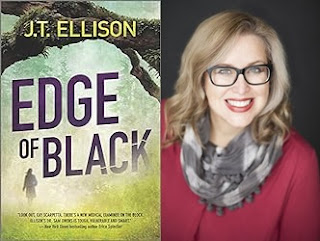
JT Ellison's Mystery Romance Stew

J.T. Ellison, Edge of Black

Because law enforcement is heavily systematized, for good reason, and crime is often banal, mystery fiction tends toward repetition. If you’ve ever screamed at a novel, wondering why the hero can’t see the widow’s lies, that’s why. Good authors beat this curb through innovative characterization—like Charles Todd and Stef Penney. JT Ellison handles this by cribbing technique from romance, another repetitive genre, with, let’s say, predictable results.

A biological attack on the DC subway paralyzes America’s government and kills three, including a congressman. ME Samantha Owens accepted a Georgetown teaching gig to escape such drama, but the DCPD and State Department need her experience and insight. When her boyfriend goes vigilante to pursue the attacker, whom he may know from his Army hitch, Sam finds herself caught between the law she’s sworn to uphold, and America’s greater good.

Presumably, Ellison wants to court the same audience that loves authors like Patricia Cornwell and Kathy Reichs. She uses much the same style: an alternation between wonky technical investigation, breakneck police work, and slow character exposition. But instead of creating taut, multifaceted character mysteries like Cornwell and Reichs, Ellison sprawls all over the map—literally, as the investigation caroms from DC to Denver and all points between.

I can’t identify which egregious mistakes bother me most. I began to get a sinking feeling when Sam Owens’ boyfriend, Xander, destroyed evidence and went off in pursuit of Lone Ranger justice. Does Sam, the career civil servant, recognize this vigilantism for the reckless endangerment it is? Nope, she considers it manful, assertive, and “the right thing.” When her DCPD contact is understandably angered, she stops barely short of calling him fascist.

Likewise, supposed professionals make such novice mistakes, I suspect they misunderstood the job questionnaire. Surely an ME with disaster training knows to volunteer her services at the perimeter of a biological attack, not to the men in the Tyvek moon suits. Police tracking a high-stakes witness should ping his cell phone now, not after he calls his girlfriend. Checking a victim’s Facebook page is victimology SOP; getting blindsided a day late is inexcusable.

J.T. Ellison
But perhaps the characters are distracted. They’re busy calibrating attractiveness: in each other, peers, bosses, and peripheral characters. Sam is deeply in love with Xander, but has to fend off romantic advances from her DCPD contact, Fletch. Meanwhile, Fletch seems to have crushes on his assistant, his boss, and a buxom vice cop. Shouldn’t skilled professionals in a national security crisis postpone the sexual byplay until happy hour?

Nor is it just the core ensemble. Ellison introduces new characters, not by name, action, or dialog, but by appearance. No character is permitted to speak, perform in-scene action, or advance the plot until Ellison establishes them as good-looking. No character who says or does anything in this book is less than ravishingly beautiful, man or woman, except one victim’s mousy mother and, in the final reveal, the culprit. Beauty equals virtue, evidently.

Between flashes of incipient sexcapades, Ellison cantilevers so many potential storylines into the book that she can’t resolve them all. Because it happens in an early chapter, it spoils nothing to say the DCPD pull Sam into the investigation because it appears the subway attack was targeted at the congressman alone. Tenuous prodding reveals that Peter Leighton may have sordid hobbies, unseemly connections, and a Moriarty-like double life.

Yet this, and several other byzantine subplots, disappear from the story for dozens of pages at once. Ellison has so many balls that she can’t juggle them together, and I kept forgetting she’d introduced something important. Then the investigation happens off-stage. Ellison introduces a possible serial rapist voyeur druggie congressman, then sends his DNA to a lab, and in the denouement, has her cop character basically shrug and say, “That was a red herring.”

BORRR-ring!

Ellison’s press biography claims she has worked with police, FBI, and other agencies to ensure the realism of her stories. After reading the slipshod techniques and outright illegalities of this story, I suspect she may have law officers asking to have their names redacted from her acknowledgments page. Her theatrics belong in a Vin Diesel movie, not in a police procedural with aspirations of verisimilitude.

This is not a serious novel. This is a mixed-genre slumgullion to fall asleep under on a beach or on a plane. Anybody who reads mysteries seriously will recognize it for a Rube Goldberg narrative, which might have worked as a parody, but is too earnest for its own good.

Monday, July 9, 2012

Finding the Facts in a Very Cluttered Case

DiAnn Mills, The Chase: A Novel

Diann Mills presents a Christian thriller novel, which apparently means no cussing and chaste romance, but remarkably blunt scenes of brutal violence. I like a lot about this book, from its interesting characters and nuanced interactions, to its well-paced, almost cinematic portrayal of a story based on a real-world case. Mills’ adaptation of real characters and situations gives her story verisimilitude. Yet she keeps finding ways to take me out of the story.

Kariss Walker, former Houston media starlet, left journalism to make a living writing chick-lit. But the last case she reported for the evening news, about a young girl found starved to death outside an apartment complex on the bad side of town, won’t let her go. So she decides to restart her career as a suspense novelist, and in pursuit of the best possible story, she teams with the local field office of the FBI for some field research.

Too bad her weatherbeaten training officer, Agent Tigo Harris, cares more for a gunrunning sting he hopes will stop American rifles funneling to Mexican drug cartels. Pursuing this Holy Grail, Tigo stonewalls Kariss, takes crazy dangerous risks, and skirts the edge of legality. But when people he cares about start dying, Tigo realizes an outside eye, like Kariss offers, might clinch the deal and stop the Arroyos, who are less a gang and more domestic terrorists.

Ignore that Mills pilfers the premise behind the TV series Castle. Even Mills obliquely acknowledges this fact. These are pretty interesting stories. The starved baby comes from the Beloved Doe case that baffled Houston for five years, and the gunrunners touch on the power of the headlines. When the two stories converge, as we know they will, they present a conspiracy so intricate, yet so plausible, they make The X-Files look like a bedtime story.

Yet Mills keeps finding ways to get between me and the narrative, reminding me that I’m reading a book. Start with the fact that our main heroine is a novelist, researching how to write... well, how to write the book in my hands. She keeps talking about the author business, phoning agents and publishers, and inserting thoughts about how, wow, this experience I’m having would be great in my novel! I can only describe that as visible authorial fingerprints.

She also alternates between gritty frankness and nigh-Victorian modesty. In the very first chapter, her FBI agent manages to shoot two gang bangers in the chest from a moving car (don’t overthink it). At various times, Mills describes people getting their heads blown off, bodies showing signs of elaborate torture, and several situations where Kariss lives in fear of getting raped. And she describes these scenes with unflinching detail.

Yet her Feds and gangsters won’t drop an f-bomb to save their lives. Really? I kept waiting for somebody to let fly with a good old-fashioned blue streak. I don’t think Jesus would mind if we depicted people talking how people talk. And sex... well, it just doesn’t happen. Our leads have the romantic tension that is mandatory in genre fiction today, yet neither will speak first, so their courtship consists of playing web app games on their smart phones.

Then Mills feels the need to clutter her good, muscular core narrative with more ornaments than a Christmas tree. Tigo’s dying mother; Kariss’ sister pregnant out of wedlock; her ex-brother-in-law, whose banal uptown greasiness hides darker secrets; the deportee father, who discovers his daughter’s grim fate, and searches for his missing wife. It gets hard to keep all the subplots straight.

All these cow paths impinge upon the attention Mills gives her central narrative. The story she promised us gets compressed, and she wanders away for whole chapters. This book could benefit from some judicious trimming, because if Mills had a more austere storyline to hold our attention, she could spend more time fleshing out the story that we readers have hung our hopes on. In other words, Mills should tell less story, but tell it better. This text says she could.

Don’t get me wrong. I read this entire book in two energetic sittings, and don’t regret the time spent. Yet I feel I could have gotten even more out of the experience if it was more tightly focused, and the author invested her energy into telling only one or two plotlines with all the strength she could muster. The thriller market is crowded, and she should reward readers’ investment with the strongest possible story she could tell.