Showing posts with label comic books. Show all posts

Friday, October 21, 2022

Doctor Who and the Myth of Time

Various writers and artists, Doctor Who: The Lost Dimension (two volumes)

Time itself is coming apart; but when isn’t it, when the Doctor is around? A massive, terrifying vortex of pure white light is traveling the universe, eating everything it encounters. We first witness it swallowing Captain Jack Harkness off a distant planet. But this monster isn’t satisfied with one planet, or even one timestream; it’s consuming the universe in reverse order. And it’s apparently started consuming the Doctor’s past selves.

Why can’t fans let prior iterations of the Doctor end? This two-volume collection from Titan Comics includes appearances by every canonical version of the character through 2018. They appear unchanged, unaged, from their onscreen appearance—a pointed fact with the Fourth and Eighth Doctors, who changed markedly between their first and last appearances. Franchise fans, and content creators who appeal to them, won’t let old forms of the character go.

In his 1972 article “The Myth of Superman,” Umberto Eco claims the archetypal hero is everyman, is universal. But in being universal, the hero is finite. Every time Superman punches villains, his mythic justice is extended, but he himself is consumed. Which sounds great when talking about past mythic heroes, like Odysseus or Charlemagne. The problem is, Superman isn’t used up; he’s continually recreated, and therefore, on paper, continually young.

Comic book characters don’t have to age. Superman, with his broad shoulders and iconic spit-curl, remains largely unchanged since 1938. The problem, as I’ve noted previously, happens when characters are depicted onscreen. Superman remains constant, outlasting George Reeves’ suicide, Christover Reeve’s quadriplegia, and the all-around disappointment of Brandon Routh. Artists continually recreate Superman, but human actors inevitably get old and die.

Something similar happens with the Doctor. The BBC writers’ room invented the narrative contrivance of Regeneration in 1966 when William Hartnell, “The First Doctor,” became too stricken with atherosclerosis to continue acting. Writers and fans continued recreating the mythological character, leaving Hartnell, a mortal, behind. The Doctor’s human aspect is transitory; his character remains present and part of audiences’ lives.

Where possible, official productions keep original actors involved: Big Finish Productions, for instance, put the Fourth and Tenth Doctors together in 2020. Tom Baker hasn’t played the Fourth Doctor onscreen since 1981 (not directly anyway) and is pushing ninety, yet he remains altogether synonymous with the role, and able to continue playing it. If original actors aren’t available, alternatives suffice: voice actors Frazier Hines and Tim Treolar currently play the Second and Third Doctors, respectively.

This recreation isn’t dependent on official BBC imprimatur, either. Fan culture, including fanfiction writers, cosplayers, and others, participate in recreating the Doctor. The BBC nominally “owns” the Doctor, yet the character is most alive and fertile in fans’ imaginations. Like all copyrighted productions, the Doctor will eventually pass into public domain, but morally, he already lives there. Every “official” franchise relies upon backstory existing in fans’ imaginations.

Titan Comics, however, tacitly acknowledges something fans already know: because the Doctor remains living, the character needs new adventures. As Umberto Eco writes, Hercules, King Arthur, and other mythic heroes are dead; writers may rewrite existing stories and apply new psychological insights, but seldom add actual new events to the mythology. Superman or the Doctor, however, always require new adventures. The narrative canon is always expanding.

Therefore Titan invents stories like this, which transcend time and bring the Doctor’s multiple incarnations together. Though this story highlights the four (male) iterations from the revived TV show, it incorporates every onscreen version to date, always looking exactly like they appeared back then. Human actors age and die, but on paper, the Second Doctor is always fortyish, the Fourth Doctor is always dark-haired and energetic.

Always the same, yet different.

Audiences yearn for new adventures starring the Doctor, but only as he/they appeared onscreen. Casting David Bradley as the First Doctor is a satisfactory workaround, one time. But audiences probably wouldn’t accept that substitution permanently. Just as Timothy Dalton’s James Bond isn’t Sean Connery’s, each regeneration of the Doctor becomes a new being, but also doesn’t. Because the Doctor moves on, but we, the audience, carry the old mythology with us.

Fundamentally, the BBC “owns” Doctor Who on paper, and licenses companies like Titan Comics or Big Finish Audio to invent new adventures, but that’s a legal fiction. The mythology has taken root in audiences’ imaginations in ways that, say, Quatermass just hasn’t. New adventures rely upon, not licensed canon, but the audiences’ living imagination. Old versions of the Doctor remain because they live and have new adventures inside us.

Monday, November 30, 2020

Hellfire and Damnation (the Lite Version)

Garth Ennis (writer) and Steve Dillon (artist), Preacher: Book One

Reverend Jesse Custer shepherds a small West Texas congregation, but one gets the impression he doesn’t have much faith. One Sunday, he mounts the pulpit, still hung over from a rage-fueled Saturday bender at the local tavern, when a massive fireball surges up the aisle and into his soul. When he regains consciousness, Reverend Custer can speak with the voice of angels. But he still doesn’t know what to say.

This graphic novel, a reprint of the first twelve issues of the monthly comic by writer Garth Ennis and principal artist Steve Dillon, comes with a reputation among comics fans. Sadly, I just don’t see it. Ennis and Dillon supposedly ask important questions about what words like “God” and “salvation” mean in a world where Christianity seems increasingly tangential. But this questioning never gets beyond a Goth-ish middle grade level.

Poor Reverend “Just Call Me Jesse” Custer’s quest begins with an important discovery. The being that possesses him is a runaway spirit, with powers so vast and ambiguous, it threatens God’s very dominion. An archangel informs Jesse and his compatriots that God has fled this spirit in terror; the throne of eternal verity sits unoccupied. Only Jesse and his friends have power enough to put this situation right.

Unfortunately, not everybody wants God restored to glory. Before he’s even gotten all his facts organized, Jesse finds powers, both human and transcendent, arrayed against him with drawn weapons and nihilistic arguments. Apparently, in a world wracked with division and pain, some people would rather embrace eternal nothingness, than face judgement from God. Who, after all, created the nonsense we currently suffer through?

Watching Jesse and his allies, Tulip the assassin and Cassidy the vampire, confront their existential quest, I got the impression that writer Ennis, an atheist from Ireland, thinks he’s the first unbeliever to postulate these questions. He clearly has no conception of theodicy, the historical struggle to reconcile a loving God and a secular world. He’s hardly the first unbeliever I’ve met who thinks nobody ever, ever faced doubt before.

This lack of familiarity with Christian history comes across in how artist Dillon depicts Jesse. When he preaches, he wears a collarless pastel suit, reminiscent of disgraced 1980s televangelist Jimmy Swaggart. After the runaway spirit, code-named Genesis, immolates that suit, Dillon re-clothes him in a cowboy shirt with silver collar points and a bolo tie. These British creators evidently tie Christianity together with Southern American cultural excess.

Promo art for Preacher

The first half of this volume, collecting the first six issues of the comic, are set in Texas, and mostly involve exposition. Our protagonists get to know one another, while piecing together the circumstances which made God go missing. Meanwhile, a literally unstoppable foe emerges, dressed like a villain in a Sergio Leone B-movie. The Saint of Killers has only one objective: stop Jesse’s gang at any cost.

By the second half, with the throat-clearing finished, our protagonists actually commence their quest for the missing God. This story couples our chicken-fried protagonists with a parody of 1990s Manhattan crime dramas, including a character who helpfully narrates his story in voice-over captions. Reading along, it becomes increasingly clear our artists only know America from prime-time network TV.

Sometimes I enjoy media constructed from scraps of previous pop culture; other times I despise it. The difference generally boils down to one question: does the artist appear to be having any damn fun? In this case, I respond with “meh.” Like, our creators apparently enjoy what they’re creating, but not enough to conceal their unfamiliarity with their topic. It’s not fun enough to sweep me past their glaring flaws.

British anthropologist (and adult convert to Catholicism) E.E. Evans-Pritchard wrote, in his 1965 book Theories of Primitive Religion, that the discipline of comparative religion suffered because too many theorists had no faith. Because they couldn’t comprehend the experience of believing in something, their theories reflected their prejudices, not facts. Evans-Pritchard didn’t prescribe any specific religion, but suggested that faith, as an experience, is necessary to studies of others’ religions.

That, I fear, describes my experience reading this book. Ennis and Dillon hold religion in undisguised contempt. Therefore they don’t realize the questions they raise are centuries old, or that their characters are little more complex than paper dolls. They just hold the characters, and their faith, up to mockery and derision, and think they’ve created a story. They interject moments of fun and complexity, but largely, they address religion like petulant children intolerant of doubt.

Thursday, October 22, 2020

Mjolnir vs. Plato: Comic-Book Philosophy


If Thor, the Norse god and Marvel Comics superhero, set his hammer, Mjolnir, down on a boat, would the boat sink? A stranger recently asked this question on an Internet discussion board, and I initially thought it a silly question. In the second Avengers movie, Age of Ultron, Thor clearly sets Mjolnir on a coffee table, and the table isn’t crushed. Therefore clearly the difficulty in lifting Mjolnir isn’t about weight.

Another stranger, though, complicated the question: leaving Mjolnir in the boat, could you pull the boat ashore? Could you successfully row the boat with Mjolnir aboard? Only Thor can lift Mjolnir, but could others move Mjolnir indirectly, as by moving whatever it’s sitting on? When Thor sets Mjolnir on Loki’s chest, in his first movie, Loki is incapacitated, but not destroyed. What force, then, makes mortals unable to lift Mjolnir?

Philosophically, these questions seem trivial. Except I’d argue they’re not. Plato, in The Republic, uses the Ring of Gyges myth to test theories of human morality. Fables, including comic book fables, have the capacity to push moral principles to their breaking point, without the complicating friction that reality inevitably provides. Questions about Mjolnir may have no practical value, but they open doors for other, more useful philosophical inquiry.

Start with the question of merit. In the first Thor movie, Odin exiles Thor from Asgard, and casts his hammer to Earth, proclaiming: “Whosoever holds this hammer, if he be worthy, shall possess the power of THOR!” This enchantment includes no meaningful definition of “worthy.” In the movie, Thor sacrifices his life to protect humanity, and is resurrected as an Asgardian. Worth, therefore, apparently means willingness to die on principle.

Except several heroes who die fighting, like Iron Man or Black Widow, can’t lift Mjolnir. Being worthy of Thor’s power evidently involves also resembling Thor’s principles, something that, in the final battle, only Captain America can match. Thor, apparently, deserves Thor’s powers, because he’s the being who most completely resembles Thor. Thus a common problem with purely theistic morality: God is righteous because God is God.

Being divine and untinged by human venality, Thor can lift Mjolnir. Tony Stark, who uses alcohol and promiscuity to plug his daddy issues, can’t. On balance, maybe that makes sense. When applying this morality to inanimate objects, it therefore extends to explain why Mjolnir doesn’t crush that coffee table, crash the SHIELD helicarrier, or plunge through multi-story buildings. Inanimate objects simply exist; matter alone is morally neutral.


This puts MCU morality in opposition to Greek gnosticism. Matter cannot be evil, because matter isn’t purposeful, only existent. This would confirm both Steve Rogers’ Christianity and Tony Stark’s atheism, both of which see matter as simply what is. That hypothetical boat would never sink, because it has no motives or purposes in itself. Though built by human hands, that boat, while floating idly, has no necessary morality.

The moment humans attempt to move that hypothetical boat, though, the movement (though not the boat itself) gains moral direction. Machines, technology, and manufactured products don’t have morality, but humans do. We can use our built environment to improve humanity and protect nature, or we can willfully cause harm. That moral judgement doesn’t accrue to the technology used, though tech might make immorality easier; judgement only applies to humans.

Our hypothetical boat, therefore, wouldn’t be immobile. It would drift on a river’s current, or rise on an ocean’s tide. If it hit a sandbar, it would still be grounded. Nature, being matter enacted by principles of physics, wouldn’t impede that boat’s progress. Mjolnir isn’t an anchor, holding that boat in one place. If it did, think how awful the consequences of Earth’s rotation would be!

Humans attempting to move that boat, however, would incur moral judgement. Either pulling the boat ashore, or rowing, would be futile efforts, except for the minority of humans pure enough to share Thor’s worthiness. Every action humans perform has purpose, even if that purpose is pre-conscious or transitory. Therefore every such action incurs judgement. In the MCU, where effect very closely follows cause, morality is always imminent.

Sadly, this creates more questions. If humans dam a river, have we imputed morality onto the altered current? Well, if the current destroys somebody’s home, perhaps. Matter may simply exist, but humans change it; that’s our nature. Therefore matter isn’t morally neutral, once humans exist. Thor’s hammer might not destroy a coffee table, but what about setting it aboard a Nazi battleship? I feel a headache coming on.

Monday, December 2, 2019

Why Is Making a Superman Film So Hard?

Henry Cavill in Man of Steel
DC’s continued struggles to create an economically viable cinematic enterprise have reached a new low. Writing in Forbes, pop-culture critic Dani Di Placido describes DC's struggles to find something for Superman to do. You’d think an alien living in America, believing in justice and honor, would have important resonance in today’s divided cultural landscape. Perhaps movie studios, notoriously jittery about public opinion, find this too pointed.

The rush of armchair critics on FaceTube and InstaTwit have readily condemned this timidity, for obvious reasons. I’m tempted to echo these positions, because that’s low-hanging fruit. Superman’s backstory would seem ripe for utilization in today’s America. His historic connection of “the American way” with “truth [and] justice” should address our trend toward conflating Americanism with untruth, subjectivity, and avarice. This shouldn’t be a hard sell.

Yet considering the economic landscape responsible for controlling this discussion lies hidden beneath the cultural issues. Superman, Batman, and the MCU don’t just objectively exist; they are properties controlled by media conglomerates, which make remarkable money off their holdings. The rentier economy allows DC and Marvel to get wealthy by owning and licensing their intellectual property, but that wealth makes them risk-averse.

DC Comics is owned by WarnerMedia, so naturally Warner makes DC movies. WarnerMedia is America’s second-largest media conglomerate, controlling about sixteen percent of America’s media revenue. That’s slightly under half the revenue controlled by America’s first-largest media conglomerate, Disney, which owns Marvel Comics and Star Wars. Following its Fox buyout, which reduced America’s major media conglomerates from six to five, Disney controls approximately one-third of America’s media revenue.

Superman on the cover of Action Comics #1
So the continued runaway success of the MCU, and DC’s inability to compete, isn’t about the competition between these two comics companies; it’s a proxy feud between America’s two largest media corporations. As I wrote recently, talking about Martin Scorsese’s condemnation of the MCU’s box-office domination, this is somewhat misguided. Yes, major-studio franchises control America’s box office. But only two franchises, Star Wars and Marvel, are currently very successful.

And both are owned by Disney.

I’m loathe to offer suggestions to major media conglomerates for controlling their more lucrative properties, since history suggests they’ll misuse that power to further limit the government. These corporations have a history of kissing tyrannical ass to ensure their continued revenue flow: Disney itself has become particularly risk-averse since it temporarily lost China’s import market following their 1997 dud Red Corner. Conglomerates suck just fine without my help.

Nevertheless, Superman has loomed large enough in American culture for so long, that abandoning his principles to corporate timidity resembles a form of surrender. So I’ll weigh in anyway. Let’s start by remembering what made children embrace comic-book superheroes over eighty years ago: they embodied American moral convictions. They believed in the same things we believed in, and then followed through.

The runaway success of Wonder Woman should instruct DC what audiences want. The titular protagonist, who believes moral right exists as an objective force, and sets out to kill war, in the midst of history’s most pointless war ever, demonstrates what traits audiences reward with money. We want moral confidence, and a will to act upon this confidence. We want characters who remind us to do what’s right.

Christopher Reeve in Superman
Following the immense, brooding darkness of Man of Steel, many critics, including me, condemned the movie’s bleak, ends-justify-the-means attitude. Charles Moss, writing in the Atlantic, pointed out that Superman’s origins were remarkably grim and violent. But I’d suggest that misses the point. Early Superman had lite-beer socialist leanings, and his willingness (in a White, urban way) to confront slumlords and corrupt bankers, reflected America’s unexpressed urge toward revolution.

Christopher Reeve’s Superman expressed the morals of another time. Flush with cash in the post-WWII years, before media conglomerates began hoovering everything upward, this Superman reflected an era whose proletarian values were less communist, more communitarian. Reeve’s Superman busted villains whose machinations interfered with everybody’s desire to live well together, rather than punishing criminals by forcing them to live under the conditions they created.

Superheroes today must express contemporary moral sentiments. What do Americans fear today? The political insurgencies of Donald Trump and Bernie Sanders bespeak distrust of political and economic establishments, including media monopolies, that serve themselves, rather than the people. Both Trump and Sanders campaigned against a fossilized social order stealing from the people. What if Superman, and the Justice League generally, fought the same fight?

This would require WarnerMedia to turn against its business model. But whose hand feeds them, ultimately? The shareholders? Or ours?

Tuesday, July 10, 2018

The Batman Movie We Need Right Now

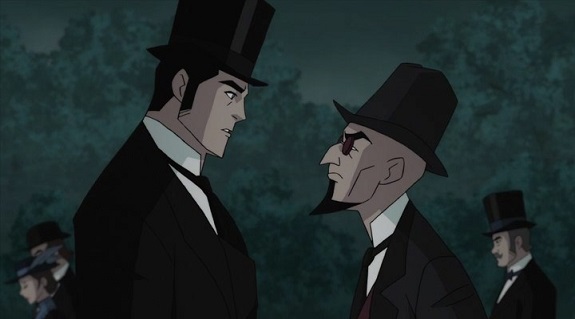
Our first glimpse of Victorian Batman

Two shadows have fallen over Victorian Gotham. One, a human-sized bat, has most criminals running, scared of its theatrical violence and bleakley absolute moral code. The other is Jack the Ripper, doing what Rippers historically just do, terrorizing those the state least cares to predict, especially poor, destitute women. Street justice and moralistic judgement personified. These forces will inevitably come into conflict; they must. Our only question is, which will ultimately represent Gotham’s beleaguered soul?

The 2018 movie Gotham By Gaslight copies the premise, but not the story, of Brian Augustyn and Mike Mignola’s 1989 comic of the same title. Resetting Batman in America's Gilded Age, the time that most resembled the economic inequality which birthed Batman, lets artists play around with bat mythology, keeping the core story intact, but stretching it to encompass larger themes. This movie is about Batman, but like good art everywhere, it’s also about us.

Batman launches his crime-busting enterprise by bringing the pain to a Fagin-like ringleader. So yeah, he initially aspires to simply fight street crime. But within moments, pained cries redirect him to a gruesome, precisely targeted murder. Batman quickly crosses paths with a female vigilante who shares his morbid interest in this crime. But the equally mysterious Selena Kyle has no patience for Batman’s theatrics. Women are dying, women like her, and someone needs to act.

Zach Snyder’s DC movies have faced much-justified criticism, including mine: their lack of heroic optimism, characterized by opponents as “cynicism,” seems to violate what superheroes do. This tone made sense in movies like Watchmen and 300, which dealt with desperate people in hopeless circumstances. But superheroes essentially require belief that something better than the present could potentially exist. Steampunk Batman apparently knows the difference between gritty realism and amoral nihilism, which Snyder’s antiheroes have forgotten.

Steampunk Batman and Selena Kyle square off, after intruding on one another's investigations

Animation director Sam Liu presents a deeply principled Batman, aligned with municipal charities, steering street orphans to a local activist convent, picking fights with law enforcement when they’ve forgotten the meaning of justice. Remarkably, Liu also shows Batman getting his ass kicked: both Selena Kyle and the Ripper are equally prepared for a fistfight. Worse, as we increasingly realize, the Ripper’s ethical motivations run as deep as Batman’s, making both men’s violence equally, brutally incorruptable.

Batman’s appeal has long centered on the fact that he doesn’t have to care. Rich and opulent, he could relax in the luxuries his money could afford, as many did in the 1930s, when the character debuted. This alternate universe makes clear this still applies: in a Gotham so impoverished that men turn to theft, and women to prostitution, just to eat, the city’s wealthy look forward to a richly appointed and cosmopolitan World’s Fair.

Yes, Bruce Wayne need not care. He need not let anybody into his inner circle. But he does: besides employing street urchins and permitting conspiracy theorists to spout their crackpot theories in his ear, Wayne’s closest ally is a nun, Sister Leslie, who has nurtured countless Gotham foundlings. When poor, desperate women are murdered in alleyways, Wayne takes their deaths personally. Unlike Snyder’s gratuitously brutal Batman, this Batman cares, even though he doesn’t have to.

Because Batman cares, he inspires others to care too. Near the beginning, as stated, Batman rescues three urchins from their Fagin-like ringleader. These urchins are named Dickie, Jason, and Timmy—a deliberate reference for comics aficionadoes. When Batman rescues them, they’re desperate, scared thieves, and they quickly return to that life, because it’s what they know. But it doesn’t take long before they’re participating in Batman’s crusade, even when common street wisdom says to run.

Bruce Wayne gets handed an important clue by Dr. Hugo Strange

This doesn’t come without contradictions. Supporting characters lavishly praise the World’s Fair (and Bruce Wayne’s financial support) in early scenes, that veteran fans realize, by the end, it will burn. The only question is how. The thing Wayne’s money has created, Batman’s pulp justice must destroy. In the end, one of Batman’s young Robins says: “It was all phony anyway. We'll make somethin' new, somethin' better.” And we, the audience, think: yeah, we probably will.

Comic-book mythology generally has one underlying ethic: a pure heart, backed with well-placed violence, can restore justice, eventually. That’s what Steampunk Batman does, too, bringing the beat-down in honor of those abandoned by society and economics. He identifies an enemy and pummels him into submission, restoring hope to Gotham's hopeless.Yet he does more, too. By caring when he doesn’t have to, and fighting when he could lose, he gives us permission to believe again.

Wednesday, April 11, 2018

Ghost in the Shell: the Iron Fist of Cyborg Law

1001 Movies To Watch Before Your Netflix Subscription Expires, Part 25:
Mamoru Oshii (director), Ghost in the Shell

1001 Books To Read Before Your Kindle Battery Dies, Part 89:
Masamune Shirow, Ghost in the Shell


Section Nine is the most advanced mobile police strike unit in post-humanist Japan, and its commanding officer, Major Motoko Kusanagi, takes no prisoners. From feral cyborgs to a government hacker turned rogue, she never fails to retrieve her target, even when failure risks her titanium-reinforced cybernetic skin. But a strange new threat, the Puppet Master, looms. With neither a body to kill nor a system to hack, Kusanagi might’ve met the prey she can’t capture.

Writer-artist Masamune Shirow first serialized his Ghost in the Shell manga (uncolored Japanese comic book) in the late 1980s and early 1990s; its English-language translation appeared in 1995. Shirow’s melancholy existential themes develop so gradually that, given the often improvisational nature of Japanese manga, one suspects even Shirow didn’t anticipate their depth. Yet the comic, and its 1995 feature-length anime (animated film) adaptation, have now influenced a generation of Japanese and Western post-humanist science fiction.

Routine human augmentation has changed the nature of crime, and also crime-fighting. Shirow depicts a world where criminal and victim are often separated by entire continents. The Internet, uncharted territory back then, provided cover for everyone from petty swindlers to contract killers. If anything, Shirow’s predictions appear, thirty years on, too modest. But the scariest monsters trafficked in altered human memories—the forerunners of “fake news.” Technology threatened to usurp our individual and shared identities.

Into this mix, Japan has thrust Section Nine. The story identifies Section Nine as a national police division, with arrest privileges, but it doesn’t take long to realize that, like James Bond or Judge Dredd, Section Nine is its own law. The government dispatches Major Kusanagi’s team to crucify criminals too dangerous to bring in alive. One scene, present in the manga but not the anime, shows the Japanese Prime Minister disclaiming Section Nine altogether.

Major Kusanagi rules Section Nine with an iron fist. Literally so: in the manga, she frequently punches underlings and even superiors to assert her authority. Yet the state permits her excesses because she wins. It’s easy for Westerners to forget that Japan retains rigid gender stratification; a female action hero is downright revolutionary, but every morning she has to prove her chops afresh. She succeeds because human augmentation renders black-and-white morals obsolete. Only winning matters.

Yet Kusanagi struggles with identity herself. A mix of human tissue and digital technology so complex, it’s impossible to separate one from another, Kusanagi spends long off-hours ruminating on human nature. If she quits Section Nine, who owns her body? What happens when her augmentations become obsolete? Can she die, and if so, does she have a soul? The movie strongly implies she might never have been human, her pre-cybernetic memories a mere factory preset.

Major Motoko Kusanagi, in the 1995 anime Ghost in the Shell

The Puppet Master upsets whatever conclusions Kusanagi previously reached. If he can reprogram human memories, then what identity does anyone have? Equally important to her job, how can she pursue criminals if witnesses’ memories, their experiences, their very identities are fabricated? But as Kusanagi chases this master criminal from place to place, she comes to suspect the unimaginable: he might not have a body. What does that make him? And what does that make her?

Mamoru Oshii’s anime adaptation strips Shirow’s subplots, focusing narrowly on the Puppet Master. Most English-speaking audiences will probably first encounter this story through Oshii’s movie. But audiences interested in these themes will find Shirow’s original manga intriguing for themes Oshii triaged out. What limitations does human physiology place on technology? Would robots ever really find sufficient motivation to rebel against humans? (Spoiler: no.) What happens when logical digital programming clashes with the rabid human id?

Shirow’s original manga clearly sets his story in Japan. Oshii’s adaptation obscures the nationality, though his streetscapes, unusually detailed for hand-drawn, pre-CGI animation, strongly suggest Hong Kong, and Jackie Chan’s best action extravaganzas. Both stories strongly suggest that digital culture, and digital crime, have rendered physical boundaries obsolete, although national identities still carry weight; Kusanagi alternately observes and transgresses Japanese gender roles, while clues suggest the Puppet Master is American. Just one more contested identity.

Oshii’s anime has inspired several spinoff media, including one direct sequel which used several of Shirow’s ancillary themes, two TV series, and one American remake which bombed on arrival. None of this spinoff material has recaptured the original magic, and is probably of interest only to sci-fi nerds and Japanophiles. But the original book and movie have massive crossover appeal. Shirow’s themes (if not his technology) remain uncannily prescient. We’re witnessing his story play out now.

Monday, November 27, 2017

Growing Up in a Land of Priests and Martyrs

1001 Books To Read Before Your Kindle Battery Dies, Part 85
Marjane Satrapi, Persepolis: the Story of a Childhood, and Persepolis 2: the Story of a Return


Marjane Satrapi was ten years old when the ayatollahs overtook Iran. Formerly educated in a French-language school with classrooms integrated by gender, she found her life uprooted and turned sideways. Teachers who, one year, told students the Shah was chosen by God, the next year told students to rip the Shah’s photos from their textbooks. Who can blame her for developing a drifting, nihilistic view of life?

Satrapi’s memoirs, written in graphic novel form, first appeared in French in four volumes at the height of the 1990s “comix” craze; they were later reprinted in English in two volumes. (A one-volume edition exists.) Like most comix artists, Satrapi embraces an auteur mindset, with a single writer-artist, and minimal editorial influence.This permits an introspective, deeply personal approach to her telling her own story.

Perhaps the most important theme in Satrapi’s memoirs is the contrast between her family’s secular, Westernized upbringing, and the increasingly repressive, theocratic regime. Before the Islamic revolution of 1979, Satrapi’s parents participated in anti-Shah marches, believing the eventual revolution would be primarily Marxist in nature. Imagine their shock when the ayatollahs became the revolution’s driving force, and eventual ideological captains. Like many, their sense of betrayal was palpable.

Not that their Western ideals excludes Islam. As a child, Satrapi believes herself a prophet, in a lineage with Zoroaster, Jesus, and Mohammed. She has intimate conversations with God to understand her confusion. Later, as an adult, she quotes the Koran fluently when religious police attempt to squelch her voice. But the Satrapis’ religion doesn’t yoke them to the past. History, for them is a march toward secular democracy.

This battle between secular and theocratic mostly happens behind closed doors. Satrapi’s parents attend parties where everyone drinks homemade wine, wears neckties, and dances to American rock, emblems of Western excess. On those rare occasions where Iran opens its borders, they smuggle in posters and cassettes of Marjane’s favorite American heavy metal artists. But they also hang blackout curtains and bribe cops, because the state encourages snitching on one’s neighbors.

Marjane Satrapi
Later, as an adult, Satrapi studies art in Iran’s state-run universities. But Iran’s draconian modesty codes mean that, in life drawing class, the models must wear massive, billowing gowns. Satrapi organizes illicit after-dark classes where peers get to draw tasteful human nudity, in the Renaissance style. Her demands evolve consummately: where once she bought bootleg American music, she graduates to bootleg American contraception.

Satrapi’s two-dimensional, black-and-white art, consistent with the comix movement, permits readers to see Iran through her eyes. We can see clashing crowds of protesters and counter-protesters without her having to write long-winded descriptions— and her flat, cartoonish art reveals how screaming ideology strips everyone of individuality. Later, she uses cutaway reveals to expose, say, how women dress beneath the veil, how they express individuality in a state that demands conformity.

It’s possible to read Satrapi’s memoirs as moments in Iranian history; that’s how they’re often marketed. A nation’s struggle to overcome its past requires it to decide what future it wants to embrace. Satrapi’s liberal, educated family embraces the homo economicus model, believing an Islamic version of rational humanism will inevitably overtake the country. They simply don’t anticipate the confidence that religious conservatism promises people who feel dispossessed.

But like the best classic literature, Satrapi’s memoir is fundamentally about its audience. As Marjane first witnesses her parents’ collisions with religious authority, and later embraces such conflicts herself, it’s impossible to avoid noticing that both sides wear ideological blinders. Satrapi uses absolutist thinking to confront absolutist religion. How often, we wonder, do we ignore our own absolutism? What sacred cows do we refuse to sacrifice, and not even notice?

Satrapi sees the world in black-and-white because, essentially, she’s a child. As the story progresses, her art becomes more sophisticated and fully dimensional, because she herself becomes a more sophisticated soul. She loves her people, and when her parents ship her to Europe as a child for safety, she returns as an adult. But eventually, even that collapses under state pressure. To remain human and sane, she has to leave.

In some ways, Satrapi retains her childhood aspirations to prophethood, Like Jesus said, a prophet lacks honor in his homeland. By exposing us to the corrupting influences of absolutism, Satrapi encourages us to understand the complexity of fellow humans. We cannot manage change without loving one another; and we cannot love without knowing one another. But Satrapi’s prophecy rejects dogmatism. Truth is messy, because it’s finally made of human beings.

Monday, October 2, 2017

SuperSuit: a Business History of a Non-Linear Business

Reed Tucker, Slugfest: Inside the Epic 50-Year Battle Between Marvel and DC

At a party recently, two fellas got into a heated tangle over Marvel vs. DC. Marvel, one insisted, has grown too snooty living atop the comics sales heap for decades. The other insisted DC was stuck in World War II and hadn’t had a good idea since Eisenhower without pirating it from Marvel. As somebody with no corner to back, I found the conflict confusing. But watching two guys kept my focus narrow.

Freelance journalist and sometime radio sidekick Reed Tucker takes a wider view. Spanning the period from Marvel’s launch to the present, he describes the parallel development of two industry titans who latch onto the wonder inside readers, and speak to beliefs in justice. Launched in 1961, by 1972 Marvel dominated the market, and has ever since. Tucker gets the business right, but something feels missing from his analysis.

After a very brief introduction to DC’s history, Tucker dives into Marvel’s launch and its industry impacts. Marvel started so shoestring that it relied upon DC to distribute its titles. But heroes like the Fantastic Four, who fought among themselves, or Spider-Man, who often couldn’t pay his bills, touched a nerve for teenage readers. DC assumed audiences stopped reading comics around age 12; Marvel caught older kids longing for something meatier.

Marvel’s heroes had complex inner lives that touched Baby Boom readers, while DC’s heroes remained patriotic pin-up characters from a prior generation. Marvel encouraged pathbreaking artists like Jack Kirby and Steve Ditko, while DC maintained a house style so generic, literally anyone could draw any hero. Marvel took risks during an era when risk-taking paid handsomely, while DC conservatively clung to a portfolio worth more in licensing than publication.

Thereafter, Marvel led while DC followed. DC’s Carmine Infantino plundered Jack Kirby, Frank Miller, and other Marvel talent, but shackled them, and their talents sputtered. Marvel pioneered event crossovers, in-universe continuity, and other now-vital aspects of graphic storytelling. DC copied. Even when DC pioneered one domain, live-action cinema, they failed to parley that into marketing success.

Tucker takes the relatively unusual tack of focusing on business and production, spending little time on stories and art. He acknowledges that early Marvel comics had a nuanced depth of characterization that DC, stuck in post-WWII kiddie schlock, didn’t match. But he doesn’t explicate why, as DC matured and Marvel became a factory, Marvel kept outselling. Especially since around 1986, DC’s stories have competed with Marvel’s for psychological complexity.

This is especially perplexing considering how many personalities, like Jack Kirby, Jim Shooter, and Frank Miller, crossed between publishers. DC literally had the ingredients for Marvel-style revolution, but couldn’t translate them into more-than-mediocre sales. Tucker limply says that DC’s in-house management style couldn’t unleash such talent. But that sounds unconvincing when talent moved between the houses throughout the 1980s. Something deeper is at work, and Tucker keeps focus elsewhere.

Tucker offers mere glimpses into even large story developments, like Secret Wars or the Death of Superman, mostly superficial descriptions which anyone who read the actual comics already knows. If Marvel really succeeds from psychological depth and complexity, why not pause on important points? Almost as weird as what Tucker includes is what he omits. Influential writers like Alan Moore, and non-Madison Avenue publishers like Malibu Comics and Dark Horse, get only salutary mentions.

On a personal level, the period Tucker identifies as the high-water mark for printed comic sales, the early to middle 1990s, is actually the period I stopped following comics. Stories became too intricate, universes too massive, and keeping abreast became a full-time job—one I didn’t want because, with young adulthood upon me, I had a literal full-time job. The qualities that drove record sales drove me away.

That being the case, I’d have prefered more attention to stories and art. The business is fascinating, particularly to fans, but sales figures and market dominance follow audience interest, not lead it. Myself, the comics I’ve most enjoyed recently have come from DC, but tellingly, have generally been non-canon graphic novels like Grant Morrison’s Arkham Asylum. Stories that don’t require decades-long immersion in character backstories and universes.

Speaking of Grant Morrison, a book already exists which addresses the psychology Tucker mostly overlooks. Morrison’s Supergods mixes Jungian analysis with Morrison’s own autobiography of comics experience to plumb how each generation’s new superheroes addresses their time’s unique needs. Maybe fans should read Morrison and Tucker together. By itself, Tucker’s MBA analytics are interesting but anemic, lacking clear insight into what drives readers and their loyalties.

Wednesday, September 13, 2017

The Best Comics Artist You've Never Heard Of

John Higgins, Beyond Watchmen and Judge Dredd: the Art of John Higgins

As the title suggests, Liverpool-born comics artist John Higgins is best known as colorist (“colourist”) on Alan Moore’s Watchmen novel, and elaborate handpainted watercolor strips in Britain’s Judge Dredd series. He doesn’t have name recognition like Frank Miller or Jack Kirby. Yet this book makes a persuasive case that we should know him: he’s collaborated on Batman, Doctor Who, the Terminator, Star Trek, and more.

Now Liverpool UP collates a massive selection of Higgins’ portfolio for an oversized book that’s half coffee-table art spectacle, half autobiography. The assortment ranges from his early days, paying dues on medical illustrations and line art for children’s game books, through prestige work on the best-known comics titles, for every major publishing house. The story of how he became John Higgins is as engaging as the visuals with which he peppers his memoir.

A school-leaver (what Americans call a high-school dropout) who joined the military to find discipline and guidance, Higgins found himself naturally using available time to draw. Eventually he completed his education at a prestigious British art college. But good-paying art jobs aren’t plentiful, not even in the 1970s, when ambitious young upstarts could schlep their portfolios directly to publishers’ doors. So he spent years paying industry dues.

Before the comics which became his mainstay, Higgins did multiple freelance jobs to develop cachet. He spends an entire chapter on his children’s line art, a style my generation will recognize from our family-friendly horror novels and game books. He shares a selection of cover art he did for science fiction novels. This selection includes full-page spreads at the end of most chapters, allowing readers to revel in the majesty of Higgins’ elaborately detailed art.

This diligence eventually paid off. Artist Dave Gibbons discovered Higgins by reputation, then eventually met him face-to-face. So when Gibbons and writer Alan Moore created Watchmen, Gibbons knew exactly who to contact for colourist work. The trio collaborated to a degree seldom seen in the 1980s, a time when comics creators were salaried work-for-hire, and colourists about equal to pack mules. This collaboration helped start a new trend.

A recent watercolor of Judge Dredd in Higgins' distinctive, hyperrealistic style

Higgins deconstructs the comics coloring process for untrained eyes. Though famous for his intricate watercolors, Higgins was forced to compromise for the industry standard in pre-digital comics, CMYK dot printing. As he demonstrates this involved some anonymous color separator, working for pennies per page, probably at a kitchen table in Illinois, literally distributing Doctor Manhattan’s eerie blue glow across the page with the corner of one thumb.

Over thirty years later, it’s easy to forget how innovative Higgins’ pathbreaking color work really was. Though he minimized bright primary colors for Watchmen, favoring muted tones and secondary hues, he lit scenes cinematically, bathing characters in one another’s castoff glow. But he took the exact opposite tack in The Killing Joke, oversaturating colors so everything appeared painfully bright, trapping readers in the Joker’s carnivalesque mindscape.

At times, Higgins was strictly a hired man. His art for cross-marketed properties like Carmageddon and BattleTanx, video games that needed the heft a printed comic provided, showcase his style, but only in serving another’s vision. Later, Higgins graduated to having greater creative control. His title Razorjack never found its commercial stride, but that’s probably an effect of media saturation; the art reproduced here is stunning.

Higgins’ survey of comics technology mingles with his life experiences, though he’s sparing in sharing his personal life. He laughs about finding his three-year-old daughter “helping” complete an early line drawing, with a green permanent marker. Nearly forty years on, he remembers the scene with good humor, though since he describes looming deadlines, I suspect it wasn’t comical back then. Such details, rare but apropos, give Higgins’ professional memoir a poignant touch.

And the art is spectacular. By his own admission, Higgins is best-known for images of monsters and carnage, from orcs and zombies in kids’ books, through the horror boom of the 1990s, and the noir pervasion of Razorjack. Here, his early-career work doing illustrations for medical journals shines: looking at a shuffling corpse, or a cyborg offering a child a flower, one can clearly imagine the bones and musculature necessary for that moment to happen.

It’s possible to read Higgins as only a memoirist of the industry. His autobiography, supplemented by powerful artwork, allows such casual consumption. But there’s something greater happening here, an investigation of how the medium’s capabilities change within one career. Though not famous, Higgins demonstrates why audiences love comics, by pushing the capabilities of the visual form.

Friday, September 1, 2017

The Tick: a Superhero For Post-Heroic Times

Griffin Newman (left) and Peter Serafinowicz in the pilot episode of Amazon's The Tick

Commenting on Amazon’s reboot of Ben Edlund’s The Tick from a cultural mythology perspective is pretty worthless. Since the Tick himself (Peter Serafinowicz) cites Joseph Campbell’s Monomyth in the pilot episode, and gauges sidekick Arthur’s (Griffin Newman) development by stages on the Hero’s Journey, that approach is already taken. This critical approach, still innovative when I discovered it five years ago, is now widespread enough to parody itself.

Not that anyone should mistake this series for parody. Like the best comedies, it has a deadly earnest heart, commenting not upon superheroes or genre media, but upon us. It presents a world where superheroes become so ubiquitous, they’re banal. Arthur, who serves as both series protagonist and audience surrogate, is the kind of dweeby, damaged nerd who, twenty years ago, would’ve embraced a superhero appearing in his apartment. Instead, he appears bored.

As tragedies do, the Tick barges into Arthur’s life unwanted, when the subject believes he’s established a working balance in life. Of course, Arthur already knows this: a flashback in the pilot episode reveals he fantasized about becoming a superhero, until a crashing Arthur is a mix of preparedness and chaos: he has spent his adult life intricately demonstrating that his city’s most notorious villain survived his putative destruction.

But once that evidence comes together into concrete proof, Arthur has no plan. He’d rather relinquish the villain to “proper authorities”—who prove equally unprepared for the actual weight of responsibility. Given the opportunity to vanquish the demon that has haunted his life from childhood, Arthur finks. Without the collusion of the Tick protecting him, and his enemies attacking, he would probably never rise above self-imposed paralysis.

We could make a drinking game of identifying the psychological role everyone plays in Arthur’s life. His sister and primary social contact, Dot (Valerie Curry), encourages Arthur’s grown-up meekness. But her hobby is violent roller derby, a hobby she subsidizes doing under-the-table medical work for the mob. Once he falls into superheroism, he gets pursued around town by the sexy, vindictive Ms. Lint (Yara Martinez), who epitomizes the allure and destructiveness of libido. Et cetera.

Before the first X-Men movie hit cinemas in 2000, superheroes belonged almost exclusively to people like me: socially isolated dreamers who saw superhumans as a repository of our own Jungian archetypes. When Batman and the Joker pummeled each other into their now-familiar stalemate, they weren’t just characters enacting a story. They embodied their’ audiences familiar battle between id and superego: return the monster to the asylum until we need him again.

The mainstreaming of superheroes permits non-nerds to share this externalized struggle. But as with indie rock and video games, the transition coarsens the object we once loved. Since the millennial superhero boom, so many people now read comics and watch related movies that they’ve stopped being art, and become a money factory. Marvel and DC each publish nearly 400 titles monthly, a mix of repetitive (another global crisis? *Yawn*) and and churlish disruption (“Hail Hydra!”).

Arthur occupies a nameless city. In his boyhood, he dreams of becoming a superhero, until he watches a hideous devolved psycho destroy both his city’s entire superhero roster, and his father, simultaneously flattening both the Freudian and the Jungian landscape. Heroism and virtue exist, for him, “out there” somewhere, in other cities and other families. Like his city, Arthur limps through life, a ghost of his own childhood expectations.

But don’t we, too? Don’t we enjoy superheroes, and explode when Zach Snyder mishandles our childhood icons, because we believe virtue exists? Maybe not in our own lives, clouded by moral compromise, the pressures of adulthood, and the need to feed our families. But Batman’s Gotham or Professor Xavier’s Westchester provide repositories of our hopes, a sort of Big Rock Candy Mountain of moral expectation.

So. Arthur believes morality and virtue exist, somewhere. He believes his life does some good, abstractly. But he’d rather be stable, self-supporting, and adult, than live his childhood virtues. Is that what Jesus, that ultimate moralist, meant when he said “Let the children come to me”? We can pay adult bills, or we can live in moral fullness. But not both.

This show acknowledges its psychological depths, implying (though unstated yet) that Arthur created the Tick from his own subconscious. But that’s where heroes come from. By marrying ironic self-awareness with a reluctant willingness to believe, The Tick tells audiences it’s acceptable to remain cynical about superhero overkill (rimshot for the fandom!), while believing virtue is still possible.

Monday, July 17, 2017

A Classic Comic Resurrection Beneath the Earth

Jon Rivera and Gerard Way, writers; Michael Avon Oeming, artist, Cave Carson Has a Cybernetic Eye, Vol. 1: Going Underground

Former spelunker and part-time action hero Calvin “Cave” Carson hung up his spurs and became a family man several years ago. But the excavation company that now employs him has ulterior motives for keeping Carson on a short leash. When a ghost from his past appears on his doorstep, Carson realizes his adventuring days aren’t through. But his employers won’t let Carson go so easily… nor his daughter, either.

DC Comics introduced Cave Carson in 1957, alongside other adventure-oriented titles, featuring heroes without superpowers, like Challengers of the Unknown and the Sea Devils. But Carson never got sufficient traction to become his own franchise; he fought alongside Superman, but always as a sidekick. Lead writer Gerard Way admits he needed to consult a concordance of obscure classic characters to find someone worthy of reboot for his Young Animal imprint.

Newly widowed at the start of this story, Cave Carson struggles to maintain connections with his college-age daughter. He goes through the motions of workplace diligence, but they mostly keep him around for nostalgia: he taught his followers everything they know about underground adventuring, before they eventually outgrew him. Now Carson has the kind of slow, melancholy conversations we recognize from action movies, right before everything hits the fan.

And fan-hitting does occur. One night, tired, frustrated, and alone in his formerly full house, Carson hears a knock. A loincloth-wearing emissary appears at his door. Seems the Muldroog, a lost civilization of mole people, are under attack, and only Carson’s late wife, with her panoply of ancient secrets, can save the underground. But with her gone, apparently a blood quantum is sufficient, because they’ll accept Carson’s daughter instead.

It’s difficult to read this graphic novel without recognizing the debts it owes older stories. Besides reviving an almost forgotten character from the Eisenhower era, and connecting him to characters borrowed from Edgar Rice Burroughs, the art suggests a combination of Peter Max and Astro-Boy. The story has hints of old EC horror comics, a tendency emphasized by sudden jarring images of amorphous fungus people savaging the peaceful natives.

Original promo art,
click to enlarge
Yet this obsessive borrowing doesn’t undercut the story. Like many serial science fiction franchises that don’t bother concealing their roots, like Star Wars and Doctor Who, this story’s connection to older pulp traditions gives it a sense of continuity. We aren’t just reading something generated last weekend like the transient comics of the 1990s that are largely unreadable today. This story connects science fiction’s past to his evolving present.

The emissary at Carson’s doorstep warns him that his employers, EBX, committed the attack on his subterranean nation. So Carson doesn’t even bother bringing his bosses into the discussion. He calls his oldest ally, Wild Dog, an Uzi-wielding maniac who plainly copied his image from the first Quiet Riot album, and goes rogue. Getting off the grid proves easy for a scientist accustomed to caves. Bringing his daughter along proves harder.

Deep underground, the Muldroog have buried a secret for generations. Why else would a nation, apparently blessed by technology but attuned to natural rhythms, continue living in caves? Seems the Muldroog civilization is based upon a lie its people tell outsiders, a curse that keeps giving, provided nobody ever finds out. But what the Muldroog have spent centuries keeping locked up, EBX wants to make into a profit engine.

For all the sci-fi-adventure trappings, this story essentially isn’t about that. Cave Carson’s cybernetic eye, which sometimes goes unmentioned for several chapters, isn’t a driving force behind the story, it’s a metaphor for a man who’s seen things he cannot forget. Carson and his wife told their daughter lies to protect her from hostile reality. Now Eileen’s gone, Cave must bear punishment for those lies alone when truth rushes forth.

This book carries a “Suggested For Mature Readers” label. Please take this seriously. Besides violence, language, and very brief nudity, the themes of long-simmering family tensions shouldn’t be taken lightly. This story introduces themes that most grown-ups will recognize from their own families. Though we perhaps won’t discover our connection to forgotten mole-people civilizations, we all struggle to accept and understand our roots.

Cave Carson is only one among several classic DC characters getting reboot treatments from Gerard Way’s Young Animal imprint. Formerly lead singer of My Chemical Romance, Way’s recent reinvention as a genre writer has made visible several themes always implicit in his music. He admits his comics deal preponderantly with strained parent-child relationships. Well, this story ends in motion; it’ll be interesting to see where he takes these themes next.

Monday, July 10, 2017

Is Wonder Woman a Pro-War Superhero?

The group photo of Wonder Woman and friends that begins the movie

This essay contains spoilers.
Patty Jenkins’ Wonder Woman continues to enjoy mainly positive reviews, the first DC Extended Universe movie to enjoy warm reception. But not everyone agrees. Self-described Leninist author Jonathan Cook calls Wonder Womana hero only the military-industrial complex could create.” He backs this with something I thought common knowledge, that America’s security apparatus has leaned on Hollywood films before. But even by Cook’s own criteria, Wonder Woman would make very poor pro-military propaganda.

The term “military-industrial complex” comes from President Eisenhower, who warned Americans that a small cadre who got rich off violence would foment new wars as tickets for personal enrichment. Eisenhower primarily meant manufacturers of war materiel: the Lockheed Martins and Northrop Grummons of the world. But Hollywood has occasionally participated in the drum-beating industry. Illustrious directors like Frank Capra and David Lean have participated in creating frequently vile wartime propaganda. So have comic book publishers.

Yet this movie doesn’t support such interpretations. Consider a key sequence: leaving England, Diana, our heroine, watches soldiers returning to London with missing limbs and disfiguring scars. Nearing the front, she wants to rescue a wailing orphan, until she sees the refugee caravan. She feels for the refugees, until she discovers an entire occupied village. She liberates the village, but sees it destroyed by chemical weapons. She destroys the general who ordered the attack, and… noting improves.

This ascending pattern describes this entire movie. Apparently Cook believes that, because Jenkins depicts war in her movie, she perforce endorses it. But Diana, trained in single combat, thinks war morally vacuous and diabolical, hoping to uproot it altogether. Ultimately, Diana’s journey isn’t to defeat war; it’s a journey to discover war’s systematic nature. No one nation, army or general holds ultimate culpability for war. Rather, human power structures keep everyone fighting over diminishing scraps.

The real Erich Ludendorff, left, and Danny Huston as Ludendorff in Wonder Woman
Cook claims Wonder Woman positions the Allied leadership as virtuous and peace-seeking, compared to the murderously war-mongering Germans. Yet General Erich Ludendorff murders most of German high command when he wants the war to continue after they’ve lost hope. Meanwhile, when Steve Trevor warns that ignoring Ludendorff could cause thousands of soldiers to die needlessly, a British general, accustomed to leading from the rear, sneers: “That's what soldiers do.” Hardly the Manichaean dualism Cook purports.

Most important, the British and German leaders aren't negotiating for peace; they’re negotiating an armistice. A cessation of active hostilities, which would prove toxic. In reality, Ludendorff survived the war and proselytized the “Stab-in-the-Back Theory,” a leading intellectual justification for rising Nazism; see Christian Ingrao. The armistice didn't solve the underlying problem, it just punted everything onto the next generation. In the final reveal, the armistice serves supernatural war efforts; peace was never on offer.

Throughout the movie, Diana pursues Ares, the war god, whom she accuses of fomenting this violence. Cook takes this accusation so literally, I wonder if he actually saw the entire film. The climactic confrontation reveals that, while Ares put ideas in human heads, humans ultimately didn’t need supernatural incitement to war. Humans, Diana discovers, are a mixture of violence and kindness, of destructive and constructive capabilities. She could defeat war, but only by obliterating humanity.

In fairness, one of Cook’s criticisms holds water. Israeli model-turned-actress Gal Gadot has, as Cook writes, served in the Israeli Defense Force, and the IDF has a dismal human rights record. Working from known dates, Gadot probably participated in Israel’s illegal occupation of southern Lebanon. But Israel has compulsory military service laws; all Israelis, except ultra-Orthodox groups, must render two years’ service. Gal Gadot served in the IDF; so did Dr. Ruth Westheimer. So what?

This picture doesn't serve my theme; I just really like that it exists (source)

In my youth, I attempted (unsuccessfully) to join the Marine Corps. Later, after my views shifted, I waved placards in anti-war demonstrations. I’ve observed the military-industrial complex from the pro- and anti- camps, and friends, if Wonder Woman glorified war, violence, or nationalism, I’d say something. The events onscreen simply don’t justify any such interpretation. Throughout, we witness Diana’s dawning realization that violence, while sometimes necessary, never fixes humanity’s underlying problems. War is not praiseworthy.

Many movies have glamorized war, often at the expense of reality. From classics like The Longest Day to recents like American Sniper, Hollywood has often bought into myths of wartime glory, and peddled Security State drivel to unsuspecting young audiences. But Jonathan Cook’s accusation that Wonder Woman joins these ranks is so unsupported by onscreen evidence, one almost suspects Cook didn’t watch the movie, and reviewed other people’s rumors. Wonder Woman isn’t a pro-war movie.

Monday, June 5, 2017

Wonder Woman and the True Meaning of No-Man's Land

Wonder Woman (Gal Gadot) preparing to go "over the top" into No-Man's Land

You’ve seen the trailer footage: Diana Prince, Wonder Woman, clad in Greco-Roman armor, pausing to stand tall amid a fire-blackened landscape, before charging into overlit tracer bullet fire. The footage doesn’t make entirely clear that she’s just risen from a British trench in the Great War, crossed into No-Man’s Land, and begun to charge the German line. And, when those numerous, fast-moving bullets inevitably pin her down, men crest the trench and follow her lead.

This doesn’t just create a good visual. After a three-movie streak of stinkers from DC studios, this moment demonstrates what makes superheroes, something Zack Snyder apparently doesn’t appreciate. Heroes represent, not the recourses we’re willing to live with, as with Snyder's Superman, but the aspirations we pursue, the better angels we hope to achieve. We all hope, faced with the nihilism of the Great War, that we’d overcome bureaucratic inertia and face our enemies head-on.

In some ways, this Wonder Woman, directed by relative novice Patty Jenkins, accords with DC’s recent cinematic outings. Diana’s heroism doesn’t stoop to fighting crime, a reflection of cultural changes since the character debuted in 1941. Ordinary criminals, even organized crime, seem remarkably small beer in today’s world. Crime today is often either penny-ante, like common burglars, or too diffuse to punch, like drug cartels. Like the Snyder-helmed movies, this superhero confronts more systemic problems.

But Snyder misses the point, which Jenkins hits. Where Snyder’s superheroes battle alien invaders, like Superman, or pummel the living daylights out of each other, Wonder Woman faces humanity’s greatest weaknesses. The Great War, one of humanity’s lowest moments, represents a break from war’s previous myths of honor. Rather than marching into battle gloriously, Great War soldiers hunkered in trenches for months, soaked and gangrenous, seldom bathing, eating tinned rations out of their own helmets.

Steve Trevor (Chris Pine) and Wonder Woman (Gal Gadot) strategize their next attack

This shift manifests in two ways. First, though Diana speaks eloquently about her desire to stop Ares, the war-god she believes is masquerading as a German general, this story is driven by something more down-to-earth. General Ludendorff’s research battalion has created an unusually powerful form of mustard gas. The very real-world Ludendorff, who popularized the expression “Total War,” here successfully crafts a means to destroy soldiers and civilians alike. He represents humanity’s worst warlike sentiments.

Second, this Wonder Woman doesn’t wear a stars-and-stripes uniform. Comic book writer William Moulton Marston created Wonder Woman as an essentially female version of Superman’s American values, an expression externalized in her clothing. This theme carried over into Lynda Carter’s TV performance. But this Wonder Woman stays strictly in Europe, fights for high-minded Allied values rather than one country, and apparently retires to curatorship at the Louvre. Her values are unyoked to any specific nation.

Recall, Zack Snyder’s Superman learned from his human father to distrust humankind, and became superheroic only when threatened by Kryptonian war criminals. Diana, conversely, learned to fight for high-minded principles—which she learned through myths which, she eventually discovers, are true without being factual. Snyder’s Superman, in fighting General Zod, showed remarkable disregard for bystanders, his film’s most-repeated criticism. But Diana charges into battle specifically to liberate occupied civilians. The pointed contrast probably isn’t accidental.

Unfortunately, Diana learns, war isn’t about individual battles. She liberates a shell-pocked Belgian village, and celebrates by dancing with Steve Trevor in the streets. But General Ludendorff retaliates by testing his extra-powerful chemical weapons on that village. No matter what piteous stories she hears about displaced, starving individuals, ultimately, her enemy isn’t any particular soldier. It’s a system that rewards anyone willing to stoop lower than everyone else, kill more noncombatants, win at any cost.

This picture doesn't serve my theme; I just really like that it exists (source)

In a tradition somewhat established by the superhero genre, Diana culminates the movie with a half-fight, half-conversation with her antagonist. Ares offers Diana the opportunity to restore Earth’s pre-lapsarian paradise state by simply scourging the planet of humanity. (Though Greek in language, this movie’s mythology reflects its audience’s Judeo-Christian moral expectations.) Diana responds by… well, spoilers. Rather, let’s say she simply resolves that fighting the corrupt system is finally worthwhile, even knowing she cannot win.

Wonder Woman’s moral mythology resonates with audiences, as Superman’s doesn’t, at least in the Snyderverse, because she expresses hope. Watching Diana, we realize it’s easy to become Ludendorff, wanting to not just beat but obliterate our opponents. Yet we desire to emulate Diana, standing fast against human entropy and embodying our best virtues. Diana is a demigod, we eventually learn, and like all good messiahs, she doesn’t just rule humanity, she models humanity’s truest potential.

Wednesday, February 15, 2017

Hugh Jackman and the Myth of Wolverine

Promo photo via 20th Century Fox
Australian actor Hugh Jackman was thirty-one years old when he played Wolverine, the role that made him a bankable global star in Bryan Singer’s 2000 film X-Men. Now forty-eight, he has completed filming his ninth (and, according to his Twitter, final) appearance as Wolverine for this year’s Logan. His age range across the movies, playing a character substantially (physically) unchanged since 1974, makes me wonder: how do mortal actors play immortal characters?

In 1972, before Wolverine existed, Italian semiotician Umberto Eco wrote a much-read essay, “The Myth of Superman.” The title is more than slightly misleading, since it’s about Superman’s audience, not Superman himself. But touching on how readers enjoyed serial stories like Superman comics, in the days before narrative continuity and “realism” became storytelling priorities, Eco notes how each story, though nominally independent, transforms the reader.

Eco’s central theme is “consumption.” Superman, who had by that time existed for about thirty-four years, isn’t constrained by time. He remains youthful, square-jawed, idealistically American. But his audience doesn’t, and as they continue reading, their ability to consume comics evolves. Every time Superman punches Lex Luthor, he nominally ages, nominally “consumes” himself—but not really. He actually consumes his relationship with his audience, and must constantly transform to remain relevant for changing readers.

By contrast, Wolverine doesn’t even nominally age. His “mutant healing factor” doesn’t merely stave off physical injury; the ravages of time don’t even influence him. His skin doesn’t leatherize, his joints don’t creak, his hairline doesn’t recede. Since I debuted the same year as Wolverine, I appreciate this mutation. But it also serves comics’ underlying conceit, that events published years, decades earlier, are somehow still recent, and events are always happening “now.”

Promo photo via 20th Century Fox
Though Wolverine’s superpowers keep him eternally thirtyish, Jackman lacks that blessing: besides deepening lines in his face, concealed behind makeup and copious facial hair, Jackman recently had his sixth—sixth!—skin cancer removed. Jackman cannot play the role forever, simply because he cannot resist time. Eventually the franchise must either end, or the role must be recast. Either option has dire implications for Wolverine going forward.

Critic Djoymi Baker writes that actors from influential franchises inevitably carry their characters into other appearances. George Takei always trails Hikaru Sulu’s clouds of glory behind him, something he used to his advantage in the series Heroes. We could continue: no matter how many roles David Tennant plays, the whiff of The Doctor always follows him. American audiences cannot see Patrick Stewart as Professor X without Captain Picard coloring our perceptions.

But the reverse also remains true. A role always has the imprint of the actor most associated with it: attempts to recast Michael Keaton’s restrained, whispering Batman became progressively worse as different actors attempted to play the same Bruce Wayne. Chris Pine as Captain Kirk remains disappointing as he cannot shake Bill Shatner’s shadow. And Brandon Routh as Superman… well. The only lead character ever successfully recast is James Bond.

That’s why, when existing superhero franchises like Batman or Spider-Man recast their leads, they also reboot altogether. As Hugh Jackman ages out of the Wolverine role, the entire franchise is jeopardized. (Notice that, unlike in comics, Cyclops and Jean Grey remain dead. [Edit: oops. I was behind in my watching.]) In comics, characters like Wolverine or the original X-Men retain their youthful vigor because they’re a collaborative invention of the artists’ and readers’ imaginations. In movies, actors get old.

Actors sometimes don’t take this well. Jackman has followed the Harrison Ford model of building a diversified career so he’s never yoked to one role to his credit. But consider how, aging out of Superman, George Reeves committed suicide, while Christopher Reeve essentially retired to yeomanry. The popularity of Birdman notwithstanding, Michael Keaton’s leading-man career essentially ended after Batman. God help Henry Cavill if he ever works for scale again.

Actor Hugh Jackman out of costume
Superheroes’ intimate relationship with their respective actors really consumes both. Since 2000, Hugh Jackman has inextricably been Wolverine, a portrayal that spills into the comics. Likewise, the reciprocal relationship between Nick Fury and Samuel L. Jackson resembles nothing seen since DC first retooled their Batman comics to portray Adam West. As Hugh Jackman uses up his ability to play Wolverine, he uses up Wolverine himself.

Grant Morrison has observed that superheroes reflect their audiences’ needs, which change with culture’s constant evolution. But depicting superheroes with live actors fixes them in time. To survive, Wolverine must completely abandon Hugh Jackman, an unlikely proposition for now. As actors and audiences age, characters become subject to time. And time is always unforgiving.