Showing posts with label action-adventure. Show all posts

Monday, October 17, 2022

Spiraling Toward Armageddon

J. Todd Scott, The Flock: A Thriller

One snowy late-fall morning in rural Colorado, three armed intruders invade Sarah Brannen’s home, shoot her husband, and kidnap her daughter. But Sarah Brannen isn’t Sarah Brannen; she’s really Sybilla “Billie” Laure, the only survivor of a Branch Davidian-style cult mass suicide. And the intruders are True Believers, convinced Billie and her daughter are the Messiah. Now Billie must travel across the country before desperate cultists literally crucify her daughter.

Former federal agent J. Todd Scott’s fifth novel reminds me of Neal Stephenson, particularly his star-making novel, Snow Crash. Like Stephenson, Scott brings together an unusual number of threads in a baroque symphony of near-future paranoia. Like Stephenson, Scott’s book runs over 400 pages of tightly paced twists and revelations. And like Stephenson, Scott cannot possibly resolve every thread he’s introduced, ensuring readers are both thrilled and ultimately confused.

Born amid an atmosphere of cultist paranoia, Billie has spent her life preparing for Apocalyptic confrontations; now her preparation pays off. She collects old debts to get the tools and weapons she needs to chase her daughter’s kidnappers. Meanwhile, small-town police chief Elise Blue, unprepared for multiple murders on her patch, draws the wrong conclusions and begins chasing Billie herself, walking straight into a trap ten years in the making.

In flashbacks, we reconstruct Billie’s childhood at the Ark of Lazarus, a cult that channels the worst of the Branch Davidians, NXIVM, and Heaven’s Gate. These similarities aren’t incidental, as Scott name-checks most of them. But a decade after the Ark died in a literal firestorm of True Belief and bureaucratic incompetence, it’s been resurrected online, accumulating new followers on Chan boards. Like QAnon, the New Lazarians are willing to die for their beliefs.

Scott’s many expository flashbacks might make this novel somewhat tough sledding for casual readers. We rediscover the Ark’s history not in sequence, but in the nonlinear form that matters most to Scott’s increasingly large ensemble. More important, the “facts” we discover in retrospect aren’t always reliable, because then and now, these characters lie. Even with a child’s life in jeopardy, they continue lying to protect their fragile self-images.

J. Todd Scott

While Billie’s front-burner narrative boils, subplots simmer in the background. Scott’s story unfolds against a background of economic stagnation, public health crisis, and environmental devastation. No wonder, Scott implies, that paranoid netizens look to the resurrection prophecies of a disgraced doomsday cult for guidance. Because it’s difficult for rational people to face a literally burning, storm-ravaged physical world that increasingly appears to have no future.

But all religion is both global and local. The New Lazarians prophesy a literal resurrection impending when Billie and her daughter are sacrificed. Believers seek a world cleansed of unrighteousness, but they also want meaning in their own lives. They seek escape from modernity irredeemably tainted by environmental rot and human sin. Peeling the onion layers of Billie’s lies, we discover, sometimes painfully, that these prophecies aren’t necessarily wrong.

Again, that’s a lot. Scott’s book, like Stephenson’s, runs over 400 pages, features a cast of thousands, and progresses out of sequence. Casual readers dipping in and out before bedtime might find Scott’s narrative impenetrable. Scott also does something many thriller novelists find distasteful: he spends time ruminating over how his massively convoluted plot traumatizes his characters. Even if his protagonists win, they can’t return to their old lives.

It bears repeating that Scott introduces so many plot elements that he cannot possibly resolve every one. Some plot elements, like a massive invasive plague, get briefly mentioned before they’re forgotten. I understand why Scott introduces so many threads, reflecting his audience’s persistent awareness of economic injustice, constant wildfires and end-of-days hurricanes, and Covid. Because today’s reality is a constant barrage of things that plan to kill you.

Perhaps, in that regard, Scott’s novel is a “thriller” because it reflects the roller coaster we’re all trapped on. Where Tom Clancy or John le Carré wrote thrillers about worst-case scenarios for the Cold War, Scott writes about the directionless world Americans find themselves trapped within today. We aren’t speeding toward nuclear conflagration anymore; like Billie, our world is just spiraling, and nobody appears to be at the controls.

Scott writes with a relentless pace that doesn’t let readers pause for breath. His chapters are short, several under one page, and nearly all end with cliffhangers or revelations so shocking, you can practically hear the soap-opera organ music. But even that feels remarkably familiar. Because under his law enforcement bluster and pacing, Scott is ultimately writing about us.

Wednesday, June 8, 2022

The Fellowship of YEE-HAW!

Bishop O’Connell, Two-Gun Witch

The Elves and their fiercest allies, the Lakota Nation, fought fiercely against the American settlers, but history already records that they lost. Now Talen, one of the Elven nation’s greatest warriors, lives the life of a colonized person. She hunts outlaws for a government that systematically oppresses her people, a paradox she’s all too aware of, thank you very much. So taking another bounty on a White settler doesn’t ruffle her moral feathers. At first.

Bishop O’Connell’s fourth novel reflects two authors whose novels influenced my heady youth: Lloyd Alexander and Zane Grey. Both authors, in their way, wrote about almost-historical lands that sort of existed, but not really, nations of moral clarity and larger-than-life conflicts, where survivors tested their mettle and emerged stronger. O’Connell’s novel treads similar ground, though he updates the moral symmetry for our more fraught times. The product is familiar and strange at the same time.

Talen is a Shadow Warden, a guardian of magical purity for her people. But after the war, when the Elves and Lakota alike were forced onto reservations, Talen bought herself a measure of freedom by becoming a U.S. Marshal, bringing in “the stained,” people whose souls have become so suffused with black magic, they can’t be saved, only killed. In the bleak desert southwest, Talen is terribly effective. This doesn’t save her from racism, though.<

In O’Connell’s telling, the Elves lived in harmony with nature and Indigenous society before White settlers came, partly because fighters like Talen kept evil away. But White society and its technological terrors brought something worse than colonialism: they brought moral complexity. This longing for supposed long-lost virtue is common to both fantasy and Western literature, a belief that people once knew right from wrong. Talen, more than most, understands the difference between “right” and “lawful.”

Though mostly centered in New Mexico, big money tempts Talen to pursue a bounty in the Dakota Territory. A White woman there has supposedly gone stained, leaving a wake of destruction behind. But even before finding her prey, Talen realizes something doesn’t smell right. Her supposedly morally rotten prey is a soft-spoken farm widow who loves horses and doesn’t handle a firearm correctly. Talen suspects she’s been sent after a false bounty for nefarious purposes.

Bishop O’Connell

Unfortunately, Talen isn’t the only half-official lawman pursuing Margaret Jameson. The Red Right Hand, a fanatic religious sect, hates the stained almost as much as it hates Elves and Lakota. And unlike Talen, who remains bound by her people’s unjust treaty with the federal government, the Red Right Hand has official standing. Talen is an accomplished warrior, but that matters little as she finds herself outmanned, outgunned, and fighting a second war against White colonialism.

It possibly isn’t coincidental that Talen’s name resembles Lloyd Alexander’s protagonist, Taran. Both heroes believe naively that they understand the moral implications of the outside world, but leaving their comfort zone, they quickly realize the world is a thicket of compromise and ambiguity. They also both become dependent on friends they didn’t know they had, much less needed. The outside world is a scary, murderous place, after all. Nobody should have to face it alone.

Despite the backward-looking nostalgia common to both Westerns and fantasy, though, there’s a distinctly modern component to O’Connell’s narrative. He populates his frontier America with groups like Elves, Dwarves, Native Americans, and White religious nuts, who all perceive the world in strictly binary terms: everyone believes they’re standing fast against implacable evil. Only when these groups come into friction does anybody realize things are possibly more complex—or that they themselves might not be heroes.

Talen begins the novel thinking that evil is an individual transgression, a single soul tainted by darkness. But Margaret Jameson’s plight forces her to rethink everything she believes. Soon she must gather a fellowship of others like her, survivors who, for various reasons, no longer believe their governments and the official story. In chasing the true source of corruption, they must soon leave their safe wilderness and venture into that darkest of unknown lands: Chicago.

O’Connell’s novel is both a continuation of the fantasy and Western genres, and a subversion. Readers find his initial language and imagery familiar, as genre audiences seek. But then O’Connell subverts genre expectations, not once or twice, but time after time. Each new revelation reveals deeper ways our characters, and therefore we, have believed widespread lies. We finish the book realizing, with Talen and her fellowship, that only one truth is sacred: your own conscience.

Wednesday, July 7, 2021

Steampunk and the Next-Wave Revolution

Aleksandr Boguslavsky, director, Abigail

The walled city of Fensington has managed to protect itself against the pestilence racking the outside world, but at great cost: Inspectors demand constant random infection checks. Anyone showing signs of illness get bundled into dark sedans and whisked away. Young Abigail watched the Security Division abduct her scientist father, calling him infected. Now a young adult, Abigail feels the first stirrings of infection inside herself.

Steampunk, as a genre, is frequently antimodernist, highlighting a premature collision between technological modernity and traditional culture. I sometimes pooh-pooh American steampunk, which often reeks of naïve pastoralism. But this Russian confection has a different ethos. Coming from a nation whose administration has been accused of assassinating dissidents, this movie’s antiauthoritarian heart feels brave, and openly tries to kick the Putin Administration in the balls.

One chance encounter shows Abigail that the Inspectors’ reach isn’t as universal as she’d thought. The state’s power, she discovers, depends on citizens’ compliance. The centralized state rewards conformity and mediocrity. Citizens willing to obey get rewarded with stable, undistinguished, middle-class jobs. But Abby is dissatisfied going along to get along; she demands to know where the Security Division took her father.

In some ways, this movie demands comparison to the original Star Wars. Abigail, blessed with the first glimmerings of supernatural power, seeks guidance, and discovers an underground resistance to the empire’s well-paid fatalism. Even the corps of masked Inspectors attack and die with the persistence of Imperial Stormtroopers. The visual design also recalls Harry Potter’s Diagon Alley, with its flamboyant spellcasters and carnival swamis.

Like those franchises, director Aleksandr Boguslavsky uses atmospherics, turning the physical space into a character. Boguslavsky turns the narrow, medieval streets of St. Petersburg, Russia, and Tallinn, Estonia, into spaces packed with terror and wonder. Fensington’s draconian mayor has greywashed the city, but the magical underground has built their own community, brightly lit, lush in color, and brimming with life. Now they have to defend it.

Unlike Luke Skywalker or Harry Potter, though, Abigail doesn’t find a resistance prepared to uphold brave humanistic values or support the transcendent. Fensington’s magical underground has become paranoid and insular, and fallen under command of Bale, a sultry-eyed, Robert Pattinson-like demagogue. Bale is charismatic and intense, but also fixed and dogmatic. Before long, Abigail realizes the resistance is as authoritarian as the government it resists.

Abigail (Tinatin Dalakishvili) makes her stand against the evil Inspectors, in Abigail

This movie’s CGI grandeur and retrofuturistic design help expound a very real conundrum in which many youth find themselves today. Abigail wants to recapture the sunlit optimism she experienced with her father, a world of nature and allegory and possibility. But she finds herself caught between two conflicting powers which have more in common than either acknowledges. Both will force her to forego her dreams, or else get her killed.

On one level, this story is very Russian. Historically, Russia and its CIS satellites have found themselves torn between conflicting absolute theories: tsarism versus Bolshevism, mafia capitalists versus secret police. In choosing between official or illicit authoritarianism, Russians have, for over a century, been forced to choose which denial of human individuality they prefer. Never free, they’re only allowed to choose which boots they have on their necks.

Yet this experience is, I suggest, not specific to Russia. As conventional religions, economies, and governments have proven themselves inadequate in recent years, the alternatives which arise to replace them have served to concentrate power, not spread it. The re-emergence of small-f fascism in multiple nations reflects the ways “free” citizens have to select which illiberal, antidemocratic force they prefer ruling their lives.

Abigail prefers another path. Guided by her absent father and his clockwork talismans, she proposes that salvation lies outside Fensington’s walls. She offers to show Fensington’s magical underground a truth hitherto unimagined: wide, sweeping vistas under blue skies. The symbolism isn’t subtle. But she can’t escape the city’s habituated limits alone; she needs other wizards’ solidarity. She needs them to step out in faith.

The fact that Boguslavsky made this movie in English bespeaks his global ambitions. (His mostly Russian and CIS actors have their lines dubbed by American voices.) Fighting battles like we’ve always fought them, Boguslavsky says, ties us to outcomes we’ve already seen. We need new approaches, and equally importantly, we need new leaders, untethered to their own glory. We have to step outside our own walls.

Boguslavsky’s grown-up fairy tale has the potential to inspire future generations to change. It also challenges us to accept the uncertainty and wonder that come with taking back our own destiny.

Wednesday, June 9, 2021

What If the 1950s, But Sillier?

1001 Movies To Watch Before Your Netflix Subscription Dies, Part 44
Walter Hill (writer-director), Streets of Fire

Glamorous rock star Ellen Aim has returned to her hometown to play a benefit gig before an adoring local crowd. But jealous biker Raven, leader of the Bombers, has other goals: his black-clad greasers rush the stage, overpower Ellen’s entourage, and carry her away like a trophy. Thousands watch helplessly, but one local woman contacts her secret weapon, her brother, the mercenary Tom Cody.

Director and co-writer Walter Hill produced this picture, an epitome of 1980s values, in the immediate wake of his runaway hit 48 Hrs. A slick package of highly choreographed fight scenes, teenage love revisited, and rock aesthetics, everyone involved anticipated another smash. It was dead on arrival, losing millions. Recent trends, however, have led critics to reevaluate this movie, reclassifying it as an ahead-of-its-time beauty of Reagan-era excess.

Tom Cody declares he doesn’t care to rescue Ellen Aim. Why get involved in local gangs and police politics? Some banter with his sister reveals Tom and Ellen were involved, years prior, but when her singing career became lucrative, they drifted apart. Tom carries a grudge. But Ellen’s nebbishy boyfriend, also her manager, offers a brick of cash, and Tom becomes interested. He buys some black-market guns and ventures into the darkest part of town.

Despite its dark premise, this movie’s defining trait is silliness. It presents all action with the depth and complexity of a Looney Tune. Its outdoor sets and streetscapes are so close-in and narrow that you never forget it’s a soundstage. Characters are exactly as deep as the plot requires, letting the script carry them from scene to scene, because they don’t have deep inner motivations; things simply happen because it’s time.

Yet somehow, we viewers feel yoked to the story’s potential. The silliness becomes downright operatic, with its tendency towards Grand Guignol and its elaborate, Tim Burton-like design. Like vintage melodrama, the characters are having enough fun that they see no reason to interrupt the proceedings. They want things to reach their inevitable conclusion because they enjoy being slick, commercial, and drenched in early-MTV sumptuousness.

In essence, this movie is a designer’s vehicle; even the rococo sets remind us we’re participating in conscious art. The nameless city’s streets have an Edward Hopper depth, very close and angular, with bare concrete under painted steel facades (which are clearly plastic and Styrofoam). Like in a dream, or myth, everything is very close together: the city’s worst street is around the corner from its best.

Ellen Aim (Diane Lane) and Tom Cody (Michael Paré) in Streets of Fire

A 1950s aesthetic pervades this film, but not deeply. Shark-fin cars and greaser boots are everywhere, but so are upswept 1980s hairdos and oversaturated music-video colors. An early title card tells us this story happens in “Another time, another place.” That time and place is clearly inside somebody’s head, because this isn’t historic; it's a Reagan-era dreamscape fueled by Top-40 skifflebop and anti-juvenile delinquent PSA’s.

Then we have the fight scenes, for which this movie was written. Unnamed characters fall off motorcycles, get whanged with sledgehammers, and tumble out of moving cars, but nobody is ever really hurt. Like I said, it’s a Looney Tune, a Bugs Bunny caper. We don’t expect realistic consequences for cartoon violence, we expect people’s heads to bounce off pavement like it’s made of rubber. Violence is slapstick, not horrific.

This pervasive silliness is underscored by the movie’s rock-and-roll soundtrack, which almost never stops. Its rockabilly vibes remind us we’re watching somebody’s nostalgic fantasy. (This is the same era when the Stray Cats and the Cramps updated Fifties vibes for a more commercial age.) This movie pines for fast guitars, slick cars, and back-alley rumbles. Like much of its era, it yearns for a simplicity that probably never really existed.

This movie plays out a Reaganite wistfulness for a simplified 1950s, divided between obvious heroes and villains. It pits calm, big-shouldered Tom Cody, the ex-soldier, against greaser Raven and his gangsters; but it also pits Tom’s demonstrative manfulness against Billy Fish, Ellen’s geeky manager and new boyfriend. Tom’s violence works, but it’s also outdated; even he admits the future belongs to people like Billy, not himself.

As stated, this movie landed with a quiet thud. This didn’t bother writer-director Hill, who was massively prolific and moved onto another project. Nearly forty years later, though, fans have reevaluated its legacy. It has more in common with mythologies like Lord of the Rings than the semi-realistic action flicks which dominated 1980s cinema, while also embodying its era’s pining for lost moral simplicity. And it’s also just silly fun.

Monday, November 30, 2020

Hellfire and Damnation (the Lite Version)

Garth Ennis (writer) and Steve Dillon (artist), Preacher: Book One

Reverend Jesse Custer shepherds a small West Texas congregation, but one gets the impression he doesn’t have much faith. One Sunday, he mounts the pulpit, still hung over from a rage-fueled Saturday bender at the local tavern, when a massive fireball surges up the aisle and into his soul. When he regains consciousness, Reverend Custer can speak with the voice of angels. But he still doesn’t know what to say.

This graphic novel, a reprint of the first twelve issues of the monthly comic by writer Garth Ennis and principal artist Steve Dillon, comes with a reputation among comics fans. Sadly, I just don’t see it. Ennis and Dillon supposedly ask important questions about what words like “God” and “salvation” mean in a world where Christianity seems increasingly tangential. But this questioning never gets beyond a Goth-ish middle grade level.

Poor Reverend “Just Call Me Jesse” Custer’s quest begins with an important discovery. The being that possesses him is a runaway spirit, with powers so vast and ambiguous, it threatens God’s very dominion. An archangel informs Jesse and his compatriots that God has fled this spirit in terror; the throne of eternal verity sits unoccupied. Only Jesse and his friends have power enough to put this situation right.

Unfortunately, not everybody wants God restored to glory. Before he’s even gotten all his facts organized, Jesse finds powers, both human and transcendent, arrayed against him with drawn weapons and nihilistic arguments. Apparently, in a world wracked with division and pain, some people would rather embrace eternal nothingness, than face judgement from God. Who, after all, created the nonsense we currently suffer through?

Watching Jesse and his allies, Tulip the assassin and Cassidy the vampire, confront their existential quest, I got the impression that writer Ennis, an atheist from Ireland, thinks he’s the first unbeliever to postulate these questions. He clearly has no conception of theodicy, the historical struggle to reconcile a loving God and a secular world. He’s hardly the first unbeliever I’ve met who thinks nobody ever, ever faced doubt before.

This lack of familiarity with Christian history comes across in how artist Dillon depicts Jesse. When he preaches, he wears a collarless pastel suit, reminiscent of disgraced 1980s televangelist Jimmy Swaggart. After the runaway spirit, code-named Genesis, immolates that suit, Dillon re-clothes him in a cowboy shirt with silver collar points and a bolo tie. These British creators evidently tie Christianity together with Southern American cultural excess.

Promo art for Preacher

The first half of this volume, collecting the first six issues of the comic, are set in Texas, and mostly involve exposition. Our protagonists get to know one another, while piecing together the circumstances which made God go missing. Meanwhile, a literally unstoppable foe emerges, dressed like a villain in a Sergio Leone B-movie. The Saint of Killers has only one objective: stop Jesse’s gang at any cost.

By the second half, with the throat-clearing finished, our protagonists actually commence their quest for the missing God. This story couples our chicken-fried protagonists with a parody of 1990s Manhattan crime dramas, including a character who helpfully narrates his story in voice-over captions. Reading along, it becomes increasingly clear our artists only know America from prime-time network TV.

Sometimes I enjoy media constructed from scraps of previous pop culture; other times I despise it. The difference generally boils down to one question: does the artist appear to be having any damn fun? In this case, I respond with “meh.” Like, our creators apparently enjoy what they’re creating, but not enough to conceal their unfamiliarity with their topic. It’s not fun enough to sweep me past their glaring flaws.

British anthropologist (and adult convert to Catholicism) E.E. Evans-Pritchard wrote, in his 1965 book Theories of Primitive Religion, that the discipline of comparative religion suffered because too many theorists had no faith. Because they couldn’t comprehend the experience of believing in something, their theories reflected their prejudices, not facts. Evans-Pritchard didn’t prescribe any specific religion, but suggested that faith, as an experience, is necessary to studies of others’ religions.

That, I fear, describes my experience reading this book. Ennis and Dillon hold religion in undisguised contempt. Therefore they don’t realize the questions they raise are centuries old, or that their characters are little more complex than paper dolls. They just hold the characters, and their faith, up to mockery and derision, and think they’ve created a story. They interject moments of fun and complexity, but largely, they address religion like petulant children intolerant of doubt.

Tuesday, June 16, 2020

Is This the Best Right-Wing Film Ever?

1001 Movies To Watch Before Your Netflix Subscription Dies, Part 40
John Milius (writer/director), Red Dawn

You already know the story: Soviet paratroopers descend upon an unsuspecting Colorado town during the local high school’s first period. The invasion is swift and decisive. Six teens, representing six personality types—jocks, rich kids, brains, et cetera—flee into the Rocky Mountain foothills, equipped with rudimentary survival gear and assault rifles. After a brief period of indecision, they begin their insurgency against the invaders. Which tired, combat-hardened kids will survive to see liberated America?

It’s sometimes difficult to appreciate exactly how conservative Hollywood’s 1980s Brat Pack movement was. The trend was spearheaded by screenwriter John Hughes, in movies like Pretty in Pink and The Breakfast Club, pictures that didn’t exactly wear their conservatism externally. These pictures, however, significantly trusted tradition and authority; they only feuded over which traditional authorities deserved teen audiences’ loyalty. This movie remains unique in broadcasting its political motivations, explicitly asserting American greatness is under threat.

The plot almost doesn’t bear recapitulation. The six teens (joined by two girls whose major contribution is being girls) organize a grassroots insurgency against the Soviet invaders and their Latin American allies. The Soviets respond with reprisals against civilian targets. Each teenager endures some traumatic personal loss, usually a dead or turncoat parent, but rather than capitulating, the kids reload and keep firing. The didactic story plays with the inevitability of a medieval morality play.

Writer-director John Milius was a classmate of George Lucas and Steven Spielberg. He arose from the same New Hollywood background that informed their earliest work, and even did uncredited script-doctor work on Spielberg’s Jaws. However, while those directors drifted increasingly into broad, downmarket blockbusters, Milius became increasingly enrapt with politics. His career peak was characterized by increasingly militant right-wing pictures. This one probably stands as his personal pinnacle, and conservative Hollywood’s Reagan-era high water mark.

Importantly, Milius doesn’t pretend his story isn’t instructive. From the opening crawl, he establishes that America has grown soft through dependence on NATO. The Soviets are able to track the teenage insurgents, who christen themselves the Wolverines (their high school mascot), through ATF paperwork recovered from the sporting goods store. In his most famous visual, Milius’ camera pans from an NRA “Cold Dead Hands” sticker to its owner, smoking pistol in his cold, dead hand.

This morality isn’t accidental. Since at least Edmund Burke, philosophical conservatism has insisted that society is occupied, all goodness colonized by pervasive sin. Good people, conservative leaders insist, must constantly refine and purge their characters through violence, literal or metaphorical. Burke despised the French Revolution, but considered it necessary, as the ancien regime had grown lenient and squishy. Teddy Roosevelt suggested having wars every generation, to mold young men’s characters. Modern conservatism is inherently warlike.


For Milius, this war isn’t institutional, it’s personal. The Wolverines find an American fighter pilot surviving behind enemy lines, almost certainly a nod to Lord of the Flies. This pilot provides the teens military training; he also narrates the developments of World War III, which unfolds as pure background. The entire war happens to teach these boys, and it’s certainly about the boys, the values they must defend against Bolshevik wickedness. It’s all about individuals.

Surprisingly, for both its genre and its era, this movie doesn’t shy from hurting the characters. Where John Hughes taught teenagers important lessons about society and values by shaming them in school, John Milius wholly tortures his kids. They watch their parents tortured and murdered. One kid, the mayor’s son, discovers his father is a collaborator, proving the failures of conventional politics. Where many action films constantly protect their protagonists, Milius kills his heroes onscreen.

We cannot avoid Milius’ conclusion, which he signposts without stating it outright: we must destroy Cold War America to save it. Milius appears further Right than Ronald Reagan, who at least nominally supported diplomacy and negotiation. Where political leaders talk and make horse trades, Milius (channeling Burke) asserts that society is a bellum omnium contra omnes, and values, including American greatness, must arise from savagery. Moral goodness comes to anyone willing to destroy evil violently.

Certainly, this movie is dated. It makes assumptions about the Soviet Union’s alliances which, we now know, were patently untrue. Its battalion of teenage archetypes represents 1980s ideals that haven’t aged well. A 2012 remake, recasting the enemy as North Korea, died on arrival. We must watch this movie as an artifact of its time; but within that context, it’s a taut, well-paced introduction to conservative philosophy. It concisely forecasts the America we inherit today.

Wednesday, March 4, 2020

Sean Connery On Age and Dignity

1001 Movies To Watch Before Your Netflix Subscription Dies, Part 38
John Huston, The Man Who Would Be King
Richard Lester, Robin and Marian


The 1970s saw Scottish actor Sean Connery taking an unusual chance in mainstream movies: he got old. Though only in his forties, he retired from playing James Bond, allowed himself to go bald onscreen, and took roles playing men facing the reality of age. Two of those movies got shoved into the niche of boyish period pieces, which is unfair, because they’re two of the best films he ever created.

1975’s The Man Who Would Be King starred Connery, Michael Caine, and Christopher Plummer, directed by John Huston. That should’ve been enough to secure classic status alone. But it also derived from a Rudyard Kipling novella, originally written in praise of English colonialism, which revisited Kipling’s themes from a perspective of realizing the empire was already doomed. The themes derived are massive.

Connery and Caine play former British NCOs, veterans of the Anglo-Afghan wars. Retired and bored, they adopt that classic British hobby: exploration. They wander into an Afghan province so remote, no outsider has conquered it since Alexander the Great. Warring clans have spent two millennia battling over Alexander’s legacy, a battle into which our heroes inadvertently stumble. When an arrow fails to kill Connery, they take him for a god.

Former enemy clans band together, believing Connery to be Alexander’s heir, a king heralded by prophecy, and Caine his emissary. The two morally dissipated British establish their petty empire on false promises, misuse of religion, and greed. Fat on conquest, with the province’s treasury at their disposal, Caine suggests absconding to England and living off their proceeds. Connery, however, has begun believing his own snake-oil pitch.

Class matters in this story. The Scottish Connery and the Cockney Caine, poor outsiders in Britain, find themselves monarchs in Afghanistan. Connery dreams of meeting Queen Victoria as an equal. Caine, meanwhile, finds himself torn between conflicting moralities: he’s a common adventurer, who subsidizes his thrill-seeking with crime. But he’s also a Freemason, which binds him to specific loyalties. Being viceroy jeopardizes both.

Sean Connery and Michael Caine in The Man Who Would Be King

In 1976, Connery revisited similar themes in Robin and Marian. Directed by Richard Lester (A Hard Day’s Night), and featuring an all-star cast, including Audrey Hepburn, Richard Harris, Ian Holm, and Robert Shaw, this film features similar motifs of reconsidering childhood myth in adulthood. This time, the myth is Robin Hood, grown old and disillusioned after his outlaw days are over. He’s too old for glory, too young to die.

Robin has discovered King Richard is as venal and corrupt as the Prince he once fought against. After King Richard dies ignominiously, Robin returns to Sherwood, unsure of his virtue. There he finds his Merry Men have become common horse thieves, and Maid Marian has joined a convent. With Prince John elevated to king, old grudges are liberated to fight again. Except for one impediment: the Sheriff of Nottingham won’t have it.

King John attempts to restore his greedy iron hand over England’s North, while Robin attempts to rebuild his Merry Men. Robin wants to turn the clock back ten years: violence, romance, and justice. He wants Marian to rejoin him in the forest. Marian, however, is sincere in her monastic vows, and attempts to broker peace between the parties. Robin literally punches her and drags her back to Sherwood Forest.

In contrast, the Sheriff of Nottingham appears downright genial. He refuses the king’s men access to his shire, preferring to enforce law locally—and is strategic in which laws he enforces. Robin and Nottingham have different visions, based on whether they live in the present or the past. They also have different experiences with their battle, because they’re getting old. Both find themselves tuckered out after relatively short clashes.

These two historical dramas reflect different points in British history, but share important themes. Both take periods famous for myth-making and national glory, and view them through a post-imperial eye. They both, in essence, admit that Britain will keep fighting wars it’s already won, until it exhausts itself and, by winning the war, loses the peace. The end result of great national glory, these movies imply, is national disappointment.

But despite their ponderous themes, these movies are also great fun to watch. They display Connery, a man clearly relishing the transitions of time, just being an old man enjoying the push forward. Both movies mix their pontifical messages with dry humor, splendorous landscapes, and beautifully choreographed fight scenes. Yes, they admit, the empire was always doomed to fail. But didn’t we live a full life on the way there?

Monday, February 10, 2020

War, and the Memory of War

1001 Movies To Watch Before Your Netflix Subscription Dies, Part 36
Ted Kotcheff (Director), First Blood


An unshaven stranger wanders into a Pacific Northwest town, with an American flag patch on his jacket and a Bowie knife on his belt. The local sheriff mistakes him for a common vagabond and shows him the far side of town. But the wanderer comes back into town, stolidly refusing to explain his unwillingness to leave, so the sheriff arrests him. Inside a subterranean holding cell, the prisoner suffers his first violent flashback to Vietnam.

Through the 1980s, movie studios struggled to reconcile John Rambo, and his massive popularity, with the stories Americans told ourselves about our Vietnam experience. They turned Rambo into a musclebound antihero of Cold War exceptionalism, a picture of single-minded virility willing to continue fighting America’s battles after the government abandoned him. This image has become so pervasive that we forget he wasn’t created that way; he was laconic, unwanted, and a receptacle for America’s doubts.

At the movie’s beginning, we know nothing about Rambo. We witness him trying to find his unit’s only other surviving veteran, only to discover that Agent Orange finally took him; the weak smile we see on his face during that scene never recurs, as he realizes nobody but himself remembers what his unit survived. Without the war, nothing gives his life structure. So he resumes the only task which postwar life has provided him: walking.

Rambo’s 1982 big-screen debut followed ten years of development purgatory after David Morrell’s novel dropped, while the war was still going on. Morrell presented Rambo (no first name in the novel) as a villain, a killing machine which America’s government built, then discarded. Wandering his homeland without direction, Rambo becomes a force of destruction, because violence gives him meaning. The movie changes this characterization, reflecting how America’s self-justifying Vietnam narrative had evolved over ten years.

Sheriff Will Teasle (Brian Dennehy) doesn’t hate Rambo initially. He simply prizes order and cleanliness over fairness and justice. Rambo looks, to Teasle, like a stereotypical drifter with no means of support; Teasle assumes that he’ll wind up panhandling downtown, undercutting local businesses. He bears Rambo no animosity, he just wants the scruffy vagrant gone. But Rambo refuses to leave, for reasons entirely his own—he’s persistently taciturn. So Teasle arrests Rambo on specious charges.

You probably already remember what happens next: an overzealous deputy, feeling authorized by Teasle’s unthinking attitudes, attempts to shave Rambo with a straight razor. Rambo suffers a flashback, attacks the massed deputies, and escapes to the wilderness. (In the novel, he kills several deputies.) The law commences a massive manhunt, carrying military-grade assault weapons, but Rambo, trained in wilderness survival, manufactures simple weapons and stays one step ahead. So Teasle calls in the National Guard.

Sylvester Stallone (left) and Brian Dennehy in First Blood

This encapsulates how Rambo represents America’s struggle with itself after Vietnam. The law wants to bury him, because if he disappears, so does the narrative of their missteps. Rambo wants only to survive. Later movies would transform Rambo into an icon of America’s individualism mythology, but in this movie, he isn’t an individualist; he’s a soldier, trained and awaiting orders, who gets dropped by the government that should’ve controlled him. He’s become an unwanted memory.

In one key scene, several National Guard “weekend warriors” preen for the camera before a mine shaft they’ve just detonated with hand artillery, believing they’ve killed Rambo inside. One of them shouts: “Now take one for Soldier of Fortune!” That magazine, which arose in Vietnam’s immediate aftermath, helped spread the belief that America’s government betrayed troops in Vietnam, popularizing the stab-in-the-back myth. These fluffy-bearded kids apparently miss the irony of killing a decorated Vietnam veteran.

Stallone heavily rewrote the story, making Rambo a more sympathetic character, ending the story with hope of future redemption. In Morrell’s novel, Rambo and Teasle kill one another. Stallone, by contrast, gave Rambo a final monologue that helped coalesce, for American imagination, how war caused trauma for wide-eyed soldiers who trained under the belief that they were doing good for world democracy. The changed ending reflects changes in how Americans understood our shared Vietnam experience.

Don’t misunderstand: this movie teems with myths Americans weren’t ready to unpack about how we brought “heroes” home and expected them to reintegrate into society. But as an artifact of a struggle Americans were only beginning to publicly confront, it remains a landmark of self-scrutiny. Sadly, just three years later, the studio flinched from continuing that scrutiny, sending Rambo back to re-fight the war. Thus we return to this moment again, after every subsequent war.

Monday, June 10, 2019

Midnight Matinee at the All-You-Can-Eat Science Fiction Buffet

1001 Movies To Watch Before Your Netflix Subscription Dies, Part 31
Takashi Yamazaki (writer/director), Returner

The mysterious extraterrestrial Daggra have overtaken humanity’s last fortress. With her species on the verge of extinction, Milly, a hardened, cynical warrior, steps into the time portal which carries her from 2084, clear back to 2002. Her mission: stop humanity’s First Contact with the Daggra, which will happen overlooking Tokyo Bay. But she’s missing important information, like how exactly to find this contact point, or what’s destined to happen.

This movie’s cover art, featuring Takeshi Kaneshiro posing with a pistol, mirror shades, and flapping black coat, suggests it’s a blatant ripoff of The Matrix, which was only three years old when this movie came out. If you think that, though, you’ve set your sights way too low. Writer-director Takeshi Yamazaki pillages story elements from dozens of American and international science fiction films, creating a beautiful, tantalizing smorgasbord of excess.

Arriving in Tokyo, Milly (Anne Suzuki, Snow Falling on Cedars) immediately prepares for violence; instead, she finds a city overrun with neon and commerce, where her wartime skills have little market. Except, of course, for one buyer: the Yakuza. Milly quickly falls in with paid assassin Miyamoto (Takeshi Kaneshiro), who thinks he’s killed her. He’s mistaken, since she arrived wearing armor. Naturally she tapes a bomb to his neck and demands his compliance.

Within the movie’s opening act, Yamazaki openly signals several of the movies he’s ransacking for ideas: the Terminator and Matrix franchises, Japanese kaiju movies like Godzilla, Hong Kong martial arts cop movies, American cyberpunk novels (the Yakuza subplot is redolent with bits recycled from William Gibson’s career-making works), and more. Yamazaki has stolen everything that wasn’t nailed down. It’s messy, and it ought to stink.

But it doesn’t. Yamazaki propels his story with the same playful glee and wretched excess of American directors like Sam Peckinpah and Quentin Tarantino, likewise famous for making massive, cornball collages of their favorite influences. This massive array of familiar science fiction and martial arts tropes, unmoored from their sources and slammed together with joyous fervor, coalesces into something distinct. Like Star Wars or LotR, it outgrows its sources.

Takeshi Kaneshiro (right) and Anne Suzuki on the brink of first contact, in Returner

Miyamoto doesn’t want Milly’s quest; he thinks her story of flying saucers and killer reptiles sounds ridiculous. But he knows her bomb works, so apparently he must comply, and he does. It certainly doesn’t hurt that Milly’s quest overlaps his, since the Yakuza boss he’s tracking has stolen the crashed Daggra spaceship. Cruel, venal Mizoguchi wants to strip the spaceship, and its injured pilot, for black market parts.


Milly and Miyamoto race against time, desperate to prevent the war Milly barely survived, but aware that Mizoguchi could make things infinitely worse. Milly has a secret weapon: she can move faster than the eye can see (“there is no spoon”), but only for short bursts. Soon they discover Miyamoto has his own secret, a telepathic link to the injured Daggra. Milly soon realizes everything she ever believed about her enemy was a lie.

Because of course it was.

Yamazaki brings together an international cast for a multilingual extravaganza. His characters move between Tokyo’s glamorous, colorfully lit upper crust and its suppurating underbelly, a transition made possible by Miyamoto’s lucrative skills in violence. And our heroes find themselves poised on the knife’s edge between pure science and its yucky commercial face. Every aspect of this story turns on themes of balance between mirror selves.

Taken together, this story wouldn’t work in a drier, more self-consciously cinematic picture. This movie is loud, saturated in color when it isn’t completely obscured in soot, and paced like a fireworks display. Yamazaki not only doesn’t disguise his takings from international cinema, he billboards them, announcing his bricolage as something proud and brash. It’s like a master-course in just enough of better films to create something new.

Naturally the film comes courtesy of the production house Toho, famous internationally as home of Godzilla and Akira Kurosawa. Besides its American influences, naked, scaly Daggra connect the story to its kaiju genes, while Miyamoto is clearly a modern, somewhat Americanized samurai. It’s consistent with much prior low-budget Japanese schlock fare, but Yamazaki makes it look anything but low-budget. Because he also steals crisp American cinematic gloss.

Critics hated this picture, naturally. It’s about as subtle as Alien vs. Predator on amphetamines. Yet its complete lack of restraint makes it something else, a big, sloppy applesauce of late-20th-Century cinematic aplomb. It doesn’t apologize for itself, nor should it, because it does what good movies should: it carries audiences along until the final, well-earned moments.

Tuesday, July 10, 2018

The Batman Movie We Need Right Now

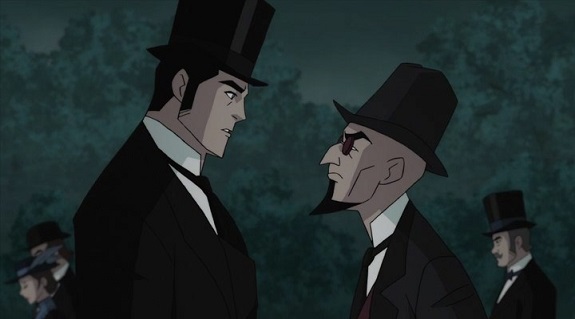
Our first glimpse of Victorian Batman

Two shadows have fallen over Victorian Gotham. One, a human-sized bat, has most criminals running, scared of its theatrical violence and bleakley absolute moral code. The other is Jack the Ripper, doing what Rippers historically just do, terrorizing those the state least cares to predict, especially poor, destitute women. Street justice and moralistic judgement personified. These forces will inevitably come into conflict; they must. Our only question is, which will ultimately represent Gotham’s beleaguered soul?

The 2018 movie Gotham By Gaslight copies the premise, but not the story, of Brian Augustyn and Mike Mignola’s 1989 comic of the same title. Resetting Batman in America's Gilded Age, the time that most resembled the economic inequality which birthed Batman, lets artists play around with bat mythology, keeping the core story intact, but stretching it to encompass larger themes. This movie is about Batman, but like good art everywhere, it’s also about us.

Batman launches his crime-busting enterprise by bringing the pain to a Fagin-like ringleader. So yeah, he initially aspires to simply fight street crime. But within moments, pained cries redirect him to a gruesome, precisely targeted murder. Batman quickly crosses paths with a female vigilante who shares his morbid interest in this crime. But the equally mysterious Selena Kyle has no patience for Batman’s theatrics. Women are dying, women like her, and someone needs to act.

Zach Snyder’s DC movies have faced much-justified criticism, including mine: their lack of heroic optimism, characterized by opponents as “cynicism,” seems to violate what superheroes do. This tone made sense in movies like Watchmen and 300, which dealt with desperate people in hopeless circumstances. But superheroes essentially require belief that something better than the present could potentially exist. Steampunk Batman apparently knows the difference between gritty realism and amoral nihilism, which Snyder’s antiheroes have forgotten.

Steampunk Batman and Selena Kyle square off, after intruding on one another's investigations

Animation director Sam Liu presents a deeply principled Batman, aligned with municipal charities, steering street orphans to a local activist convent, picking fights with law enforcement when they’ve forgotten the meaning of justice. Remarkably, Liu also shows Batman getting his ass kicked: both Selena Kyle and the Ripper are equally prepared for a fistfight. Worse, as we increasingly realize, the Ripper’s ethical motivations run as deep as Batman’s, making both men’s violence equally, brutally incorruptable.

Batman’s appeal has long centered on the fact that he doesn’t have to care. Rich and opulent, he could relax in the luxuries his money could afford, as many did in the 1930s, when the character debuted. This alternate universe makes clear this still applies: in a Gotham so impoverished that men turn to theft, and women to prostitution, just to eat, the city’s wealthy look forward to a richly appointed and cosmopolitan World’s Fair.

Yes, Bruce Wayne need not care. He need not let anybody into his inner circle. But he does: besides employing street urchins and permitting conspiracy theorists to spout their crackpot theories in his ear, Wayne’s closest ally is a nun, Sister Leslie, who has nurtured countless Gotham foundlings. When poor, desperate women are murdered in alleyways, Wayne takes their deaths personally. Unlike Snyder’s gratuitously brutal Batman, this Batman cares, even though he doesn’t have to.

Because Batman cares, he inspires others to care too. Near the beginning, as stated, Batman rescues three urchins from their Fagin-like ringleader. These urchins are named Dickie, Jason, and Timmy—a deliberate reference for comics aficionadoes. When Batman rescues them, they’re desperate, scared thieves, and they quickly return to that life, because it’s what they know. But it doesn’t take long before they’re participating in Batman’s crusade, even when common street wisdom says to run.

Bruce Wayne gets handed an important clue by Dr. Hugo Strange

This doesn’t come without contradictions. Supporting characters lavishly praise the World’s Fair (and Bruce Wayne’s financial support) in early scenes, that veteran fans realize, by the end, it will burn. The only question is how. The thing Wayne’s money has created, Batman’s pulp justice must destroy. In the end, one of Batman’s young Robins says: “It was all phony anyway. We'll make somethin' new, somethin' better.” And we, the audience, think: yeah, we probably will.

Comic-book mythology generally has one underlying ethic: a pure heart, backed with well-placed violence, can restore justice, eventually. That’s what Steampunk Batman does, too, bringing the beat-down in honor of those abandoned by society and economics. He identifies an enemy and pummels him into submission, restoring hope to Gotham's hopeless.Yet he does more, too. By caring when he doesn’t have to, and fighting when he could lose, he gives us permission to believe again.

Monday, January 15, 2018

Indiana Jones in the Temple of Rhyme

Aaron Poochigian, Mr. Either/Or: a Novel in Verse

One sunny weekday, when you’d rather be gallivanting around Manhattan’s privileged haunts, a call comes from your other life. Your Federal Agent handlers require your unique services to recover an ancient artifact. So you pause your daytime undergraduate identity and pursue a mysterious Chinese chest into Gotham’s rankest sewers, literally and metaphorically. But just as you think you’ve escaped this relic’s curse, an even more malevolent fossil threatens to destroy everything New Yorkers hold dear.

Aaron Poochigian is a noted classicist, famed mostly for translating Sappho’s fragments. He’s also published two volumes of his own poetry. So it’s difficult to qualify whether this is his third book, under his own byline, or his sixth. But calling it “a novel in verse” makes it sound more solemn and sententious than it really is. It’s more an Indiana Jones-like pastiche of mid-20th Century pulp potboilers, handled with a poet’s level of care.

Pressed into service, you dive into conflicts that involve alien conspiracies, ancient curses, lingering scars of Western colonialism, and more. In one early scene, you (the narrator insists on the “you” address, though you have multiple aliases) must defend a Chinese jade reliquary from a battle between Maoist insurgents and Latino gangsters, because Manhattan. But you don’t dwell on implications. You aren’t the ruminative type; you’re constantly busy plunging from one high-tension encounter to another.

Poochigian writes with the practiced confidence of a classicist, of someone intimately familiar with time-honored poetic forms because he’s maneuvered them across languages. But poetry, for him, isn’t a dead letter. He uses form because it heightens his story, which, like his shorter verse, is salted with short, punchy vernacular English. It simultaneously does and doesn’t read like conventional poetry:
Business cuts, taupe ties, and muted suits
are shrieking G-men—two more barbered brutes
churned from assembly lines of matching brothers,
each a tool as blunt as all the others.
You’ve always snobbed their brand, detested dashing
douchiness, cursed the smug conspiracy
to fix the markets of what man should be.
Lord look at them, all puff and polish, flashing
badges and sizing up your robot brain….
Most lines rhyme this way, though some parts are written in Saxon-style short, alliterative lines. The shift gives Poochigian’s action scenes real punch.

Aaron Poochigian
Other verse novels I’ve read use poetic language for long, discursive cogitation on important philosophical points; long-form poets think their outsized form gives them permission to write like Homer. Not Poochigian. Calling his storytelling “fast-paced” undersells his turbo-charged cadence. Not only does his story unspool faster than most poets would permit, even most paperback novelists would say “Hey, slow down, dude.” Yet somehow his story always feels quick, never hasty. You decide whether that’s good.

The second-person protagonist of this novel (more like a sequence of linked novellas), has the vocabulary and thought processes of a “C” student at NYU. That is, an average student at a top-flight university. He, you, whatever, has fantasies about chucking everything and becoming a real student, and he romances scholarly types who assist his investigations, in the best James Bond tradition. But time doesn’t permit him to think deeply; he’s a man of action.

This collision between the stately conventions of rhyming verse, and the frenetic exigencies of Poochigian’s story, really sell the tension. Like Indiana Jones, this story isn’t for everyone. I admit, I didn’t initially appreciate Indiana Jones, because I didn’t understand the narrative intent. Like those movies, I struggled to adapt my thinking to Poochigian’s unusual structure. I needed to get several chapters in before I appreciated his form. Some readers won’t give him that chance.

Maybe that’s the message of his title. In opening pages, Poochigian identifies Mr. Either/Or as the hero straddling two worlds, either a student or a secret agent, never quite both. But simultaneously, this book is either an contemporary adventure comedy or a traditional verse epic. And we, the audience, are either willing to follow Poochigian’s journey, or too strung up on formal interpretation. This duality dogs the entire book, forcing us readers to take sides.

So, Poochigian requires readers willing to suspend judgment. That’s not easy for everyone (certainly not me). But, like most of the best poetry, it rewards readers who adjust their rhythms to the verse. It’s just that, where most verse adjusts our rhythms to languid timelessness, Poochigian prefers craggy whirlwind modernity. I don’t think I could do that very often. But I’m glad Poochigian brought me along on his strange, Lovecraftian journey, just this one time.

Thursday, August 10, 2017

The Other Boy Who Could Fly

John Leonard Pielmeier, Hook's Tale: Being the Account of an Unjustly Villainized Pirate Written By Himself

First, his name isn’t Hook. James Cook, great-grandson of the explorer James Cook, is press-ganged into the Queen’s Navy, aged 14, ending his London childhood and Eton education forever. But rumors of treasure lead to mutiny, and Cook finds himself sailing under the Black Flag. Soon his ship crosses the line into a mysterious land where nobody, not even little boys dressed in tattered leaves, ever grows up.

American author John Leonard Pielmeier is probably best-known for his play, and later film adaptation, Agnes of God. Since that classic, he’s become an in-demand screenwriter, especially for adaptations of heavy, difficult literature. But he admits, J.M. Barrie’s Peter Pan first awakened his interest in reading, and in his first novel, he returns to Neverland, retelling the story from the forsaken antihero’s perspective.

Cook finds himself orphaned, expelled, and pressed in quick succession. A comforting life of middle-class London innocence surrenders to harsh sailors’ compromises. Under his captain’s Puritanical supervision, Cook toughens his skin, practices his Latin, and conquers his ignorance. Soon he’s a real sailor. Then the mutiny forces him to choose between honesty and survival. And, on a distant Neverland shore, he finds a castaway who remembers Cook’s long-lost father.

If Peter Pan is the Boy Who Wouldn’t Grow Up, James Cook is the Boy Who Has Adulthood Thrust Upon Him Violently. There’s a Luke Skywalker quality to Cook’s transition, but he often learns the wrong lessons. He abandons his post to discover more about his father. He nurses petty grudges and pursues vengeance so far, he inadvertently injures himself. He admits lying to achieve his ends—then demands we trust him, not Barrie, to tell the real story.

Peter Pan, meanwhile, proves himself capricious, controlling, and worse. Marooned by his shipmates, Cook meets Peter, and both are overjoyed to finally make friends their own age. But Cook doesn’t want to stay fourteen forever. He faces a monster so terrible, even Peter can’t stomach it, and in so doing, wins Tiger Lily’s heart. Peter, jealous that his friend doesn’t live in the eternal present, murders her. Or so Cook says.

John Leonard Pielmeier
Pielmeier strips Barrie’s Edwardian sensationalism. Cook repeatedly insists he’s no pirate, but an orphan caught in something beyond his control. He’s certainly not Blackbeard’s bo'sun. The Piccaninnies aren’t a stereotyped Plains Indian tribe, they’re a proud Polynesian nation, the Pa-Ku-U-Na-Ini. And Neverland isn’t a haven of eternal innocent irresponsibility, it’s a land of Lotus-Eaters where all time gets compressed into Yesterday, Today, and Tomorrow.

Repeatedly, Cook insists he’s no villain. Yet he’s exactly that, if accidentally: everywhere he goes, his presence disrupts the balance. Gentleman Starkey initiates the mutiny because he finds Cook’s treasure map. Peter and the Pa-Ku-U-Na-Ini live in peaceful rapport until Cook interrupts their religious ceremony, breaks Tiger Lily’s prior engagement, and leaves Peter friendless. He even accidentally hastens the Wendy Darling’s kidnapping.

Critics have seen, in Barrie’s Peter Pan, an enactment of the Oedipal conflict, as Peter battles the piratical father-figure and must choose between three ideals of womanhood. I see, in Pielmeier’s Cook, a dark mirror of Campbell’s Heroic Journey metaphor. Pielmeier hits every marker: the Call to Adventure, the Threshold, the Road of Trials, the Temptress, even the Return. But unlike Campbell’s hero, at every opportunity, Cook makes the wrong choice.

Cook insists he’s innocent. But everywhere he goes, he leaves a trail of broken souls and dead bodies. He insists upon his own honesty, and gives a detailed accounting of his actions, while he admits lying to achieve selfish ends. Though book-smart and crafty, he lacks wisdom, perhaps because his lifetime’s experiences don’t match his bodily appearance. Thus, instead of achieving enlightenment, he becomes driven by vengeance and rage.

Maria Tatar writes, of Barrie’s original play and novel, that the dominant theme is futility. The Lost Boys, Piccaninnies, and pirates pursue one another in a permanent clockwise pattern around the island, perpetually enacting time, though they never age. Pielmeier disrupts that: Cook enters a magic archipelago where time means nothing, but instead he brings change. He brings mortality into a land without age. But he never understands this.

Pielmeier isn’t the first author to rewrite Hook’s backstory. Besides Barrie himself, recent entries have included J.V. Hart, Christina Henry, and Dave Barry. However, I particularly like Pielmeier’s psychological depth and emotional complexity. Pielmeier’s Cook is a master schemer, but also a master of self-deception. He successfully complicates Barrie’s original story, but only at great cost to himself, which he clearly hasn’t begun to understand.

Monday, July 17, 2017

A Classic Comic Resurrection Beneath the Earth

Jon Rivera and Gerard Way, writers; Michael Avon Oeming, artist, Cave Carson Has a Cybernetic Eye, Vol. 1: Going Underground

Former spelunker and part-time action hero Calvin “Cave” Carson hung up his spurs and became a family man several years ago. But the excavation company that now employs him has ulterior motives for keeping Carson on a short leash. When a ghost from his past appears on his doorstep, Carson realizes his adventuring days aren’t through. But his employers won’t let Carson go so easily… nor his daughter, either.

DC Comics introduced Cave Carson in 1957, alongside other adventure-oriented titles, featuring heroes without superpowers, like Challengers of the Unknown and the Sea Devils. But Carson never got sufficient traction to become his own franchise; he fought alongside Superman, but always as a sidekick. Lead writer Gerard Way admits he needed to consult a concordance of obscure classic characters to find someone worthy of reboot for his Young Animal imprint.

Newly widowed at the start of this story, Cave Carson struggles to maintain connections with his college-age daughter. He goes through the motions of workplace diligence, but they mostly keep him around for nostalgia: he taught his followers everything they know about underground adventuring, before they eventually outgrew him. Now Carson has the kind of slow, melancholy conversations we recognize from action movies, right before everything hits the fan.

And fan-hitting does occur. One night, tired, frustrated, and alone in his formerly full house, Carson hears a knock. A loincloth-wearing emissary appears at his door. Seems the Muldroog, a lost civilization of mole people, are under attack, and only Carson’s late wife, with her panoply of ancient secrets, can save the underground. But with her gone, apparently a blood quantum is sufficient, because they’ll accept Carson’s daughter instead.

It’s difficult to read this graphic novel without recognizing the debts it owes older stories. Besides reviving an almost forgotten character from the Eisenhower era, and connecting him to characters borrowed from Edgar Rice Burroughs, the art suggests a combination of Peter Max and Astro-Boy. The story has hints of old EC horror comics, a tendency emphasized by sudden jarring images of amorphous fungus people savaging the peaceful natives.

Original promo art,
click to enlarge
Yet this obsessive borrowing doesn’t undercut the story. Like many serial science fiction franchises that don’t bother concealing their roots, like Star Wars and Doctor Who, this story’s connection to older pulp traditions gives it a sense of continuity. We aren’t just reading something generated last weekend like the transient comics of the 1990s that are largely unreadable today. This story connects science fiction’s past to his evolving present.

The emissary at Carson’s doorstep warns him that his employers, EBX, committed the attack on his subterranean nation. So Carson doesn’t even bother bringing his bosses into the discussion. He calls his oldest ally, Wild Dog, an Uzi-wielding maniac who plainly copied his image from the first Quiet Riot album, and goes rogue. Getting off the grid proves easy for a scientist accustomed to caves. Bringing his daughter along proves harder.

Deep underground, the Muldroog have buried a secret for generations. Why else would a nation, apparently blessed by technology but attuned to natural rhythms, continue living in caves? Seems the Muldroog civilization is based upon a lie its people tell outsiders, a curse that keeps giving, provided nobody ever finds out. But what the Muldroog have spent centuries keeping locked up, EBX wants to make into a profit engine.

For all the sci-fi-adventure trappings, this story essentially isn’t about that. Cave Carson’s cybernetic eye, which sometimes goes unmentioned for several chapters, isn’t a driving force behind the story, it’s a metaphor for a man who’s seen things he cannot forget. Carson and his wife told their daughter lies to protect her from hostile reality. Now Eileen’s gone, Cave must bear punishment for those lies alone when truth rushes forth.

This book carries a “Suggested For Mature Readers” label. Please take this seriously. Besides violence, language, and very brief nudity, the themes of long-simmering family tensions shouldn’t be taken lightly. This story introduces themes that most grown-ups will recognize from their own families. Though we perhaps won’t discover our connection to forgotten mole-people civilizations, we all struggle to accept and understand our roots.

Cave Carson is only one among several classic DC characters getting reboot treatments from Gerard Way’s Young Animal imprint. Formerly lead singer of My Chemical Romance, Way’s recent reinvention as a genre writer has made visible several themes always implicit in his music. He admits his comics deal preponderantly with strained parent-child relationships. Well, this story ends in motion; it’ll be interesting to see where he takes these themes next.

Wednesday, November 5, 2014

Parallel Reality and the Human Heart

Claudia Gray, A Thousand Pieces of You (The Firebird Trilogy, Part One)

Marguerite Caine is caught between worlds. Literally. Thanks to her parents’ invention, the Firebird, she can leap into parallel dimensions: a technologically advanced London, Russia where the Revolution never happened, a research colony on the ocean floor. But she isn’t leaping just for fun. Marguerite is seeking the man who killed her father, stole his trailblazing research, and not incidentally broke her heart. Along the way, she’ll uncover dimension-spanning conspiracies that undermine everything she knows.

On one level, journeyman YA author Claudia Gray compiles elements familiar from her genre. For instance, on Page One, she declares unambiguously which character Marguerite believes killed her father. If you’ve read more than one YA novel—well, more than one any-age novel—you realize that, by page 350, circumstances will reverse everything she believes, every obvious judgment. We know where Marguerite’s journey ends; we only read to discover what circuitous route brings her there.

However, that route remains gripping. Gray constructs an elaborate superstructure based on secrets and revelations. Every unveiled event opens a cascade of further secrets, as what begins in an apparent crime proves far larger. Details dropped before page fifty suddenly prove consequential after page 300. Marguerite’s life is massively interconnected; it’s impossible to tell, at any moment, which flippant detail might prove massively important. The complexity of Gray’s story keeps readers eager for another discovery.

Reading Marguerite's story as a straightforward chase narrative with romantic overtones offers a plainly fun story. But that’s like reading The Hunger Games and eliding Collins’ political subtext. Marguerite’s physicist parents believe they’re pursuing “pure science,” knowledge for knowledge’s sake. When their graduate assistant murders her father, leaving not even a body to examine (lampshade!), she discovers all knowledge has moral implications. Continuing revelations push this further, questioning boundaries between pure science and marketable technology.

Gray also invites speculation on themes of identity. Her premise forbids Marguerite to leap, Scott Bakula-style, into just anybody; she only visits dimensions where she somehow already exists. Yet in various realities, she’s a hedonistic orphan, a tzarina, a submarine pilot, and more. Gray forces Marguerite to question the circumstances that created her identity. Had reality unfolded differently, would we make choices similar to those we’ve already made? Are we mere products of our environment?

Claudia Gray
Marguerite’s story proves further intricately connected. Only looking backward can we comprehend just how beautifully Gray has constructed Marguerite’s reality. Seemingly insignificant revelations dropped fleetingly before page fifty prove crucial to explosive climaxes nearly 400 pages later. Once we recognize her elaborate, Jenga-like lattice, we naturally attempt inferences. But Gray constantly frustrates our attempts to predict her narrative: in her tightly woven narrative, the difference between playful scene-setting and dropping serious clues becomes increasingly indistinguishable.

This novel succeeds on so many levels. Despite my paragraphs of literary disquisition, Gray markets a high-tension yarn that sweeps readers along briskly, pace never flagging, characters never growing repetitive. Unlike many eat-your-spinach novels I remember from my teens, Gray wastes little time directly expounding morals; her points arise from characters whose tense situations force them to act. Gray remains a storyteller first, but her story, like life, forces characters and audience into deeper reflection.

Viewpoint narrator Marguerite serves the same basic role as human companions on Doctor Who: somebody needs to translate massively rococo science concepts into small words for the audience. Also, somebody needs to justify science that doesn’t actually make sense (quick scans of Brian Greene dismantle both Marguerite’s Firebird and the TARDIS). Though telling her own story, Marguerite is essentially us, facilitating our vicarious adventures through realities too sleek, romantic, dangerous, or marvelous to ever exist.

Saying “this book isn’t for everybody” seems almost redundant with YA literature. Despite her prudent adolescent narrator and early-twenties core ensemble, Gray drops occasional language and violence—less than typical cable dramas—and brief sex. Though Gray’s telling remains tasteful, parents should realize this ain’t no TBN after-school special. Her characters have sex to express deep devotion, not momentary thrill, and nobody imagines murder plots without violence. Just don’t mistake this for something it ain’t.

Today’s sweeping popularity of YA fiction with adults sometimes drives literary purists into a tizzy. Grown-ups, they say, should read books for grown-ups. Yet reading novels like this, I understand why audiences remain loyal to writing aimed at teenagers. Wise to life’s nuances, but unencumbered by adulthood’s baggage, teens see reality their own way. We adults, glazed in learned cynicism and hip gloom, would recapture that clarity. For one moment, between two covers, we can.

Friday, September 26, 2014

Torture Porn in the Boardroom

Matthew Klein, No Way Back: A Novel

Ex-addict Jimmy Thane wants to rebuild the Silicon Valley career he squandered, and South Florida’s Tao Software offers that opportunity. An eminently marketable product marred by mismanagement, Tao Software just needs Thane’s unsympathetic touch to become profitable—if he can make dwindling cash reserves last. But when cops question Thane about his missing predecessor, he realizes, Tao isn’t just suffering. It’s toxic… and contagious.

Former tech startup guru Matthew Klein brings copious hard-won business savvy to this, his second thriller. He doesn’t, however, bring much thrill. Reading this story, I couldn’t help recalling Joseph Finder’s Paranoia, which uses similar themes to much greater effect (the excellent book, not the dismal film adaptation). But Klein doesn’t create a business thriller, like finder; he writes a hard-boiled mystery, to very limited effect.

Jimmy Thane swings his hammer and busts nuts like an Elmore Leonard refugee. Seriously, exactly like a Leonard character: he uses macho swagger and telegraphic language to impose himself on others. Also to block his inner demons. He’s so focused on cracking others’ heads that he avoids using his. Therefore he never asks why Tao’s previous CEO vanished abruptly. At midday. With his car door unlocked and engine running.

Thane, our narrator, spends pages and pages discussing techniques to salvage foundering venture capital investments. So many pages that Klein evidently forgets he promised us a crime thriller. Nothing criminal happens between page 4 and page 77, then it’s only embezzlement. Klein requires longer to reach thrilling crimes than Dashiell Hammett required to write entire novels. Klein, through Thane, thinks everything involved in running business deserves included herein.

Finder’s vastly superior novel delivered complex insights, not into how business run normally, or even under exceptional circumstances; it focused on how inter-business conduct mimics Cold War espionage. He didn’t need bloody violence to twist the psychological knife. Klein, by contrast, recycles boilerplates familiar from countless postwar noir thrillers. Thus, despite its Net-age trappings, this novel feels dated, like reading somebody’s cheap Raymond Chandler knockoff in an MFA workshop.

Matthew Klein
Rather than integrating the business techniques and the crime narrative, throughout most of the book, Klein keeps them running parallel. Though we suspect the violence has foundations in the business model, they scarcely overlap. Joseph Finder made the business milieu all about duplicity, politics, and scheming. Klein just imposes an unnecessarily violent torture porn narrative onto a business exposé. The noir components never seem to integrate into the story.

Regarding women, Klein’s language is downright appalling. Through Thane, his first-person narrator, he widely characterizes women as “whores” and “dykes” without first getting to know them. Thane calls his receptionist a “loose woman” because she’s beautiful but reads the Bible at her desk. Really, that’s his criteria. Eventually, the sweeping anti-woman slurs become so all-encompassing, I cannot tell whether the ugly language represents Jimmy Thane’s opinion, or Matthew Klein’s.

One woman escapes Thane’s insults: his wife, Libby. Thane praises her persistent loyalty after he descended into alcohol, drugs, gambling, and infidelity. Even after their son drowned in the bathtub, Libby remained faithful, and Thane praises her for her loyalty—while admitting she cries herself to sleep after strikingly joyless sex. In a by-the-numbers noir thriller, I grew bored awaiting the reveal where Thane’s marital illusions come crashing down.

Klein also frustrates readers by using British orthography in an American story. I’m an Anglophile, but having such Yankee-Doodle characters write “cheque,” “centre,” and “neighbourhood” wrenched me outside the narrative. I formerly made this mistake, before my mentor pointed out that if non-British characters write thus, it draws attention to the words, away from the story. If audiences notice the orthography, it divides their attention away from the narrative.

Finally, there’s nothing South Florida about Klein’s South Florida setting. Florida has a culture so distinct that even CNN has shrugged at shocking behavior and mumbled: “Eh, that’s Florida.” Novelists like Carl Hiaasen and Tim Dorsey have written popular, energetic thrillers utilizing Florida’s incomparable culture, but Klein’s novel could’ve been set anywhere. Positioning it in Manhattan, Houston, Santa Clara, or Singapore would’ve changed little, except the humidity Thane deplores.

This story runs so predictable, so tediously banal, that I’m convinced any MBA with my review and a dog-eared copy of Mickey Spillane’s Kiss Me Deadly could’ve written this book. Despite intermittent moments of shocking violence and hard-boiled suspense, the real motors in Klein’s narrative live too far apart to maintain momentum. This novel reads like a sophomore writing exercise, not a grown-up thriller from a major American publisher.