Showing posts with label historical fiction. Show all posts

Thursday, April 9, 2026

The Deep, Dark Mines of the Uncanny Valley

T. Kingfisher, What Stalks the Deep

Shellshocked veteran Lt. Alex Easton’s sole qualification to investigate unexplained phenomena, is that they’ve seen it before without flinching. But where they previously fought ineffable monsters in their native Gallacia, a mysterious Eastern European land of dismal swamps and forests primeval, this time, they’ve been invited to America. But then, if there’s a place as old and as hostile to humankind as Gallacia, it must surely be Southern Appalachia.

T. Kingfisher’s “Sworn Soldier” novellas, starring Alex Easton, whose unique gender identity doesn’t translate into English, each delve into different horror subgenres. The first retold a Poe classic, highlighting a theme Poe introduced, but didn’t explore. The second followed the conventions of folk horror. This third unpack a theme popular in recent movies: the legend of mysterious humanoids dwelling in the caverns and mines permeating America’s eastern mountains.

Dr. James Denton, a supporting character from Easton’s first story, has telegrammed Easton for their help. He admits Easton isn’t particularly qualified, except that they’ve faced similar conflicts before, and he needs a partner who won’t ask stupid questions. So Easton crosses the ocean, rides America’s rails, and walks into West Virginia’s dark, forested mountains, a terrain from which more intrepid explorers have frequently failed to return.

Many American folk myths speculate that something dark and mysterious dwells underground, a horrible monster which we’ll uncover by mining for hydrocarbons or even just spelunking. This monster is usually whispered to be older than humankind, and eager for small provocations to resurge and take America from us. Of course, this is coded language. We “Americans” know who we stole this land from, and why they deserve to reclaim it.

Kingfisher salts these themes with a Lovecraftian influence which she acknowledges in her afterword, but which she doesn’t hammer needlessly. Rather, she describes two war-torn old souls, walking wounded, who investigate a land older than human conception. There, they discover a cavern that cannot possibly exist, guarded by a force so close to human, that its very existence personifies the uncanny valley. But that force is holding something worse back.

T. Kingfisher (a known and public
pseudonym for Ursula Vernon)

Reading this novella, I’m reminded of StanisÅ‚aw Lem’s signal classic, Solaris. Both stories feature humans encountering an intelligence so different from themselves that they cannot truly communicate. Though Easton and Denton have more success than Kelvin in making peace, they struggle with some of the same problems. What does it mean to “communicate” with an intelligence that isn’t human? Or to speak individually with a collective intelligence?

But our protagonists bring something to the story that neither Lovecraft nor Lem considered: capitalists’ willingness to burn everything that doesn’t turn a profit. Lovecraft’s shoggoths and Lem’s ocean planet encounter humans primarily through scientists and explorers. Kingfisher’s primordial intelligence comes to light because humans dynamited the mountains and uncorked Earth’s mantle in search of power and money. Therefore, “first contact” means not curiosity, but pain.

I’ve become a particular Kingfisher fan because she reverses widespread cultural expectations. In this case, besides Easton’s blunt defiance of the Anglophonic gender binary, Easton also sees America as exotic and foreign, reading America back to Kingfisher’s audience. Burned out on conflict, Easton sees American glorification of the Spanish-American war as bizarre and uncivilized. America’s much-bandied national youth seems ridiculous amid Appalachia’s uncountable antiquity.

One could continue unpacking Kingfisher’s themes. Cartesian dualism versus the Freudian psyche, perhaps, or the failures of technological triumphalism in the face of Earth’s unimaginable age. Kingfisher plays with these thematic contrasts and reversals like Lego bricks, creating a whole that readers recognize from previous books, but which is entirely her own. Her ability to use common strategies to tell an uncommon story is why I’ve become a Kingfisher fan.

Although this story remains short, it’s the longest yet of Kingfisher’s Sworn Soldier novellas, over 170 pages plus back matter. This gives Easton space not only to investigate their themes, but also to confront the monster. But this story also has perhaps the largest company of characters yet, and Kingfisher doesn’t give everyone full development. Easton’s loyal batman Angus, in particular, gradually disappears from the story, which is disappointing.

That said, this story largely maintains the momentum of the previous “Sworn Soldier” novellas. Though I might wish the story was about fifty pages longer, to give every character the space they deserve, that would’ve changed the novella-reading experience. Kingfisher’s distinct voice and nonconformist attitude remain visible and keep the narrative popping. It reads like a slice of popular literature, just seen through a lens like you’ve never read before.

Monday, August 25, 2025

A Child’s-Eye View of the End of the World

1001 Movies To Watch Before Your Netflix Subscription Dies, Part 55
Guillermo Del Toro, The Devil’s Backbone

Carlos, newly orphaned and unprepared for violence, is dropped off at an orphanage in the last year of the Spanish Civil War. There he encounters one of the least subtle symbols in cinematic history: an unexploded Nationalist bomb in the front courtyard. Inside, he finds the boys playing out the events of the war outside, without really understanding their roles. He also encounters the ghost of another boy who died under murky circumstances.

This, Guillermo Del Toro’s first feature film, captures several themes which recur throughout his body of work. A society caught in rapid change, and people unprepared for the consequences of that change. A world where life and afterlife are separated by mere moments. The tedium of life, punctuated by flashes of sudden violence.

Carlos struggles to acclimate himself to the orphanage’s internal politics. The concept of “politics” turns unusually literal here: administrators Casares and Carmen support the Loyalist cause, with its rhetoric of democracy and freedom. But that rhetoric sounds hollow when Jaime, the school bully, rules the residents with an iron fist. As often happens with children, the bully appears dominant and charismatic; but like Franco’s Nationalists, he rules erratically and inconsistently.

Looming over the orphanage is the story of Santi, a child who vanished the day the unexploded bomb fell. The timing is suspicious, but nobody ever found Santi’s body. Sneaking around after curfew, Carlos encounters a spectral boy with an open head wound, but the apparition won’t communicate. Instead, it wordlessly indicates something untoward is happening with Jacinto, the orphanage janitor, whose loyalties are strictly to himself.

Del Toro’s storytelling is slow, cerebral, and moody. Despite the wartime setting, his characters spend the most time simply waiting. Jaime and Jacinto, the child and adult bullies respectively, occasionally try to make events happen, to offset their existential boredom; but when their forced actions don’t go according to plan, they feign gape-jawed surprise. Bad people claim to be helpless when bad acts produce bad consequences.

Most importantly, though, Del Toro doesn’t tiptoe around the supernatural themes. Ghost story filmmakers often attempt to skirt their ghosts’ reality, keeping their gossamer spirits in the corner of the shot, where characters can explain them away. Not here. As in other Del Toro movies, the ghost here is real, solid, and centrally framed. When Carlos runs from the ghost, he isn’t fleeing a shimmery haint; Santi’s ghost is palpable, and his blood is still hot.

Carlos confronts the ghost of Santi in The Devil’s Backbone

Jacinto believes the administrators are hiding a treasure that he could steal, in order to ingratiate himself with the Nationalists. Like the ghost, Casares and Carmen’s treasure is real, but nevertheless immaterial. The treasure matters less than the way the treasure makes people act. Greed makes Jacinto reckless, which makes Casares defensive. Eventually the administrators chase Jacinto, the Nationalist bully, out of the building. But that only makes him more aggressive.

The children’s loyalty unfortunately fluctuates. With Casares seemingly ascendant, Jaime declares his support for Casares and the Loyalists. But that reveals to Carlos how cowardly and inconsistent the bully actually is. He takes it on himself to investigate the building, and its resident ghost, willing to shoulder the cost. But when Jacinto returns, now backed with Nationalist support and the ability to actually hurt the children, Carlos realizes he’s now completely alone.

Well, alone except for the ghost.

That brings up one remaining recurrent theme in Del Toro’s work. Yes, in his world, ghosts are real, not something the living can rationally explain away. But they aren’t monsters. Del Toro’s ghosts linger because they need something: an unfinished task, undelivered message, or unresolved injustice. We, the living, can absolve the dead and set their spirits free, but only by paying attention, only by listening without words. For ghosts, this world is purgatory, and the living hold the key.

World events like the Spanish Civil War attract Del Toro, not because they're violent, but because they test human loyalties. (Del Toro would return to the Spanish Civil War for Pan’s Labyrinth.) People have to choose sides in wartime; those who claim neutrality get clobbered by those who care enough to fight. Carlos cares deeply, but without ideological commitment, so he initially gets swayed by superficial charm. He learns, however, to take sides for solid, palpable reasons.

Like with most of Del Toro’s ghost stories, the message here is far from spectral. Ghosts linger because the past isn't really the past, and the living bear a responsibility to those who can no longer speak for themselves.

Wednesday, February 26, 2025

The First and Last Days of Scottish Witchcraft

C.J. Cooke, The Book of Witching

A calamity has occurred on an uninhabited island in the Orkneys, in Scotland’s sparsely populated far north. Three teenagers reenacted a pre-Christian ceremony, with all the cocksure enthusiasm of teenagers; but it’s ended with one teen dead, another maimed, and the third missing. Now the adults around them must reconstruct what happened, because a malevolent force nobody’s yet seen may have something to profit from the catastrophe.

C.J. Cooke, a sometime university professor, has gained renown for her intensively researched, historically themed dark fantasy novels. This is no exception; not many horror novels include a works-cited page. For this volume, she delves into one of Scotland’s darker episodes. Even by witch trial standards, Scottish trials were notoriously brutal, a revolting mix of Christian piety and state-sanctioned torture which extracted confessions through truly appalling means.

In 2024, Clementine Woodbury struggles to understand the events that stranded her daughter in a Glasgow burns unit. Once lively and free-spirited, Clem’s daughter Erin has grown moody and secretive since becoming a teen mother. With Erin under sedation in a sterile room, Clem can’t ask direct questions about her mysterious injuries, so she takes her granddaughter and commences a freelance investigation. She isn’t prepared for the secrets she uncovers.

Parallel to Clem’s investigation, Alison Balfour stands accused of witchcraft in 1594 Kirkwall. Though the accusation carries whiffs of religious paranoia, Alison quickly realizes the truth: she’s a pawn in a powerful dynastic struggle for control of the Orkneys. Her confession, or lack thereof, will determine which rapacious aristocrat will control Orcadian government—though either outcome will be disastrous for ordinary smallholders like her family.

Cooke’s balance between these two narratives asks important questions. What debts do we moderns owe for injustices performed centuries ago? And what obligations do we bear to future generations? Alison Balfour realizes quickly that she can’t prevent her own unjust death; she can only determine what consequences her death brings upon others. Clem can’t pinpoint what caused her family’s sufferings, but clearly something dark lingers in her heritage.

C.J. Cooke

Though marketed as a “thriller,” this novel’s contemporary portion more resembles an amateur sleuth mystery. While the police struggle to fit Erin’s grievous injuries into their pre-written crime narrative, Clem assumes responsibility for uncovering what happened to her daughter. If this means scrambling into Scotland’s enigmatic, impoverished north to confront a secretive cabal, she clearly considers this an acceptable price for a truth she might not like.

The historical portion, meanwhile, is explicitly political. Orkney suffers under a government that rules by stoking fear among the population, retaining power by convincing the population of an even worse enemy. Alison knows she can’t win this battle. Therefore she’s forced to redefine victory according to what keeps her family and her people alive. Cooke reconstructs a poorly documented time of paranoia, recorded only through state and religious propaganda.

Therein, Cooke tacitly acknowledges something often forgotten in histories of witch hunts: they weren’t the flexings of invincible empires, eager to demonstrate their power. Witch hunts happened after the church-state hybrid began losing unquestioned authority. Alison Balfour’s execution happened a generation after the Scottish Reformation, as the Stuart monarchy clung to dwindling authority. Witch hunts are the superannuated flailings of a broken empire already in retreat.

In this, Cooke shows an aristocracy terrified of its people. Patrick Stewart, Second (and last) Earl of Orkney, sought the church’s benediction because he knew the people already organized against him, that the trade guilds that built his palaces were also hotbeds of insurrectionist intrigue. The Earl and his retinue yearn for unquestioned power, but the very fact they must resort to such extremes proves they’ve already lost the people’s devotion.

Alison Balfour works as a peasant healer among people who survive in nature’s bounty; but palace intrigues and state paranoia drag her into early modernism. Clem Woodbury trusts medicine, modernism, and police technocracy; but she’s forced to delve into her lost heritage and forgotten bloodline when modernity can’t answer her questions. Both women discover truth hiding in secretive corners, that nothing’s ever as simple as the official narrative would claim.

Cooke creates a story of nuance and complexity that rewards multiple levels of reading. She uses the markers of paperback thrillers, and on that level, one could read this book casually, like any other beach novel. But Cooke also asks questions about heritage, responsibility, and power, which don’t yield themselves to easy answers. Especially in Europe, where aristocratic paranoia still casts a long shadow, is the past ever really gone?

Tuesday, December 17, 2024

Witches of the World, Unite!

Alix E. Harrow, The Once and Future Witches

The three Eastwood sisters carry old resentments, and their household witchcraft is fairly lackluster, letting them eke by in 1893 America. But, after seven years of estrangement, they bump into one another in the busiest square in New Salem. Their unexpected reunion corresponds with the emergence of a fortress unseen since the age of myth. The Eastwood sisters must ask themselves: are they the chosen ones to restore American witchcraft?

Alix E. Harrow, who was a professor of American and African American Studies before becoming a full-time novelist, does something similar here to what Susanna Clarke did with her breakout novel, Jonathan Strange and Mr. Norell. Harrow combines the trappings of modern fantasy with the great, socially engaged novels of the 19th Century. Harrow’s take is, unsurprisingly, more American in tenor, but it accomplishes the same goals with comparable aplomb.

Harrow creates an alternate America where magic actually exists, and the great witch-hunters of colonial antiquity had a point. (She plays somewhat loose with historical dates, so plan your response accordingly.) The Salem Witch Trials ended in a massacre, the entire village razed to ferret out the relatively small number of actual witches. The survivors hurried to create New Salem, their moral utopia of Christian privilege and mechanized industry.

Into New Salem stumble the Eastwood sisters. Hedge witches from the agrarian hinterlands, they have accepted lives of compromise in New Salem’s patriarchal system. But their forced reunion causes the entire city to glimpse Avalon, the last bastion where the storied St. George purged the last true witches. The sisters attempt to escape what appears to be Fate forcing their hands, but every sidestep draws them closer together.

But a specter looms over New Salem. Gideon Hill, an avaricious political candidate, promises to purge witchcraft, trade unionism, moral decay, and the kitchen sink. His stump speeches combine rhetorical nods to Christianity with a laundry list of grievances for White citizens feeling threatened by rapid change. Taken for himself, Hill is greasy and unpleasant, but not dangerous. Except he’s riding a wave of public umbrage to the mayor’s office.

Alix E. Harrow

In some ways, Harrow writes a standard fantasy narrative. The Eastwood sisters resemble heroes like Frodo Baggins or Geralt of Rivia, true believers who must resist a rising tide of injustice, even when they’ve grown fatigued. Mass-market fantasy loves its beleaguered underdogs. But, removed from Neverland and placed in a milieu American readers will remember from high school history class, the themes become exceptionally poignant for current audiences.

These themes of alienation and moralistic terror could describe 1893 or today. Harrow laces her narrative with allusions to Dickens, Marx, Upton Sinclair, and others, but not fatuously. For Harrow, these writers describe the American experience amid rapid change, an experience that remains unsettled 130 years later. Powerful people resist change because it threatens their authority, and they seek ways to make the populace complicit in their oppression.

Harrow demonstrates that hierarchies of power rely on equal measures of power and deceit. The Eastwood sisters must resist Gideon Hill’s instruments of physical force, but they must also unlearn messages of fear and self-doubt that they’ve internalized throughout their lifetimes. They must fight injustice, even when they’re tired, even when they’re ready to have normal human-scale relationships, because the fight is right, and because there’s nobody else.

We feel for the sisters, in their struggle to liberate Avalon from the patriarchy, because they are human. Yes, the truth of Avalon is vast and metaphysical. But their story is ultimately about people: about the jobs we accept to pay rent, the relationships that make the battle worthwhile. Therefore when the sisters rise up against tyrannical bosses, pietistic politicians, and toxic partners, we undertake that journey with them.

Further, Harrow avoids facile answers to difficult problems. She has at least three moments that, in conventional genre fiction, would’ve signaled the story’s culmination and the sisters’ ultimate triumph. But in Harrow’s telling, there is no grand culmination, no moment of eternal transcendent victory. Instead, the story keeps changing, the conflict evolves to reflect the characters’ complex world evolving with them.

By combining the nostalgia of historical fiction with the splendor of paperback fantasy, Harrow creates a story that readers can immerse ourselves in, with characters who feel like our friends. But she also addresses themes that the great (male) writers of American literature introduced viewed from another angle. We can enjoy this engaging story of complicated characters. Or we can recognize ourselves, and our struggles, amid Harrow’s urgent themes.

Tuesday, December 10, 2024

Knowledge That Died in the War

Jayne Anne Phillips, Night Watch: a Novel

Young ConaLee comes from a part of West Virginia hill country where people don’t need, or know, one another’s last names. Therefore it isn’t strange that she doesn’t know hers, or her mother’s Christian name. When the aggressive interloper that ConaLee knows only as Papa (though he isn’t her father) tires of ConaLee’s family, he deposits them at the lunatic asylum in Weston, ConaLee must maintain the illusion of post-Civil War respectability that she’s mastered.

Author and professor Jayne Anne Phillips’ novels focus on lonely souls wandering an America they don’t understand. She won the Pulitzer Prize for this novel, which focuses on the loss of knowledge that follows war. Phillips’ characters spend the story pursuing information, and the healthy closure that come with it, and several times come perilously close to finding it. They never know how close, though, because unlike we readers, they have only a limited perspective.

Yanked out of the only life she’s ever known, ConaLee wants to protect her mother from more harm than she’s already experienced. ConaLee blames herself for her failure to ward of Papa, a Confederate deserter and sexual predator. This self-blame is certainly unfair, since she’s only thirteen. But the wider world ConaLee experiences at the Weston lunatic asylum [sic] makes her realize how small and uninformed she is, leaving her desperate for any momentary understanding.

Her mother passes as Miss Janet, a well-to-do who keeps her secrets zealously. Glimpsed from her perspective, though, the story changes. Her husband, ConaLee’s father, enlisted at the start of the Civil War, believing that valorous service would grant him status. They ran from ignominious beginnings, after all, and live in constant fear of capture. Service would grant both of them a legal name and freedom from the hunt. Sadly, he just never came back.

John O’Shea, the asylum’s Night Watch, knows that isn’t his real name. Wounded at some distant battle, he lost all memory before the War. He earned a pseudonym and discovered a talent for helping those who, like him, lost mental capacity through trauma or abuse. He continues searching for his past identity, feeling the gnawing sensation that someone, somewhere, waits for him. We know, as readers, who that is, but his wounded memory remains slippery.

Jayne Anne Phillips

Overseeing everything is Dearbhla (pronounced “Dervla”), a patient watchwoman who is half doting grandmother, half Irish swamp witch. She longs to restore ConaLee’s sundered family and exorcise Papa’s damage, but without better skills, she remains an observer. She wanders throughout the Virginias, seeking the lines of knowledge which war severed, always one step removed from finding it. Readers see how close she comes, always doomed to mishear a valuable clue or to miss something important.

Phillips’ narrative might meet the criteria of “postmodernism,” since it deals with the finitude of human knowledge. Her characters stumble blindly, always just barely failing to glimpse the truth, because they don’t understand their place in the narrative. Because they don’t know it’s a narrative. We readers understand we’re reading a novel, and therefore we grasp the importance of the many missed clues. But meaning is something readers impute, not something these characters naturally have.

Novels like this turn on degrees of disappointment. Characters are condemned to repeat the patterns of dancing right up to the precipice of understanding, then dance away again, never realizing how close they came. We wait on tenterhooks to see when the characters will realize what’s obvious to us, knowing that when they do, some other form of disappointment will follow. The limits of human perspective, and the fallibility of human memory, keep them blind.

The narrative voice reads more like a prose poem than a novel. Or like several braided poems. ConaLee, home-schooled on the books her mother can afford, mostly Dickens and the Bible, speaks in a lyric voice which differentiates her from more pragmatic characters, like the asylum doctor. O’Shea, a complete tabula rasa, has a plainspoken patter, a strict noun-verb voice bereft of ornament. War has changed how characters speak, leaving them with outdated, peculiar voices.

Human beings, Phillips implies, exist within a broader tapestry. But seen from inside, we never grasp the part we play, the thread we leave behind. Meaning comes only when we view the story from outside, which individuals can never do. Knowledge is something we create, not something that exists. And, as characters change names like shirts, even our identities come from our actions, not our beings. Someday, looking back, we’ll glimpse what it all meant.

Wednesday, April 12, 2023

The Women of the American Revolution

Amy Harmon, A Girl Called Samson: a Novel

Deborah “Rob” Samson grew up as an indentured servant in colonial Connecticut, surrounded by farmer boys and their dreams of war and glory. So when the American Revolution started, she watched her foster brothers enlist, and she watched the condolence letters come home. But Deborah believes the high-minded Revolutionary ideology, and memorizes the Declaration of Independence. It only makes sense for her to eventually run away and enlist.

The first thing to remember when reading prolific author Amy Harmon’s latest historical novel is that Deborah Samson (or Sampson) was a very real person. She really enlisted near the culmination of the Revolution, serving for seventeen months as Robert Shurtliff. Therefore, Harmon’s story is circumscribed by history, and often lacks the unity and panache of wholly fictional stories. Life often lacks a plausible through-line.

Rather than inventing the story, Harmon invents Samson’s untidy inner turmoil. She creates a heroine who reads the Bible and Thomas Paine, and believes their exhortations. What Samson doesn’t believe is the narrative given her, of the importance of finding a husband and assuming domestic duties. She doesn’t want a colonial woman’s limited options; she wants the life promised to the men surrounding her, and she’ll lie to achieve it.

Harmon presents this novel as the memoir Deborah Samson never wrote. (She spoke prolifically, but left few texts.) Samson describes the various lessons learned from authority figures around her: the parish pastor who encourages her literacy, the employers who treat her more like a daughter than the help, and her foster brothers. She learns to trust her own capabilities, and shows little patience with social niceties foisted upon women.

But when she hits adulthood, something changes. Everyone around her begins pressuring her to marry; by colonial standards, she’s considered an old maid at twenty. Modern audiences will surely sympathize, as authorities spend a child’s first eighteen years encouraging them to dream, then the rest of their lives telling that former child to wake up. To us, Samson’s refusal isn’t rebellious, it’s a reasonable response to unreasonable expectations.

Amy Harmon

That collision between the story’s historical context and the audience’s expectations is where I begin having problems. Harmon trusts our instinctive reactions, which makes sense in reading a contemporary setting. When several men (including one of her foster brothers) make fumbling attempts to court Samson, she dismisses them flippantly, as we would; she doesn’t linger on them. And she doesn’t emphasize what an act of moral rebellion this refusal is.

Our story unfolds from there, more a series of episodes than a unified narrative. Samson progresses from bucolic agrarian childhood, through the relationship pressures of adolescence, to adulthood and enlistment, with remarkably little friction. Along the way, Samson has various encounters with historical figures; though Harmon creates a fictional array of enlisted men to annoy Samson, the officers in Harmon’s narrative are actual people taken from the record.

One example should emphasize my disappointment. When Samson finally enlists (on the second try), she’s rostered with a battalion of locals who josh her for being young and pretty. They don’t know she’s marching in drag, obviously. These local regulars are one-dimensional, and identified entirely by their surnames. One youth shows some glimmerings of complexity, just before they’re all killed in a skirmish with De Lancey’s Brigade.

This narrative arc is taken directly from countless war movies. Bigger, more aggressive recruits haze our timid protagonist, but the arrogant swashbucklers are ill-prepared for war, and die quickly in front of our protagonist. The hero must then face the survivor’s guilt. Once again, Harmon relies upon our familiarity with the narrative trope, because she doesn’t return to it, or dive any deeper into the consequences.

Such problems abound. Samson has various encounters, which are isolated and seldom plumbed deeper. She acquits herself admirably in battle, and eventually becomes General John Paterson’s personal aide. Harmon ramrods in a Twelfth Night-ish implication of sublimated romance, then largely abandons it. Any of these might’ve been profitably expanded to a full-length novel, or deep-dive short story anyway. But Harmon mainly name-checks the war movie tropes, then blithely moves on.

The historical Deborah Samson was eventually discovered. In an unusual twist, she received, not a reprimand, but an honorable discharge, for her distinguished service; she later became the first woman to receive a U.S. Army pension. She was among her era’s few women to resist gender roles, and win. Samson was admirable, and Harmon clearly admires her. But admiration isn’t enough; this low-friction version of Samson’s story is ultimately lukewarm.

Monday, January 16, 2023

India’s History and the War for the Soul

1001 Films To Watch Before Your Nexflix Subscription Dies, Part 48
Santosh Sivan (director), Ashoka

Prince Ashoka has become the most successful general in the Mauryan Empire, a claim he makes despite, not because of, his royal standing. A younger son of a lesser queen in the Emperor’s harem, nobody expects Ashoka to inherit, least of all his favored brother Susima. When Susima deliberately refuses to support his brother in battle, Ashoka manages a massive strategic victory, then returns to the capitol, intent on vengeance.

World cinema should, ideally, offer ambitious audiences an opportunity to immerse themselves in somebody else’s culture for a few hours. Unfortunately, Hollywood’s carcinogenic influence has undercut that recently; filmmakers must appeal to English-speaking audiences to make bank. This Hindi-language movie therefore makes an interesting contradiction. It embraces the full vaudeville cheese inherent in Bollywood masterpieces, while striving to tell an important story of historical and cultural significance.

Despite his military proficiency, Ashoka proves less capable of palace intrigue. His initial plans for vengeance against Susima and his other brothers fails, and he narrowly avoids an attempted assassination. At his mother’s insistence, Ashoka flees the palace, posing as a commoner and sleeping rough. This experience teaches Ashoka important lessons in humility, but it also gives him a long-overdue opportunity for love, when he meets Kaurwaki, exiled princess of Kalinga.

Shahrukh Khan, India’s biggest matinee idol, plays Ashoka in a manner Western audiences might find jarring. One moment, he has smoldering, Brad Pitt-like charisma and an understated performance, stone-faced and impassive, the character happening entirely in his eyes.The next moment, he turns into a caricature, chewing scenery with the aplomb of Gary Oldman. No matter his tone, he always carries a sure and placid confidence in his star power.

These tonal shifts reflect the Bollywood culture that birthed this movie. Bollywood has certain requirements. For instance, every movie requires five tightly choreographed song-and-dance routines. Four routines directly advance or comment on the plot; the fifth is pure lowbrow spectacle. Americanized audiences unfamiliar with Bollywood convention may feel back-footed when the prince begins singing and dancing for the first time. But that confusion is half the fun.

Ashoka is an important figure in Indian history. He pushed the Mauryan Empire to its greatest geographical expanse, and he sponsored massive artistic and public-works projects. Many of his surviving artworks are among India’s national treasures, and have weathered 2,300 years remarkably intact. But at his empire’s peak, he converted to Buddhism, foreswore violence, and rededicated his empire to helping India’s most defenseless peoples. History doesn’t exactly record why.

Kareena Kapoor as Princess Kaurwaki and Shahrukh Khan as Prince Ashoka

This movie speculates on the forces leading to Ashoka’s conversion. The resulting mix is both personal and national, both contemporary and historical. Ashoka’s life among the poor and destitute reflects the Buddha’s own mythological journey outside the palace walls. But his personal romance with a foreign princess reflects important modern concerns, that while Ashoka was a product of his times, he also rejected those times for deeply personal reasons.

Director Santosh Sivan directs this picture in ways that reflect Ashoka’s dualism. He designs his shots with Peter Jackson-like simplicity that makes the Iron Age setting come alive. The Mauryan palace has timber frames and beaten metal ornaments that bespeak both poverty and ambition. Important character moments happen while Ashoka hides out in windswept caverns and candlelit temples. Shadows cut deep across his face as he chews up his enemies.

And chew them up he does. Sivan recreates military conquest in images that would make Cecil B. DeMille envious. The movie cuts from conversations inside stone-walled taverns to massive cavalry charges as quickly and effortlessly as Ashoka’s military lifestyle requires. Ashoka’s relationship with his bodyguard Virat begins with slapstick that would make American directors flinch, and concludes in truly heartbreaking tragedy.

The contrast of tones, not only within the movie but within principal characters from scene to scene, creates a jarring disjunction that English-speaking audiences might find uncomfortable. Sivan includes broad physical comedy in a tragic film, and religious rumination in a war epic. Western audiences aren’t accustomed to such juxtaposition. This film dropped in 2001, about the time American TV and movies shifted to whispered dialog and solemn, unsmiling faces.

However, that very juxtaposition bolsters this movie’s themes. Sure, Ashoka lived around the same time as Alexander the Great, and we’d consider him ancient. But the concerns that forced him to reject empire and embrace transcendence, aren’t only located in the past. Ashoka laughs, gets drunk, and adores his mother; he also gives reign to murderous rages and destroys entire nations. Because ultimately, so do we.

Wednesday, March 16, 2022

The Truth, the State, and Store-Bought Justice

1001 Movies To Watch Before Your Netflix Subscription Dies, Part 46
Michael Apted (director), Gorky Park

Three corpses lie buried in snow in Moscow’s most popular amusement park. Evidence suggests they were shot in broad daylight, two of them more than once, yet somehow nobody noticed. Then, when a curious KGB officer with no regard for procedure partially uncovers them, they reveal their most grisly sacred: the bodies have been mutilated, their faces and fingertips flensed. No way of knowing who they were.

The film noir tradition has its history in places of moral degradation and political malaise: Vichy France, London’s dockyards, McCarthyite America. Working from a novel by Martin Cruz Smith, director Michael Apted applies the same principles to Soviet Moscow. Apted leads us through a world where politicians love ideology but don’t live by it, where money greases the Cold War’s wheels, and evidence doesn’t determine truth, the state does.

Chief Inspector Arkady Renko (William Hurt) tries to unload the Gorky Park murders onto the KGB, not because he believes the murders are political, but because the KGB so clearly doesn’t want them. He’s accustomed to turf battles with state enforcement, so the state’s hasty acquiescence worries him. Especially when the autopsy reveals that at least one anonymous corpse belongs to an American national, an oddity in Soviet Russia.

Despite the Soviet Union’s society nominally being undivided by class, Renko is something of Moscow aristocracy. His superiors repeatedly name-check his father, a war hero, which probably explains why he outranks officers significantly older than him. Renko has, however, chosen a career in the Militsiya, the nationalized Soviet civilian police force, a dimly regarded profession for a member of the nomenklatura. This causes suspicion among an already distrustful bureaucratic hierarchy.

That same hierarchy quickly introduces Renko to Jack Osborne (Lee Marvin), an American importer. Osborne wears slick suits, seems chummy with Moscow’s swells, and sleeps with much younger Russian women. When Osborne starts asking pointed questions about Renko’s investigation, Renko starts suspecting Osborne’s motivations. It seems Moscow’s chief prosecutor might share those suspicions, and urges Renko to investigate further.

Martin Cruz Smith wrote the original novel after spending several weeks in Moscow in the late 1970s. His book, and Apted’s subsequent movie, were condemned as anti-Soviet propaganda, and banned by the pre-Glasnost state. However, in fairness, Smith’s American characters hardly emerge smelling like roses. When Jack Osborne transparently bribes Soviet officials, those officials buy in hastily, making Osborne complicit in state-based suppression of facts.

Lee Marvin (left) and William Hurt at the big reveal of Gorky Park

Besides Osborne, another American begins probing the investigation. William Kirwill (Brian Dennehy) lurks around the crime scene’s periphery, but when Renko approaches, Kirwill rabbit-punches him and runs. Renko, his curiosity piqued, searches Kirwill’s hotel room, where he finds a gold-plated badge. Seems Kirwill, like Renko, is a homicide detective, NYPD. Renko quickly reminds Kirwill this isn’t his patch, and confiscates the badge.

Throughout the movie, the Moscow nomenklatura remind one another that Renko is one of Russia’s best homicide investigators. Quickly, however, we discover what “best” means. He casually lies to informants, threatens witnesses, and carries an unregistered sidearm. Despite showing no ambition to rise in the Soviet state, a tendency which worries his power-hungry superiors, Renko mixes a strong belief in justice, with a casual disregard for procedure and tedium.

Renko’s attitude arises from his circumstances. He learned early that powerful people manipulate rules, that the state’s ideological rigidity doesn’t translate into honesty. The same Soviet enforcers who censor media and redistribute private property, maintain a background life of lavish parties and under-the-table financial dealings. They attempt to break up the back-alley black market economy, while maintaining the exact same practices in their gilded offices and lavish country dachas.

Apted’s physical design emphasizes the movie’s moral themes. His Moscow (mostly shot in Helsinki, Finland) is constantly saturated with light. This illumination doesn’t make anything clearer, though: reflected off concrete buildings and mounded snow, Moscow’s constant sunlight is more blinding than enlightening. William Hurt squints into this overlit streetscape with the intensity of a man who loves and defends his people, but has clearly come to hate his city.

In some ways, this movie is distinctly dated. Its Reagan-era anti-Soviet propaganda, backed with James Horner’s melodramatic score, clearly belongs to the early 1980s. But in other ways, with its intrusive government that dictates policy, and its police who guard order without underlying principles of justice, this movie clearly describes our present. It’s easy to see ourselves, and the authorities who dictate our lives, portrayed in this film.

Because really, in forty years, neither post-Soviet Russia nor America has learned very much.

Monday, March 14, 2022

Magic Riders on the Underground Railroad

Nicole Glover, The Conductors

Hetty Rhodes didn’t smuggle dozens of escaping slaves to freedom in Philadelphia during the Civil War, just to watch them get murdered. But that’s exactly what’s happening. During the precarious Reconstruction years, White police have little interest in violence perpetrated in Philadelphia’s Black community. So Hetty and her husband Benjy take it on themselves to investigate, armed only with ingenuity and a little carefully chosen magic.

Nicole Glover’s debut novel channels multiple well-loved writers in the crime, historical fiction, and fantasy genres. But Glover also establishes her own voice based on her characters’ precarious economic and social positions. She writes from a position simultaneously outsider, kept down by institutional barriers and stark, unquestioned racism, but also insider, as her characters establish their own community in the shadow of White dominion.

The first body shocks everyone. Charlie Richardson, an escaped slave like Hetty and Benjy, parlayed his natural wits, and limited moral reserves, into a local fortune, but made enemies along the way. Because the community doesn’t trust lawmen, witnesses turn to Hetty, whose experience on the Underground Railroad has made her a local legend. But when Hetty begins investigating, she discovers a cursed mark carved into Charlie’s flesh.

Before long, Hetty’s astrology-based wizardry begins finding traces of magic strewn across Philadelphia. Hetty is an unusually skillful spellcaster, but in a city where magic is an artisanal skill, sold from street-corner stalls, her celestial powers get lost in a cacophony of evidence and rumor. Then the second body appears, suspiciously close to Hetty and Benjy’s door. Seems the killer’s motives are personal, and the Rhodes family themselves are targets.

Because of how books are marketed, Glover’s story will draw comparisons to writers like Laurel K. Hamilton and Jim Butcher, fantasy novelists whose supernatural elements heighten their gritty, crime-strewn urban settings. But reading Glover, my mind drifted to Walter Mosley. Both authors feature characters transplanted from their home communities, into segregated cities that prove to be anything but promised lands. Both address how cities create, and enforce, racial boundaries.

Nicole Glover

And both, in differing ways, deal with how law often functions as an impediment to order. Hetty and Benjy Rhodes, like Mosley’s Easy Rawlins, investigate crimes which law enforcement openly disregards. They accept penny-ante payments for their inquiries, and have to maintain day jobs among the suspects they’re investigating. They do this because, if the community doesn’t enforce ethics and punish wrongdoers, nobody will. Their neighborhood has to govern itself.

The Reconstruction-era setting emphasizes Glover’s themes of division and community. With the Civil War over, America has forgotten its pledges to Black citizens, who live marginally. Though key plot points turn on a local Black political machine, it’s dominated by men (specifically men) desperate to be seen as reputable by White Philadelphians. Notably, Black wizards aren’t allowed to own wands, just as freed Blacks weren’t allowed to own guns.

Magic, in Glover’s telling, isn’t a preternatural workaround for difficult situations, a way to suspend physics. Instead, it’s a skill, and a common one: every storekeeper and housewife has a few spells handy, just in case. Hetty is remarkably skilled at “Celestial Magic,” but so is the murderer. She uses magic like James Bond uses his famous gadgets, a handy way to escape momentary problems, but ultimately a tool.

Perhaps you’ve noticed that I felt deeply invested in Glover’s atmospheric storytelling. For her, magical Philadelphia isn’t a background; she immerses readers in an intricately realized environment. An important side point in Glover’s novel is that Hetty is a renowned storyteller, who spins elaborate yarns of her Civil War adventures spontaneously for eager listeners. This lampshades the parts of storytelling that clearly interest Glover most.

But don’t overlook the mystery aspect of Glover’s storytelling, either. The murders, which start out with only a handful of loosely spaced clues, become more tangled as the investigation progresses. Hetty and Benjy have to pursue evidence without official help, even as the killer clearly aims at them. As a veteran mystery reader, I started a suspect list and tested it against the mounting evidence. But even I was wrong.

Glover’s writing hooks you early and keeps you engaged. Her style is familiar enough to genre readers that it won’t jar anybody, or probably change anybody’s understanding of the genres; but she uses readers’ expectations as a foundation to build on, not as a hammock. Her writing is familiar, but not passive. Even as I recognized the influences that shaped Glover’s voice, she never stopped finding ways to surprise me.

Thursday, February 24, 2022

Our Lady of Grace in the Snow

Peter Manseau, The Maiden of All Our Desires: a Novel

The distant convent at Gaerdegen has a secret. The Benedictine sisters gather to work and pray like mendicants throughout Christendom for centuries. But between their ancient prayers, they possess a more intimate connection with God. Mother Ursula, their chapter’s founder, bequeathed them a substantial trove of mystical insight. In a world still reeling from the Black Death, Mother Ursula’s words hint at secrets hiding behind Christian mortality.

The dust-flap synopsis on Peter Manseau’s eleventh book, and second novel, seems to promise something similar to Umberto Eco’s The Name of the Rose. A distant abbey, a heretical book, a secret the episcopate will move mountains to keep hidden. But Manseau offers a different book. It’s much more intimate and humane, a portrait of sinners trying, where their limited vision permits, to glimpse the purpose tying their lives together.

Mother John, the convent’s second abbess, has spent twenty years preserving Mother Ursula’s vision of prayer, work, and simplicity. Under pressure from other convents, which increasingly run like businesses, Mother John preserves her abbey’s traditions, and personally sweeps the cloisters daily. But even her sisters don’t know her secret: she joined the convent to flee her family obligations, and didn’t really convert until spending years inside the convent.

Father Francis, the abbey priest, resents his posting. Exiled to Gaerdegen to conceal his indiscretions, he feels slighted, a thinker and craftsman who could’ve brought Christ to the masses. But his solemn words conceal his unwillingness to own his past transgressions. His sins, both of commission and of omission, leave a trail of destruction, which renders him distrustful. He foresees destruction in the plague-ravaged land, with nothing to offer but fear.

On one level, this novel describes one day within Gaerdegen. As the sisters await a vindictive bishop, who promises a church trial to expunge veneration of Mother Ursula, a blizzard descends. Trapped in close proximity, the sisters and their resentful, authoritarian priest begin voicing old resentments, and engaging in political posturing. Nothing less than the future of their honored abbey hangs in the balance.

Peter Manseau

But while this surface story unfolds, the characters travel back along the paths that brought them here. Father Francis remembers the entirely human passions, the capacity for love, that defined his early priesthood. Francis created art from the thickly forested land around them, but also from his personal relationships within the community. When those relationships embarrass the bishop, Francis finds himself exiled, unable to either preach or practice his art.

At Gaerdegen, Francis clashes with Mother Ursula. He finds a woman capable of great holiness, but also great rage. As the plague decimates the cities, leaving many sisters with no earthly family, Francis and Ursula have very different ways of facing this tribulation. Both visions are founded in a mix of Christianity and hard experience. Yet, faced with the same evidence, these two professional holy people reach completely opposite conclusions.

Manseau mostly avoids truth claims about the religious controversies driving his characters. A professional scholar of religion, he’s written extensively about the collision between faith and doubt before, and apparently has few ready-made solutions. Instead, he foregrounds the personalities, the lifetime of influences that steer how people of open hearts and mystical souls can disagree so wholeheartedly. Manseau dares ask: what if nobody is right? Or wrong?

To these characters, words have power. Encouraging homilies written years ago by thoughtful mentors can change the course of lives. Words spoken in anger create clefts not easily mended. Worst of all, words spoken carelessly can have consequences far beyond the moment. Words give true believers courage against a world turned grim and bloody, while powerful people fear the authority words of love can have.

It’s tempting to find contemporary references in Manseau’s heavily symbolic story. Metaphors of money and disease, of walls and doors, seem timely, and that probably isn’t coincidental. But Manseau isn’t talking about us, or not only about us. His characters, like his readers, keep seeking beauty and certainty in a world driven by fear and doubt. They never entirely find it, but maybe the seeking matters more than the finding.

Again, the synopsis implies a political thriller in a time of historic uncertainty. But the actual book is more gripping simply because it’s driven by honesty. Good people of upright character wonder which anointed leader to trust. What happens when two incompatible choices, both supported by God, force us to pick sides? Maybe it’s better to do something, even if it’s wrong, than to get lost in philosophy.

Wednesday, March 4, 2020

Sean Connery On Age and Dignity

1001 Movies To Watch Before Your Netflix Subscription Dies, Part 38
John Huston, The Man Who Would Be King
Richard Lester, Robin and Marian


The 1970s saw Scottish actor Sean Connery taking an unusual chance in mainstream movies: he got old. Though only in his forties, he retired from playing James Bond, allowed himself to go bald onscreen, and took roles playing men facing the reality of age. Two of those movies got shoved into the niche of boyish period pieces, which is unfair, because they’re two of the best films he ever created.

1975’s The Man Who Would Be King starred Connery, Michael Caine, and Christopher Plummer, directed by John Huston. That should’ve been enough to secure classic status alone. But it also derived from a Rudyard Kipling novella, originally written in praise of English colonialism, which revisited Kipling’s themes from a perspective of realizing the empire was already doomed. The themes derived are massive.

Connery and Caine play former British NCOs, veterans of the Anglo-Afghan wars. Retired and bored, they adopt that classic British hobby: exploration. They wander into an Afghan province so remote, no outsider has conquered it since Alexander the Great. Warring clans have spent two millennia battling over Alexander’s legacy, a battle into which our heroes inadvertently stumble. When an arrow fails to kill Connery, they take him for a god.

Former enemy clans band together, believing Connery to be Alexander’s heir, a king heralded by prophecy, and Caine his emissary. The two morally dissipated British establish their petty empire on false promises, misuse of religion, and greed. Fat on conquest, with the province’s treasury at their disposal, Caine suggests absconding to England and living off their proceeds. Connery, however, has begun believing his own snake-oil pitch.

Class matters in this story. The Scottish Connery and the Cockney Caine, poor outsiders in Britain, find themselves monarchs in Afghanistan. Connery dreams of meeting Queen Victoria as an equal. Caine, meanwhile, finds himself torn between conflicting moralities: he’s a common adventurer, who subsidizes his thrill-seeking with crime. But he’s also a Freemason, which binds him to specific loyalties. Being viceroy jeopardizes both.

Sean Connery and Michael Caine in The Man Who Would Be King

In 1976, Connery revisited similar themes in Robin and Marian. Directed by Richard Lester (A Hard Day’s Night), and featuring an all-star cast, including Audrey Hepburn, Richard Harris, Ian Holm, and Robert Shaw, this film features similar motifs of reconsidering childhood myth in adulthood. This time, the myth is Robin Hood, grown old and disillusioned after his outlaw days are over. He’s too old for glory, too young to die.

Robin has discovered King Richard is as venal and corrupt as the Prince he once fought against. After King Richard dies ignominiously, Robin returns to Sherwood, unsure of his virtue. There he finds his Merry Men have become common horse thieves, and Maid Marian has joined a convent. With Prince John elevated to king, old grudges are liberated to fight again. Except for one impediment: the Sheriff of Nottingham won’t have it.

King John attempts to restore his greedy iron hand over England’s North, while Robin attempts to rebuild his Merry Men. Robin wants to turn the clock back ten years: violence, romance, and justice. He wants Marian to rejoin him in the forest. Marian, however, is sincere in her monastic vows, and attempts to broker peace between the parties. Robin literally punches her and drags her back to Sherwood Forest.

In contrast, the Sheriff of Nottingham appears downright genial. He refuses the king’s men access to his shire, preferring to enforce law locally—and is strategic in which laws he enforces. Robin and Nottingham have different visions, based on whether they live in the present or the past. They also have different experiences with their battle, because they’re getting old. Both find themselves tuckered out after relatively short clashes.

These two historical dramas reflect different points in British history, but share important themes. Both take periods famous for myth-making and national glory, and view them through a post-imperial eye. They both, in essence, admit that Britain will keep fighting wars it’s already won, until it exhausts itself and, by winning the war, loses the peace. The end result of great national glory, these movies imply, is national disappointment.

But despite their ponderous themes, these movies are also great fun to watch. They display Connery, a man clearly relishing the transitions of time, just being an old man enjoying the push forward. Both movies mix their pontifical messages with dry humor, splendorous landscapes, and beautifully choreographed fight scenes. Yes, they admit, the empire was always doomed to fail. But didn’t we live a full life on the way there?

Sunday, March 17, 2019

Our Lady Mary Magdalene of Ireland

1001 Movies To Watch Before Your Netflix Subscription Dies, Part 30
Peter Mullan (writer/director), The Magdalene Sisters

In 1964, three women from different parts of Ireland find themselves ripped from their lives and forced into the Magdalene laundry. Overseen by battalions of hard-faced nuns, the girls, none older than twenty, are forced to toil as penance for sexual sins most haven’t even committed yet. They struggle under the convent’s harsh rule, which literally desires to control their souls. But they keep one eye on the outside, and plan for their eventual escapes.

Officially called “Magdalene Asylums,” the Magdalene laundries started out as places prostitutes and other “fallen women” could rebuild their lives and achieve redemption. Many were established throughout the world, including Britain and America; the Irish laundries, however, became an unmitigated horror show. When the nuns operating the laundries discovered they were making a profit, their original Christian mission went by the wayside.

Writer-director Peter Mullan focuses on three women among the dozens held captive at the laundry. Rose (Dorothy Duffy) is an unmarried mother, anathema in a Catholic country. Margaret (Anne-Marie Duff) was raped. And Bernadette (Nora-Jane Noone), an orphan raised in a church home, is simply too pretty and warm to boys’ attention; the nuns at her orphanage believe she’ll inevitably produce more orphaned children for the church to raise.

All three get shipped to the laundry by relatives or caretakers—it’s somewhat murky where the story takes place, though it was inspired by UN reports of abuses at a laundry based in Cork. Mother Superior of the facility, Sister Bridget (Geraldine McEwan), comes across as soft-spoken and amiable to her wards. However, it quickly becomes clear she relishes power, demonstrated by moments of casual sadism, and cares mostly about money.

The girls remain trapped in the laundry for four years, working ten-hour days and six-day weeks. As the only reliable service able to process the laundry produced by a large swath of Ireland, their services are in constant demand. And we see it pays well: the nuns eat buttered toast and bacon for breakfast. The girls who do the actual work, however, eat oatmeal and water.

Worse, the girls are subject to constant abuse. Not only are they overworked by the nuns, and physically punished for insignificant infractions, but the pries, Father Fitzroy, who wants to reform the laundry, becomes corrupted by the culture and starts sexually abusing a developmentally disabled girl. The men who drive the delivery lorries, meanwhile, who are the girls’ only contact with the outside world, often trade sex for favors.

Mother Superior (Geraldine McEwan) leads a line of trapped workers (left to
right Anne-Marie Duff, Nora-Jane Noone, and Dorothy Duffy) in The Magdalene Sisters

Mullan focuses on character drama on character, letting larger history speak for itself. Unlike Neil Jordan, writer-director of Michael Collins, Mullan doesn’t lecture about history, or make Irish facts digestible for international audiences. He instead forces characters into an intolerable situation, and lets their actions speak for themselves. His heroines have two choices: either conform to a corrupt system, or break out by force.

The Magdalene nuns repeatedly promise the girls, when they’ve achieved salvation, they’ll be permitted back into the world. As years drag on, however, and the girls find themselves unconsciously mimicking the power hierarchies that control them, we start to realize: not everyone will escape. They’ve internalized the nuns’ system of abuse. The convent has lost interest in salvation; as Bernadette observes once, they only care whether the work gets done.

The cozy relationship between Church and government during the early Irish Republic often corrupted both institutions. Police helped dirty priests cover their sins, while idealistic young clergy often tried to change the system from within, but found the system changing them. Ireland consistently proves a point I’ve long believed: individual Christians often create powerful good, but the Church, like any other institution, serves mainly to protect itself.

In 1993, long after the events depicted here, property developers working land formerly owned by Dublin’s Magdalene laundry uncovered a mass grave containing 155 skeletons of unidentifiable girls. By this time, the Dublin convent was Ireland’s last Magdalene laundry, and the outcry generated by this discovery forced its closure. Only after the laundries ended did anyone officially discuss their existence, or the church-state relationship that made their abuses possible.

Peter Mullan made this movie partly to raise awareness of the Magdalene abuses, which weren’t officially redressed until 2013. Within Ireland, this movie helped make these crimes visible, but international audiences should watch too. Only by staring directly at the history of religious intolerance and state corruption, can mass populations, Christian or secular, ensure these crimes aren’t repeated. Because bigotry like this still exists in our world.

Monday, August 20, 2018

The Moment Dogs Made Us Human

Keda (Kodi Smit-McPhee) and his wolf (Chuck, a Czechoslovakian Vicak) in Alpha

The movie Alpha begins with its principal character Keda’s (Kodi Smit-McPhee) funeral. After a mishandled moment in a bison hunt, Keda gets flung from a cliff and trapped on a ledge overlooking a ravine, dazed and senseless; his tribe mistakes him for dead, and his father builds him a ritual cairn. He passes through the ceremonies of death, which probably makes this the first of the remarkably literal moments of heroic journey in this movie.

Director Albert Hughes sets this story in “Europe, 20,000 years ago,” a convenient time for historical dramas, since there’s remarkably little history available. We know humans existed, because we’ve recovered bones and rudimentary tool heads, but no known documents, textiles, or complete settlements exist. This lets Hughes liberally combine influences of Tibetan, Inuit, Siberian, and other cultures, to create a hybrid that exists somewhere in the mists of human subconscious, unburdened by boring old facts.

The Hero’s Journey has existed, as a philosophical concept, since at least the 19th Century, but is probably best known from Joseph Campbell. It postulates the idea that mythological experiences share a similar structure, which reflects the human experience across cultures. The hero, who both represents everybody and mentors humankind, passes outside civilization, wanders the wilderness, and returns home transformed, ready to teach us. Think the temptations of Christ, or Buddha’s long journey to enlightenment.

For Keda, this journey is unusually literal. Abandoned by his people, ritually dead and buried, he goes outside civilization because civilization has walked away from him. In a world with only the most rudimentary technologies, Keda cannot survive alone. But early on, he proves himself soft-hearted, unable to kill an already subdued boar, even for food. So when he wounds a wolf that tries to kill him, Keda still cannot leave this predator to die.

Hughes utilizes this preconscious environment well. His Ice Age hunters have elaborate systems of ritual, but no particular religion. Other than occasional references to ancestor worship, the people’s rituals are remarkably utilitarian. Keda and the other youth undergoing manhood rites have tattoos placed on their hands and arms, but these aren’t totems of glyphs; they’re maps to navigate the steppes by the stars. The people’s cairns aren’t holy sites, they’re signposts back to the village.

Kodi Smit-McPhee as Keda in Alpha

Keda nurses his wolf to health, thinking they’ll achieve some ill-defined truce, until it returns to its pack. The idea of humans and wolves working together apparently never crosses his mind. Keda lives in a world where humans use animals for their parts: flesh for meat, skin for textile, bone for tools. But apparently no human has ever decided to cooperate with another species. In Keda’s world, human tribes collaborate peacefully, but not other species.

This movie rejects Thomas Hobbes’ interpretation of human motivations. Life among the people is not “nasty, brutish, and short,” nor is it a “war of all against all.” The movie’s opening scene depicts a bison hunt performed with military precision… until Keda’s accident. In Keda’s world, humans work together. So when he, abandoned by his people, meets a wolf abandoned by its pack, the transition to cooperation requires little leap. Humans are primed to collaborate.

This is a remarkably optimistic interpretation of humanity. We’ve become accustomed to the Ayn Randian interpretation of humanity as essentially competitive, of life as an essentially savage zero-sum game. We construe war, distrust, and advantage-seeking as innately human; think Arnold Schwarzenegger in T-2, intoning dolefully how it’s in human nature to destroy ourselves. Albert Hughes dares reject this, instead believing, as an increasing cohort of sociologists do, that early human survival necessarily required open-hearted cooperation.

From this environment, Keda ventures forth. He’s learned to trust other people; but part of his adulthood rituals also involve surviving a good pummeling, since life outside the village is frightening and painful. Humans we trust, nature we fear. We depend upon animals, but we don’t share with them; that belongs only to humans. But Keda, scorned for soft-heartedness, sees in animals the qualities we trust in humans. Keda sees animals as souls like his.

This openness allows him to do something no human before him has ever accomplished: work equally with animals. His alliance with his wolf comes because he takes natural human cooperation and extends it to all species. And when they return from his journey in the wilderness, becoming, in the people’s eyes, alive again, he’s prepared to lead humanity to its next stage. Keda isn’t exactly a prophet, but he’s truly a teacher of his people.

Tuesday, July 10, 2018

The Batman Movie We Need Right Now

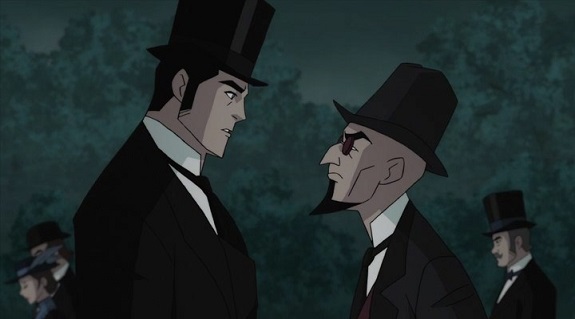
Our first glimpse of Victorian Batman

Two shadows have fallen over Victorian Gotham. One, a human-sized bat, has most criminals running, scared of its theatrical violence and bleakley absolute moral code. The other is Jack the Ripper, doing what Rippers historically just do, terrorizing those the state least cares to predict, especially poor, destitute women. Street justice and moralistic judgement personified. These forces will inevitably come into conflict; they must. Our only question is, which will ultimately represent Gotham’s beleaguered soul?

The 2018 movie Gotham By Gaslight copies the premise, but not the story, of Brian Augustyn and Mike Mignola’s 1989 comic of the same title. Resetting Batman in America's Gilded Age, the time that most resembled the economic inequality which birthed Batman, lets artists play around with bat mythology, keeping the core story intact, but stretching it to encompass larger themes. This movie is about Batman, but like good art everywhere, it’s also about us.

Batman launches his crime-busting enterprise by bringing the pain to a Fagin-like ringleader. So yeah, he initially aspires to simply fight street crime. But within moments, pained cries redirect him to a gruesome, precisely targeted murder. Batman quickly crosses paths with a female vigilante who shares his morbid interest in this crime. But the equally mysterious Selena Kyle has no patience for Batman’s theatrics. Women are dying, women like her, and someone needs to act.

Zach Snyder’s DC movies have faced much-justified criticism, including mine: their lack of heroic optimism, characterized by opponents as “cynicism,” seems to violate what superheroes do. This tone made sense in movies like Watchmen and 300, which dealt with desperate people in hopeless circumstances. But superheroes essentially require belief that something better than the present could potentially exist. Steampunk Batman apparently knows the difference between gritty realism and amoral nihilism, which Snyder’s antiheroes have forgotten.

Steampunk Batman and Selena Kyle square off, after intruding on one another's investigations

Animation director Sam Liu presents a deeply principled Batman, aligned with municipal charities, steering street orphans to a local activist convent, picking fights with law enforcement when they’ve forgotten the meaning of justice. Remarkably, Liu also shows Batman getting his ass kicked: both Selena Kyle and the Ripper are equally prepared for a fistfight. Worse, as we increasingly realize, the Ripper’s ethical motivations run as deep as Batman’s, making both men’s violence equally, brutally incorruptable.

Batman’s appeal has long centered on the fact that he doesn’t have to care. Rich and opulent, he could relax in the luxuries his money could afford, as many did in the 1930s, when the character debuted. This alternate universe makes clear this still applies: in a Gotham so impoverished that men turn to theft, and women to prostitution, just to eat, the city’s wealthy look forward to a richly appointed and cosmopolitan World’s Fair.

Yes, Bruce Wayne need not care. He need not let anybody into his inner circle. But he does: besides employing street urchins and permitting conspiracy theorists to spout their crackpot theories in his ear, Wayne’s closest ally is a nun, Sister Leslie, who has nurtured countless Gotham foundlings. When poor, desperate women are murdered in alleyways, Wayne takes their deaths personally. Unlike Snyder’s gratuitously brutal Batman, this Batman cares, even though he doesn’t have to.

Because Batman cares, he inspires others to care too. Near the beginning, as stated, Batman rescues three urchins from their Fagin-like ringleader. These urchins are named Dickie, Jason, and Timmy—a deliberate reference for comics aficionadoes. When Batman rescues them, they’re desperate, scared thieves, and they quickly return to that life, because it’s what they know. But it doesn’t take long before they’re participating in Batman’s crusade, even when common street wisdom says to run.

Bruce Wayne gets handed an important clue by Dr. Hugo Strange

This doesn’t come without contradictions. Supporting characters lavishly praise the World’s Fair (and Bruce Wayne’s financial support) in early scenes, that veteran fans realize, by the end, it will burn. The only question is how. The thing Wayne’s money has created, Batman’s pulp justice must destroy. In the end, one of Batman’s young Robins says: “It was all phony anyway. We'll make somethin' new, somethin' better.” And we, the audience, think: yeah, we probably will.

Comic-book mythology generally has one underlying ethic: a pure heart, backed with well-placed violence, can restore justice, eventually. That’s what Steampunk Batman does, too, bringing the beat-down in honor of those abandoned by society and economics. He identifies an enemy and pummels him into submission, restoring hope to Gotham's hopeless.Yet he does more, too. By caring when he doesn’t have to, and fighting when he could lose, he gives us permission to believe again.

Wednesday, April 4, 2018

The King's Rebellious Archbishop

1001 Movies To Watch Before Your Netflix Subscription Dies, Part 24
Peter Glenville, director, Becket


King Henry II of England (Peter O’Toole) thinks being king is amusing. When not fighting useless wars to bolster his popularity, Henry engages in vulgar debauchery at London’s taverns and whorehouses. He merely tolerates his sons, despises his wife, and picks fights with the church. And he has elevated the Saxon Thomas Becket (Richard Burton) to aristocracy, apparently to provoke his French-speaking Norman court. When the Archbishop of Canterbury suddenly dies, Henry spots an opportunity.

Closely adapted from a play by French dramatist Jean Anouilh, this movie resembles widescreen Technicolor epics of its generation, movies often helmed by outsized personalities like David Lean and Richard Attenborough. But it has a different moral fiber, a conflict driven by two characters’ very different expectations. Henry, born to rule, has become an ethical black hole. Becket, a commoner, has authority thrust upon him, and finds himself transformed. The contrast will resonate for centuries.

Like wealthy people throughout history, Henry is fascinated by commoners. He admires their Saxon language, their earthy values, their disregard for courtly duties. But like most class tourists, he mistakes poor Britons’ tools of survival for moral laxity. He thinks he can become Saxon by getting drunk, having irresponsible sex, and generally behaving like a boorish lout. At the beginning, Becket is Henry’s enabler. By encouraging Henry’s flamboyant lifestyle, Becket gains the trappings of nobility.

Eventually Henry needs somebody pliant in positions of actual authority. He thinks he can control Becket, so he invests Becket with nobility and makes him Lord Chancellor. To Henry’s shock, Becket takes his authority seriously, even siding against Henry in a brief dispute. Petulant at this apparent betrayal, Henry creates new, meaningless responsibilities for Becket, and leaves his former friend running the household while he chases military adventures. Everyone expects Becket to fail, including Becket.

Peter Glenville directed this adaptation, having previously directed the play’s Broadway debut. To his credit, Glenville doesn’t merely film a stage play; though his long, eye-level takes create a theatrical look, his camera work is remarkably subtle, jumping between viewpoints without self-conscious showmanship. Keeping with contemporary film technology, Glenville’s production is somewhat set-bound. However, the sets are elaborate; the stone walls look hand-mortared, the furniture rough, like it was hewn from oak with an axe.

Peter O'Toole (left) and Richard Burton, as Henry II and Thomas Becket

Today’s audience, accustomed to HD imagery often shot through grey filters, may find Glenville’s saturated Technicolor pictures jarring. This technology creates screen images both more and less real than today’s directors favor. Glenville uses Technicolor’s vibrancy to his advantage. Henry flounces around England in military jerkins and tight pantaloons, ornamented with gold and jewels, to highlight his colorful but stern personality. Becket favors bright primary colors as a commoner, graduating to more somber tones later.

This happens especially when Henry presses his advantage. Having picked fights with several bishops by levying taxes on church property, he has few ecclesiastical allies. A vacancy in Canterbury, the primate church of England, leaves the state church rudderless. Before Rome appoints a successor, Henry races in and (possibly illegally) installs Becket as Archbishop, thinking the suddenly popular bureaucrat will favor state interests. Again, Becket surprises everyone by taking his responsibilities, and England’s faith, seriously.

Then as now, the relationship between Church and State is deeply problematic. Henry wants an Archbishop to sanctify his debauchery and glory-seeking; Becket wants a King that will fight for the virtues he pretends to have. Thrust into power over England’s immortal soul, Becket rediscovers the desperation and hunger his fellow Saxons never forgot. Secure in his cathedral, Becket feels no compunction against naming his former friend’s increasingly visible sins. The two are never reconciled.

Admittedly, this movie is somewhat squishy on history: the actual Becket was Norman, not Saxon, and though he died unpopular, Henry II was never as debauched as this depiction. These and other casual inaccuracies come directly from Anouilh’s play, which took dramatic license to convey its message. Like Shakespeare, Anouilh sees reality as less important than truth. This story takes Henry and Becket on one shared journey, from which they learn two very different lessons.

At nearly two-and-a-half hours, this movie is comparable to The Bridge on the River Kwai, and shorter than The Ten Commandments or O’Toole’s other legendary star vehicle, Lawrence of Arabia. Yet despite a running time that wouldn’t discomfort most cinema managers today, this film certainly fits the description of “epic.” It invites viewers to join its characters on a journey that leaves them, us, and their entire world transformed. We cannot finish this movie unchanged.