Showing posts with label mythology. Show all posts

Tuesday, December 23, 2025

The Sleeper and the Beauty of Dreams

T. Kingfisher, Thornhedge

Toadling, a human foundling stolen by evil sprites, has guarded the nameless castle for 200 years, while civilizations rose and fell around her. Hidden behind an impenetrable thorntree wall and a blighted desert, the keep once governed a pastoral kingdom. But through the centuries, Toadling has secured the fortress, and ensured the old stories were soon forgotten. All for one reason: to assure the sleeper within never wakes.

This is my third T. Kingfisher novella, and each retells existing stories from new perspectives. Here, Kingfisher retells “Sleeping Beauty” as a dark fantasy, in which the princess and the fairy who cursed her dwell in a dysfunctional symbiosis. Except that the story which everyone tells has grown distorted by retelling, and there’s a deeper violence sleeping in the tower. But the fairy Toadling has never told her story.

Into the myth rides Halim, an itinerant Muslim knight without a war to fight. Uninterested in tourneys and too amiable for mercenary work, he seeks another avenue to make his name. So he approaches the fabled castle, pursuing the “fair maiden” supposedly immune to time. Instead, Halim finds Toadling, a half-fairy hybrid who, after centuries of isolation, is eager to confess her secrets. Assuming anyone will believe her.

“Sleeping Beauty” has evolved over centuries. Early forms exist in Italian and Catalan folktales, though the version we know comes mainly from Germany by way of France. The story’s development has taken some weird turns, but all share one characteristic: until the later Twentieth Century, the eponymous princess has no autonomy. She’s merely the passive, often nameless battleground between patriarchy and a dark netherworld.

Kingfisher reinvents the princess as Fayette, too young to understand her own unfettered power. But there’s a second princess, Toadling, a human who learned magic while growing up in fairyland. Toadling came to Fayette’s christening with one simple gift—and promptly fumbled it, trapping herself and Fayette inside the king’s castle. Thus begins a battle for power that threatens to become apocalyptic if they slip out of balance.

T. Kingfisher (a known and public
pseudonym for Ursula Vernon)

Mass-media critic Jude Doyle sees, in many stories of feral adolescent girls, a shared fear of our sweet child becoming a woman. There’s something here. But where conventional stories conflate this fear with sexual maturity, Kingfisher finds something else. Catholic theology and the “age of accountability” lingers in the background. As Princess Fayette becomes old enough to answer for her choices, we wonder whether she really has free will.

Doyle dedicates an entire chapter to the changeling myth. The sweet babbling infant learns to walk and talk, and suddenly, the poor harried mother becomes terrified of what she’s created. This being, once part of me, has become willful, greedy, possibly destructive. Why, this must be a monster from a dark netherworld, not a human child anymore! Toadling and Fayette become diametrical forms of this internal conflict, the good and bad daughters, ego and id.

The story unfolds forward and backward. Toadling knows she out to keep Halim away from the sleeping princess in the tower, to fulfill the enchantment that keeps her safe. But after centuries of loneliness, she permits Halim to carve his way through the titular thorn hedge. As he works, she tells her story, which contradicts the centuries of legend that have accrued to her. Halim must decide who he believes.

Kingfisher writes with a plainspoken style that’s become common in genre fantasy lately. Not for her either C.S. Lewis’ playful voice nor Tolkien’s stern epic storytelling. Toadling, her viewpoint character, is definitely a supernatural being who has survived two centuries alone with an onerous responsibility. But she’s also a young woman, stuck for centuries in her early twenties, desperate for someone to talk to.

On one level, we could read this as a grim, grown-up fairy tale. It’s short enough to read in one dedicated evening, builds to a taut double climax, and pays off with a firm resolution. Kingfisher’s characters are sober without being ponderous, and her revision of a well-loved fairy tale takes risks without veering into silliness. Kingfisher hits Sleeping Beauty’s beats without ever feeling beholden to the old story.

But there’s another level. Toadling tries different tactics to control the other, darker princess, but her internal abilities aren’t enough. Only when she trusts another person with the secrets she’s been carrying, will she finally reconcile the conflict between the good and bad daughters. Only then can she walk away from the thorn hedge she built around her childhood home, and venture out into the world.

Saturday, March 22, 2025

Why Ostara?

A 19th century engraving depicting
Ostara (source)

Each year during Lent, social media surges with claims that Easter derives its name and mythology from the Anglo-Saxon fertility goddess Ostara. These memes often include claims about how Ostara gives us numerous Easter myths: that rabbits and eggs were her sacred symbols, that her worship involved sexual rituals which early Christians suppressed, even that Ostara died and rose again. These claims are largely fictional; Ostara’s actual mythology is lost.

Less interesting than what Anglo-Saxons believed, or didn’t, about Ostara, is the eagerness with which online critics invent Ostara mythology. No information about Ostara, beyond her name, survives, yet commentators assert a panoply of just-so stories, many beginning with “it’s said” or “the story goes,” variations on the folkloric “Once Upon a Time.” Some such stories are pilfered from Germanic or Near Eastern religions; others seem to be purely fabricated.

Such attempts to revive otherwise lost pre-Christian religions seem counterintuitive. The so-called New Atheists, like Sam Harris and Richard Dawkins, claim that scientific modernity doesn’t need creation myths and just-so stories to organize society. Yet even as Christianity seems ever-further removed from today’s culture, at least a vocal contingent seeks moral justification, not in science, but in ancient myth. The very antiquity of pre-Christian myth gives it exotic appeal.

Multiple factors contribute to why Christianity, and its myths and practices, are fading in Western Civilization. Clergy abuses, past and present, surely contribute. Christianity’s association with warlike, nationalistic, and racist factions doesn’t help. Even its ancient texts, unchanged since the Iron Age, makes it seem weighted with antique baggage. But I’d suggest one important reason Christianity seems distant from modern culture: the religion focuses heavily on death.

Why does Jesus’ suffering and death dominate Christian theology? The Apostle Paul highlights Christ’s crucifixion and resurrection, far beyond Jesus’ moral lessons. Christianity originally spread amid conditions where death was commonplace; most people died, not in hospitals, but at home, surrounded by family. Funerals were massive public gatherings signified by music, food, and other festival trappings. Such events still sometimes happen in rural areas, but have become uncommon elsewhere.

A 19th century Easter card (source)

Rather, modern death has become aberrant. The most common causes of death throughout history—tuberculosis, malaria, bubonic plague, polio, tetanus, whooping cough—have become rare in the last century, the time when Christianity saw its fastest decline. Even industrial accidents and war wounds are treatable in ways past generations didn’t know. Death, once so ever-present that people discussed their funeral preparations over family dinner, has become rare, distant, and distasteful.

Theologians have created convoluted justifications for Christ’s death and resurrection. As Fleming Rutledge writes, virtually no such justifications withstand scrutiny. But for early Christians, no justification was necessary; Christ died because we’ll eventually die, probably sooner rather than later. That camaraderie with God brings comfort. I’ve known two atheist friends who embraced faith and prayer when loved ones were dying, then returned to unbelief when the crisis passed.

But death doesn’t define Ostara. Though some online stories claim she dies and is resurrected every spring, these stories are peripheral. The made-up myths generally highlight fertility, growth, planting, and sex. Concocted myths prioritize life, flourishing, and birth, which seem closer to modern daily experience. In a culture where death seems abnormal, a unifying spiritual narrative privileging birth and life arguably makes sense. Penicillin rendered Christianity obsolete.

This stumbles on one important problem: we’re still going to die. As someone who recently watched a loved one struggle on life support before the merciful end, I find the Easter narrative of God’s mortality comforting in new ways. But we’ve made death distant and antiseptic, hidden inside hospital or nursing home walls, no longer present with daily life. Death has become atypical, but we’re still going to die.

Speaking personally, in past years, I’ve found the romantic mythmaking of Ostara merely treacly. This year, it’s become something more pointed, something harsher. It’s become an active denial of human inevitability, and a shared refusal to accept the human condition. Modern technological society hides death, and dying persons, in antiseptic conditions, pretending they don’t exist. Life has become an eternal present, a permanent now.

I’ve written about this before: myths are ultimately not about the truth, they’re about the people who create them. But in this case, the attempt to invent new “ancient” myths about a lost folk religion aren’t just explanations. They reveal a way modern society denies an important aspect of life, and hides our mortal end like a shameful thing. These myths look cute, but they’re subtly dangerous.

Friday, March 15, 2024

Everyone Loves a Dragon Queen, Part 2

This essay follows my prior review, Everyone Loves a Dragon Queen. In the review, I attempted to avoid spoilers. In this essay, I make no such effort; if you would like to watch the movie, please do so before reading any further here.
Princess Elodie (Millie Bobby Brown) has had it with your myths, in Damsel

When Prince Henry tosses his bride, Princess Elodie, into the dragon’s chasm, on one level we witness a conventional myth. Like Jesus or Orpheus, Elodie must pass through the grave, defeat the chthonic monster, and return bearing the truth. On another level, we witness an uncomfortable reality that past myths elided: that the truth our hero brings from beyond the grave isn’t what we want to hear. And we don’t know how that truth will change us.

Tolkien and Lewis aggressively embraced fairy tales in a specific context, following the degradations of two world wars. Both fought in World War I before becoming scholars, then sat helplessly through World War II and the Blitz. As Christians, both men believed true morality existed, but they couldn’t see it around them. So they sought moral certitude in distant lands and times, an evasion of the present which Lewis himself acknowledged outright.

Today’s fairy tales, like the movie Damsel, emerge from a different context. Where both Tolkien and Lewis yearned to restore divinely anointed god-kings to their fairylands’ thrones, we live in the backwash of colonial empires, unable to pretend the past we admire consisted of unadulterated goodness. No matter where we live, our land was seized from another people, maybe recently, maybe centuries ago. But literally everyone lives on stolen land.

Damsel enacts this myth in stark realism. Queen Isabelle of Aurea and her superficially charming son, Henry, live on land stolen from the dragon. They admit this during the closing rituals of the marriage ceremony. They must propitiate this distant past through continual sacrifice, through the blood of those descended from the original settlers. Aurea’s continued glittering prosperity relies on someone reënacting that original conquest.

Here we might benefit from consulting prior religious scholars. Émile Durkheim believed that religion begins by extoling the people’s innate virtues; God, Durkheim believed, came late to religion. What Durkheim called “primitive” religion simply preserves the people’s shared virtues by ritualizing them. Mircea Eliade went further, seeing the liturgical calendar as a continuing reënactment of the religion’s founding moments. We walk forever in our prophets’ shoes.

In this regard, Queen Isabelle acts not as her nation’s political leader, but its priest. (No commoners speak in this movie; every character is aristocratic, or an aristocrat’s courtier.) She enacts her nation’s founding sacrifice, preserving peace and stability through blood. Sure, she uses a technicality to weasel out of the actual sacrifice, making beautiful foreigners pay Aurea’s actual blood debt. But the forms matter to national religion, not the spirit.

Princess Elodie (Millie Bobby Brown) and Prince Henry (Nick Robinson)

Passing through the grave, Princess Elodie returns with the capital-T Truth that Aurea’s founding myth is a lie. Aurea’s founding king attacked the dragon, not to preserve his people, but to enlarge his own glory; he slaughtered the land’s original inhabitants, the dragons, purely for spite. The dragon appears monstrous to living humans because mythology has created this terror, but Truth says humans must abandon this belief and confront their own guilt.

The parallels with modernity are so stark, they need acknowledged but not explicated. As an American, I realize my Anglo-Saxon ancestors seized this land from its prior inhabitants. But that’s what Anglo-Saxons do, as they also previously conquered Britain from its Celtic inhabitants. Not that those Celts were innocent, as their mythology describes seizing Britain from Albion, a terrible giant whose exaggerated evil resembles that of Elodie’s dragon.

Every human nation sits on conquered land. Every nation also has founding myths to justify that conquest. Virgil invented a conquest myth to justify Roman military might, and India’s earliest Vedic poetry is a fight song in praise of seizing a neighboring tribe’s women. Only recently has public morality evolved to consider conquest unsavory, mostly after two World Wars, when technology made conquest both visible and grisly in wholly new ways.

Damsel ends with Aurea’s capital in flames. Though the camera lingers on Queen Isabelle’s death, we know nothing of the civilians caught in that conflagration. Because although every myth and fairy tale agrees that exposing the Truth will liberate the oppressed, we don’t know what comes next. The Bible claims that the triumphant Truth will simply conclude this Age. This movie follows the scriptural precedent, burning human kingdoms down and sailing into a vague future.

Lewis and Tolkien loved fairy tales because they believed their mythology could address modern questions without modern moral blurriness. Damsel arguably takes the same tack. However, it proceeds from an assumption that the mythic past wasn’t as pearly as prior generations believed.

Wednesday, February 28, 2024

Burnt Offerings in America, Part Two

This essay is a follow-up to Burnt Offerings in Modern America
Émile Durkheim

Unfortunately, when men (and it’s mostly men) like Thích Quảng Đức, Mohamed Bouazizi, or Aaron Bushnell offer themselves as burnt offerings, we don’t know where those offerings go. With burnt offerings of animal flesh in the Epic of Gilgamesh or the Hebrew Tanakh, offerings go directly to God or the gods, who take delight, pleasure, and nourishment from humans’ sacrifices. Nowadays, we lack such confidence.

Nearly all early civilizations practice some form of blood sacrifice. Some are dramatic, like Abraham’s averted sacrifice of his son Isaac, or Menelaus’ unaverted sacrifice of his daughter Iphigenia to start the Trojan War. Others are merely grotesque, as the human sacrifice supposedly practiced among the Mexica (often misnamed the Aztecs), a narrative mainly remembered in lurid Spanish retellings. But early religions agree, the gods require blood.

However, religions generally move away from blood sacrifices. They gradually replace spilled blood with the first fruits of the people’s harvest, or gold, or ultimately the cheerful work of devoted hearts. We might imagine, optimistically, that True Believers gradually realize their gods require human hands to perform divine missions. More realistically, they probably realize that propitiating sky spirits with gifts doesn’t do much by itself.

Émile Durkheim believed that pre-literate Earth Spirit religions started without gods. Early peoples, in Durkheim’s telling, sought the people’s well-being, and selected a totemic image, usually an animal, to represent the people’s collective spirit. Across succeeding generations, though, worshippers forgot the image’s original symbolic meaning. They took metaphorical stories literally, and started worshipping spirits which their priestly ancestors never intended anyone to factually believe.

Durkheim, and his rough contemporary Sigmund Freud, wrote extensively about what they termed “primitive” totemic religions in Africa and Australia. Unfortunately, they wrote without visiting those places. Both thinkers wrote mainly about their own places and times. Watching religion fade from French public life, Durkheim saw “Liberté, Egalité, et Fraternité” and images of Marianne, the personification of France’s national spirit, march into the spaces God recently vacated.

No society, Durkheim believed, could survive long without having something it considers sacred. Societies create mythologies, wither of sky spirits or of national heroes like Robespierre and George Washington, to embody the nation’s spirit and embolden shared identity. Whether the object of worship is Jehovah or Paul Revere, what we worship isn’t really the identity which might have existed somewhere, once. It’s the moral principle that identity represents.

Aaron Bushnell

Which necessarily elicits the question: what principles do Americans consider sacred?

American patriots seek sacred principles in the Declaration of Independence or the Federalist Papers—while conveniently ignoring impolitic passages, like the “Merciless Indian Savages” clause. Without either a king or a state church, America has recourse only to Enlightenment philosophy and humanist precepts. Christian Nationalists might think America has a state church, but only in vague terms; pressed for details, they, like most Christians, fall quickly to infighting.

Americans demand that schoolchildren learn the mythology of Thanksgiving, and recite the Pledge of Allegiance daily. These myths and rituals serve social needs left vacant by religion’s retreat from public life. They give Americans a unifying narrative and shared identity, while we recite public moral statements in unison, exactly like the Apostles’ Creed. As in church, these secular values are vague, but they’re shared, which is what really matters.

Those American principles, however, have not withstood scrutiny. Tales of American atrocities which trickled in slowly from the Philippine-American War or Mexican Border War, accelerated in the Twentieth Century. War crimes in Vietnam or Operation Desert Storm hit the nightly news, and the hideous violence and mission drift of the Global War on Terror happened instantaneously online. Now America’s proxy wars in Ukraine and Gaza are streaming live.

When Aaron Bushnell immolated himself this weekend, he wore his military uniform, then live-streamed his suicide on Twitch. Therefore, he didn’t just destroy himself. American secular religion, embodied in his uniform, burned first. And he distributed the image to goggle-eyed Americans instantaneously, circumventing a commercial media apparatus that’s often seen its independence undermined by state intervention, especially during wartime. This wasn’t just a statement, it was a religious declaration.

Therefore, only one question remains: will True Believers accept this declaration? Bushnell’s suicide was only secondarily about his stated beliefs; like the Pledge of Allegiance or the Apostles’ Creed, his final manifesto was necessarily vague. Religion isn’t about information, it’s about the True Believers themselves, and it doesn’t intend to educate them, but to transform them. Are we, who take Bushnell’s principles seriously, willing to let ourselves be transformed?

Friday, July 28, 2023

The Women’s Odyssey

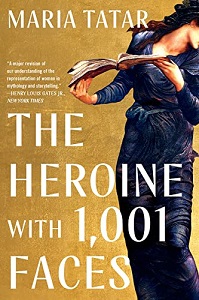
Maria Tatar, The Heroine with 1,001 Faces

What do women do while men leave to vanquish dragons and cross trackless seas? Is it possible for a woman to be a hero? Joseph Campbell, whose major work The Hero With a Thousand Faces popularized the ides of a “hero’s journey,” believed heroism was a singularly male pursuit (while teaching at a women’s university). In Campbell’s precepts, femininity is womb and grave, wife and temptress, a heroic man’s original source and his ultimate destination.

Maria Tatar, professor of German and children’s literature at Harvard University, sees a second track running under mythology. While men become heroes by leaving home and swashbuckling through the world, women often become heroic in how they resist. Put another way, heroism is something men find; it’s something women have thrust upon them, sometimes bodily. Tatar unpacks threads of feminine heroism from classical mythology and medieval folklore to modern Hollywood, sometimes with decidedly mixed results.

In the oldest mythology, Tatar finds women struggling to maintain an identity when men try to constantly control them. Helen of Troy finds herself passed, hot potato-like, between the hands of male heroes, her story getting lost along the way. Philomela literally loses her voice to her rapacious brother-in-law, who severs her tongue after violating her; but she reclaims her voice through embroidery. “Women’s work” becomes how she reclaims her voice and receives deferred justice.

Similar themes recur in Tatar’s telling, but importantly, when women find their voices, others take those voices away again. Arachne, the famous weaver whose skills challenge the gods, is a good example. In Ovid, the goddess Athena punishes Arachne, not because her weaving is excessively superior, but because she uses her weaving to call out the injustices of the Olympian gods. Modern mythologists reverse this, though, turning her into a moralistic warning against simple pride.

Nor are the connections to modernity incidental. Then as now, women seek the autonomy to tell their own stories, which they can frequently only achieve through subversive means. Consider how the #MeToo movement won its incremental successes despite, not because of, conventional media. Women fight a system designed to preserve the status quo of power and freedom, even when the existing system rewards the already excessively rewarded, and silences those who call injustice by name.

Maria Tatar

Tatar especially appreciates women who bring the ancient unresolved questions into the modern world. She extensively unpacks authors like Margaret Atwood, Pat Barker, and Madeline Miller, who rewrite the classical myths from a woman’s viewpoint. In the Homeric traditions (which Joseph Campbell considered normative), women are either largely voiceless, like Penelope or Briseis, or downright villainous, like Circe. Tatar loves when women writers return to the ancient well and give silenced women their own voices.

Continuing into medieval folklore, Tatar examines the same themes as they recur—or, just as importantly, as they’re silenced. French fairy tale author Charles Perrault writes in “Bluebeard” of a woman captive to a terrible husband, who discovers the truth, and is rescued by her brothers. But when the same story reappears in the oral tradition, usually by women, as in the Brothers Grimm’s “Fitcher’s Bird,” the beleaguered bride rescues herself, because there’s nobody else.

Tatar’s explanatory skills work best in the classical and medieval myths that mostly inspire her and Campbell. Moving into the modern era—which, since the middle Twentieth Century, mostly means movies and TV—her critical skills become more synoptic and brief. Maybe she expects her audience to already be familiar with the Hollywood stories she mostly just mentions and briefly describes. But the product feels rushed; she doesn’t so much unpack Hollywood as name-check it.

That said, she does describe the thread of women’s resistance to worldly injustice. From Cassandra, who gets mocked and derided for speaking the truth, and Scheherazade, who tames the destructive monarch by telling tales, to modern mythic tales like Little Women and Wonder Woman, Tatar sees something continuous. Women through literary history have established themselves by telling their counter-narrative, keeping their stories alive against men. Women survive by preserving and by passing along their stories.

Maria Tatar is hardly the first scholar to postulate a feminine analogue to Campbell’s “hero’s journey.” This book’s Amazon page links to at least two books entitled “The Heroine’s Journey.” Tatar brings her contribution, a knowledge of classical and medieval mythology as capacious as Campbell’s own, arrayed thematically to demonstrate that women are no less heroic, just because they don’t conquer. Women, arguably, do something more heroic: they face an unjust (male) system, and survive.

Also by Maria Tatar:
Enchanted Hunters: The Power of Stories in Childhood

Friday, November 18, 2022

Thanksgiving and the American State Church

Not the original photo (source)

I fear that, somewhere near Albany, New York, a TV station still has news footage of seven-year-old me wearing fake Native American war paint. I’d made a war bonnet from construction paper and an old terry-cloth headband, and wore it to the second grade Thanksgiving reenactment at Howe Elementary School, in Schenectady. I was the only student there representing the Native American side.

Every year, countless American grade schoolers make black conical “Puritan” hats out of construction paper and craft glue and replay the “first Thanksgiving” in mid-November. These performances are crinkum-crankum, and for good reason. The first Thanksgiving is part of American state religion, and reenacting it serves exactly the same purpose as children’s Nativity pageants on Christmas Eve: it forces us to verbally commit ourselves to the faith and morality represented.

Except, that faith isn’t equally represented. In every grade-school Thanksgiving pageant I remember, nearly everybody dressed as English Pilgrims. The uniformly somber men’s costumes, with buckles on their hats and shoes, while women bundled their hair into off-white bonnets and carried fall flowers against their pinafores. Nearly every year, the Wampanoag Indians were verbally acknowledged, but not present.

In 1982, in consultation with my parents, I decided somebody needed to represent the Indians. We didn’t really know what that meant. Thanksgiving history usually focuses on Pilgrims surviving a tumultuous winter, then learning (in passive voice) to plant maize and hunt wild turkey. In seasonal art, the Wampanoag are usually represented by one or two shirtless Brown men with feathers in their hair; the art emphasizes White people and their massive chuckwagon spread.

My parents are generally conservative, never-Trump Republicans, but they’ve always had a soft spot for Native American history. In the 1980s, though, their idea of Native Americans wasn’t differentiated by nations and regions; they believed a broad pan-American indigenous myth that mostly resembles Plains Indians. So that was our pattern, and I attended that year’s Thanksgiving pageant dressed as a White boy’s homemade idea of a Ponca warrior.

Forty years later, I struggle with this. By any reasonable standard, this was cultural appropriation: I, a White person, took it upon myself to tell the BIPOC story. But if I didn’t, who would? There was literally nobody else willing to speak that truth, that the Wampanoag existed and participated in that pageant. Without my clumsy, stereotyped mannequin, the Native American voice would’ve been completely excluded from that American myth.

A common clip art of the First Thanksgiving, with benevolent
Englishmen and highly stereotyped Native Americans

Our Thanksgiving pageant was considered newsworthy, and broadcast on regional TV, because our class partnered with the Special Education classroom down the hall. We were deemed a beacon of inclusiveness. Though both classrooms were entirely White (with an asterisk: several Jewish students), regional media wanted to praise our efforts. Camera crews, helmed by a pretty young human interest journalist, captured the whole event.

Because I was a kid, and this happened forty years ago, I don’t remember the event itself at all. My one clear memory is watching the news from Albany that evening to see our story. At one key moment, the camera zoomed in on me, the only Pretendian in the room, with my brightly colored acrylic “warpaint” and my war bonnet held together with hot glue. The journalist didn’t say anything. My presence was sufficient.

My family and I felt pretty good about that. Somebody, however feebly, stood up for the Native American presence at an important White mythological event. Forty years later, I can only remember that moment with a combination of pride and cringe. A White kid, amid forty other White kids, dressed as a Plains Indian in a Massachusetts harvest festival? The cheek of it! But… but it matters that somebody said it.

By today’s standards, that tin-earred display of cultural goulash was wildly inappropriate. But I also stood in the assembly to remind everyone, in this moment of American state church, that our mythology needed to be broader than it is. We not only preached that counter-myth to two second-grade classrooms, but with media assistance, our message carried regionally: Native Americans were there, and deserve representation.

I wouldn’t do that again, certainly. And if I had kids, I’d think long and hard before encouraging them to do likewise. But for all its ham-handed stereotyping and cultural appropriation, I also wouldn’t undo that event. Somebody needed to say it. Somebody needed to remind the American state church that its mythology has excluded too many people for too long. Maybe I was a clumsy, childlike prophet, but at least I said it.

Wednesday, November 16, 2022

Thoughts on the Importance of Creation Myths

Michelangelo's The Creation of Adam, from the Sistene Chapel ceiling

Plant ecologist Robin Wall Kimmerer begins her book, Braiding Sweetgrass, by comparing the Potowatomi and Christian creation myths. Kimmerer positively contrasts Skywoman, who builds the Earth from music and faith and communion with animals, with Eve, whose only described accomplishment is failure and exile. Not only does Skywoman promote harmony with nature, Kimmerer believes, but Eve encourages attitudes of fatalism and misogyny.

I won’t say Kimmerer is wrong, because she isn’t. But the more versed I become in comparative religion, the more I believe her correctness is conditional. The Skywoman narrative describes the creation of a people defined by their relationship with one place and the land. Adam and Eve describes a people defined by exile and return. The Hebrew Masoretic Text is bookended by Israel’s exiles in Egypt and Babylon, and their respective returns.

Religious absolutists generally take their creation myths seriously, and one of the Twentieth Century’s greatest controversies has been how to teach, for instance, science in light of seven-day creationism. But I contend that religious creation myths are only literally true for those who have forgotten why those myths were written. Creation myths don’t pretend to accurately describe how the world came into being; rather, they describe their authors’ identity.

Adam and Eve are doomed to wander, not because their creation myth is fatalistic, but because Israelite history is one of resident aliens amid occupying nations. Arguably, Adam and Eve, who are vaguely defined characters, are less important as creation archetypes than Cain. Christian interpretations of Cain and Abel characterize Cain as the antagonist. But perhaps Cain, both exiled and protected by God, is the actual Israelite ancestor.

The Native American creation myths I’ve read generally spotlight either an Animal, such as Coyote in many Southwestern myths, or a woman, such as Kimmerer’s Skywoman, or the Corn Woman common in many narratives. Either an animal spirit, a maternal spirit, or both, brings forth reality. Humans, in these stories, are afterthoughts. Our world isn’t a habitation, as in Abrahamic religions, but a responsibility, one which White invaders habitually shirk.

While American schools cope with how, and whether, to teach Abrahamic creationism, the real mythological battle takes place in history classes. Politicians and educators feud mightily over how to teach American history, because the narrative we learn in public (state) schools—the only narrative some students ever learn—defines how we receive ourselves as a nation. The official history has become a creation myth.

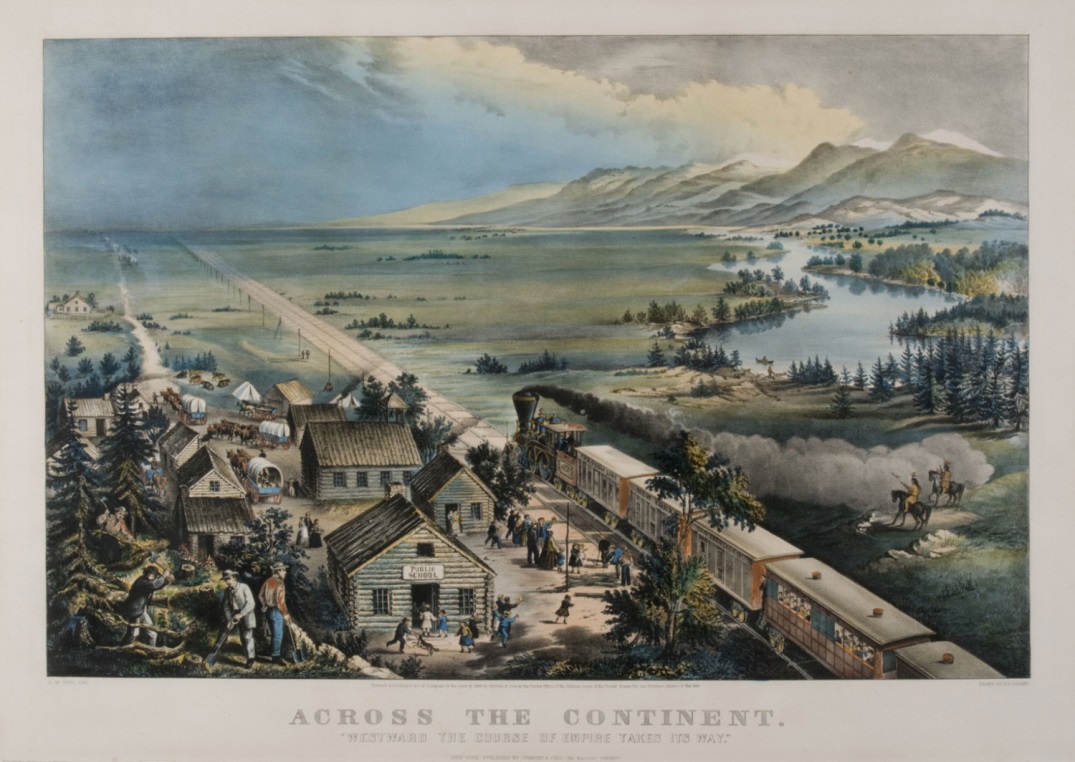
The frontier as depicted by Currier and Ives (click to enlarge)

This isn’t metaphorical, either. We literally learn a sanitized version of history because, like Eve and Cain, the narrative is about us, the living. Where I live, in Nebraska, we learn just-so stories about plucky settlers who walked overland, Conestoga wagons in tow, to claim and domesticate an unsettled prairie, pulling crops from uncooperative soil. Agrarian industriousness is Nebraska’s state religion, Laura Ingalls Wilder’s Little House books our scripture.

Except.

This holy writ is compromised from the beginning. As LSU historian Nancy Isenberg writes, the original sodbusters who “domesticated” this soil were despised, and were chased off the land once it became lucrative for Back-East speculators. Conestoga settlers and their immediate heirs, the cowboys, were valorized in American mythology only once they were safely dead and couldn’t challenge our beliefs about our ancestral greatness.

Besides which, as Yale historian Greg Grandin writes, White settlers didn’t “domesticate” the prairie. My ancestors only crossed the frontier line years after the U.S. Cavalry cleared Native Americans off the soil. As I've noted elsewhere, Wilder’s Little House books weren’t really history, they were Libertarian myth-making, heavily rewritten by her daughter, Rose Wilder Lane. As myth-makers have always known, true virtue always exists in a distant, morally scrubbed past.

Though the White sodbuster narrative contains nuggets of truth, it’s as much mythology as Zeus on Olympus. That’s why American history classrooms have become as hard-fought as Martin Luther pleading his case before Cardinal Cajetan, because the “history” we’re fighting over is American state religion. We aren’t fighting over how to teach facts, because facts are ancillary. We’re fighting over which story we use to define our shared national identity.

Perhaps that’s why progressives struggle in this debate. They believe they’re laying out “facts,” when what the debate needs is a counternarrative, an alternate myth. Historian James Loewen notes that American classroom history is presented as an unbroken arc from triumph to triumph, which precludes both backsliding and penitence. What Americans need isn’t facts, it’s a more nuanced story, a creation myth that includes room to admit mistakes and learn.

Wednesday, December 8, 2021

Society Is a Machine To Be Broken (Part Three)

This essay follows Society Is a Machine To Be Broken (Part One) and Society Is a Machine To Be Broken (Part Two)

The genetic similarities between the Terminator and Matrix franchises are so obvious, they barely deserve further description. Both depict humanity overthrown from within, by the machines we built to serve us, by the social systems we created and couldn’t control. But the differences between these franchises speak volumes to the options available to humanity going forward. And those differences originate in the contexts that created them.

Written and filmed in the bleakest years of the Cold War, The Terminator assumed the defense networks humans created would identify humanity overall as the enemy. This isn’t a stretch, after all, as the greatest threat to world peace is certainly the humans living on the world. Those of us old enough to remember Ronald Reagan and the SALT Treaty negotiations will remember believing that little fundamentally mattered, because the bombs would drop any day.

By contrast, The Matrix dropped in the late 1990s. As fear of imminent global firebombing retreated, America retreated into a hangover of Furbies, Spice Girls, and NAFTA. Where The Terminator anticipated a war machine classifying humanity as the enemy, The Matrix forecasted humanity’s synthetic workforce rising against us, the bloated consuming class. One franchise considered humanity overprepared for war; the other saw humanity fattened on peace.

What each franchise anticipated arose from its circumstances. The Terminator foresaw a militarized future, where constant war against the machines has become humanity’s default; to be human, in Skynet’s world, is to be permanently part of the French Resistance. Kyle Reese sleeps with his helmet on, cuddling his M-16 like a teddy bear, because gun-toting infiltration units could overrun his bunker at any time. Humans, in The Terminator, are constantly awake.

Compare that to The Matrix, where humans are constantly asleep. Rather than occupation and slaughter, these machines offer humanity comfortable dreams and superficial meaning, in return for our complete subservience. The illusion lets humans continue living, working, and even rebelling, in ways controlled and permitted by the system. Of course, none of it was real, and the rewards generated went entirely to the machines, who owned everything.

Note that before his liberation, Neo alternates between the conformity of employment, and the counterconformity of acid rave culture. He maintains the postures of rebellion, the actions of freedom. But this freedom, this rebellion, doesn’t really exist; no choices exist, except those for which the machines have written a template. He yearns for autonomy, but can’t see past the illusions created by the socioeconomic system.

Please note, though: reality didn’t unfold that way. We GenX’ers whose childhood was dominated by fear of annihilation, haven’t been constantly awake; we’ve largely ceded authority to a gerontocracy that retains control for literally decades, often without improving anything. Millennials and Zoomers, however, those raised on the post-Reagan economic surfeit satirized in The Matrix, are among history’s most politically engaged.

Either way, these franchises promise humanity a singular messiah, a designated deliverer whose unique skills and connection to the system will redeem humanity from its disaster. Whether a military conqueror like John Connor, or a spiritual guru like Neo, both assume that, when circumstances permit, the chosen individual will appear and restore the balance. Our enemies will be routed, our freedom will overcome, and humanity will reclaim its independence.

And yet…

In both cases, this triumph appears transitory. John Connor’s victory in Terminator 2 is repeatedly overwritten in sequels, though these revisions never stick—perhaps, I’d suggest, because the Cold War circumstances that made The Terminator so terrifying no longer exist. Meanwhile, trailers for the anticipated fourth Matrix movie depict Neo having to relearn his messianic nature. It seems, in Hollywood, our sci-fi messiahs never quite stick.

We can attribute this, partly, to the requirements of the franchise. If the characters’ problems are ever permanently resolved, the story ends. (Witness how the stories flailed when Disney tried to keep the galactic civil war alive in Star Wars.) But it also reflects our inability to imagine what happens on the other side of this life. We can’t imagine salvation, or even post-capitalism, except through analogies to this life, which are generally unsatisfying.

No matter whether we grew up amid the nihilism of the Cold War, or the orgiastic backwash that came afterward, we’re conscious, on some level, of the machinery that dragged us here. We know this condition isn’t natural, or inevitable, and we seek someone to deliver us from this system. But that deliverance is permanently in the future, because deep down, we can’t imagine any lasting condition but servitude.

Wednesday, September 29, 2021

The Problem With Wizards

“Yer a wizard, Harry.” These words, snarled in Rubeus Hagrid’s West Country drawl, have achieved life beyond their franchised origins. They confirm for one stir-crazy London pre-teen that his beige suburban life isn’t inevitable, that he could, simply by embracing it, become destiny. Like the X-Men or Ender Wiggin, Harry’s revelation echoes the desires of countless drab childhoods, acknowledging that their greatness merely hasn’t been recognized yet.

But it’s always made me uncomfortable. Hagrid doesn’t promise Harry, “Ye’ve got magic in ye, Harry;” wizard isn’t something he becomes. Rather, it’s a pre-emergent state, something Harry already is, without his consent or awareness. Like discovering you’ve always been White, or middle-class, the condition doesn’t require his awareness; it’s part of his essential being. “You’re already a wizard, Harry,” Hagrid basically says, “so decide how to use that fact.”

Author JK Rowling has latterly achieved internet notoriety for her inability to shut up about gender issues. Rowling believes one’s gender corresponds, one-to-one, with one’s genital anatomy, existing from birth, and any deviation is aberrant. Scholars call this position “gender essentialism”; I consider that title a misnomer, but that’s another discussion. What matters, for our purposes, is that Rowling believes gender precedes conscious awareness.

Many fantasy novelists use some concept of “the gift” or other euphemism for pre-emergent magical identity. Maybe this reflects Sir Thomas Malory, who depicted Merlin as a human-demon hybrid, or Tolkein, who presented wizards as ageless emissaries of God. Either way, wizards aren’t like us plebians; they have a nature that makes magic available. No amount of practicing or education will close this gulf; wizardry isn’t like golf, or playing the guitar.

This perhaps makes sense with Rowling. As a Scottish Presbyterian, Rowling has some familiarity with Calvinist doctrines of predestination: God already knows the roster of the saved. To the Calvinist, we indeed have pre-emergent natures. As this conundrum fermented with me, however, I realized I’d spotted this elsewhere: Rowling’s wizards, like George Lucas’ Jedi, can never emerge from pedestrian bloodlines like ours.

Lucas’ original Star Wars, latterly retitled A New Hope, presented Luke Skywalker as mastering the Force through self-discipline and mindfulness, but also through genetics. From the beginning, Obi-Wan Kenobi clearly considered Luke an apprentice, and wanted him to reconcile ancestral transgressions. Luke is one of us, but not really. This sense of inherited responsibility became only more glaring in Lucas’ prequel trilogies, with the introduction of midi-chlorians.

Calvinist predestination becomes especially pointed because Luke Skywalker, like Harry Potter, is a child of prophecy. Like Katniss Everdeen, Aragorn, or Neo, these promised Messiahs come at pre-ordained intervals to deliver humanity from thinly coded Nazis. Individually, these stories seem hopeful, leading benighted humans into liberty. Together, a pattern emerges: the Nazis were necessary to purge senescent society, and now the Messiah will restore the balance.

Who, then, are these predestined Messiahs saving humanity from? The tyrannical Empire, Ministry of Magic, Panem, or machines? Or are they saving us from the doddering human dominion that let the tyrants in? Are we fortunate enough to receive these Messiahs’ salvation exclusively because we were born after the necessary cleansing? And therefore, does the Messiah’s existence loom as a threat, that we, too, might get cleansed next?

Predestination might make sense in an environment with a literal God. As a Christian myself, Calvinist predestination has always made me uncomfortable, since it implies God has already cut some people loose; it’s a short leap to assuming that God approves discrimination. But in science fiction and fantasy environments, where transcendence is, at best, murky, the potential for misuse becomes glaring. As Rowling has tragically discovered.

Yet such abuse seems implicit if humans have a pre-emergent nature. If being a wizard, or mystic space samurai, or techno-Jesus, is something somebody just innately is, then it follows that it’s also something everyone else innately isn’t. Even if the muggles and non-Jedi aren’t explicitly inferior, that potential is implicit. Observe when the unwashed masses submit themselves to Jedi judgement, or wizards alter muggle memories to protect their secrets.

Like millions of audience members, Harry Potter and Luke Skywalker propelled me along their narratives when they were new. Like in real life, we don’t have time to ruminate upon the moral implications during the action. Only later, in quiet recollection, do the story’s moral contradictions suddenly intrude upon our appreciation. But the fact that we needed years to recognize the contradictions, doesn’t make them less real.

A world with real wizards is just too depressing to contemplate.

Wednesday, September 22, 2021

Two Modern American Myths

Mounted border patrol agents break up a refugee camp. Photo by Paul Ratje for AFP

Two stories achieved critical levels of awareness in America this week. In Texas, Border Patrol agents on horseback, wearing Stetsons and chaps, broke up an encampment of Haitian refugees. Many Haitians had hiked from as far as Brazil, where they’d fled after the devastating 2010 earthquake. The agent in the most widely shown photograph waves something at a refugee; commentators argue whether it’s a whip, a strap, or a lariat.

Almost simultaneously, a massive dragnet in Wyoming’s Grand Teton National Park found human remains consistent with missing “van life” vlogger Gabby Petito. Her fiancé, with whom she’d been traveling when she disappeared in August, has gone missing, apparently with his family’s assistance; circumstantial evidence and bad PR make it appear increasingly likely he’s responsible for her death. Millions of Americans follow the story with tightly held breath.

The jagged contrast between these stories speaks volumes about our identity as Americans—volumes that, sadly, don’t reflect well on us. The copious attention paid to a young, good-looking White woman’s disappearance contrasts poorly with the many disappearances of Native American women in the same area. As tempting as I find it to make flippantly cynical comments about looks and influence, I fear a darker narrative is in play here.

Narratives about defending women, especially White women, permeate American propaganda myths. “Wives and daughters back home” get used to justify atrocities by troops abroad, and by militarized police at home. Historian Kathleen Belew writes how White Power cells use language of marriage and motherhood to justify race-based violence against the state. Womanhood, implicitly White in the mythology, continues justifying America’s worst impulses in the world.

(I’ll briefly acknowledge that many people following Gabby Petito’s story are women, including women of color. As cultural critic Sady Doyle notes, women’s aggregate attraction to true-crime narratives may reflect their awareness of their precarious position in a violent, patriarchal society. This true-crime myth, and the “wives and daughters” myth, likely have wide overlaps. But I only have space to address one.)

Historically, the myth that White womanhood needs defended against an encroaching Black criminal class, has justified egregious vigilante violence. Carolyn Bryant’s claim that teenager Emmett Till wolf-whistled at her justified her extended (male) family torturing and murdering Till—even though we now know Bryant lied. That’s just one highly visible instance where protecting White women weighed larger than either Black men’s lives, or American ideals of justice.

A still of “van life” vlogger Gabby Petito, taken from hew video history

In fairness, I doubt strongly that anyone popularizing Gabby Petito’s story has consciously racist motivations. Nevertheless, the absence of matching coverage for the area’s many missing Native American women, and the massive outlay of resources and manpower to investigate Petito’s tragedy, follow the time-honored script. And events in Texas, while perhaps not directly motivated by Petito, still reflect how myths of White womanhood steer myths of White manhood.

The Border Patrol agents’ cowboy garb, and slave-catcher tactics, reflect a belief that some uniquely American essence is under attack. Maybe it is. The increasing popularity of “van life” culture, propelled by Internet charisma, suggests that important parts of the American Dream, including home ownership, stable employment, and parenthood, are dwindling. Whether the Dream is dying because of kids living frugally, or adults paying starvation wages, goes unexamined.

It’s always been easier to blame dark-skinned outsiders for unwanted change, than to examine the economic and power dynamics that make people’s choices for them. Fear of refugees at the southern border, joins past narratives of “uppity” Black men, “Indian outrages,” or the “Yellow Peril,” to provide a ready-made narrative. As Yale historian Greg Grandin demonstrates, racist violence on America’s margins always increases after overseas wars, especially unsuccessful ones.

American youth increasingly don’t believe home ownership and participation in capitalism are desirable, or even possible. American military might can’t silence restive populations internationally. Human greed and environmental decay mean youth increasingly don’t believe they have a future. The generation that still holds power in America’s government and economic institutions believes their systems of control are failing, because in fairness, they are.

Gabby Petito’s death provides a neat, linear narrative that White womanhood is beleaguered, and not, the powerful rejoice, from above. Rather than address patriarchal attitudes that make violence less emasculating than a breakup, America has retreated into that other myth we foolishly believe, that shows of strength can bring the hammer of justice, in the best John Wayne style. The result is ugly all around.

America is showing the world its worst face. Worse, we’re showing that our mythology doesn’t work anymore.

Thursday, July 1, 2021

Gwen Berry, the Flag, and the Nature of Ceremony

The photo that made Gwen Berry (left) infamous.
With DeAnna Price (center) and Brooke Andersen

This weekend, during national trials for the Tokyo Olympics, the Women’s Hammer Throw event mattered for the first time, probably, ever. Gwen Berry, two-time gold medalist at the Pan-American Games, finished third, qualifying for the Olympics. But during the medal ceremony, Berry, who is Black, didn’t participate in the National Anthem, turning instead to face the crowd.

The Usual Suspects flipped their wigs, of course. Matt Walsh, Meghan McCain, and Ben Shapiro used their mass-media platforms to shriek, sometimes incoherently, about Berry’s horrendous travesty. Representative Ben Crenshaw went on the Former President’s favorite news network to demand Berry be ejected from the team. Wypipo Twitter, hardly a bastion of nuanced deliberation, turned downright ugly in its condemnations, and frequently racist.

(No, I won’t link their Tweets. They don’t deserve the oxygen.)

In my ongoing quest to better understand American conservatives, in terms they’d use to describe themselves, I spent time performing what rhetorician Peter Elbow calls “the believing game,” taking another person’s position seriously and respecting it, without trying to debunk it. Conservative allegiance to ceremonies of Americanism have long baffled me. Yet after some consideration, I’ve had some possibly helpful insights I’d like to share.

The pundits outraged over Berry’s demonstrative refusal are, unsurprisingly, the same pundits outraged over Colin Kaepernick kneeling. These same pundits also complain whenever news re-emerges that grade school children aren’t universally required to perform the Pledge of Allegiance daily. Fox & Friends, where Representative Crenshaw aired his demands, also complained, during the Obama Administration, that President Obama was inconsistent and frequently sloppy in returning military salutes.

(Executive protocol doesn’t require Presidents to salute, but many do so out of good taste.)

To outsiders, these forms of demonstrative Americanism appear entirely ceremonial. That is, people perform these actions simply because we perform these actions. Yet to their loyalists, the ceremonial quality isn’t empty; the ceremony gives it mass. Like a priest speaking the words of institution, and thereby transforming inert bread into the Body of Christ, ceremonial Americanism transforms the person in the ceremony.

Remember when the Former President hugged an American flag at CPAC, to thunderous applause? Progressives and liberals derided the action. Yet for the Former President’s intended audience, this action had significant weight. Ceremonies like saluting the flag, singing the National Anthem, and speaking the Pledge of Allegiance, make the ceremony enactors more American, a state that needs constantly renewed.

Would critics have been happier with this older photo of Gwen Berry? Who can say?

If we’re honest, liberals and progressives understand this impulse. Even unbelievers want someone with official standing to officiate their weddings, because the ceremony, not the sentiment, makes the marriage. Likewise, progressives trust the Courts, a bastion of ceremony, to enforce laws justly. Consider how important it is to dress appropriately, use people’s official titles, and rise or sit without hesitation.

Observance of ceremonial rules, in other words, matters. The only difference is which ceremonies different groups honor. The progressives who claim they don’t understand the outrage over Berry or Kaepernick’s non-participation in flag ceremonies, would understand altogether if, say, one of Former Guy’s indicted advisors addressed an enrobed judge by first name inside a courtroom.

Ceremonies like the National Anthem, or “all rise,” gain their authority because, like religious liturgy, everyone performs them together. A stadium facing the flag, hands on hearts, stops being, temporarily, massed individuals; they become united in purpose. Individuals stop existing, provisionally. For the moment we’re singing “Oh Say Can You See,” we briefly no longer exist.

Therefore, protests like Berry’s or Kaepernick’s also gain substance from ceremony. By disrupting the unified performance, they drag us back into ourselves during our moment of ecstatic transport, making us again, unwillingly, human. They ask us whether the mass to which we’ve surrendered our individuality actually deserves such ceremonial acclaim. They force us to be conscious during a moment of unconsciousness.

This defiance of rules matters in sports, an activity defined entirely by rules. Obscure rules like the Fair Catch Kick don’t inhibit football; the rules make the game. Like standards surrounding the National Anthem, the individual disappears into a regulated world and is fleetingly transformed. Therefore, maybe it shouldn’t surprise us when lovers of the rules hate seeing others honoring the rules selectively.

Because some people desire to disappear, briefly, into ceremonial unity, reminders of human finitude disturb them. Again, for them, the ceremony isn’t emotion; it literally transforms and renews their American natures. Like a caterpillar in a chrysalis, breaking them loose prematurely stops them becoming whole. No wonder they’re angered by displays like Berry’s. They’ve been denied their renewal.

Saturday, March 27, 2021

Pop Messiah and the Breakfast Cereal Killers

Jensen Karp (right), with his wife, actress Danielle Fishel

I’d never heard of Jensen Karp before this week, when he allegedly found shrimp tails, dental floss, and rat poop in a box of Cinnamon Toast Crunch breakfast cereal. Karp’s Twitter posts about the debacle became an instant sensation, garnering thousands of retweets in mere hours. Despite his decades-long career as a child actor, comedian, and TV writer, it took breakfast cereal to turn Karp into an overnight sensation.

Then his ex-girlfriends began making their voices heard.

I understand the appeal behind Karp’s story. In a classic David and Goliath story, an individual hero stands fast against the industrial monster, General Mills. We humans seek heroes to confront our problems, because we recognize how pervasive our challenges are. But the rush to embrace Jensen Karp gave me instant willies, especially when he refused to participate in any effort to rectify the problem. That was my first problem.

Karp’s story appeared “ordinary” despite his large audience, drawn from his media presence. Decades deep in entertainment, he knows how to sell a story to the public, evidenced by his generous use of visuals. Karp offers a simple morality play of corporate negligence, or worse, while pitching himself as a hero against the mighty monster of General Mills. We buy it because we know corporations fundamentally aren't on our side.

David-and-Goliath mythology looms large in Western morality. We believe that the small, the ordinary, and the workaday, somehow deserve saving, a belief which transcends any religion. Yet we seek extraordinary individuals to perform that saving. Rather than collaborating with other individuals, a notoriously high-risk enterprise, we instead yearn for a superhuman hero who will do the defending for us.

Both political parties claim to speak for commoners and ordinary people, while shrugging at actual abuse. From Republicans turning water cannons on protestors, to Democrats abandoning campaign promises like disgraced lovers, conventional solutions just don’t work. We watch the powerful work in tandem with the rich to impede necessary changes, while the world literally burns and floods around us. And mere notional reforms only bandage a dying system.

Humanity has an innate desire to stand up against the powerful. But actually doing so carries great personal risk: the first person to threaten the powerful, usually gets struck down. Instead, we await an exceptional individual to do the threatening for us. After that person dies to save us, like Jesus or Fred Hampton, we’ll rally around that person’s martyrdom to provide moral unity and direction.

This messianic desire made sense in prior times. The idea of Christological salvation matters, because only with a rallying cry, could the weak and the defenseless band together against the powerful. The early church provided a place where the oppressed could air their grievances and be taken seriously. Sadly, of course, as the church became powerful in its own right, it switched sides and defended the rich and mighty.

If we’re honest, we don’t want to improve the world in the abstract, we want to live in the improved world. But challenging the powers which shackle us carries a price few people are willing to pay. We need someone willing to die for us. Our messianic hope tempts us to accept that Jensen Karp might threaten the corporations. But he can’t. He isn’t willing to die. His product is entirely himself.

Jensen Karp isn’t a messiah. His behavior, before and since, demonstrates that he’s in it for himself. He wants the rewards of notoriety. As reports of narcissistic behavior and sexual harassment emerge, it appears that Karp has always been his own product. He has always maintained a camera-friendly version of himself, perhaps because of his media upbringing. He has spent his life in the media eye, and knows how to keep it focused on himself.

Karp’s history of seeking attention comes at others’ expense. This isn’t the proletariat punching up. Karp used his media connections to manipulate a digital marketplace which loves a simple moralistic story. His attempts to hijack our moral umbrage redound entirely onto himself and his career. Karp has a product to sell, which is himself, and he’s sold it aggressively, because he knows the short horizon for media attention anymore.

I cannot fault anyone for embracing this story. It plays well: a massive multinational corporation did something negligent, and answered the everyman’s challenge with haughty disdain. It fits Western, Christian-adjacent morality neatly. Too neatly, as it turns out. Hopefully, Jensen Karp offers us a chance to learn how to spot, and avoid, future secular messiahs.

Thursday, July 16, 2020

The Last African Outpost in the Solar System

1001 Books To Read Before Your Kindle Battery Dies, Part 107
Mike Resnick, Kirinyaga: a Fable of Utopia


Koriba is the mundumugu, the great priest-healer, of his tribe, the Kikuyu. Sure, he has a Westernized education and speaks English fluently; but he rejected his European learning to become his people’s spiritual guide. Sadly for him, his Kenyan homeland is overrun with technology and silicon; his Africa has no place for African ways. So he has led his tribe to a new settlement: a terraformed planetoid called Kirinyaga, out amid the solar system.

Mike Resnick’s science fiction was often heavily influenced by myth and fable, and his stories, including the eight interconnecting narratives which comprise this novel, often functioned as modern parables. He first began visiting Kenya as a trophy hunter; he later became fascinated by the indigenous cultures. He especially respected the ways African societies adapt to colonial influences, while retaining their unique characters. But this respect was tempered by trepidation.

In this setting, the Kikuyu people have named their adopted homeland Kirinyaga, their native name for the mountain Europeans call Kilimanjaro. Koriba, our first-person narrator, repeats this fact frequently, emphasizing the almost-Zionist nature of his culture. His people have struggled to recreate the experience of living in pre-colonial Africa, hunting game and farming dryland crops. Koriba himself has spearheaded the effort to reconstruct traditional Kikuyu religion.

The experience is deeply imperfect, however. The Kikuyu language is dead, so Koriba’s people speak Swahili, something Koriba, a trained classicist, finds distasteful. Lions and elephants are extinct, so the Kikuyu have populated their homeworld with as much African wildlife as possible; but without predators to stabilize populations, bottom-feeders quickly strain the ecosystem. Koriba must frequently use European technology to restore the balance.

Most important, Kirinyaga receives its license to operate from Maintenance, a bureaucratic institution that oversees terraformed planetoids. Maintenance means well, and seeks to ensure rights and autonomy for various populations. However, its primarily White membership has a frustrating tendency to enforce its own ideals upon license-holders, like the Kikuyu. Koriba balks at what he perceives, with some justification, as an extension of European colonialism.

Resnick was deeply conscious about the moral compromise inherent in himself, a White American, writing a story of African characters, using a Black African narrator. In interviews, he expressed his trepidations, yet admitted this was essentially a story of outsidership. His themes are not innately Africa, nor Black; beneath the surface, his story deals with themes about the balance between tradition and innovation, and how maintaining that balance can be deadly.

Mike Resnick
Koriba has a powerful ally in Koinnage, chief of the settlement. Between them, they represent the two authorities which govern traditional life: while Koriba tends to his people’s spiritual hungers, Koinnage handles the politics, and traffics with Maintenance. Both, however, face problems common to utopian thinkers throughout history. They have romantic ideals, often at odds with daily life. Both are European-educated, but trying to reconstruct African society.

And both are getting old.

This novel’s third principal character is Ndemi, Koriba’s student, whom Koriba hopes will eventually inherit his responsibilities. (Koriba failed to adopt a girl student, a tragedy which haunts him.) Ndemi was born on Kirinyaga, raised on Koriba’s African parables and Koinnage’s political ideals. As he approaches adulthood under Koriba’s tutelage, however, Ndemi discovers how compromise with European bureaucracy has tainted his people’s culture.

Because Koriba reflects the twin impulses of utopianism, themes which have colored utopian (and dystopian) literature throughout the last century. He has strong beliefs, and clings to them desperately. Koriba’s desire to preserve his people’s identity comes at great human cost, including, on occasion, innocent lives. His belief in capital-T Truth justifies him lying to his people and keeping Ndemi, his future heir, in the dark.

But strong beliefs don’t feed the utopian family. Little hardships make rank-and-file villagers, including Ndemi, question Koriba’s convictions. Couldn’t we make one little change, they ask, or adopt one European technology, to make village life less onerous? Koriba always refuses, believing that any change will make his people no longer Kikuyu. Tradition and morality have become, for him, their own ends. The people’s hunger is secondary at best.

Nearly a quarter-century after publication, it’s tempting to look backward and assume Mike Resnick considered himself a White Savior, writing about Africans’ concerns. But using that paradigm, I quickly realized: Koriba is Black, but he’s a White Savior himself. His traditionalist African beliefs are so ascendant, he’s incapable of understanding the harm he does by doing good. That, perhaps, was Resnick’s message. But he conveys that message so artfully, he never descends to preaching.

Monday, February 10, 2020

War, and the Memory of War

1001 Movies To Watch Before Your Netflix Subscription Dies, Part 36
Ted Kotcheff (Director), First Blood


An unshaven stranger wanders into a Pacific Northwest town, with an American flag patch on his jacket and a Bowie knife on his belt. The local sheriff mistakes him for a common vagabond and shows him the far side of town. But the wanderer comes back into town, stolidly refusing to explain his unwillingness to leave, so the sheriff arrests him. Inside a subterranean holding cell, the prisoner suffers his first violent flashback to Vietnam.

Through the 1980s, movie studios struggled to reconcile John Rambo, and his massive popularity, with the stories Americans told ourselves about our Vietnam experience. They turned Rambo into a musclebound antihero of Cold War exceptionalism, a picture of single-minded virility willing to continue fighting America’s battles after the government abandoned him. This image has become so pervasive that we forget he wasn’t created that way; he was laconic, unwanted, and a receptacle for America’s doubts.

At the movie’s beginning, we know nothing about Rambo. We witness him trying to find his unit’s only other surviving veteran, only to discover that Agent Orange finally took him; the weak smile we see on his face during that scene never recurs, as he realizes nobody but himself remembers what his unit survived. Without the war, nothing gives his life structure. So he resumes the only task which postwar life has provided him: walking.

Rambo’s 1982 big-screen debut followed ten years of development purgatory after David Morrell’s novel dropped, while the war was still going on. Morrell presented Rambo (no first name in the novel) as a villain, a killing machine which America’s government built, then discarded. Wandering his homeland without direction, Rambo becomes a force of destruction, because violence gives him meaning. The movie changes this characterization, reflecting how America’s self-justifying Vietnam narrative had evolved over ten years.

Sheriff Will Teasle (Brian Dennehy) doesn’t hate Rambo initially. He simply prizes order and cleanliness over fairness and justice. Rambo looks, to Teasle, like a stereotypical drifter with no means of support; Teasle assumes that he’ll wind up panhandling downtown, undercutting local businesses. He bears Rambo no animosity, he just wants the scruffy vagrant gone. But Rambo refuses to leave, for reasons entirely his own—he’s persistently taciturn. So Teasle arrests Rambo on specious charges.

You probably already remember what happens next: an overzealous deputy, feeling authorized by Teasle’s unthinking attitudes, attempts to shave Rambo with a straight razor. Rambo suffers a flashback, attacks the massed deputies, and escapes to the wilderness. (In the novel, he kills several deputies.) The law commences a massive manhunt, carrying military-grade assault weapons, but Rambo, trained in wilderness survival, manufactures simple weapons and stays one step ahead. So Teasle calls in the National Guard.

Sylvester Stallone (left) and Brian Dennehy in First Blood

This encapsulates how Rambo represents America’s struggle with itself after Vietnam. The law wants to bury him, because if he disappears, so does the narrative of their missteps. Rambo wants only to survive. Later movies would transform Rambo into an icon of America’s individualism mythology, but in this movie, he isn’t an individualist; he’s a soldier, trained and awaiting orders, who gets dropped by the government that should’ve controlled him. He’s become an unwanted memory.

In one key scene, several National Guard “weekend warriors” preen for the camera before a mine shaft they’ve just detonated with hand artillery, believing they’ve killed Rambo inside. One of them shouts: “Now take one for Soldier of Fortune!” That magazine, which arose in Vietnam’s immediate aftermath, helped spread the belief that America’s government betrayed troops in Vietnam, popularizing the stab-in-the-back myth. These fluffy-bearded kids apparently miss the irony of killing a decorated Vietnam veteran.

Stallone heavily rewrote the story, making Rambo a more sympathetic character, ending the story with hope of future redemption. In Morrell’s novel, Rambo and Teasle kill one another. Stallone, by contrast, gave Rambo a final monologue that helped coalesce, for American imagination, how war caused trauma for wide-eyed soldiers who trained under the belief that they were doing good for world democracy. The changed ending reflects changes in how Americans understood our shared Vietnam experience.

Don’t misunderstand: this movie teems with myths Americans weren’t ready to unpack about how we brought “heroes” home and expected them to reintegrate into society. But as an artifact of a struggle Americans were only beginning to publicly confront, it remains a landmark of self-scrutiny. Sadly, just three years later, the studio flinched from continuing that scrutiny, sending Rambo back to re-fight the war. Thus we return to this moment again, after every subsequent war.

Wednesday, October 30, 2019

Star Trek, the Frontier, and the Borg


“We are the Borg,” the faceless cube intones in the movie First Contact. “Your culture will adapt to service us. Resistance is futile.” These words have struck such fear into a generation of science fiction fans that the final sentence has escaped the genre pen and become a larger cultural touchstone. Simply say the words “Resistance is futile,” and most people, sci-fi fans or not, will immediately understand exactly what you mean, and fear appropriately.

Throughout genre history, American science fiction has frequently had a frontier element. Whether it’s Han Solo promising to move quantities of goods to market without revenuer interference (“selling whiskey to Indians”), Commander Adama plotting a course beyond the Red Line (“light out for the territories”), or Malcolm Reynolds’ all-around cowboy ethic, science fiction has pilfered generously from America’s frontier mythology. That goes double for Star Trek, which Gene Roddenberry pitched explicitly as a “space western.”

Captain Kirk announced the original Star Trek by describing himself traversing the “final frontier.”  He made it his goal to encounter undiscovered peoples, several of which, in the original series, are depicted as having Native American qualities. (These qualities are broad stereotypes, and often played by White actors in heavy makeup, though that’s too many themes too address here.) Though the Prime Directive stops Kirk becoming an out-and-out conqueror, he’s nevertheless frequently a White Savior.

Perhaps that’s what made Picard’s contact with the Borg so terrifying: colonists and empires don’t like having their own actions thrown back at them. In the original series, Kirk and the Federation dealt intermittently with the Klingon threat, a metaphor for America’s interactions with the Soviet “menace,” but never investigated that in detail, perhaps because, in light of the ongoing conflict between two global superpowers, creators couldn’t face the implications. America was an empire, too.

As the Cold War wound down, though, such investigation became available to Picard. The Next Generation included more scrutiny of the Federation and its operant principles, which were primarily White, male, and expansionist. The series still held itself back in service to the tastes of its time, and Roddenberry’s humanist philosophy, but we began seeing rot and disorder among the Federation hierarchy. White humanity’s innate goodness wasn’t something the Federation could take for granted anymore.

A Borg drone (Hugh) from the episode "I, Borg"
White America’s history with indigenous peoples will never escape the taint of racism. Forced removals and the Trail of Tears; state-sponsored missionary activity designed, in no uncertain terms, to abolish native culture; the Carlisle Indian School. And that’s just our interactions with Native Americans. The phrase “Your culture will adapt to service us” accurately describes the philosophy underlying how White people viewed Native American culture until very recently—and, in too many quarters, still does.

Funny enough, while America saw itself as a bastion of rugged individualism, it painted the “Evil Empire” as a faceless collective bent on assimilating citizens’ identities into a top-down social stratum. It’s almost like, viewing from within, we saw ourselves as individuals with goals and personalities, while viewing our “opponents” from without, we considered their people the sum total of their government’s belligerent rhetoric. One wonders how Native Americans saw the Cavalry crossing the frontier.

American frontier myth, to work, always requires viewing from the White side. Whether it’s children playing Cowboys and Indians, or NASA pledging to establish colonies on the Moon and Mars, somehow the White settlers always win. But science fiction, which regularly abandons moorings in the putatively “real” world, has liberty to speculate on big themes which we’re often denied in reality, including the possibility that, someday, somebody new may cross another frontier and find us.

That’s what happens with the Borg. After decades of Roddenberry’s mythology assuming humans, mostly White males, would win the colonial enterprise, the Borg upend this assumption. They enter our space. They want to conquer us, and make us part of their, ahem, enterprise, rather than us inviting strangers into our Federation. And though, pursuant to the needs of episodic television, the humans always successfully resist the alien invaders, they nevertheless remind us, victory isn’t certain.

Our frontier myth has frequently tainted America’s interaction with the wider world, as historians like Greg Grandin have noted. The myth has faltered significantly in the 21st Century, but still basically drives our foreign policy. That’s why we need something like the Borg, to remind us that, viewed from outside, we probably don’t look like the Federation. We probably look like an anonymous mass of technological monstrosities, bent on yoking other peoples to our vision.

Friday, May 24, 2019

Batman, Edward Cullen, and the Mythic Actor

Robert Pattinson
Last week, Warner Brothers announced their tentative casting of British actor Robert Pattinson as Batman—and the Internet collectively flipped its shit. People posted wrath to social media, shared windy YouTube videos, and even started an online petition to revoke this casting. The screeching eerily resembles the same anger that followed Ben Affleck’s announced casting in 2013. Internet users apparently have nothing to do except get pissed off by popular culture.

The Pattinson-related outrage relates heavily to his prior prominent role, Edward Cullen from Twilight. Some criticism is explicitly sexist: because he headlined a “girl” franchise, he’s tainted for a boy-friendly property like Batman. Others dog-whistle their bigotry, talking about how an actor carries past roles into new ones (then complaining about shparkles). These complaints probably are the minority, but are voluble enough to sound more prominent than they are.

I’m tempting fire here, but I’ll say it: there’s something to this.

Djoymi Baker, lecturer of Cinema Studies at the University of Melbourne, writes that actors playing multiple roles serve functions similar to retellings of classic myths in ancient times. Homer could tell myths about Odysseus, say, possibly composing them fresh; but he could also throw in something comparing Odysseus to Jason, and audiences would respond immediately. Understanding one myth made understanding other myths simpler thereafter.

Actors do something similar. When William Shatner, say, appears as Denny Crane in Boston Legal, Dr. Baker writes, his bodily presence carries past roles, like Captain Kirk and T.J. Hooker, onto the screen with him. Every actor contains elements of past performances. Baker calls this an “intertext,” a critical term which usually refers to ways one text comments on another, like Marvel interpreting DC. Except Baker’s model makes the actor personally a “text.”

Every character Robert Pattinson plays will draw comparison to Edward Cullen, just as every Bill Shatner appearance draws Captain Kirk comparisons. Some actors resist this: while Shatner has embraced being Kirk forever, Leonard Nimoy resisted being Spock for decades, and failed. Other actors, like Mark Hamill (Luke Skywalker), Robert Patrick (T-1000,), and Anthony Perkins (Norman Bates) were forced to accept their lifelong association with just one role.

Dr. Baker, however, specifically cites Batman as a modern mythological figure that, like Achilles, gets transformed through successive retellings. Each new Batman telling, including the 1960s television series, the Burton/Schumacher movies, Christian Bale’s version, and the DCEU, has referenced and commented upon previous manifestations. Simultaneously, they’ve also differed from whatever came before, thus advancing our appreciation of the character.

Pattinson as Batman will bring the role a youthful sexuality it hasn’t previously had. Though previous big-screen Batman portrayals have been both attractive and sexual, like Michael Keaton or Christian Bale, the sex has always remained at a tasteful remove. Because Pattinson’s persona involves the first adolescent fumblings toward romance, any attempt to not address this history in his Bruce Wayne portrayal would merit condemnation from fans and critics alike.

Three actors, one role: Michael Keaton, Adam West, Christian Bale (click to enlarge)

Directors wanting to avoid actors’ prior history have only one realistic choice: cast actors with no history. Legendary screenwriter William Goldman describes the decision to cast Kathy Bates, a relative unknown, in Misery: James Caan, the male lead, had a history of personal struggle and substance abuse that meshed with his character. But we know nothing about Annie, nothing. Kathy Bates was, for the audience, a complete blank slate, capable of shifting like a storm.

Studios know actors have professional histories. Sometimes they even bank on that: Brad Pitt, Sandra Bullock, and Samuel L. Jackson are bankable properties whom audiences expect to propel stories in certain directions, and purchase tickets specifically to see that happening. We know what we expect from these actors, and they pretty consistently deliver—with occasional minor diversions and surprise reversals.

Having said that, however, I must acknowledge that actors sometimes reset their histories altogether. A seismic rift exists in Michael Keaton’s career between everything that came before Batman, and everything after. When discussing earlier movies, like Mr. Mom and Beetlejuice, it sometimes feels like discussing a completely different actor. Batman so completely changed Keaton’s career that he never shook it, which he acknowledged with 2014’s Birdman.

Such reversals, however, are rare. 1989’s Batman reset Keaton’s career, but forced Jack Nicholson to redouble on a character type he’d been playing, to greater and greater degrees of caricature, for twenty years. So yes, Robert Pattinson will probably meld Edward Cullen into Bruce Wayne. If they’re smart, his producers will lean into this. Because actors are, themselves, the carriers of modern mythological form.