Showing posts with label women. Show all posts

Tuesday, March 17, 2026

T. Kingfisher and the Kingdom of Free Women

T. Kingfisher, Nettle & Bone

Princess Marra of the Harbor Kingdom is a spare daughter, never to inherit, whose only hope for advancement is to wed a prince, someday. Until then, she’s foisted onto a provincial convent while her older sister gets the prestigious marriage. But she discovers the truth: her sister is a political pawn, abused and terrified, reduced to a walking shadow. Naturally, Marra decides to organize a campaign to assassinate the patriarchy.

In the last year, I’ve become a massive fan of T. Kingfisher’s novellas. She channels classic literature and folklore, refashioning the background noise of our dreams into insightful dark fantasy. This is Kingfisher’s first full-length novel I’ve read, and instead of remaking a specific story, she uses images cherry-picked extensively from Grimm’s Fairy Tales. The product turns childhood mythology into a grown-up fable of power, resistance, and self-reliance.

Marra’s story begins when she’s already past thirty. She chastises herself for being an adult and still believing the legendry of “happy ever after.” Her sister’s marriage to a handsome prince, solemnized by a literal fairy godmother, has proven disastrous. Perhaps Marra’s awakening comes late, but it nevertheless comes. So she leaves the religious cloister and begins walking, seeking the magical assistance that will help her liberate her family.

Psychologist Bruno Bettelheim wrote that, in the realm of fairytale, the bond between siblings matters more than that between spouses. That certainly applies here. Marra and Kamia had a contentious relationship a children, but as adults, their mutual trust and self-reliance gives them strength when faced with duplicitous adulthood. Kingfisher’s narrative maps so perfectly onto Bettelheim’s Jungian prototype that it’s tempting to psychoanalyze her story.

However, this is a false temptation. Kingfisher creates a dreamlike atmosphere, appropriately devoid of proper nouns. Many characters are identified only by their roles: the king, Sister Apothecary, the dust-wife. When characters merit names, it’s only first names, usually Anglo-Saxon: Marra, Agnes, Fenris, Miss Margaret. Even countries have names like the Harbor Kingdom and the Northern Kingdom. (One country has a name, but it’s distant and half-mythic, like Avalon.)

T. Kingfisher (a known and public
pseudonym for Ursula Vernon)

Characters and places lack names, here, because they belong only to a stage in Marra’s life. Bettelheim’s map of fairytale describes children transitioning into adulthood, with accompanying adult roles, like marriage and family. But Kingfisher describes a subsequent transition, where adults finally shed the conditioning of childhood storytelling. Princess Marra was first conditioned by the royal court, then by the convent. Now she must at last become herself.

Prince Vorling of the Northern Kingdom, Marra’s brother-in-law, is indeed handsome and charming. He’s also violent, domineering, and jealous. He maintains power, over both his kingdom and his family, through exaggerated displays of male swagger, and he sacrifices all relationships to maintaining the illusion of control. He truly desires to be a fairy-tale prince, and he’ll brook no intrusion on that story from annoying human foibles.

Therefore, Marra literally walks away from her society’s twin institutions of power: the royal court and religion. She spent over thirty years appeasing the dual threats of state violence and eternal judgement. Now she must obey the only instrument more true than either the kingdom or the gods, her own conscience. If that means striking a dagger to the power structures of two kingdoms, well, so be it.

Along the way, she assembles her company: the dust-wife (a vaguely defined sorceress), her mousey fairy godmother, and a massive, gentle-hearted warrior. Oh, and Bonedog, the company mascot, whose name says it all. He’s a dog resurrected from reassembled bones. If this sounds like somebody’s Dungeons & Dragons campaign, I won’t disagree, and the story has the semi-improvisational feel of a dungeon master trying to wrangle the players back on track.

Kingfisher’s product invites comparison to Tolkein, Michael Moorcock, and Andrzej Sapkowski, writers who mix dreamlike whimsy with painful grown-up realizations. Kingfisher’s characters march against the arrayed ceremony of kingdom and state religion, knowing death is likely, simply because it’s right. Princess Marra doubts herself and, without her companions’ support, would probably back out. But together, they form their own morally succinct counterculture, linked by morality and trust.

Please don’t misunderstand. I’ve deployed terminology from psychology and lit-crit, but one could read Kingfisher’s narrative as a rollicking adventure. Like the best literature, though, the story exists on multiple levels. Kingfisher uses playful genre boilerplates to make her message acceptable. But she also reminds us, in this post-MeToo culture, that “happily ever after” relies on the honor system. If Prince Charming lacks honor, then sisters must stand together.

Other reviews of T. Kingfisher books:
Man You Should’ve Seen Them Kicking Edgar Allan Poe
Secrets Buried in the World’s Darkest Corners
The Sleeper and the Beauty of Dreams

Tuesday, December 17, 2024

Witches of the World, Unite!

Alix E. Harrow, The Once and Future Witches

The three Eastwood sisters carry old resentments, and their household witchcraft is fairly lackluster, letting them eke by in 1893 America. But, after seven years of estrangement, they bump into one another in the busiest square in New Salem. Their unexpected reunion corresponds with the emergence of a fortress unseen since the age of myth. The Eastwood sisters must ask themselves: are they the chosen ones to restore American witchcraft?

Alix E. Harrow, who was a professor of American and African American Studies before becoming a full-time novelist, does something similar here to what Susanna Clarke did with her breakout novel, Jonathan Strange and Mr. Norell. Harrow combines the trappings of modern fantasy with the great, socially engaged novels of the 19th Century. Harrow’s take is, unsurprisingly, more American in tenor, but it accomplishes the same goals with comparable aplomb.

Harrow creates an alternate America where magic actually exists, and the great witch-hunters of colonial antiquity had a point. (She plays somewhat loose with historical dates, so plan your response accordingly.) The Salem Witch Trials ended in a massacre, the entire village razed to ferret out the relatively small number of actual witches. The survivors hurried to create New Salem, their moral utopia of Christian privilege and mechanized industry.

Into New Salem stumble the Eastwood sisters. Hedge witches from the agrarian hinterlands, they have accepted lives of compromise in New Salem’s patriarchal system. But their forced reunion causes the entire city to glimpse Avalon, the last bastion where the storied St. George purged the last true witches. The sisters attempt to escape what appears to be Fate forcing their hands, but every sidestep draws them closer together.

But a specter looms over New Salem. Gideon Hill, an avaricious political candidate, promises to purge witchcraft, trade unionism, moral decay, and the kitchen sink. His stump speeches combine rhetorical nods to Christianity with a laundry list of grievances for White citizens feeling threatened by rapid change. Taken for himself, Hill is greasy and unpleasant, but not dangerous. Except he’s riding a wave of public umbrage to the mayor’s office.

Alix E. Harrow

In some ways, Harrow writes a standard fantasy narrative. The Eastwood sisters resemble heroes like Frodo Baggins or Geralt of Rivia, true believers who must resist a rising tide of injustice, even when they’ve grown fatigued. Mass-market fantasy loves its beleaguered underdogs. But, removed from Neverland and placed in a milieu American readers will remember from high school history class, the themes become exceptionally poignant for current audiences.

These themes of alienation and moralistic terror could describe 1893 or today. Harrow laces her narrative with allusions to Dickens, Marx, Upton Sinclair, and others, but not fatuously. For Harrow, these writers describe the American experience amid rapid change, an experience that remains unsettled 130 years later. Powerful people resist change because it threatens their authority, and they seek ways to make the populace complicit in their oppression.

Harrow demonstrates that hierarchies of power rely on equal measures of power and deceit. The Eastwood sisters must resist Gideon Hill’s instruments of physical force, but they must also unlearn messages of fear and self-doubt that they’ve internalized throughout their lifetimes. They must fight injustice, even when they’re tired, even when they’re ready to have normal human-scale relationships, because the fight is right, and because there’s nobody else.

We feel for the sisters, in their struggle to liberate Avalon from the patriarchy, because they are human. Yes, the truth of Avalon is vast and metaphysical. But their story is ultimately about people: about the jobs we accept to pay rent, the relationships that make the battle worthwhile. Therefore when the sisters rise up against tyrannical bosses, pietistic politicians, and toxic partners, we undertake that journey with them.

Further, Harrow avoids facile answers to difficult problems. She has at least three moments that, in conventional genre fiction, would’ve signaled the story’s culmination and the sisters’ ultimate triumph. But in Harrow’s telling, there is no grand culmination, no moment of eternal transcendent victory. Instead, the story keeps changing, the conflict evolves to reflect the characters’ complex world evolving with them.

By combining the nostalgia of historical fiction with the splendor of paperback fantasy, Harrow creates a story that readers can immerse ourselves in, with characters who feel like our friends. But she also addresses themes that the great (male) writers of American literature introduced viewed from another angle. We can enjoy this engaging story of complicated characters. Or we can recognize ourselves, and our struggles, amid Harrow’s urgent themes.

Monday, May 13, 2024

Stormy Daniels and the Evils of “Purity Culture”

Content Warning: This essay includes discussions of sexual assault, exploitation, and—obviously—Donald Trump's criminal accusations.
Stormy Daniels

I can’t imagine the widespread trauma and lingering hurt that Stormy Daniels’ testimony last week must’ve reawakened in some people. As key to the prosecution’s case in Donald Trump’s criminal indictment, she garnered national attention. Newscasters, commentators, and comedians hungrily consumed, and relentlessly regurgitated, salacious details of Daniels’ sexual encounter with Trump—an encounter that, on testimony, sure sounds like rape.

Yet I also can’t imagine the damage done by repeated mention of Daniels’ former longtime career. Even sources sympathetic to Daniels reflexively describe her as an “adult film actor” or “former porn star.” Journalists persistently describe the source of this story as one of Trump paying money to conceal sex with a porn star, as though her paying career matters. They even persist in using her stage name over her government name, Stephanie Clifford.

This bespeaks the importance of purity in American culture. From the Puritans to the present, Americans have believed that anybody sexually stained must forever bear that stain. Daniels joins the ranks of other would-be serious actors, like Traci Lords and Belle Delphine, whom nobody can ever write about without mentioning their previous “adult film” careers. They wear their sexual histories like Hester Prynne’s notorious scarlet letter.

Sex work is the only occupational category I know where a perfectly legal activity becomes criminal because money changes hands. Making adult films is perfectly legal, as millions of couples who’ve recorded themselves in the throes of passion already know. But making money from adult films makes participants into criminals, and worse, taints their ability to pursue future above-the-table employment. Once a sex worker, always a sex worker.

I remember once discussing with a loved one why prostitution is illegal. For clarity’s sake, I was younger and more libertarian back then; I believed prostitution should be decriminalized for free-market reasons. My loved one responded, with audible indignation: “Women are forced into prostitution because of poverty and systemic injustice!” I responded by asking who’s helped when we criminalize a commodity they have, that others willingly pay for.

Former President Donald Trump

Looking back at that conversation twenty-five years later, from a more progressive and justice-minded worldview, I realize that conversation cuts to the heart of society’s attitudes toward sex work. When our society classifies sex work as “crime,” it isn’t really about sex; it’s about finding more punitive ways to prevent poor people escaping poverty. Like laws against gambling, loitering, and drugs, anti-sex work laws are mainly enforced against the poor.

American society prizes purity. This overlaps heavily with something I’ve written before, about Mary Magdalene, but it bears repeating: once you’ve compromised your purity, Americans frequently refuse your return to polite society. The phrase “purity culture” comes from White evangelical Christianity, which fetishizes virginity, especially female virginity. But it also reflects the Temperence Movement’s attitudes toward alcohol: you’re either Wet or Dry, and once Wet, you’re never Dry again.

Thus you see not only the vilification of Stormy Daniels, but also Alexandria Ocasio-Cortez. Some conservative commentators seemingly have a knee-jerk need, when discussing AOC, to describe her as a former bartender. If you’ve ever done bar work, or even sat at one for any length of time, you know the work is poorly paid. But women working in bars also face constant sexual come-ons, catcalls, and requests for dates.

Stormy Daniels, like Monica Lewinsky before her, has become a synecdoche for male sexual malfeasance. Both Daniels and Lewinsky were exploited by powerful men who made promises of future networking and career opportunities which never materialized. Following her public disgrace in the 1990s, Lewinsky retreated into years-long seclusion, while the President who exploited her took a victory lap. Daniels, presumably more prepared for public scrutiny, has remained visible.

To be completely fair, we’ve witnessed some revision in public perception. Some men who traded sexual favors for insider access, like Ryan Adams and Joss Whedon, have faced consequences in recent years. Yet those examples remain outliers, and the prosecution of chromic exploiters like Bill Cosby and Harvey Weinstein have chugged on, producing minimal outcomes, for years. Culpability still resides mostly on women, especially poor women.

The simple fact that Donald Trump is only now facing any charges for a sexual assault which occurred in 2006, speaks volumes about who faces consequences in American society. Stormy Daniels will probably forever remain a “former adult film performer,” while Trump flourished for decades after his assault. He had to fuck the entire country before anybody thought he deserved meaningful consequences for entrapping one woman and lying about it.

Tuesday, March 12, 2024

Everyone Loves a Dragon Queen

Millie Bobby Brown as Princess Elodie in Juan Carlos Fresnadillo's Damsel

What is it with filmmakers chopping off Millie Bobby Brown’s hair? The haircuts are explicitly gendered, too, or anyway counter-gendered. In her first featured role, Intruders, she gave herself a weirdly genderless half-bob to emphasize the show’s supernatural themes. Stranger Things obviously involved her learning how to be a girl. Now, in Damsel, another self-inflicted haircut signposts her transition from “princess” to “warrior queen.”

Any analysis of Damsel necessarily involves admitting this is a movie for mainly young audiences. Grown-ups will almost obsessively notice the prior media products this movie pinches from. This includes obvious borrowings from LotR and Game of Thrones, and less widely viewed fare, like 2019’s Ready or Not and your nephew’s latest Dungeons & Dragons campaign. There’s even a helpful map carved into a wall, guiding player characters to safety.

Younger viewers, unburdened by prior experience, will probably enjoy this movie, simply for MBB’s character. Princess Elodie spends nearly half the movie onscreen alone, sometimes accompanied by a CGI dragon. She’s dressed inappropriately for the environment, still wearing her wedding dress, and has no tools, weapons, or food. She extemporizes survival gear from whatever comes to hand. Princess Elodie is, admittedly, gripping to watch.

Queen Isabelle tempts Elodie from her icy, impoverished homeland by promising her son, Prince Henry, as a groom. Elodie, though a princess, is reasonably self-reliant, and chops wood herself to provide for her subjects during an unusually bitter winter. But Prince Henry and the Kingdom of Aurea offer Elodie the opportunity to see a larger world and live without constant fear. Despite her youth, Elodie acquiesces to this arranged marriage.

Unfortunately, the movie’s trailer already spoiled the twist that caps Act One: the marriage is a lie. Isabelle and Henry need Elodie as a sacrifice for a nameless dragon whose mountain overshadows the kingdom. Cast headlong into the dragon’s lair, Elodie must struggle not only to escape, but to uncover the long-simmering ancestral lie that makes her sacrifice necessary. Because her survival doesn’t matter if Queen Isabelle sacrifices Elodie’s sister.

Robin Wright, who kick-started her career playing a similarly betrothed ingenue in The Princess Bride, portrays Queen Isabelle with the same oily deceit she probably learned from her co-star, Chris Sarandon. (Yet another cinematic borrowing.) Meanwhile the dragon, voiced by Iranian-American actor Shoreh Agdashloo, seems transplanted from Shrek—yes, seriously. Because Elodie’s and Shrek’s dragons share character motivations entirely female in nature.

Yes, that’s a stereotype, but a useful one.

Robin Wright as Queen Isabelle in Damsel

Elodie’s character arc isn’t new, or even particularly recent. The “Princess Rescues Herself” trope certainly predates my awareness of fantasy literature: almost from the moment Tolkien solidified the genre’s standards, fans began rewriting Arwen-type characters into greater self-reliance. But MBB invests this road-tested story arc with the gravitas she brings to characters like Eleven. Elodie is strong, not because it’s a genre boilerplate, but because she has no other choice.

Brown conveys her internal transformation externally. She’s thrown into the dragon’s pit still wearing her satin wedding dress, without tools or weapons. The more determined Elodie becomes to survive, the more pieces of her elegant gown tear off. She fashions bandages from her skirts, a glowworm lantern from her sleeves, a climbing piton from her corset stays. Piece by piece, the emblems of luxury transform into the tools of survival.

This results in an outcome that may give some parents pause: the more resilient and self-assured Elodie becomes, the more naked she becomes. That’s also where the hair-chopping comes in, as her long, elegant tresses become an impediment to survival. Elodie emerges victorious and muscular, but also showing plenty of skin. She saunters into her triumphant scene reduced to torn, scorched undergarments, looking like a Frank Frazetta splash panel.

Given the movie’s primarily young target audience, this nakedness, coupled with some Game of Thrones-ish violence, will give some parents pause. It doesn’t rely on explicit sex or coarse language, and anyway, most middle-grade viewers have probably seen content more graphic online anymore, so tweens and early teens will undoubtedly enjoy it. If your kids are grade-school-aged, though, maybe consider watching beside them, just in case.

Some prior critics lambasted this movie for unrealistic standards. Eldie outruns fire, survives catastrophic injury, and handles a sword correctly the first time she grabs one. Apparently some people find this implausible in a movie with an immortal fire-breathing dragon. Picky, picky, picky. The movie’s intended audience will have no such qualms; they’ll simply enjoy watching Elodie survive. And parents will enjoy watching their kids enjoy it.

This review continues in Everyone Loves a Dragon Queen, Part 2

Friday, November 17, 2023

Meg Myers Speaks a Cold and Distant Truth

Meg Myers, TZIA

I needed longer than usual to embrace Meg Myers’ third LP-length album, not because of the music, but because of her amended image. Her previous albums foregrounded her beauty, but in ways that subverted White Euro-American standards. Her redesign into a strange, Star Trek-like dominatrix, seemed too abrupt. Then somebody reminded me of David Bowie’s Diamond Dogs album, with its body horror-influenced art, and I finally glimpsed Myers’ intent.

Like Bowie, Myers has apparently decided to periodically reinvent herself to ensure that she, and her audience, never become complacent. This new image accompanies Myers’ rejection of the “Big Sad” character she’s previously played. This album contains several songs explicitly declaring how she’s no longer beholden to the demons from her past. Which is personally empowering, sure; but as art, this album feels more like a TED Talk than music.

Several tracks have lyrics so declarative, I can only call them thesis statements. Lines like “I know the truth is inside of me, I hold the key” (from “A New Society”) or “A call for all the people, Who stand for what is right, From different places, We all unite” (from “Sophia <144>”) bespeak the energy Myers wants to convey. She’s no longer content describing her pains from a personal, introspective angle. She’d rather unify listeners in rebellion against the conditions that made those pains possible.

This puts me, the listener, in an awkward position. I respect the hippie-esque protest anthem motivation. Pop music has a long history of demanding the world do better, that it show more respect to those most abused by our culture and economy. Many of these songs, written in a very square 4/4 time, are perfect for marching on public squares and national monuments. Myers clearly wants to create a pop-art manifesto for a post-Me-Too world.

Yet something feels missing. Most tracks have a synth-driven background with a programmed percussion track—the personnel list names a human drummer on only two songs. This results in hypnotic, looping rhythms on most songs, like a heavier ‘Hearts of Space” trance. Looking back on classic protest songs, like “Peace Train” or “Fortunate Son,” these songs shared an important quality: audiences could sing along. That’s far harder here.

Meg Myers

Myers’ thesis statements are well-grounded, mostly. She decries the ways culture moralistically controls women’s sexuality, while ironically foregrounding sex, with lines like “Victimized, I’ve been tied to bedposts” (from “Me”). She excoriates the ways women, including herself, manage men’s emotions for so long that they become deaf to their own needs, in “My Mirror.” The song “Searching For the Truth” begins with the self-explanatory lines:

Everybody’s hiding from their fears
Spinning in their cycles all alone
With a hand over one eye
Disconnected pieces of a whole

I appreciate these messages, which would arguably make good stump speeches. But since Myers tells us how to receive her songs directly in the lyrics, and we’d struggle to sing along with her trance-inducing rhythms, I struggle to understand why she wrote them as songs. She isn’t inviting us listeners on a journey, she’s lecturing to us based on her hard-won experience. Basically she’s channeling her inner indie-pop Rebecca Solnit.

As a result, this album’s most intensely felt song is probably the only one she didn’t co-write. When I saw the title “Numb” on the track listing, I assumed she’d re-recorded her own song of the same title. Nope, she’s covered Linkin Park’s icky 2003 hate-lust anthem, possibly on a dare. Her understated arrangement here serves her message, as a synth drone and Myers herself on harp create a disconnected, ethereal soundscape. The collision with the original version is palpable.

In the decade since her first EP, Myers has reinvented herself constantly. Among other things, she’s shaved her head after each album tour. She’s given conflicting reviews of her earliest recordings, sometimes claiming she was constrained and controlled, other times claiming her collaborations with Andrew Rosen and Atlantic Records brought her to technical musical maturity. Maybe that explains this album’s line: “It’s time to give yourself all of the love you’ve been missing.”

Despite what I’ve said, this album does have admirable songs. Tracks like “Bluebird” and “Waste of Confetti” stop the lecturing tone and instead invite listeners on Myers’ unique journey. But they don’t come together to create an album the way her previous two LPs did. Perhaps this is a transitional album. I’ve previously felt drawn to Meg Myers’ personal, confessional lyric style. Sadly, it feels she’s now holding us at arm’s length.

Friday, July 28, 2023

The Women’s Odyssey

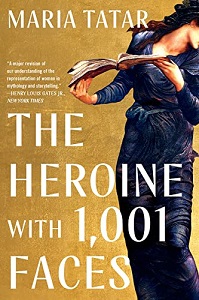
Maria Tatar, The Heroine with 1,001 Faces

What do women do while men leave to vanquish dragons and cross trackless seas? Is it possible for a woman to be a hero? Joseph Campbell, whose major work The Hero With a Thousand Faces popularized the ides of a “hero’s journey,” believed heroism was a singularly male pursuit (while teaching at a women’s university). In Campbell’s precepts, femininity is womb and grave, wife and temptress, a heroic man’s original source and his ultimate destination.

Maria Tatar, professor of German and children’s literature at Harvard University, sees a second track running under mythology. While men become heroes by leaving home and swashbuckling through the world, women often become heroic in how they resist. Put another way, heroism is something men find; it’s something women have thrust upon them, sometimes bodily. Tatar unpacks threads of feminine heroism from classical mythology and medieval folklore to modern Hollywood, sometimes with decidedly mixed results.

In the oldest mythology, Tatar finds women struggling to maintain an identity when men try to constantly control them. Helen of Troy finds herself passed, hot potato-like, between the hands of male heroes, her story getting lost along the way. Philomela literally loses her voice to her rapacious brother-in-law, who severs her tongue after violating her; but she reclaims her voice through embroidery. “Women’s work” becomes how she reclaims her voice and receives deferred justice.

Similar themes recur in Tatar’s telling, but importantly, when women find their voices, others take those voices away again. Arachne, the famous weaver whose skills challenge the gods, is a good example. In Ovid, the goddess Athena punishes Arachne, not because her weaving is excessively superior, but because she uses her weaving to call out the injustices of the Olympian gods. Modern mythologists reverse this, though, turning her into a moralistic warning against simple pride.

Nor are the connections to modernity incidental. Then as now, women seek the autonomy to tell their own stories, which they can frequently only achieve through subversive means. Consider how the #MeToo movement won its incremental successes despite, not because of, conventional media. Women fight a system designed to preserve the status quo of power and freedom, even when the existing system rewards the already excessively rewarded, and silences those who call injustice by name.

Maria Tatar

Tatar especially appreciates women who bring the ancient unresolved questions into the modern world. She extensively unpacks authors like Margaret Atwood, Pat Barker, and Madeline Miller, who rewrite the classical myths from a woman’s viewpoint. In the Homeric traditions (which Joseph Campbell considered normative), women are either largely voiceless, like Penelope or Briseis, or downright villainous, like Circe. Tatar loves when women writers return to the ancient well and give silenced women their own voices.

Continuing into medieval folklore, Tatar examines the same themes as they recur—or, just as importantly, as they’re silenced. French fairy tale author Charles Perrault writes in “Bluebeard” of a woman captive to a terrible husband, who discovers the truth, and is rescued by her brothers. But when the same story reappears in the oral tradition, usually by women, as in the Brothers Grimm’s “Fitcher’s Bird,” the beleaguered bride rescues herself, because there’s nobody else.

Tatar’s explanatory skills work best in the classical and medieval myths that mostly inspire her and Campbell. Moving into the modern era—which, since the middle Twentieth Century, mostly means movies and TV—her critical skills become more synoptic and brief. Maybe she expects her audience to already be familiar with the Hollywood stories she mostly just mentions and briefly describes. But the product feels rushed; she doesn’t so much unpack Hollywood as name-check it.

That said, she does describe the thread of women’s resistance to worldly injustice. From Cassandra, who gets mocked and derided for speaking the truth, and Scheherazade, who tames the destructive monarch by telling tales, to modern mythic tales like Little Women and Wonder Woman, Tatar sees something continuous. Women through literary history have established themselves by telling their counter-narrative, keeping their stories alive against men. Women survive by preserving and by passing along their stories.

Maria Tatar is hardly the first scholar to postulate a feminine analogue to Campbell’s “hero’s journey.” This book’s Amazon page links to at least two books entitled “The Heroine’s Journey.” Tatar brings her contribution, a knowledge of classical and medieval mythology as capacious as Campbell’s own, arrayed thematically to demonstrate that women are no less heroic, just because they don’t conquer. Women, arguably, do something more heroic: they face an unjust (male) system, and survive.

Also by Maria Tatar:
Enchanted Hunters: The Power of Stories in Childhood

Wednesday, April 12, 2023

The Women of the American Revolution

Amy Harmon, A Girl Called Samson: a Novel

Deborah “Rob” Samson grew up as an indentured servant in colonial Connecticut, surrounded by farmer boys and their dreams of war and glory. So when the American Revolution started, she watched her foster brothers enlist, and she watched the condolence letters come home. But Deborah believes the high-minded Revolutionary ideology, and memorizes the Declaration of Independence. It only makes sense for her to eventually run away and enlist.

The first thing to remember when reading prolific author Amy Harmon’s latest historical novel is that Deborah Samson (or Sampson) was a very real person. She really enlisted near the culmination of the Revolution, serving for seventeen months as Robert Shurtliff. Therefore, Harmon’s story is circumscribed by history, and often lacks the unity and panache of wholly fictional stories. Life often lacks a plausible through-line.

Rather than inventing the story, Harmon invents Samson’s untidy inner turmoil. She creates a heroine who reads the Bible and Thomas Paine, and believes their exhortations. What Samson doesn’t believe is the narrative given her, of the importance of finding a husband and assuming domestic duties. She doesn’t want a colonial woman’s limited options; she wants the life promised to the men surrounding her, and she’ll lie to achieve it.

Harmon presents this novel as the memoir Deborah Samson never wrote. (She spoke prolifically, but left few texts.) Samson describes the various lessons learned from authority figures around her: the parish pastor who encourages her literacy, the employers who treat her more like a daughter than the help, and her foster brothers. She learns to trust her own capabilities, and shows little patience with social niceties foisted upon women.

But when she hits adulthood, something changes. Everyone around her begins pressuring her to marry; by colonial standards, she’s considered an old maid at twenty. Modern audiences will surely sympathize, as authorities spend a child’s first eighteen years encouraging them to dream, then the rest of their lives telling that former child to wake up. To us, Samson’s refusal isn’t rebellious, it’s a reasonable response to unreasonable expectations.

Amy Harmon

That collision between the story’s historical context and the audience’s expectations is where I begin having problems. Harmon trusts our instinctive reactions, which makes sense in reading a contemporary setting. When several men (including one of her foster brothers) make fumbling attempts to court Samson, she dismisses them flippantly, as we would; she doesn’t linger on them. And she doesn’t emphasize what an act of moral rebellion this refusal is.

Our story unfolds from there, more a series of episodes than a unified narrative. Samson progresses from bucolic agrarian childhood, through the relationship pressures of adolescence, to adulthood and enlistment, with remarkably little friction. Along the way, Samson has various encounters with historical figures; though Harmon creates a fictional array of enlisted men to annoy Samson, the officers in Harmon’s narrative are actual people taken from the record.

One example should emphasize my disappointment. When Samson finally enlists (on the second try), she’s rostered with a battalion of locals who josh her for being young and pretty. They don’t know she’s marching in drag, obviously. These local regulars are one-dimensional, and identified entirely by their surnames. One youth shows some glimmerings of complexity, just before they’re all killed in a skirmish with De Lancey’s Brigade.

This narrative arc is taken directly from countless war movies. Bigger, more aggressive recruits haze our timid protagonist, but the arrogant swashbucklers are ill-prepared for war, and die quickly in front of our protagonist. The hero must then face the survivor’s guilt. Once again, Harmon relies upon our familiarity with the narrative trope, because she doesn’t return to it, or dive any deeper into the consequences.

Such problems abound. Samson has various encounters, which are isolated and seldom plumbed deeper. She acquits herself admirably in battle, and eventually becomes General John Paterson’s personal aide. Harmon ramrods in a Twelfth Night-ish implication of sublimated romance, then largely abandons it. Any of these might’ve been profitably expanded to a full-length novel, or deep-dive short story anyway. But Harmon mainly name-checks the war movie tropes, then blithely moves on.

The historical Deborah Samson was eventually discovered. In an unusual twist, she received, not a reprimand, but an honorable discharge, for her distinguished service; she later became the first woman to receive a U.S. Army pension. She was among her era’s few women to resist gender roles, and win. Samson was admirable, and Harmon clearly admires her. But admiration isn’t enough; this low-friction version of Samson’s story is ultimately lukewarm.

Thursday, June 16, 2022

Who Says You Can't Go Home Again?

Erin Bartels, The Girl Who Could Breathe Under Water: a Novel

Kendra Brennan has returned to the upstate Michigan cabin where she spent her childhood summers, in order to write her overdue second novel. Her first was a runaway success, and she fears she can’t match it. This fear is exacerbated by a “fan letter” she’s received, accusing her of exposing years of deeply buried secrets in her literary breakout. Whoever wrote this letter must know Kendra’s personal story. Whoever it is must know this Michigan cabin.

The back-cover copy on Erin Bartels’ fifth novel somewhat implies a twisting thriller, perhaps a Gone Girl about early traumas and the platonic bond between women. What we get is quieter and more nuanced, less Gillian Flynn, more Thomas Wolfe. Not that Kendra’s return to the site of childhood trauma (which Bartels basically admits is semi-autobiographical) isn’t thrilling. But the journey is more internal that I would’ve anticipated.

Kendra retells her story in the form of a letter to her childhood BFF, Cami, who spent summers in a similar vacation home across the lake. Kendra grew up with a single mother, and a very old-school grandfather who mastered the art of stuffing his emotions. Cami’s father, by contrast, was a star novelist who embodied the phrase “mo’ money, mo’ problems.” These girls came from different worlds, but in Kendra’s telling, her lakefront summers were her real life.

As an adult, however, she’s confronted with the realization that she saw Hidden Lake through a child’s eyes. She didn’t understand what her fast-paced, glamorous BFF might be enduring when the world wasn’t looking. And when she suffered a life-changing trauma on the water, one she finally exorcized ten years later in her first novel, she didn’t realize that it wasn’t her trauma alone. It’s difficult to see how one’s choices inevitably influence others.

One of Kendra’s summer goals is to confront Cami’s brother, who caused her life-changing trauma. And yes, that trauma is exactly what you expect it is. I feel comfortable spoiling this revelation, because the confrontation which Kendra expects to solve everything actually happens less than halfway through the book, and actually creates more confusion than it resolves. Especially as further old family secrets continue percolating toward the surface.

Erin Bartels

In many ways, Bartels’ message with this novel, is that life doesn’t work like a novel. Healing from adolescent trauma isn’t like Freytag’s Pyramid; there’s no climax, followed by morally pat resolution. Instead, each question Kendra answers invites three more. Before long, she realizes that her childhood summers, which looked straightforward to a child’s eyes, concealed a Peyton Place-like nest of lies, secrets, and damaging escapades.

Full disclosure: Erin Bartels is generally known as a Christian novelist, and this novel comes from a dedicatedly Christian publisher. There’s no cussing or violence, and one subplot involves a romance that remains remarkably chaste. Even as Kendra pursues her childhood trauma—and, piece by piece, that of others—Bartels never uses language you would feel uncomfortable repeating in front of your grandmother. Bartels’ writing is simultaneously frank, and demure.

This isn’t, however, a “Christian novel.” In over 300 pages, Bartels references church twice, God three times, and one transient reference to prayer. None drive the plot. Instead, this is a novel about facing, and moving beyond, the trauma that once seemed monolithic, a novel of psychological depth and complexity, which just happens to have been written by a Christian author. Bartels’ moral code is present, but it isn’t what the book is about.

Indeed, if this novel contains a Christian message, it’s that there’s a difference between fairness and justice. Kendra returns to the lake, expecting that her childhood tormentor will be thunderstruck with guilt, she’ll receive recompense, and the universe will restore balance. Instead, she learns that every terrible act comes from somewhere; and while her tormentor should’ve made better choices, it’s still not her place to pass judgment.

That’s sometimes a bitter pill to swallow, for us as much as Kendra. I almost stopped reading this novel because there’s an extended passage that, to modern progressive readers, sure looks like victim-blaming. I’m glad I kept reading, though, because Bartels reminds us that context matters. She also reminds us that one transgression, even one that causes trauma, doesn’t make individuals evil. We all have to atone for something, to somebody.

This isn’t an easy novel, but it’s a gripping one. Bartels’ message is bracing to Christian and non-religious readers alike. And I can pay no better compliment than that stayed up past my bedtime to finish reading.

Friday, June 25, 2021

Britney Spears, Fathers, and Womanhood Deferred

Britney Spears

Perhaps the most appalling news from Britney Spears’ testimony against her court-appointed conservatorship this week concerns her IUD. The revelation that her conservators—mainly her dad—are forcing her to consume pharmaceutical lithium against her will, probably says more about her long-term health and the harm being forced upon her. But audiences probably had more gut-level revulsion to learn that she can’t make her own reproductive health decisions.

With the vantage of hindsight, it’s difficult to consider Spears without her semi-rural Southern origins. Born in McComb, Mississippi, and raised in nearby Kentwood, Louisiana, she started in America’s Bible Belt, was baptized Southern Baptist, and first sang publicly in church. Though she left the Bible Belt, aged eight, to pursue her entertainment career, that upbringing cannot help but loom large in considering the tribulations she currently faces.

Reading the transcript of Spears’ testimony, I’m seized most immediately by how explicitly sexual her father’s control is. He makes decisions about her reproductive health, although she’s thirty-nine years old, because he perceives controlling her sexual decisions as an economic instrument. Britney’s body has become a commodity which her father markets, like he’d market her clothing if she designed fashion. Jamie Spears’ management of his daughter’s career is painfully sexual.

This testimony occurred just days after Spears’ family church, the Southern Baptists, shared a cringe-inducing “Modest Is Hottest” music video at a denominational gathering. I’m somewhat more forgiving of singer-songwriter Matthew West, who sings from a father’s viewpoint, because parents do frequently have to make decisions about appropriate wardrobe and comportment for minor children, who by definition can’t make such decisions for themselves. But that forgiveness only goes so far.

My problem is, Matthew West, like Jamie Spears, frames appropriate behavior in terms of being “hot.” That is, while the commercial forces that often dominate American life value women according to their ability to get naked, West values his daughters according to their ability to resist this appeal. Yet he openly frames this resistance in terms of sexual appeal and attractiveness. Like Spears, West dominates and commodifies his daughters’ sexuality.

The Purity Culture of the 1990s, which dominated—and frequently still dominates—Bible Belt Christianity, sees adolescent girls as entirely sexual beings, defined by their ability to tempt and entice men. Britney Spears and Matthew West express the extremes of this definition. From her beginnings, when Britney tied her shirttails above her navel in her “Baby One More Time” video, fresh-faced adolescent sexuality has occupied the core of her message.

Britney with Paris Hilton, ca. 2008

Yet Britney’s sexuality, sure as the West daughters, was controlled by her father and other surrounding adults. Jamie Spears made decisions about how to sell her:, for instance, letting Max Martin pitch her a debut song written for a vocalist ten years older than her. Jamie Spears made marketing and image decisions which were entirely, outwardly sexual. Before she turned eighteen, he made his daughter’s body into a commodity.

This tension between seeing one’s daughter as your little girl, and acknowledging her nascent sexuality, probably plagues fathers worldwide. I can’t imagine what frustration it must cause fathers to give advice and guidance about sex, knowing daughters will ignore some or all advice until it’s too late. Yet 1990s Purity Culture, and the opposite number embodied in Britney’s in-your-face exhibitionism, made girls into completely sexual beings, then entrusted that sexuality to fathers.

Readers old enough, like me, to remember the emergence of “purity balls,” know what I mean. These weird virginity proms spotlighted fathers and daughters in relationship. These girls were presented as already women, but per the arrangement, they consciously abnegated their own sexuality, entrusting it altogether to their fathers. These bizarre, frequently disturbing events turn adolescent girls into childlike dependents and also Jezebels at the same time.

In fairness, discordant events like this aren’t exactly inexplicable. As traditional gender roles have proved unsatisfactory, and have receded, without anything prepared to take their place; as sexual mores have evolved, reflecting the fact that most families don’t need to breed their own workforce anymore, older people feel dislocated. Rapid change, venturing into unknown territory, is scary. Some people seek comfort in extreme forms of nostalgia.

But as Britney’s testimony reveals, an iron paternal grip on youthful sexuality doesn’t prevent dangerous consequences; it just changes one unknown outcome for another. Britney’s expertly managed teenage sexuality and Christian Purity Culture couldn’t have existed without one another. Both saw teenaged girls as essentially sexual, and both entrusted that sexuality to heavy-handed dads. And now we’re paying for both.

Monday, June 21, 2021

The End of the Ends of the World

N.K. Jemisin, The Fifth Season (The Broken Earth 1)

Essun, a humble schoolteacher and mother, returns home one fateful afternoon to find her toddler son murdered, presumably by his father. Her world, as she knows it, has ended. The grief leaves her so shocked and paralyzed that she fails to notice when the literal end of the world begins around her: earthquakes, volcanoes, ashfall from the sky. Only latterly does she realize she has to venture out into Armageddon.

N.K. Jemisin had written several critically acclaimed science fiction and fantasy novels before beginning this, her breakout success. This volume addresses the circularity of time, how past events form our present in ways we can’t shake. Essun wants to establish herself, but doesn’t know herself. She’s been molded by a system of fears and doubts, a terrifying bureaucracy which has taught her to fit in or be, literally, struck down.

This novel belongs to a science fiction subgenre called “Dying Earth.” This subgenre deals with civilizations so far into the future, our present isn’t even a historical oddity. Technology has become so advanced that, as Clarke posited, it’s indistinguishable from magic. Yet entropy has become widespread, the Earth is used up, and the Sun is dying. Characters can’t fight for the future, because there barely is any future.

From childhood, society has taught Essun to fear certain people. Then she discovers she’s one of the feared. This novel addresses three stages in Essun’s life: Jemisin doesn’t state this directly until late, we could be reading about three different women, but experienced readers will recognize early that we’re witnessing Essun’s Maiden, Mother, and Crone stages, sort of. The ways she learns to love and hate.

Lifted from her provincial childhood and taken to the Empire’s greatest academy, young Damaya is taught the ways of orogeny, a sort of plate-tectonic wizardry. She’s immensely powerful, but the Empire fears her powers, and molds her through intensive conditioning. She isn’t permitted to pick her own career, or even her spouse; her life is about compliance with unquestionable authority. This authority is paternalistic, even loving, but always autocratic.

As a child, Damaya simply asks questions and wants to better understand her world. She seeks knowledge, but the bureaucracy deems certain knowledge too dangerous. Instead, she’s channeled to public service. Her career is chosen, and her sexuality becomes a matter of semi-public spectacle. She could’ve been a scientist, but the state deems science dangerous. When she rebels against social order, it literally kills people.

N.K. Jemisin

In young womanhood, renamed Syenite, the Empire uses her abilities to preserve its own ideals. This concept of Empire matters greatly. Jemisin’s characters discuss power, conquest, and the instruments of control. The Empire, we learn early, is moribund and decrepit, the Emperor a prisoner, and the bureaucracy marches on. Nothing new gets invented, because to the Empire, the only meaningful truth is continuity.

Finally, in adulthood, Essun wants what everyone wants, love and relationship and community. She becomes a wife and mother; but the secrets she’s spent decades burying reveal themselves in her children. She has to pay for the secrets she’s kept, because even amidst the End of Days, powerful people out there still see her as an enemy who needs to be crushed. And somewhere, she still has one surviving child.

Jemisin’s system, reflecting the three stages of woman in pre-Christian religion, suggests that Essun might be a nascent goddess. She faces systems of control and, in different ways at different times, decides whether to comply or resist. This may include malicious compliance, near the end: on one level she’s broken, but on another, she becomes independent where the world abandons her, and she transcends the world’s fight-or-obey dichotomy.

Essun’s maturation reflects ours, as all literature is about its audience. Throughout the story, she faces the reality of her dead child, or children; she exists without a real future. Environmental decay, technological bloat, and alienation from herself: Essun is the modern adult woman, adrift in a world that perceives her as inherently dangerous, even before she’s actually done anything. Sadly she lives up to, or down to, the world’s expectations.

Jemisin combines several existing tropes: pre-Christian stages of womanhood, or Freud’s belief that civilization causes neurosis, to name just two. But she sees these tropes through a lens that is particularly modern, American, and Black. She offers a literature of rebellion, of anti-imperialism, even when breaking the empire could have grim ramifications. This isn’t a manifesto, don’t misinterpret me; it’s simply a book about not complying with evil, dying systems.

Friday, June 4, 2021

Some Thoughts on Mary Magdalene

Mary Magdalene painted by Titian

Mary Magdalene, one of the few figures identified by name in all four canonical Gospels, wasn’t identified as a prostitute. Let’s start with that. Yes, Luke’s Gospel calls her “Mary called Magdalene, out of whom went seven devils,” so she had a past. But nobody considered her a prostitute until Pope Gregory I, who syncretized several widely spaced references to simplify doctrine. This happened in the Sixth Century CE.

Yet I’ve been considering Mary recently, and I suggest, considering her a prostitute makes theological sense. The fact she has a past, and a past which her time and ours often consider irredeemable, carries important weight. We now know, as public moralists in Jesus’ time didn’t, that women enter prostitution mainly because of economic desperation. To First Century moralists, prostitutes didn’t just sell sex, they sold their identities as women.

“The Virgin-Whore Dichotomy” has become a widespread critical buzzword for the moral roles enforced upon women. It’s important to remember, though, that at one time, this wasn’t metaphorical. Women were wholly commodities; their virginity made them valuable as wives and mothers, like prize heifers. If they didn’t possess their virginity, they became something men could rent, like a Buick, but never really own. Bought or rented, never independent.

In either case, women (and by implication everyone) are defined wholly by their past. Prostitution became, not something a woman did, pressed by poverty and need, but something a woman was. Consider all the identity roles enforced on people today: race, gender, nationality, immigration status, economic class. Even your name, assigned at birth and changeable only by court order. Every identity marker binds you entirely to your past.

If Mary was a prostitute, she would’ve understood this intimately. Once the world recognized her as sexually “unclean,” she would’ve had no route back; she was beyond redemption. This attitude isn’t millennia old, either; “purity culture,” which dominated sectors of White Christianity for the last thirty years, preaches the same message. You’re either pure or fallen, and once fallen, that condition lasts forever. Impurity is beyond redemption.

By contrast, Jesus says we, like Mary, aren’t yoked to the past. A repentant heart has freedom to move, because it abjures its past, and faces the future. The world chains us to mistakes we made previously, maybe years ago, a posture that comforts the powerful by making everyone fixed and controllable. But Jesus says other people don’t own you, can’t define you by choices made in your past.

Mary Magdalene painted by Guido Reni

Worldly authorities love creating categories of control. Consider the pundits who love reminding everyone that Representative Alexandria Ocasio-Cortez used to work as a bartender. Such moralists want to define her entirely according to a job they consider menial; power, they imply (like the Romans and Pharisees before us) belongs to people of means and leisure. If you’ve ever needed to accept a derided job, they’ll define you by that forever.

Throughout history, powerful people have attempted to yoke the poor, the despised, and women to their pasts. In Second Temple Judaism, the punishment for crimes of desperation, like prostitution or petty theft, was maiming or death: punishments that cannot be rescinded. You became, forever, the “worst” thing you ever did. Nor did Christians improve things; from medieval flagellants to modern Evangelicalism, sexual indiscretions have tainted women for life, and beyond.

Rather than the comforting, but damning, certainty of the past, Jesus offers a dangerous, uncertain future. That sounds terrifying to people who prefer certainty, and not without reason; remember, eleven of the twelve male Apostles died violently. But the alternative to this living, risky future, is the fixity of the past. You can race headlong, giddy, into the future, encountering it on Jesus’ terms; or you can be static and dead.

I admit, I’m frequently bad at embracing this. The past is knowable, to the extent that humans can know anything, because it doesn’t change. Sure, it gets reframed, our understanding changes, but the past itself stands. The future may sucker-punch us, and frequently does. The desire to reduce risk makes us hug the chains connecting us to the past, dragging our guilt, resentment, and fear everywhere.

Yet I consider the prospect that we aren’t beholden to our past liberating. Worldly powers continue defining us according to our past: dragging the punishment for nonviolent drug offenses out for decades, for instance, or insisting on deadnaming us. To the hierarchy, prostitution is the epitome of this. But the Gospel says: you’re defined by where you’re going, not where you’ve been.

Monday, December 14, 2020

Women, Academia, and Lousy, Lousy Men

Dr. Jill Biden

Joseph Epstein is a twat-waffle who shouldn’t be taken seriously by anyone. My regular readers can surely agree on this thesis. I can add nothing to the controversy surrounding Epstein’s contemptible Wall Street Journal op-ed which hasn’t already been said better by women, professional academics, and scholars of journalism. And yet, even as I consider him a total asswipe, I can’t help understanding where he’s coming from.

Admittedly, I haven’t read Epstein’s attempted take-down of presumptive First Lady Dr. Jill Biden, and her use of her academic title in non-academic situations. I didn’t bother going beyond the paywall; the first paragraph, in which Epstein calls Dr. Biden “kiddo,” a term almost exclusively used on small children and women, demonstrated Epstein’s attitude promptly. I wouldn’t read a student assignment with such an opening; it demonstrates bad faith.

A former student from Epstein’s years adjuncting at Northwestern University recently posted a personal memoir of Epstein’s thoroughgoing disdain for women. His refusal to call on them in class, to acknowledge their contributions, or to believe they wrote the works they actually wrote, is probably familiar to generations of women. Yet, as a former adjunct myself, I can’t help wondering what my students thought of my treatment according to gender.

Nobody ever complained, to my face, that I favored one gender over another. Indeed, as my entire career focused on teaching Freshman Composition, I found women generally better prepared for college-level writing than men. I seldom gave 100% on any student assignment, but the two times I clearly remember, were both women. If I favored one gender, it was women, but I favored them because they—generally—earned it.

My final teaching semester, I had a student, a young man on a football scholarship, approach me after class. I found this youth, let’s call him Michael, a willing student, eager to learn, but unprepared for higher-level writing. Rarely did I actively dislike any student, but I felt warmly for Michael, because he earnestly tried to overcome his unreadiness; he genuinely wanted to succeed. He just didn’t know how.

“I don’t know, Mr. Nenstiel,” Michael said, studying his shoes with a distinct lack of confidence I don’t recall seeing in many football players, “this just feels more difficult than anything I’ve done before. I just feel like the girls are kicking my ass. I don’t know if I can compete with them, they just do so much better than me.”

Joseph Epstein, former
academic and crap journalist

This was the closest anybody ever came to accusing me of gender favoritism. The girls, Michael felt, were kicking his ass. (I distinctly remember that phrase, and have written about it before.) Yet even then, I realized, Michael saw things incorrectly. In a classroom roughly divided equally by gender, only one woman regularly participated in discussions without being called on; I had five men who eagerly participated.

Yet Michael felt outclassed, not because of classroom participation, but because of tangible, portable outputs. Later in my teaching career, I abandoned lecturing at the 101 level and began running my classes as writing workshops, which better suited my disposition. Therefore Michael had seen every student’s assigned writing, even the women who didn’t speak up, and saw they wrote with more confidence and experience. He didn’t know how to compensate.

Michael responded to this lack of preparation by turning his feelings inward and blaming himself. Personally, I’d blame a public education system dominated by “skillz drillz” and Scantron tests, administered by career overseers with little classroom experience. Women, whose brains mature earlier, need less guidance, in a guidance-free school system, than men. But someone like Joseph Epstein sees the same lopsided outcomes and blames the women for succeeding.

Nearly sixty percent of college students today are women. Women are not only more likely to enter college, they’re more likely to finish what they’ve started, and more likely to achieve graduate degrees. Academia, like business, remains dominated today by male executives and managers, but as the paucity of qualified men becomes more prominent, we’re likely to witness the female domination of post-secondary school and business, possibly within our lifetimes.

Where men like Michael consider themselves responsible for this outcome, and struggle to compete individually, men like Joseph Epstein respond by attempting to tear women down. His attack on Dr. Biden’s qualifications doesn’t merely attempt to diminish Dr. Biden, or even women generally; Epstein attacks academia itself, a system that often rewards prior preparation and early maturity. A system that, in blind outcomes, rewards women. That, to him, cannot stand.

Tuesday, January 21, 2020

Living With the Ghosts of H.P. Lovecraft

Kij Johnson, The Dream-Quest of Vellitt Boe

Scandal rocks the ivied streets of ancient Ulthar: a young woman has fled with her beau to another world. The great university city of the dreamlands, Ulthar is prestigious, but precarious. In order to maintain the balance with human benefactors and capricious gods, Professor Vellitt Boe volunteers to track the young woman down and bring her home. But what should’ve been a brief mission becomes a massive quest when it appears the woman has entered that great forbidden realm: the waking world.

Hugo and Nebula award-winning novelist Kij Johnson grew up reading H.P. Lovecraft, according to her annotations. Like many readers, she loved his ability to create feelings of creeping dread and nightmare-like atmosphere, without resorting to easy jump scares. But she also wondered at his deep-seated racism and casual misogyny. So, like many good readers, Johnson dived back into Lovecraft’s published corpus and crafted this, a companion to his legendary Dream Cycle stories.

Professor Boe, an erstwhile nomad, rediscovers the joys of crossing the dreamlands, a continent where distances are arbitrary and monsters lurk behind every corner. Death, to citizens of the dreamlands, is a comfortable neighbor. Accompanied by one of Ulthar’s legendary cats, Boe traverses cities with nameless streets, and forests overgrown with vines, until she finds the temple leading to the waking world. But the temple priests don’t have the key to cross; that lies with Randolph Carter.

Yes, Randolph Carter. Just as Lovecraft’s works include frequent references to his own work, Johnson liberally inserts dense references to Lovecraft. Professor Boe knows she must locate her missing student, before Ulthar is destroyed like ancient Sarnath. She names, and fears, Lovecraft’s fickle Elder Gods. In her allusions to Lovecraft’s works, Johnson channels his nightmare-like tone, without collapsing into mindless pastiche. This is both a Lovecraft work, and something more.

Readers familiar with Lovecraft’s works recognize Randolph Carter as Lovecraft’s Mary-Sue character. Which leads me to wonder: is Vellitt Boe Kij Johnson’s Randolph Carter? (Let’s not grammatically parse that sentence.) Boe and Johnson are similar in age, profession, and even appearance. In chasing Randolph Carter across the dreamlands, and finding him a shadow of his former self, is Johnson confronting Lovecraft and his influence on her writing? That’s what I would do.

Kij Johnson
I’m unsure that’s what Johnson does, though. Rather than confront Randolph Carter, Professor Boe utilizes him to pursue her own goals. If Vellitt Boe serves the same role for Kij Johnson that Randolph Carter serves for Lovecraft, then Carter/Lovecraft is neither a monster to defeat, nor a lover to embrace, though Boe implies he might’ve been both once. Instead, Carter becomes part of the youthful influences that made adult Boe. Johnson handles this better than I might.

H.P. Lovecraft was decades ahead of other writers in the weird horror genre, and his influence echoes across today’s publishing world. He was also so unbelievably racist, even by his day’s standards, that his friends and colleagues felt compelled to comment upon it. This duality, between the progressive writer and the regressive man, influences his dreamlands, a landscape that stretches across multiple stories, populated by bigoted stereotypes and, notably, very few women.

Johnson comments upon Lovecraft’s unexamined prejudices by doing the opposite of anything he would’ve done. His world was overwhelmingly male, so she creates a female protagonist. Lovecraft considered the waking world real, and dream people subordinate, so Johnson gives us a dreamlands native. Randolph Carter refused to age, even as Lovecraft handled the years poorly, so Johnson’s Vellitt Boe wears her iron-haired years with resolute pride. Everything Lovecraft would’ve hated, Johnson puts front and center.

The result feels like both a love letter to Lovecraft’s influence, and possibly a Dear John letter. It’s also a self-contained narrative, a story that doesn’t require any previous familiarity with Lovecraft, because Johnson creates character and atmosphere entirely her own. Vellitt Boe walks through a world that resembles our own dreams: we can traverse the land, but can never return, because the path we’ve taken returns whence it began, our own brains. I create as I speak.

If Vellitt Boe is Johnson’s alter ego, she occupies Lovecraft’s world with grace and dignity seldom seen since the original. And if Vellitt Boe is a woman crossing dangerous territory in her own right, she’s a dauntless heroine, a weird fiction icon for the present generation. This book is short, barely 160 pages, yet finishing the story, you feel like you’ve undertaken a momentous journey. Because maybe, in Lovecraftian terms, you have.

Monday, September 17, 2018

The Day Daddy's Girl Had To Grow Up

Jennifer Handford, The Light of Hidden Flowers

“I had aced every test I had ever taken, but I had also failed to grow up, and of that fact, I was now suddenly keenly aware. I was smart, but I wasn’t wise. I had clung to my role as my father’s child.” (Page 49)
I sometimes complain that books tell me what to think or feel, but rarely do they contain something so akin to a thesis statement as the above quote. As protagonist Melissa “Missy” Fletcher faces her steadfast father’s apparently sudden senility, she realizes she has accomplished little in life. It isn’t a dawning realization from evidence, either. She has a divine afflatus so abrupt, one suspects she knows she’s a character in a novel.

This novel commences on Missy’s thirty-fifth birthday. She insists she doesn’t work for her father, a successful financial planner in Richmond, Virginia; she’s a full partner in the family business. The mere fact that Dad’s the company’s public face, while Missy handles market forecasts, mundane paperwork, and other behind-the-scenes tedium, doesn’t make her inferior. Anyway, she keeps telling herself that, and by implication, us.

But one sunny morning, Frank Fletcher, pillar of Richmond’s financial community, forgets his well-rehearsed banter. A seemingly insignificant “senior moment” marks the beginning of a pattern, as memory slips, blown judgement calls, and getting lost become remarkably common. It takes 100 pages for a neurologist to confirm it, but don’t worry, the dust-flap synopsis spoils the reveal: Dad has Alzheimer’s disease. Missy has never felt so alone.

With postponed adulthood suddenly thrust upon her, Missy doesn’t know what comes next. She’s dating a handsome but uninspiring tax analyst across town. He’s asked her to marry, but she dithers, because he’s so plain-vanilla (literally so: vanilla ice cream is about the only thing he gets excited for). I can’t fault Missy’s ambivalence. She’s a foodie, he enjoys TGIFriday’s and tap water. She wants to visit Italy, he considers Yellowstone an adventure.

Missy grasps the hypocrisy in this judgement, though. She chose her college and career specifically to keep close to her father and hometown. Despite longing to visit Italy, the one time she attempted travelling anywhere, paralyzing fear forced her off the airplane; her bags went to Florence, she stayed home. (This is Missy’s only deeply investigated fear, but she misconstrues even this. Since panic struck before takeoff, I think she fears, not flying, but travelling.)

Jennifer Handford
Most tellingly, Missy Facebook-stalks her high school boyfriend. She admires his glamorous wife and three handsome children. Because Joe selectively curates his life, though, we know what she doesn’t: Joe’s wife has left him, he lost one leg in Afghanistan, and his daughter suffers major depression with suicidal ideation. Wait, he’s getting divorced while she’s contemplating loveless marriage? Which character will crack and divulge the truth first?

Perhaps we’re supposed to consider Missy an unreliable narrator. Though she spends chapter after chapter reminding us how homely, geeky, and uninspiring she is, occasional chapters told from Joe’s viewpoint stress Missy as elegant, beautiful, and awesome Missy is. Though Joe is unhappily married and raising emo kids, he’s clearly paused his heart, waiting for Missy to return. Anyone who’s reconnected with their high-school crush in their thirties cringes inwardly.

I make fun, but there’s a decent coming-of-age story underneath Handford’s authorial baggage. As Ernest Hemingway once wrote, adulthood isn’t a matter of turning twenty-one or whatever, it’s about taking possession of your own life. Just because Missy doesn’t start doing that until she’s thirty-five doesn’t make it less meaningful. Today’s generation knows that technology, economics, and other forces often force “adults” to continue living like kids for years.

Sadly, when I mention Handford’s authorial baggage, there’s lots of that. She overextends Missy’s adolescent hand-wringing well beyond necessity. It takes too long to reach Dad’s Alzheimer’s diagnosis, especially since we already know it’s coming. Then the disease progresses so quickly, we feel pity, not empathy. Her romantic life has more red flags than a Soviet parade. We, the readers, desperately want Missy to get out of her own way and do, well, anything.

One wonders, reading this novel, whether any editor anywhere, at any point, took Handford’s manuscript and said, “You need to have characters act, not narrate.” We know Handford has the ability to write with telling detail, because she describes financial documents and dinner preparations with exquisite specificity. She just doesn’t use such skills on human interactions. Handford, through Missy, holds her audience at arm’s length. In the end, I just got bored.

Thursday, June 28, 2018

The Gothic Forest in the New Millennium

Julia Fine, What Should Be Wild: a Novel

Young Maisie Cothay can kill or resurrect at a touch. Not just humans, either: she has accidentally resurrected winter-killed grass, taxidermy, and roadkill. Because of this, her widowed father raised her in her family’s ancient stone-walled manor house, in almost complete isolation, since birth. But at age sixteen, she finds herself without a guardian, scared and truly alone. So, like girls everywhere, she prepares for an epic quest.

Debut novelist Julia Fine creates a sort of Modernist Gothic tale, a story about a girl who cannot exist with society, but whose coming of age makes her desperately lonely. It has all the classic Gothic components: mysterious old house full of relics, dark forest, moving pathways, evil inheritance. Fine combines these elements with a dawning adulthood, with all the complexities that entails, in a symbolic Mulligan stew that’s remarkably unsubtle, but nevertheless pretty satisfying.

Maisie’s father raises her in Urizon, a massive, labyrinthine house that’s been in her late mother’s family for generations. She grew up with only books for companions, which explains her strange, Jane Austen-esque manner of speaking in the early 21st Century. Maisie’s only friends were Mrs. Blott, a grandmotherly woman from town, and a dog named Marlowe, the only living thing that resists the mortal effects of her touch.

Urizon overlooks a mysterious, trackless forest. Local legends abound of villagers who wandered into the forest and emerged, days or weeks later, gibbering deliriously about how the pathways move behind them, so they cannot find their way out. Despite encroaching modernism, the forest remains a primeval source of terror. We know, though Maisie doesn’t, how seven women in her matrilineal genealogy wandered into this forest… and are still watching her.

It’s tough to review books like this. Fine deliberately defies Rule Number One of postgraduate writing workshops: hide your sources. It’s impossible to read this novel without noticing how the Brontë sisters, Daphne du Maurier, and Shirley Jackson have influenced Fine. Ambitious readers could profitably do a source study on where this novel fits in Goth-Lit history. Fine’s biggest contribution is moving her main story into a world of smartphones and GPS.

Julia Fine
This placement within a literary continuum could be criticism or praise. Reading this novel, I never stopped noticing Fine’s genre influences. However, I never stopped noticing Fine’s genre influences, yippee! Though it’s possible, even easy, to identify where Fine appropriated plot elements and character types, she handles them well, constructing a story where the pieces fit smoothly, without a sense of being stitched together.

Fine keeps the novel’s setting fairly ambiguous. The Elizabethan manor house, overlooking a village straight from The Wicker Man, suggests England, as does the gradually revealed family line, dating back to the Iron Age. But certain cultural markers, including Maisie’s generous use of Americanisms, suggest a North American setting. Such ambiguity of place reflects Gothic tradition: the story is usually set everywhere and nowhere, to literary sticklers’ chagrin.

I can muster one definite criticism. Around the one-third mark, old age takes Mrs. Blott (what a perfectly Dickensian name!). Her role—old, maternal, vaguely sexless—transfers to her university-age nephew, whom Maisie can’t help noticing is handsome, with his runner’s physique and curly hair. This leads to Maisie’s nascent sexual awakening, which Fine describes in terms of her body: breasts, thighs, and other chicken parts. She sounds uncannily like a male writer.

So yeah, spoilers but not really: Mrs. Blott dies, Maisie’s father evidently wanders into the forest that sometimes takes people, and Maisie finds herself without guardians for the first time. But she gains her first connection with a human being near her own age. Maisie and Matthew resolve to rescue her father, though they don’t know where to begin. This commences Maisie’s symbolic rise to adulthood, in which sexuality inevitably plays a part.

Of everything Fine addresses in this novel, the one thing I wish she handled more subtly was Maisie’s sexuality. Other parts of her relationship with Matthew, and others, flow naturally, especially for a girl who experiences life primarily through books. The fantasy aspects never seem pasted onto the coming-of-age narrative. Fine is realistic where realism works, and Gothic where supernaturalism serves her story’s needs.

This book primarily appeals to readers who already appreciate the Goth-Lit tradition, who understand how Fine’s consciously anachronistic storytelling serves a purpose. Audiences unfamiliar with Gothic tropes may find her choices confusing. But for the correct readers, Fine creates a supernatural story just realistic and relevant enough to add something new to the tradition.