Wednesday, November 16, 2022

Thoughts on the Importance of Creation Myths

Michelangelo's The Creation of Adam, from the Sistene Chapel ceiling

Plant ecologist Robin Wall Kimmerer begins her book, Braiding Sweetgrass, by comparing the Potowatomi and Christian creation myths. Kimmerer positively contrasts Skywoman, who builds the Earth from music and faith and communion with animals, with Eve, whose only described accomplishment is failure and exile. Not only does Skywoman promote harmony with nature, Kimmerer believes, but Eve encourages attitudes of fatalism and misogyny.

I won’t say Kimmerer is wrong, because she isn’t. But the more versed I become in comparative religion, the more I believe her correctness is conditional. The Skywoman narrative describes the creation of a people defined by their relationship with one place and the land. Adam and Eve describes a people defined by exile and return. The Hebrew Masoretic Text is bookended by Israel’s exiles in Egypt and Babylon, and their respective returns.

Religious absolutists generally take their creation myths seriously, and one of the Twentieth Century’s greatest controversies has been how to teach, for instance, science in light of seven-day creationism. But I contend that religious creation myths are only literally true for those who have forgotten why those myths were written. Creation myths don’t pretend to accurately describe how the world came into being; rather, they describe their authors’ identity.

Adam and Eve are doomed to wander, not because their creation myth is fatalistic, but because Israelite history is one of resident aliens amid occupying nations. Arguably, Adam and Eve, who are vaguely defined characters, are less important as creation archetypes than Cain. Christian interpretations of Cain and Abel characterize Cain as the antagonist. But perhaps Cain, both exiled and protected by God, is the actual Israelite ancestor.

The Native American creation myths I’ve read generally spotlight either an Animal, such as Coyote in many Southwestern myths, or a woman, such as Kimmerer’s Skywoman, or the Corn Woman common in many narratives. Either an animal spirit, a maternal spirit, or both, brings forth reality. Humans, in these stories, are afterthoughts. Our world isn’t a habitation, as in Abrahamic religions, but a responsibility, one which White invaders habitually shirk.

While American schools cope with how, and whether, to teach Abrahamic creationism, the real mythological battle takes place in history classes. Politicians and educators feud mightily over how to teach American history, because the narrative we learn in public (state) schools—the only narrative some students ever learn—defines how we receive ourselves as a nation. The official history has become a creation myth.

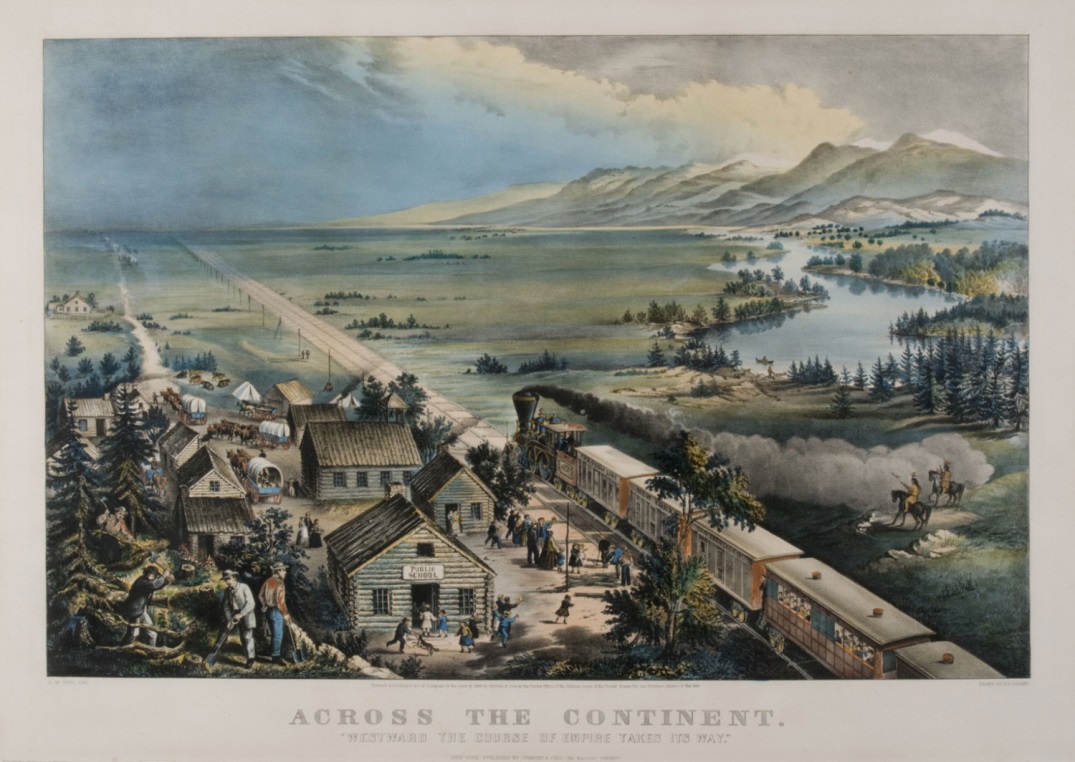
The frontier as depicted by Currier and Ives (click to enlarge)

This isn’t metaphorical, either. We literally learn a sanitized version of history because, like Eve and Cain, the narrative is about us, the living. Where I live, in Nebraska, we learn just-so stories about plucky settlers who walked overland, Conestoga wagons in tow, to claim and domesticate an unsettled prairie, pulling crops from uncooperative soil. Agrarian industriousness is Nebraska’s state religion, Laura Ingalls Wilder’s Little House books our scripture.

Except.

This holy writ is compromised from the beginning. As LSU historian Nancy Isenberg writes, the original sodbusters who “domesticated” this soil were despised, and were chased off the land once it became lucrative for Back-East speculators. Conestoga settlers and their immediate heirs, the cowboys, were valorized in American mythology only once they were safely dead and couldn’t challenge our beliefs about our ancestral greatness.

Besides which, as Yale historian Greg Grandin writes, White settlers didn’t “domesticate” the prairie. My ancestors only crossed the frontier line years after the U.S. Cavalry cleared Native Americans off the soil. As I've noted elsewhere, Wilder’s Little House books weren’t really history, they were Libertarian myth-making, heavily rewritten by her daughter, Rose Wilder Lane. As myth-makers have always known, true virtue always exists in a distant, morally scrubbed past.

Though the White sodbuster narrative contains nuggets of truth, it’s as much mythology as Zeus on Olympus. That’s why American history classrooms have become as hard-fought as Martin Luther pleading his case before Cardinal Cajetan, because the “history” we’re fighting over is American state religion. We aren’t fighting over how to teach facts, because facts are ancillary. We’re fighting over which story we use to define our shared national identity.

Perhaps that’s why progressives struggle in this debate. They believe they’re laying out “facts,” when what the debate needs is a counternarrative, an alternate myth. Historian James Loewen notes that American classroom history is presented as an unbroken arc from triumph to triumph, which precludes both backsliding and penitence. What Americans need isn’t facts, it’s a more nuanced story, a creation myth that includes room to admit mistakes and learn.

Monday, November 14, 2022

I Am Vengeance, I Am the Night—And So Much More!

It’s been touching to watch tributes roll in for American voice actor Kevin Conroy, following his passing this past Thursday at age 66. Fan loyalty to an actor they knew almost entirely through his voice speaks volumes to how important that symbol remains for so many who were young in the 1990s and early 2000s. I suspect Conroy knew his importance to a generation; his enthusiastic reception at fan conventions is the stuff of legends.

Live-action superhero actors come and go; cinema is currently on its sixth or seventh Batman, depending how you count. Fans greet every new Batman actor with hostility, though public sentiment usually adjusts quickly (pipe down, George Clooney). Behind them all, Kevin Conroy has persisted; he portrayed Batman from 1992 to 2019, when he finally portrayed the character in live-action on an episode of Batwoman. Twenty-seven years associated with the role.

However, I can’t help noticing how every tribute focuses on one role. Besides Batman, Conroy played a handful of other television and movie roles, particularly supporting roles on daytime soaps and crime dramas; few got any particular traction. But his theater career was extensive, and focused heavily on Shakespearean roles. Conroy studied at Julliard, under John Houseman, and his classmates included Robin Williams and Kelsey Grammar.

As a sometime actor myself, I wonder the implications of being so closely associated with one role. Like Jeremy Brett, whose once-storied career collapsed entirely into the role of Sherlock Holmes, every eulogy for Kevin Conroy remembers one role. His entire career has been compressed into something that happened in a sound studio, while the mostly anonymous animators worked around the needs of his voice.

I don’t want to disparage Conroy, or the influence his raspy, war-torn performance had on his intended audience. For two generations, his performance encapsulated not only Bruce Wayne’s willingness to fight for his beliefs, but the price he paid for continuing that fight. Conroy was the first gay actor to portray Batman (though this fact wasn’t initially known), and with his hard-chisled features and intense stare, it’s amazing he didn’t get live-action screentime sooner.

Kevin Conroy pictured with frequent co-star Mark Hamill

But actors with diverse range and untapped capabilities often get their careers reduced to one iconic role when they die, or even retire. When Ian Holm passed away in 2020, dozens of obituaries named his appearance in only two franchises: Alien and Lord of the Rings. When David Letterman retired from nightly TV, The New Yorker ran an illustration of him throwing pencils at the camera—which he hadn’t done in over twenty years.

Likewise, Kevin Conroy’s Shakespearean career largely vanished. So did his dedication to public service: following the terrorist attacks of September 11th, 2001, Conroy cooked and served meals for first responders sifting the rubble of the World Trade Center. In an era dominated by public attention-seekers like Kanye West and Elon Musk, Kevin Conroy happily worked hard, gave back, and let the results speak for themselves.

Conroy persistently remained conscious of his public role as an actor. As a gay man performing during a time when being publicly out could submarine a man’s career, Conroy took seriously theatre roles like “Peter” in Richard Greenberg’s Eastern Standard, a closeted entertainment executive who didn’t dare live his truth, for fear of imploding his career. In interviews, Conroy described such roles as an important moral statement.

Therefore I find myself torn. Like everyone, I think it’s fitting to celebrate the role that had such wide-ranging influence on a generation, and mourn the fact that this role has now ended. Yes, some other voice actor will certainly portray Batman, and probably mimic, to some degree, Conroy’s performance; but it’ll never be Kevin Conroy. Like Adam West before him, Conroy’s Batman mattered, and now it’s over.

Yet that isn’t Conroy overall. Like Jeremy Brett as Sherlock Holmes, or Harry Corbett as Harold Steptoe, Conroy’s career has largely vanished into one role. I don’t suppose Conroy minds, considering his active embrace of the organized fan community. (Unlike Corbett, who despised his iconic role and tried to distance himself from it.) Fan tributes to Conroy are remarkably one-note, and though it’s an awesome note, it isn’t a symphony.

Batman’s message matters, and the animated performance, uncluttered by the studio interference that reportedly hamstrung Tim Burton, conveys that moral complexity. Kevin Conroy will always be vengeance and the night for an entire generation, and he rightfully should be. But he was so much more than that and, actor to actor, I fear that getting lost.

Friday, November 11, 2022

Quacking In My Boots

Marjorie Taylor Green is so routine in her spiteful rhetoric and over-the-top claims that I sometimes mistake her for a Saturday Night Live character. From the moment she fumbled ass-backward onto the national stage, spouting QAnon theories and mangling her sentences, she’s played like a slightly sexist satire of bottle-blonde conservative women. Her racist statements, foot-in-mouth moments, and love of shouting have endeared her to the sensationalist media.

This week’s tweet about “our enemies… quacking in their boots” seems apropos. I admit having mocked her myself, because it’s consistent with Greene’s oeuvre of public gaffes, including “gazpacho police” and “peach tree dishes.” I’m having second thoughts, though, because unlike those notorious spoken blunders, this has a simpler explanation. Greene tweeted from her iPhone, and got AutoCorrected. Anybody who’s ever inadvertently typed “duck this pizza ship” knows that feeling.

Greene’s AutoCorrect error has, unfortunately, overshadowed the revealing information she tweeted out on purpose. “Quacking” is funny, yes. But the sentence’s real meat is the word “enemies.” Like President Trump before her, she characterizes her opposition as hostile adversaries, as foes who need defeated, as though politics were a real-time game of Dungeons & Dragons, and Greene sees herself as a paladin. That’s a painful insight into Greene’s moral calculus.

I remember learning, in 12th grade American Civics, how democratic politics rests on certain shared suppositions. Different political parties may disagree on the most efficient way to organize an economy or levy taxes, for instance. Such disagreements can even be beneficial, since they result in debates and evidence testing to refine first blush ideas. But small-d democratic participants have to agree on one precept: the process itself.

For democracy to function, all participants must agree that functioning democracy is, itself, a good. They must regard elections as desirable, fellow elected officials as peers, and office as service, not power. That’s why, in Congressional debates, representatives who disagree with one another on fundamental issues of power and government, are supposed to refer to one another as “my esteemed colleague” or “the honorable Representative.”

Rep. Marjorie Taylor Greene (R-GA)

This veneer of respect is, certainly, often gossamer-thin. In 1856, Charles Sumner, an abolitionist Massachusetts senator harangued the Senate chambers, calling pro-slavery senators a string of ugly personal names. South Carolina Representative Preston Brooks responded by beating Sumner with a cane. This failure of the ability of rhetoric to resolve deep regional differences is regarded by historians as evidence that the Civil War was, by then, inevitable.

Please don’t misunderstand me. Greene’s sloppy, high-handed rhetoric isn’t evidence that a Brooks-style physical attack is imminent. However, the characterization of ideological opponents as enemies, rather than as fellow participants in the democratic process, is a sign that procedural norms are failing. Greene, Trump, and those who agree with them have abandoned the pretense of agreement. Governance, for them, is a fight to win, not a debate to resolve.

We’ve witnessed this in, for instance, the way Greene notoriously harassed gun-control advocate David Hogg. Greene eschewed standards of procedural debate and literally chased Hogg down the street. Greene’s defenders will note that she wasn’t yet elected, and her actions have no official governmental standing. But she permitted herself to be recorded, and used the resulting footage in her Congressional campaign, an action which reflects her intent.

The fact that Greene was elected to a second term this week, even as she’s continued such high-profile antics in her official status as a Representative, speaks to more than just her. It tells me that voters, at least in Georgia’s mostly-White 14th Congressional District, actually like this behavior. Greene’s voting base sees her performing such ridiculous stunts, frequently with undisguised malign intent, and says: we’ll have more of that.

Greene was one of several Representatives elected in 2020 on the promise, not to govern responsibly, but to vanquish supposed enemies. While North Carolina Representative Madison Cawthorn got turfed out in the primaries after, Colorado Representative Lauren Boebert is, at this writing, likely to win a second term on a whisker-thin majority. The 2024 Republican presidential ticket is a likely split between culture warriors Donald Trump and Ron DeSantis.

Democrats continue playing the game soberly, using titles like “the honorable” and inviting the opposition party to debate. But that doesn’t work anymore. In my state, Nebraska, governor-elect Jim Pillen refused to debate the Democrat, Carol Blood, and Pillen won. Small-d democratic precepts are currently failing in America. If we don’t face that fact soon, we’ll face it when the governing party starts suspending elections and civil rights laws.

Monday, November 7, 2022

On Losing and Regaining My Love For Science

Tom Baker as the Fourth Doctor

I first wanted to become a “scientist” in second grade, not long after discovering Doctor Who reruns on PBS. I’m sure it wasn’t a coincidence. The Doctor, then played by Tom Baker, presented himself as a scientist, and frequently expounded on difficult scientific topics in layman’s language to advance the story. But for him, science was a journey, an opportunity to meet new people and have new experiences and, frequently, confront injustice at the root.

Whenever anybody asked grade-school Kevin what he wanted to be when he “grew up,” he continued insisting he wanted to be a “scientist” for years. I read books on science history for kids, which often presented science in metaphor: Louis Pasteur’s early vaccination experiments, for instance, were presented as armed soldiers posting pickets around a weakened body and defending it against an invading army. Science became a source of adventure.

Not until middle grades did I actually study science as a distinct discipline. Then, we began performing “experiments” demonstrating important concepts like, say, the states of matter, the function of liquid capillarity, or the complexity of vertebrate vascular systems. Fun stuff, in isolation. Except we performed each “experiment” one time, and if we didn’t achieve the preordained outcome, we flunked. This “science” was remarkably rote and cheerless.

Where, I wondered, was the adventure which The Doctor encountered, and equally importantly, the moral purpose? We weren’t venturing into unknown countries to gather new evidence and fight the scourge of ignorance that kept entire populations enslaved. We were repeating experiments so crinkum-crankum that the results were absolute. While we individually definitely learned new facts, the facts we learned were vetted and ratified in advance by authority figures.

Before going further, let me emphasize: I don’t blame individual teachers for this. Teachers must face bureaucratic intransigence, work with textbooks pre-approved by those same authority figures, and teach to the test. As Dana Goldstein writes, America’s school systems are organized around cost efficiency, not learning outcomes. Many top-tier teachers resist monolithic book learning, but can only accomplish so much when fighting the system.

Louis Pasteur, discoverer of multiple
medical procedures

But the effect was the same: the sense of moral adventure which Doctor Who promised came sideways against an educational system which only permitted experimental results which were absolutely true. There was no venturing off the map in school science. I now know, as I couldn’t have known in middle school, that this wasn’t accidental. Powerful people, and the legislators they purchase, want all “learning” to result in predictable outcomes which discourage questions.

In my childhood, science was the battlefield to control the public discussion. Important religious leaders actively torpedoed any inquiry which would verify the theory of evolution (and, in some places, still do). Today, that battle has shifted to history, where teachers are required to teach bland myths and scrub history of any ambiguity or fault. In both cases, the underlying philosophy remains unchanged: prevent questions by excluding doubt.

During college, I discovered physics, and felt jolted. Before college, my limited understanding of “science” basically bifurcated into either chemistry or biology, both of which deeply disappointed me. Physics, by contrast, held the same qualities I found in science fiction adventure stories: degrees of uncertainty, reasoning through analogy, and an element of faith. In physics, all explanations are provisional, and failure is embraced in ways high school chemistry rejects.

Had I discovered physics earlier, my life might look different today. Surely some teacher somewhere introduced the discipline, but amid the crush of mandatory points which state boards required them to hit, the information got lost. By college, I’d shifted to literature, the discipline which promised the moral purpose which “science” no longer offered. Also, without a scientific goal, my math scores had languished beyond repair.

Mathematician Paul Lockhart writes about teaching middle-school math by ripping away students’ reliance on absolutely correct answers. When uncertainty becomes common again, students reinvest themselves in the process, and fall in love with learning as an adventure. A history teacher I know does something similar, capping his course with a role-play about rebuilding civilization after an EMP. Doubt becomes central to students’ intellectual investment.

I embraced the idea of “science” in childhood because it seemed bold and adventurous. But by eighth grade, I’d abandoned that ambition because it became tedious and repetitive. Only in adulthood did I discover how that tedium was engineered by powerful people to support their own power. We citizens need to reject the narrative, in any discipline, that questions are bad. Because bad people profit from our lack of answers.

Wednesday, November 2, 2022

Why Doesn’t Tarzan Have a Beard?

Johnny Weissmuller as Tarzan

Somebody presented this to me as a head-scratcher recently: why is Tarzan, who lives in the jungle and has never encountered a razor, clean-shaven? In saying “Tarzan,” of course, the asker meant Johnny Weissmuller, the gold medal-winning Olympic swimmer who played Tarzan in twelve feature films from 1932 to 1948. But seriously, the same applies to Buster Crabbe, Gordon Scott, and Alexander SkarsgÃ¥rd: Tarzan is portrayed without facial or body hair.

Weissmuller’s Tarzan remains the character’s iconic depiction, with the curved muscles and sleek skin of somebody who trained his body to resist water drag. But checking photos, I realize Weissmuller wasn’t just clean-shaven. His hair is also neatly barbered, slicked back in the “RKO Pictures Means Business” style that might, maybe, have reflected jungle sweat, but is clearly Brylcreem. Sure, apes groom one another, but it doesn’t look like that!

My immediate response was: same reason Elizabeth Taylor as Cleopatra has a fashionable bob. Because these movies are never really about what they’re about; they’re about the people who make and watch them. This stock answer could apply to countless historical or mythological epochs. Cinematic depictions of Hercules, Abraham Lincoln, Gandalf, or King Richard III always say more about us than about the characters.

Thinking about that answer, however, I’ve become increasingly dissatisfied with it. Weissmuller’s moderately muscled, glossy Tarzan isn’t a statement about the people who make or consume those movies, any more than the more absurdly muscled depictions of Hugh Jackman as Wolverine or Chris Hemsworth as Thor really reflect us. These characters aren’t who we, the audience, are; they’re lectures about who we, the audience, should be.

Abandoned from infancy, Tarzan grows to adulthood in an Edenic jungle politely untainted by ordinary old Black Africans. He innately understands Euro-American standards of personal grooming, fitness, and hygiene, which travel hand-in-glove with his instinctive ability to fashion tools and shelter. His ability to command animals is interesting, but incidental. His real accomplishment is bending the “wilderness” to suit his distinctly industrial-era demands.

Elizabeth Taylor as Cleopatra

Tarzan is the perfect colonial agent. He shapes nature to his expectations, but he also, on first encountering White people, recognizes their superiority, and longs for assimilation. Sure, in the movies he always returns to Africa, because if he ever permanently leaves, the franchise ends and RKO loses money. But once there, he consistently aids White imperialists and never once sullies himself with boring old Africans.

(I know, the movie with Alexander SkarsgÃ¥rd attempted to subvert this and make Tarzan more inclusive. That movie also tanked. All the perfumes of Arabia can’t wash the stink of colonialism off the franchise.)

Taylor’s Cleopatra tells a very different story. Released as the post-WWII generation hit adulthood, with the industrial excesses and pop-culture liberation that 1963 entailed, Cleopatra was no less a moralistic lecture. Surrounded by riches, adoration, and power, Cleopatra represented postwar American splendor. But she also represented deep distrust of powerful women. The movie repeatedly moralizes about how destructive imperial power becomes in feminine hands.

In 1963, women like Wanda Jackson, Lesley Gore, and even Elizabeth Taylor herself stopped accepting men’s shit. They demanded autonomy, which they weren’t always willing to state as explicitly sexual, though Taylor was already on her fourth marriage, age 31. Meanwhile, Cleopatra hit cinemas the same year Betty Friedan’s The Feminine Mystique dropped, pushing second-wave feminism into America’s mainstream. This wasn’t coincidental.

Cleopatra is presented as commanding, imperial, regal, but also doomed. The movie depicts her openly consuming male adoration, setting her own sexual terms, and demanding recognition. But we, the audience, know she’s already doomed. She’s going to embrace the wrong war, backed by the wrong allies, and will eventually choose suicide to avoid the ignominy of capture. We already know this, and implicitly, so does she.

Both movies arise from cultural contexts. Tarzan appeared, first in Burroughs’ short novels, then onscreen, as European empires in Africa and India were disintegrating, but America was establishing colonies in the Asian Pacific. Tarzan’s African jungle was transferable to American soldiers in the Philippine rainforests. Cleopatra subsequently emerged as women began challenging a male-dominated social order.

So no, I realize, these characters don’t really reflect us. Rather, they establish moralistic models for how we should or shouldn’t behave. Tarzan bespeaks the values of White empire, while Cleopatra warns about the perils of female ambition. Both characters serve a White male power hierarchy. One buys in, and is rewarded; the other rebels, and is punished. They aren’t us; they’re who Hollywood’s elite wants us to be.