 I love a good fantasy. Swords, sorcerers, and savagery get my blood pumping. And, in the tradition that the old ways are the best ways, I’ll rush out for a well-made take on the Matter of Britain. But the high quality of two recent, but very different, Kings Arthur makes me wonder: why do writers look backward when they want to retell a good story?
 The BBC’s Merlin and Starz’ Camelot share a young, fair-haired, and very pretty Arthur who proves his manhood against seemingly insurmountable odds, and there the similarity ends. They tell very different stories, for very different audiences, with wildly divergent morals, and incompatible tones. Comparing these two stories says a great deal about the needs modern audiences bring to myth and legend.
Start with the heroes of each story. Merlin, as the title suggests, foregrounds the wizard whose exploits parallels Arthur’s. The first episode features a fresh-faced Merlin entering Camelot to find his adult role. He quickly discovers that his innate magical talents make him a fugitive, even as he finds his way into the king’s court, and discovers a prophecy that entwines his future with that of arrogant, untested Prince Arthur.
 |
| Arthur (Bradley James) and Merlin (Colin Morgan) in the BBC's Merlin |
The world depicted in Camelot is much grittier than the one in Merlin. Camelot comprises many more drystone walls, thatched cottages, and dirt-smeared peasants. Merlin looks more like the Fantasy Village at Disneyland. Where the title fortress in Camelot is a Roman ruin whose gradual reconstruction mirrors the growth of the kingdom, the fortress in Merlin is an elaborate French fairy-tale confection, layered like a wedding cake.
I mean that as no insult against Merlin. Rather, it self-consciously tells a story of boyish bravado in which young men test their legs in relative safety. It makes no pretense of recounting a history that might have happened to real people in a real place. Camelot, despite the narrative use of magic, essentially presents Britain as it may well have looked in the Fifth Century CE. Merlin increases romance; Camelot expunges it.
Moreover, Merlin offers a story with not one but two father figures. Merlin shelters with royal physician Gaius (a role created for the series), while Arthur learns kingship from his father, King Uther. These two paternal figures guide their wards into adulthood gradually, imparting lessons of self-restraint and discretion from which the show’s intended young audience can also learn.
 Camelot, by contrast, has no paternal figures whatsoever. Patriarchal, yes: King Uther is a domineering barbarian who threatens his children and bullies dissenters. While Merlin bears more interest in justice and the common good, he relies on realpolitik and expediency. This Merlin, whose external scars reflect his cynical soul, resembles Otto von Bismarck more than Obi-Wan Kenobi.
These contrasting visions of Arthuriana woo different audiences. The BBC produces Merlin for children and youth. Starz, a pay cable network, uses its freedom from censorship to tell a grown-up story. Merlin’s Arthur enjoys a chaste romance with Guinevere, a servant with a heart of gold. Camelot’s Arthur has an adulterous, and boldly sexual, relationship with Guinevere, wife of his greatest champion.
Not that Camelot shows the exhibitionistic streak underlying other pay cable shows like True Blood. Despite nudity, sex, and language, it never feels like the creative team is being merely dirty. It just pitches for an audience older, and more sexually aware, than Merlin courts.
So the question becomes: why do creative types feel the need to look backward to create new content?
 |
| Arthur (Jamie Campbell Bower) and Merlin (Joseph Fiennes) in Starz' Camelot |
No, you can’t. Because we don’t spin myths anymore; we manufacture commodities. So as much as I enjoy these Kings Arthur, they display the loss of folk traditions that permitted Western society’s greatest classic artworks. What a shame.


 Benefactors, likewise, come in three stripes: private donors, public spending, and internal resources. Each has its own demands. Private donors, for instance, often give with strings attached. They may want their money spent on specific projects, or resent any funds going to administrative costs. Public money can shift with the political winds. And internal resources must be stewarded with care.
 Both failed, I contend, because they want to live in the present on the rewards of future effort. Credit cards allow users to put effect before cause. Collateralized debt devices and related derivatives, which propelled the economy during the rah-rah Bush administration, let buyers live in the future output of others’ labor. The entire pre-meltdown economy existed in the present tense.
 To discover that the government cannot function, to discover that we cannot balance our society’s obligations without selling promises on the future, breaks my heart. Our society really cannot function, in its current arrangement, without ignoring the lessons learned at our parents’ knees. The organizing power structure in modern America fundamentally violates our private ethical premises.
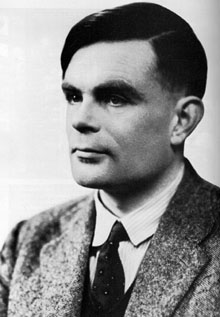 British mathematician Alan Turing, whose code-breaking helped the Allies win World War II, proposed in 1950 that we could consider computers intelligent when they successfully mimic human behavior, particularly conversation, in blind experiments. This has remained the Holy Grail of artificial intelligence research for over six decades. And despite incremental gains, this triumph remains just out of reach after all that time.

 In Yiddish myth, a person of surpassing righteousness could build a Golem, a rudimentary human made from clay. This was possible because righteousness make that person similar to G-d. But because limited humans can never be as righteous as G-d, the Golem can never speak, because humans cannot invest our creations with souls.
 Do not hold back the wages of a hired worker overnight.
 Now to the one who works, wages are not credited as a gift but as an obligation.
 But woe to you who are rich,
 Christianity and other faith heritages failed to provide a relevant counter-narrative. Who, really, can blame Oprah’s generation for seeking its beliefs among charismatic, reverent eminences? And when TV’s ultimate best friend lent her support to spiritual leaders who ratified her own empowerment principles, crowds flocked to the likes of Gary Zukav and Iyanla Vanzant in hopes of sharing her sacred intimacy.


