Monday, August 15, 2011

The Next University

For all that we stereotypically believe others need to change, educators are notoriously resistant to changes in their own field. Yet we teachers cannot silence the realities of academic technology. Thus the question, I fear, has become not whether education will change, but how—and, just as important, which changes should we embrace, and which should we resist?

The National Writing Project commissioned Because Digital Writing Matters to emphasize the growing importance of writing across divergent platforms. Similarly, Linda and Peter Jeschofnig wrote Teaching Lab Science Courses Online because they believe new technology can tap unrecognized angles of student development. Both books bring important ideas to the table, but both fall prey to sweeping generalization.

The NWP says that the coming generation, to face a heavily digital marketplace, cannot learn writing as the mere arrangement of words on paper. The ability to cross platforms into web writing, video composition, and multimedia, open up worlds of opportunity for what we can call “writing.” And why not, since this generation already writes more copiously than most before it, in the form of Tweets, Facebook updates, text messages, and other non-academic writing.

The Jeschofnigs embrace online science courses because they fear that, as long as students see science as something they go to and practice in groups in public laboratories, they will never internalize scientific principles or evade “magical thinking.” Performing science privately, under digital supervision, makes students own the scientific method. And making students buy their own equipment shifts costs off perennially cash-strapped schools.

Though they address similar ideas, the two books are not essentially interchangeable. Beyond the differing disciplines, they also focus on different age ranges—the NWP ranges from Kindergarten through college while the Jeschofnigs engage mainly post-secondary educators. And they also draw different conclusions, in that the NWP assumes that the classroom remains the educational core, while the Jeschofnigs propose the imminent end of campus learning.

The NWP speaks of copious technologies writing teachers (who they say should re-envision themselves teaching “composition”) should add to their existing pedagogy. While I understand the importance of teaching students to write for visual media, or for multimedia platforms, teachers are generally poor in time and cash. Adding even more for reluctant students to master clutters the class and gives teachers more to do with the same time and support.

But the Jeschofnigs swing to the other extreme, claiming that students do more, feel closer to their teachers, and savvy the learning better if they do it on their own time and in their own space. To which I say: maybe. Not all students are equally motivated. I did well reading and writing on my own, but in science, which was a weak subject for me, I found the classroom environment motivating because I had others depending on me. Different students learn in different ways.

That last statement underlies Clayton Christensen and Henry Eyring’s The Innovative University. Higher education’s fundamental core will undergo seismic shifts in coming years, as the end of the go-go economy means endowments are less stable, and costs increase faster than students’ ability to pay. Christensen and Eyring speculate on how universities will evolve to face new demands and tightened circumstances.

Unlike the prior books, which are slim and practical, this book is brick-like and theoretical. Yet for a book running nearly 500 pages, its focus seems appallingly narrow. The authors contrast Harvard, which has set the standards for American research universities since just after the Civil War, with the former Ricks College, now BYU-Idaho. While these represent strong possible contenders for the future university, two isn’t enough.

I wait in vain for more diverse examples. What of St. John's College of Annapolis and Santa Fe? This school's self-consciously classical curriculum, focused on the Socratic method, makes a bracing antidote to Harvard's secular modernism. What of California's Deep Springs College? This tiny (twenty students) two-year school combines liberal learning with autonomy and hard work, with a profitable cattle student-run ranch keeping tuition permanently free.

This book, like the prior two, is a step in the right direction. Yet like the prior two, it can’t quite see past its own inherent limitations. All three of these books make good entries in the debate of higher education’s future in modern America. I’m glad I read all three of them, because I’m now better equipped to enter the debate. But each by itself suffers its own limit of vision, and the debate will go on for some time to come.

Friday, August 12, 2011

William Shirer—Journalism's Guiding Light

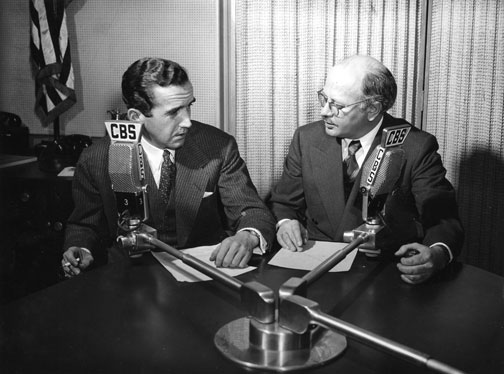
Edward Murrow (left) and William Shirer pioneered
journalistic techniques that remain standard today
William Shirer’s pioneering radio journalism deep inside Hitler’s Berlin didn’t just pioneer how Americans received their news. He revolutionized how Americans perceive war. With live reports from Anschluss, the French surrender, and Berlin under heavy British bombing, he transformed journalism from gathering facts to recreating experiences. Shirer’s fingerprints, alongside those of his colleague Edward Murrow, linger throughout journalism today.

Steve Wick’s The Long Night: William L. Shirer and the Rise and Fall of the Third Reich appears as more than a memoir of a person. It reads like an indictment of current journalism: why do today’s news gatherers lack Shirer’s courage? While the presidential press corps eats anything appointed spokespeople spoon up, and business writers unquestioningly repeat corporate news releases, audiences long for difficult stories gathered deep in the trenches.

Fired from a prestigious European correspondent job deep in the Depression, Shirer was days away from losing everything when Edward Murrow hand-picked him to start CBS Radio’s second European bureau. His appointment coincided with Germany’s stirring aggression, and as a journalist in a police state, Shirer accepted a very difficult job: telling the truth in a nation where truth came from the state, not from reality.

Faced with the choice of repeating inane propaganda, as many of his colleagues did, or being ejected from Germany, Shirer undertook an elaborate tapdance. His journalistic loyalties lay with the truth, not with expediency, and he risked his safety (and his Austrian wife’s life) to ensure the world saw the real Germany. But the state did everything in its power to bring Shirer to heel.

Reading this harrowing story, I remember complaints from embedded American reporters at least as early as Operation Desert Storm. By keeping journalists close by, and beholden to the military for even basic supplies and information, officers and the state they represented could control what facts the people knew. Reporters conducted intricate subterfuge to smuggle information out of the war zone.

Writers like Sheldon Rampton and John Stauber described President Bush’s press corps as possibly the most cowed ever. Reporters who deviated from the administration’s official line reported that they often found themselves locked out of important scoops. Despite promises of increased transparency, President Obama has treated journalists little better. Recall how dismally he handled the Wikileaks affair.

Shirer remained unable to forgive the
German people well into his eighties
Too many journalists today attend journalism schools, earning specialist degrees in how to gather news as it’s always been gathered. Like business degree holders, who seldom make successful entrepreneurs, journalism degree holders repeat successful formulae of the past, rarely breaking new ground. Shirer, by contrast, had an English degree. Upton Sinclair never completed his university degree, and Nellie Bly never even began hers.

People in power never want the full truth told. History proves this time and again, although journalists who want official commendation court politicians, generals, and capitalists. Yet how many journalists enjoying insider status make significant breakthroughs? Shirer sat across the table from Goebbels and Ribbentrop, both of whom offered access if he would only report their propaganda unquestioningly. Shirer had the integrity to refuse.

American newspapers founder under the weight of their credentialed, university-taught writers’ stables, complaining that TV and the Internet have dealt their deathblow. Audiences roll their eyes, knowing that journalistic timidity, not technology, has rendered our news toothless and bland. What journalist today would say, with Ambrose Bierce: “We know what happens to people who stay in the middle of the road. They get run over”?

Shirer’s experiences in Berlin, and his journalistic acumen, helped him craft his classic, The Rise and Fall of the Third Reich. While scholars flinched from addressing the greatest event of their generation, Shirer culled thousands of documents, and his own diaries, to recreate for Americans the social circumstances that permitted the Nazi atrocity. His book remains the definitive call to stand fast against extremism and obdurancy.

It would be a mistake to compare today’s situation to Germany in 1932. Yet consider how many matching traits apply: economic uncertainty, belief in a unitary executive, and a populace that prefers security to liberty. When Steve Wick describes the inflammatory rhetoric and violence Shirer observed in Depression-era Paris, it’s hard not to draw parallels to the political sharpshooting that enforces such a sharp division between Right and Left today.

History is an ever-patient teacher, yet her pupils remain recalcitrant. One could hope that the lessons Shirer learned in his generation could penetrate the popular mind today. Cynicism is a cheap excuse not to get involved, yet it has become hard to remain optimistic.

Thursday, August 11, 2011

Can We Really Control Our Own Lives?

Too many people go through life knowing we should change, but unsure how to actually do so. A major subset of book publishing attempts to give is the tools to make changes in our lives—be it our careers, our family life, our souls, or whatever. And many such books wash out. Three recent books provide an eye into the difference between successful and failed self-help literature.

Julie Donley makes a good kickoff point. In Does Change have to be so HARD?, Donley, a registered nurse and entrepreneur, uses a four-point mnemonic to define what impedes our ability to change our lives: Habits, Attachments, Resistance, and Discouragement. Then she shares an eightfold path to overcome these obstacles. Wait, four noble truths and an eightfold path? Why does that sound familiar?

Unlike the Buddha, Donley offers a prescriptive approach to changing one’s life. Like too many psychologists and self-help gurus, she seems misguided in her assumption that all people are alike, and therefore can learn from instructions as clear and inflexible as those with an IKEA entertainment center. There’s no story and few object lessons— and those few objects we get come mainly from Donley’s own life, so we know who she considers the typical human.

Frustratingly, Donley isn’t wrong. Her insights into the processes humans engage to entrench themselves in bad paths, and the simple steps we could use to overcome them, make sense. They certainly ring true in my life. Yet instead of investigating any in-depth, she simply names them, gives instructions, and moves on. So I like Donley’s ideas... in the abstract. In the concrete, she holds herself distant.

Rick Singer also holds himself distant in Now: Embracing the Present Moment, yet he does so for different reasons, achieving a different effect. A student of Eastern wisdom, Singer’s similarities to the Buddha don’t seem nearly as accidental as Donley’s, and instead of giving directions in taking control of life, Singer would rather give us wisdom to ruminate over. Which makes him more effective, if less universal.

Singer divides his book twofold. First he offers ninety-nine homilies on quotes from recognized thinkers. Though these commentaries run vague, they also run short, less than a page each. Like sermonettes, these nuggets guide readers to consider some important point: how do we know success when we see it? Why is morality better than profligacy? How can we discard fears of the future and recriminations over the past to live our best right now?

In his second part, Singer provides several short essays by people who have found ways to live in the present. These essayists don’t pretend to have every answer, and they certainly don’t tell us how to approach our own lives. Yet their examples tweak our imagination, giving us the passion to look at ourselves and make the changes we need to pursue the present with everything at our disposal.

Srinivasan Pillay, in Your Brain and Business, utilizes many of Singer’s best qualities. Yet his book certainly isn’t for everyone. Utilizing the latest neuroscience, he examines the differences in brain function between people who succeed—in business, art, and life—and those who merely go through the motions. And he provides guidance on how to implement his ideas in your life.

Despite the title, this book discusses little specific to business. Rather, Pillay applies functional magnetic resonance imaging (fMRI) to different personality types and identities, connecting domains of success with particular neurological phenomena. This process returns results that often seem counterintuitive, yet demonstrate that the brain enjoys greater complexity, and more adaptability, than we realize on the surface.

Unfortunately, where Donley offers vague prescriptiveness, Pillay suffers from excessive specificity. Early on, he pledges not to rely on terminology, but he’s less than successful in that goal. His dense, highly technical language can make for very tough reading at times, and mining his jargon for application can require a hearty constitution.

Notwithstanding its density, I wish I’d known what this book describes when I started teaching. Pillay explains, for instance, the feeling of desperation that comes with new learning. Why should discovery feel so unpleasant? Because, as it turns out, we’re growing new synaptic connections. As a teacher, I can recognize my students’ discomfort as a sign of real learning.

These books’ differing levels of success might reveal a problem with the self-help publishing market.  But I suspect that these three authors court very different selves that need help.  I just wonder if they’ve all decided who those selves are yet.

Friday, August 5, 2011

How I Became a Lady Gaga Fan

I admit disliking most pop music, so when Lady Gaga appeared, I filed her beside other one trick ponies who come and went (remember Toto? Christopher Cross?). Her grotesque stage presence, exemplified by displays like the notorious meat dress, reinforced that Gaga was, as her second album title said, The Fame Monster, motivated by desire for attention that cared little for talent. Her prurience, blasphemy, and other shock tactics may offend blue-noses, but considered coolly, they’re remarkably banal. I gave her no further thought.

Then I started working at the factory.

Amid the cacophony of conveyor belts, motor vehicles, percussive equipment, and jangling metal, the company provides us radios and lets us pick our music. One radio’s sound doesn’t carry far amid the conflicting sounds, so a thirty-foot stretch of factory has three radios, each playing its own music, and each inaudible before you reach the next. In picking stations, we must recall that not everything is audible among conflicting sounds. The folk music I favor at home has no place in the factory.

Lady Gaga, remarkably, makes good factory listening. Her complex high-end orchestration, combined with a simple rhythm section that lays down a largely unvarying groove, gets on my nerves if I listen to her in ordinary circumstances. But in an environment where lesser noises can disappear beneath sturdier competition, Gaga’s clear voice carries remarkably well, and the simple, repeating guitar and synth licks that form her musical backbone set an important counterpoint to the factory’s funereal percussion.

Plenty of music I’ve often disparaged as inane suddenly becomes worthy in the factory space. In the larger world I mock Tom Petty’s lack of imagination, Duran Duran’s use of synth hooks in lieu of something important to say, and the Eagles’ excessively polished niceness.  Yet these “shortcomings” become artistic contributions when they cut through the factory noise.  Like Gaga, all these acts become something greater in the factory mainly behind one important virtue: I can hear them.

I can’t help remembering the band Judas Priest. Formed in Britain’s industrial capitol, Birmingham, the band derived its invariable pulsating rhythm, and the title of its classic 1980 album British Steel, from the steel mills that dominated their city, interrupted school lessons, and defined when Brummies could sleep and wake. Instead of complaining, they made that thrumming, alongside the sound of glass breaking and children screaming, the heart of their sound. They became a music of their place and time.

Taken from that angle, Lady Gaga too is an emblem of our time. I do not mean that in terms of her musical content, which resembles little so much as a small child reciting curse words and dirty jokes to elicit a reaction from nearby grown-ups. Rather, as our society becomes increasingly cluttered with extraneous sound, and we need more and more piercing influences just to make themselves audible, she does manage to cut through the chatter. People can, and choose to, hear her.

When I mention our society’s extraneous sound, I do mean the obvious: cars, cell phones, mass media. We’re a literally noisy society. But we’re noisy in other ways. As I’ve said before, we refuse to hear each other. Even regarding our most important issues, we talk past each other. We won’t stop talking, and we won’t stop demanding that others pay us some attention; but we won’t listen. We spew noise and expect others to accept it, even as new digital technology floods our synapses with more content than any human being can process.

Let’s not discuss know-it-alls clogging the blogosphere just now, okay?

Like Madonna before her, Lady Gaga takes her time’s inherent solipsism and displays it externally. I might not wear a barbed wire dress to get an audience’s attention, but I expect people to treat me with the same reverence as a celebrity. I don’t choose a pseudonym based on religious or aristocratic pretensions, but notice how I expect people to spell my name with the middle initial, as though I were C.S. Lewis or F. Scott Fitzgerald. Like my society, I’m very arrogant.

Doing something unusual makes me audible through the noise. I’m sure Lady Gaga deliberately courted controversy by using insensitive terms in her song Born This Way, if for no other reason than to get people’s ears. I may not go as far as Gaga does, and I certainly don’t have her audience. But like her, I just want to be heard. And in our time, embracing the theatrical makes that possible.

Monday, August 1, 2011

New Ways of Business and Work

As I grow accustomed to working my new job, please forgive me if I need more time to prepare a book review.  Until then, enjoy this classic from 2009, written for my newspaper column but never published before its cancellation.

In times like these, it’s necessary to examine how we conduct the business of work. Three teams of authors consider this issue from three angles.

Darrell Rigby uses Winning in Turbulence to give pointers on surviving this recession as a strong company. His jargon-dense prose may be useful if you know the terminology, but could muddy the waters if you don’t.

Tight times underline how businesses succeed, and more important, they highlight bottlenecks that impede efficiency. Rigby says this economy is a tool for trimming fat and returning focus to your company’s core mission.

Some of Rigby’s points seem obvious. Keep an eye on customer service; build clear strategy; know where every dollar goes. I wanted to say “Well duh!” when I read this. Who doesn’t know these things? Then I recalled how we got into our current mess, and realized some business leaders need a reminder.

Other points are less clear. Consider this from chapter seven: “A critical first step is implementing a practical thirteen-week cash flow tool that starts from the bottom of an enterprise and builds upward, showing what’s flowing into and out of each business segment on a weekly and monthly basis.” Can anyone explain what a “thirteen-week cash flow tool” is? And can I buy one at Menard’s?

This book is probably useful if you know the terminology. But small operators can’t afford an MBA to translate for them, much less the army required for Rigby’s multi-phase suggestions.

One valid point Rigby makes is that managers exist to serve front-line staff, not vice versa. Bob Pike expands this idea in The FUN Minute Manager. Pike, with Robert C. Ford and John Newstrom, thinks workers should have fun at their jobs. Not that they should throw parties in their cubicles, but they should enjoy work enough to want to attend every day.

Our authors tell the fable of Bob Workman. Bob manages an engineering firm, and discovers that morale is through the floor. Bob researches new theories on having fun on the job. He discovers data which reveal that fun reduces absenteeism, trims health costs, lowers turnover, and boosts productivity.

Bob visits recognized fun workplaces, learning that fun is an elastic concept. It requires a keen relationship between management, staff, and customers, and varies for different kinds of work. Bob also finds that fun cannot be decreed from above. Fun is cooperative between management and labor. Therefore fun makes workers take responsibility for their jobs and builds team ethos.

This short treatise explains Bob Workman’s nine simple insights. Meant for middle managers, Pike’s suggestions give handy concrete ideas for building an affirmative workplace while remembering that all work is not the same.

For us who don’t manage our own businesses, Jennifer and Joe Remling offer Carve Your Own Road . The subtitle says it all: Do What You Love & Live the Life You Envision. The Remlings traveled America in an Airstream trailer, interviewing people who make meaning in their work. From these interviews, they devise a seven-part approach to finding what you want from life and labor.

Some interviewees found their bliss by founding businesses. Others made their mark in existing corporations. What they have in common is what Jennifer calls a “Mindset of Clarity.” That means they know their goals, immerse themselves in their ambitions, and are adaptive enough to not get stuck in ruts. Jennifer Remling distills these tendencies into a few insights and exercises so we can build our own Mindset of Clarity.

The first half of this book is occasionally opaque. The Remlings mix travelogue, manifesto, and memoir to show us what their goals are, and how they pursue them. Jennifer’s description of recovery from a disastrous first marriage, building her business, and discovering her dream go a long way toward that goal. But Joe’s narrative of the research process, getting the Airstream into Manhattan and dealing with dogs, is wordy and distracting. But stick with it. The second half of the book is where the best pointers live.

A sour economy is no excuse to settle for second best. If you want to build your company or revive your career, read these books. Your best business years are still ahead of you.