Monday, November 28, 2011

Has Jim Butcher Changed—Or Have I?

I just can’t bring myself to finish Jim Butcher’s newest Harry Dresden novel, Ghost Story. This frustrates and confuses me, because I’ve enjoyed every book in the series up to this point. This one continues the same dynamic character tensions and intricate situations, and takes the series’ backstory to new levels. So I certainly can’t say the book is any less good than its predecessors—just the opposite, if anything.

Yet I stalled out around page 225, and I can’t bring myself to pick it up again. Why the sudden change?

It’s not just Harry Dresden I’ve strayed from. A friend put me onto the first Dresden novel back in the spring of 2008, and I read all the series in print as fast as I could. The concept impressed me so much that I started snapping up every author I could: Kat Richardson, Seanan McGuire, Thomas E. Sniegoski, Caitlin Kittredge, Jes Battis. As with any genre, some authors really stunk up the joint. But others were quite smart, inventive, and engaging.

I read my last urban fantasy novel in mid-December 2010. I’d read them at a rate of about four per month for over two-and-a-half years, squeezing them in amid grad school requirements, more sober novels, and other “serious” reading. When I put the last one down, I had over half a dozen waiting for my time. A couple were half-finished, the rest waiting for me to start. And I made a good-faith effort to start. Believe me, I tried.

Maybe I burned myself out. If I overloaded on urban fantasy, I have no one but myself to blame. But considering what a glut these hard-boiled fantasies have been on the market recently, why hasn’t the entire genre burned out? Is there no critical mass beyond which readers cannot handle the saturation? Evidently not.

The problem must be me.

Publishers crank these books out so rapidly that the authors have little time to finish one before they must start the next. These companies, many of which began as labors of love by small entrepreneurs who expected only minimal returns, are now owned by multinational conglomerates. And their corporate overlords demand such extravagant returns that international drug lords would blush.

But we can’t blame publishers alone. Sure, they demand ceaseless reiterations of what they already know the market will bear, but that market consists of real humans who buy books. If authors have become factory hands, assembling uniformly predictable product, surely they do so because they know readers will buy it. Inoffensive blandness may curl my hair, but it also ensures a bottomless revenue stream.

Yet people like urban fantasy because it contains at least the germs of an older fantastic form—which is far from safe. As Richard Mathews asserts in Fantasy: The Liberation of Imagination, fantasy’s founding myth-makers knew their greatest popularity when their work was at its most unsettling. Consider the conflict between the secularist William Morris and the Christian George MacDonald.

Even better, consider the writers who brought the genre to maturity in the 20th Century. Writers like Robert E. Howard, whose classic Conan lashes out against metaphorical agents of the Gilded Age. Writers like JRR Tolkien, whose best works reflect trench soldiers’ fears in World War I. Writers like Lloyd Alexander, who discovered the timelessness of Welsh myth while facing life’s transience during World War II.

The best fantasy is often mischaracterized as bucolic, when at root, it’s profoundly unsettling. It deals head-on with life’s finitude in ways that “realistic” fiction cannot. Like all good literature, good fantasy is slightly threatening. But too many readers want to be soothed like kittens. And paperback publishers, like candy makers, sell anything their customers buy, even if it’s bad for them.

Perhaps I’m the outsider, because I like challenges. As I've said before, I want reading fantasy to be like visiting a foreign country, getting lost on unfamiliar streets, and trying to order coffee in a strange language. Plenty of fantasy still provides that. And while Jim Butcher’s Harry Dresden may lack the epic magnitude of Howard’s Conan or Tolkien’s Aragorn, he at least challenges me from time to time.

But those challenges now come too infrequently. I want authors to push themselves harder, so they can push me harder. I want them to take me farther. I want to continue growing. The current crop of paperback writers, including Jim Butcher, just don’t offer that. And Butcher’s newest sits on my bedside table, months later, still unfinished.

Friday, November 25, 2011

Three Straight Ways to Conquer Your Waist

This holiday eating season, many will squander limited energy worrying about their beltlines. In my last weight-loss book review, I said different people gain weight for different reasons, so we must lose it through different tools. Maybe that isn’t scientifically rigorous, but it certainly resolves the issue to my satisfaction. But that doesn’t stop the book industry from printing money by insisting why every other weight loss regimen in the world is wrong.

Take, for instance, Jonathan Bailor’s The Smarter Science of Slim, and Mike Schatzki’s The Great Fat Fraud. Both authors claim to sort mountains of scientific research, and both have the uncountable source notes to prove it. Both claim the truth of real weight control has been stifled by a monolithic corporate conspiracy that would rather sell us a million pills than see us get permanently well. That’s where the similarities end.

Bailor builds his book on the thesis that we should “Eat more. Exercise less. Smarter.” For him, the problem stems from habits that short-circuit natural metabolic processes. High-starch diets and workouts that inefficiently distribute benefits leave us more hungry, more tired, and more obese than when physical fitness went mainstream forty years ago. His solution lies in more carefully choosing what goes into our bodies, and how we use them.

Schatzki, however, sees the focus on weight as a canard. The problem, for him, is “fitlessness,” widespread inattention to core wellness that extends beyond mere weight issues. Humans evolved in unsteady circumstances, forced to eat whatever came to hand, even if it wasn’t balanced. Fitness, for Schatzki, croses all weight classes. Instead, we should focus on whether we work our muscles in the way for which our bodies are optimally designed.

I suspect that, if Bailor and Schatzki sat on the same panel, they would be at each other’s throats constantly. They have different solutions because they favor different issues. What one sees as the real problem, the other sees as a mere subset. Though I doubt they’ve read each other’s books, each takes a sneering attitude toward the other’s solution. Here’s the kicker: I suspect they’re both right. By which I mean, they’re both wrong.

Where Bailor presents a fine-tuned diet and exercise regimen, stressing protein and focused effort, Schatzki sees such approaches as sauce for the gander. Humans evolved to walk fourteen miles per day, and if we want to keep our health, we should do so, no matter our weight. Both solutions are more complex than that, of course, and you should not undertake either without consulting your doctor. But that’s their respective positions, in a nutshell.

Both systems make sense, because both stress how the body is engineered. Human physiology exquisitely demonstrates purpose-built design, for hard work, feast-or-famine food supplies, and long haul endurance in hardship conditions. Unfortunately, starchy diets and sedentary lifestyles short-circuit those advantages. Thus both systems are perfectly correct, and woefully lopsided.

That’s why I like Don McGrath’s Dream It, Live It, Love It: Beyond Well, Beyond 50. Where Bailor and Schatzki name ways people should improve weight and fitness, quoting stats and research, McGrath interviews people past fifty who, at an age when many settle into comfy ease, have continued, or even newly begun, competitive athletic careers. No abstractions for these heroes; they’re too busy living to hypothesize.

McGrath interviews runners, cyclists, rowers, triathletes, mountaineers, Special Olympians, and even a competitive dancer. Most are in their fifties and sixties, though some maintain top form into their seventies, eighties, and beyond. Banana George Blair, McGrath’s cover model, remains a top-ranked barefoot waterskier past ninety. The accompanying photos showcase trim figures with great skin and bright smiles. Nobody would mind turning fifty if age looked like this.

The patterns McGrath sees among these heroes, salted with a hint of science, support a three-part system to identify the difference between competitive masters and the rest of us. But these aren’t rare saints. They emphasize that, with determination and the right mindset, we could achieve the heights they have. The effects our culture associate with age reflect inactivity and poor choices more than actually getting old.

McGrath doesn’t contradict anything Schatzki or Bailor say. In fact, he proves them right. How we eat and exercise makes a difference. But instead of treading the rare air of scientific research, he shows us real people who incorporate these principles into their own lives. McGrath provides inspiration; Bailor and Schatzki provide tools. Now it falls on us to make the difference in our own lives.

Wednesday, November 23, 2011

Billy Graham's Guide to Aging in God's Grace

Famed evangelist Billy Graham once led month-long revivals noted for aerobic sermons. Now in his nineties and widowed, he can’t get out of his chair unaided. Many people might consider that as sign that the ministry has ended; not Graham.  In Nearing Home: Life, Faith, and Finishing Well, he exposes the great gifts the aged still have to give for the Kingdom, and the lessons the aged still have to learn from the young.

Graham admits he never thought he’d live this long. The grueling paces he put himself through in his younger days often left him exhausted. Yet the Lord has another purpose for him. He might not get to lead his citywide “crusades” any longer, but his years of accumulated wisdom make him an invaluable resource for those who have inherited his ministry. He may lack the stamina to sermonize, but he has the experience to guide and uplift.

He does not claim this position for himself alone. He makes plain that, like the man who built his house on the rock, a family or society that trusts in the wisdom of the aged—the wisdom of the ages—will withstand the shifting struggles of the moment. Of course this means the aged have a responsibility to take stock of their wisdom. For Graham, as for countless evangelists before him, “fear of the Lord is the beginning of wisdom” (Psalm 111:10).

But he doesn’t limit himself to considering the aged as mere fonts for others to draw on. Those who live long enough have a new ministry. Whether they help guide coming generations, or use years of professional experience to defend the oppressed and uphold the discouraged, or just provide a good model of how to age well and face death secure in God, the elderly never stop offering something profound to this world.

Graham also speaks to the young, from multiple angles. Adult children of the aged have something to learn from their parents, and they have something to give as well. The young deserve the lessons of the aged, but they also have the privilege of offering their clear-eyed vigor to those who need assistance. The partnership of the young and the old, often attested in Scripture but too rare today, is dear to Graham’s heart.

Billy Graham
In Chapter 7, Graham approaches something profound. At one time, multi-generational homes were common, and children sat down to dinner with their parents, grandparents, and even great-grandparents. Their partnership kept farms and cities both flush with shared heritage and full of the energy to uphold our best angels. Homes were places of learning, sharing, and growth, for the old as much as the young, who constantly prodded each other productively.

I wish Graham would take that even further. Today we hardly know members of other generations. We hide the aged in nursing homes, and the young in schools, creating a society of people only in their middle years. Our culture exists only in the present tense, without past or future, without wisdom or energy, without tradition or rebellion. Should we act surprised, then, that depression, drugs, and workoholism have rushed in to fill the void?

Graham’s recommendations include the spiritual, as we’d expect from a lifelong evangelist. But he also looks at practical considerations. Have the aged kept their affairs and medical directives current? What can the young do to look after their parents without lapsing into patronizing? How should the elderly respond, in our strange and complicated society, when called on to fulfill roles we never previously expected of them, like raising their grandchildren?

In raising these questions, Graham rejects the temptation to seek pat answers. He guides our attention to our own experience, our shared heritage, and Scripture. The answers to life’s questions, for Graham, always lead to the Kingdom, where we all hope to live when this life is over. To the faithful, this world is not our home. We will all die to this world, and then we will live forever where God always intended. Everything serves that goal.

Some of Graham’s intended readers are already aged. Most of the rest hope to live long enough to get old, too. Whether we reach that goal, or have already, we need hope of how we can age well, and use our age to serve God’s calling. Graham’s clear, thoughtful approach offers great hope while remaining graciously free of stifling dogmatism. He offers real hope for the aged, and those of us who look forward to age.

Monday, November 21, 2011

A Writer's Guide to Taking Your Own Control

When I began reviewing, I accepted any and all books that came my way, because I wanted to give up-and-comers a chance. But after several writers who had paid to publish their own books lashed out at me for calling unpolished books unready for the marketplace, I began flatly rejecting all self-published and subsidy published books. It speaks volumes for Joel Friedlander that his book, A Self-Publisher's Companion, has convinced me to change my mind on that policy.

Friedlander zeroes in on the reasons I react adversely to self-published books. Too many are done hastily, with little interest paid to design, legibility, or whether the audience will enjoy the finished product. Subsidy publishers in particular care little for whether the book sells, because they make their money from the author, not the reader. Many people who call themselves “self published” have merely printed their books, not published them.

But instead of calling a halt there, Friedlander looks at the difference between printing a book and truly publishing one. This means a sequential approach, starting with making sure the book is actually ready for distribution. Too many authors print cringe-inducing books because they rush past the editing stage, presenting us, the reading public, with prose that might make sense to the author. Without taking all the steps, such writers advertise their own amateurish tendencies.

This dovetails with Friedlander’s second point, that self-publishers must wear many hats. At some point they must stop being writers and become entrepreneurs. They must be serious enough about publishing to ask themselves what they need to add, what they need to cut, and then act on the answers. They must ask themselves what they cannot do for themselves. And they must admit when they need to seek help from outside.

Just because you have written a book does not mean you know how to arrange the pages for easy, pleasant reading. In the same way, many authors get caught up in the words they’ve written, and forget that the cover is an advertisement for the book. They either think the cover needs to represent their literary vision, or they care little for the cover and tear off a computer generated art project. Outside and in, the book ballyhoos its lack of insight.

Or authors never investigate their niche. Novelists and poets craft art that is a pale shadow of work already available. Nonfiction writers fail to gauge their audiences’ needs and produce work that is lackluster, uninformative, or just vague. Writers of any stripe enter the self-publishing game with poorly defined goals and little understanding of the business. But, Friedlander insists, their common mistakes are entirely avoidable—and he suggests how.

Joel Friedlander
Consider all the church cookbooks or school histories you’ve bought from fundraisers. Consider the cockeyed prose, misplaced photos, and flimsy binding. That’s because the producers didn’t think of themselves as publishers. But Friedlander believes that every church circle or PTA committee could make themselves into the hometown Rachael Ray or David McCullough if they just took themselves seriously enough.

Friedlander made his publishing chops in the letterpress printing heyday, when typesetters actually set type in a frame. This made for a meticulous design approach, since each page was an artwork in its own right. When he discovered an untapped market, and no publisher with an interest in testing uncharted waters, he used his hard-won experience to publish his own book. Even in those pre-Internet days, he sold 10,000 copies over five printings.

Since then, he has guided other aspiring publishers through the design process, helping even complete novices produce professional books. And he has steered them through the post-printing arc, which is just as much of the publishing process. Through it all, he has stayed abreast of new developments, helping publishers utilize advancing technology, innovative publicity techniques, and emerging media.

This is not a how-to book. Friedlander will help you prioritize what goes into your publishing budget, but he will not quote figures to you. He will help you weigh options in e-publishing, but he will not coach you on using specific platforms. If you need a more nuts-and-bolts guide, I recommend Tom and Marilyn Ross’ The Complete Guide to Self-Publishing. Friedlander cares more about developing a productive publishing mindset.

Yet he should care about his area. He helps aspiring publishers identify the industry’s most neglected corners. And he has successfully persuaded me that self-publishing is a legitimate approach for those writers—and those reviewers—who treat it with the respect it deserves.

Wednesday, November 16, 2011

Writing a Paper, and Other Futile Acts

I’ve grown accustomed, when my factory colleagues discover that I still teach English part time, to the reflexive revulsion they express. Plenty of people dislike English as a discipline. Many of my students make no bones about the fact that they consider my class a nuisance they must endure to reach the major courses they really want. More than one of my co-workers admit that their inability to savvy English class kept them from getting into college.

Not that I can blame them. Academic disciplines pick up in-group codes and lingo. I have a great interest in physics, but my one class in the subject foundered on my professor’s frequent recourse to jargon. I try to make my class as straightforward and free of buzzwords as possible, but many others don’t share that value. Especially in college, where professors aren’t trained in classroom management, teachers and students often speak completely separate languages.

The other day I overheard my manager—one of the few other workers with a college degree—speaking with another employee. My boss, “Miranda,” admitted that, while she liked most of college, writing-intensive classes drove her nuts. There seemed so many rules, such onerous restrictions, that writing got between her and learning. So she had absolute sympathy with anyone, like the worker she was speaking with, who finds learning a long row to hoe.

That’s when I realized the problem. Many pedogogical theorists have all kinds of theories to explain why students struggle in this class or that one. Some critics think English class divides people according to the development of the corpus callosum, the organ that joins human brain hemispheres, since reading and writing require both hemispheres. Others suggest that English success is class-based, since the poor have little time to read. I say: maybe.

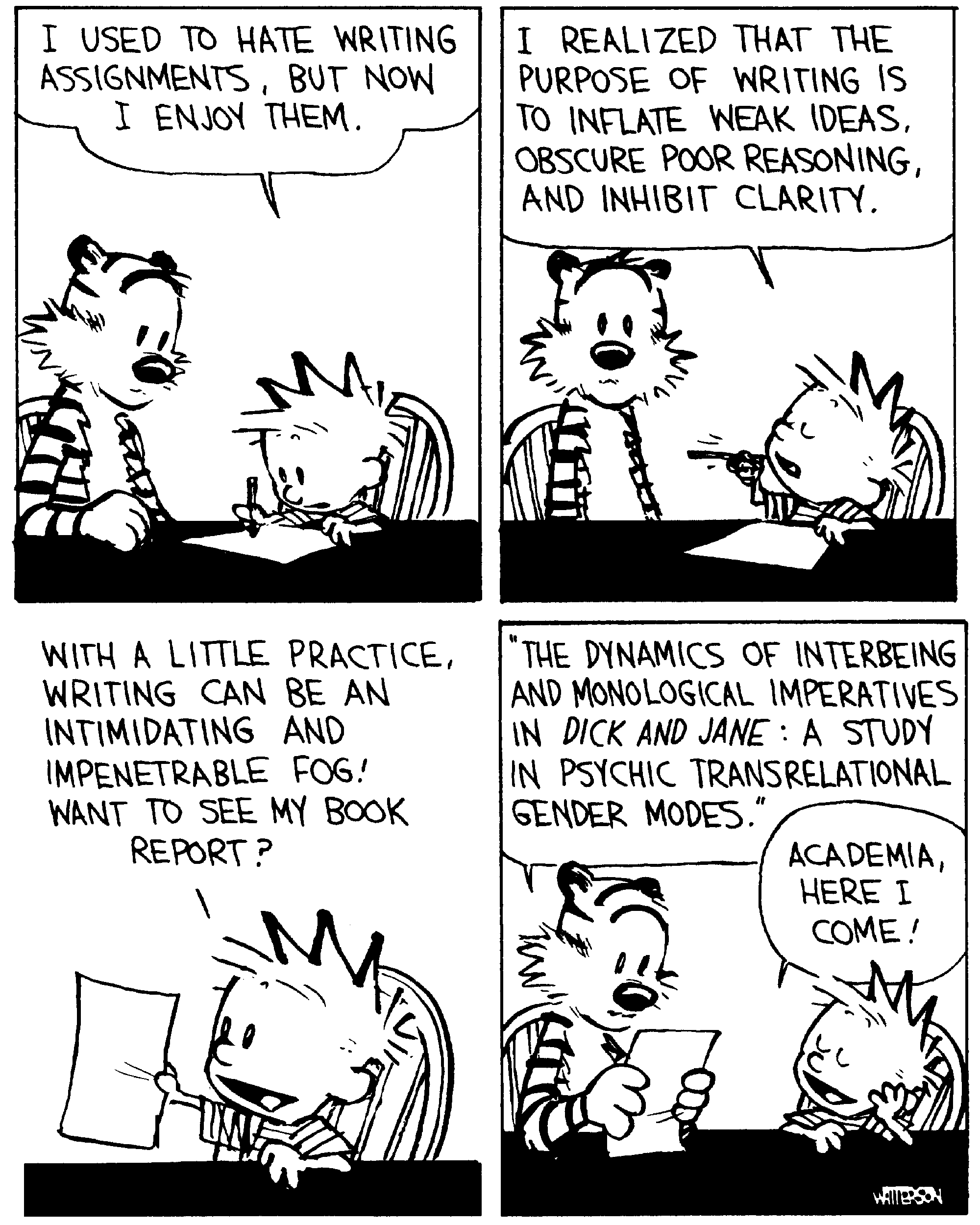
More likely, students stumble on the highly artificial act of “writing a paper.” This act bears little resemblance to any form of technical, scholarly, or aesthetic writing performed by working writers. Comparing the writing done in most classrooms with most novelists, critics, and other people who make their living arranging words on paper, my students might be astonished by how little the two processes have in common.

In public school, my teachers hit me with strange rules about writing. I needed to arrange paragraphs with a topic sentence, supporting claims, and a summation. Paragraphs need a minimum of three sentences. Papers should consist of neither more nor less than five paragraphs. The first sentence of the first paragraph should state the point of the entire paper, and the first paragraph should include a complete summary of everything which will follow.

I balked at these rules as early as eighth grade. The writers I read for fun don’t do these. They stagger sentence and paragraph lengths. Few writers use topic sentences, and thesis statements are optional at best. As I advanced in writing, I learned that working writers seldom use other tools I’d learned as mandatory, like outlines and note cards. This tendency to treat certain writers’ tools as universal makes a straightforward expressive art falsely imposing.

But I had the greatest problem with the route my papers followed. I would spend hours, days, sometimes weeks working on a single paper, which I would show to one teacher, and the arc would be complete. I had no audience. There was no sense of participation in any larger communication. No one would ever respond to my work, because nobody but my teacher—who may or may not read the whole paper—would ever see it.

It felt like throwing my words into a vacuum.

The ability to translate abstract thoughts into words isn’t trivial. As I've written before, people have fought for the liberty to speak with others who aren’t right in front of them. The neurological development that comes with the ability to read and write also correlates with business and professional skills. Simply put, even people who don’t make a living as writers see their economic potential improved by perfecting the ability to communicate in writing.

But school hampers that freedom. It shackles expression to regulations and limitations. It threatens students with punishment if they violate systems that they knowl are completely artificial. Small wonder so many, even those who write recreationally, balk at classroom writing requirements. Saying we write to uphold the rules is like saying we have children so they can get jobs that enrich others without nourishing their souls.

Or is that in fact what we are saying?