Friday, January 11, 2013

The Christian Signal and the Worldly Noise

Johnnie Moore, Dirty God: Jesus in the Trenches

Broadcasting professionals speak of the “signal-to-noise ratio” to describe how much information reaches the receiver, and how much vanishes into static. We can think of today’s media-saturated world, where we’re bombarded on all sides by constant static, as the noise. This would make any message we must urgently convey—political, social, religious—the signal. And it’s getting hard these days to push any signal through the noise.

Christian academic Johnnie Moore attempts to recast the often sanitized Christian story in terms accessible to modern seekers. In some ways he resembles better known writers like Shane Claiborne and Rob Bell, who dare suggest that Biblical Christianity little resembles the rote observances in modern churches. I agree with Bell, Claiborne, and Moore. But Moore uses bland language in mundane ways. His signal would never penetrate the noise.

Moore’s thesis, which any Bible-believing Christian would accept, contends that the Christian message provides a powerful counter to earthly narratives. In a world enamored of human power and earthly glory, Jesus chose a path of humility and poverty, leading to his own death, so that he might ennoble ordinary people like us. If we trust in Jesus’ sacrifice and resurrection, we can know the honor once reserved for priests and kings.

Again, I agree with this message. But Moore pitches it in “seeker-friendly” language designed to not scare off spiritual hopefuls. Though I understand this motivation, Christian language is so innately bound to Western society that I doubt many people really don’t know what core doctrinal language means. By stripping away even elementary terminology, Moore reduces his otherwise admirable signal to the level of the surrounding noise.

Consider these representative examples:
What I like best about the narrow way of grace versus the wide way of works is that all along the way are massive billboards that say in every language of the world: “You’re not guilty! You’re forgiven! You’re healed. Things are okay!” (56)
Jesus can hold the universe, which he created, in the palm of his hand. Even so, Jesus comes to us totally differently from any other god. He entered history as a God who looked more like man. (33)
Grace is unorthodox. When it is a part of someone’s life, it should cause others to wonder why this person is behaving this way. Someone who lives a lifestyle of grace should seem to live out a different ethic. (121)
[Early Christians] thought of Jesus the way we think of a fireman rescuing a child from a house crackling and exploding in flames. They thought of Jesus the way we think of a lifeguard pulling a drowning man from the tumbling ocean. (105)
Understand, Moore says nothing I dispute. Despite his unorthodox use of the word “unorthodox,” in terms of Christian belief, everything he says is spot on. It’s also ordinary. Christians and non-Christians alike have heard this static for most of their lives, and it’s banal. Spiritual seekers want a compelling counter-narrative that speaks to their lived situation, not Sunday School pamphlets that repeat pedestrian slogans they’ve heard since childhood.

For instance, what is a “lifestyle of grace”? Moore talks about it in broad, sweeping terms. But his only concrete example is the radical forgiveness the locals extended following the school shooting in Nickel Mines, Pennsylvania. While I like that example, it contradicts Moore’s point, because Moore claims Christians should embody Christ in ordinary circumstances. Nickel Mines, and its school, are Amish. Moore doesn’t comment on the gap.

He also misses the contemporary implications of Christ’s social message. He notes, correctly, that Jesus preached against religious leaders of his day. But he elides the fact that the religious leaders were also political leaders, and that the Temple priests appeased Rome to retain their earthly power. Moore teaches and administers at Liberty University, which has allied with the Republican Party and U.S. nationalism. The parallel goes unheeded.

Throughout, Moore’s reliance on second-person-singular language bugs me. Jesus came for you. Jesus’ blood sets you free. Moore occasionally says “we,” but not very often. His message lacks the community spirit of the Book of Acts, or the Hebrew urgency of culture-wide prophetic awakening. Again, Moore isn’t wrong; his signal just gets lost in the noise.

Our world suffers unprecedented vulnerability to religious extremism, woowoo cults, and existential despair. Many people desire spirituality, but Christianity offers sweeping bromides to people seeking a real, substantive counternarrative. Moore never says anything out-and-out wrong, but he reinforces my recurring frustration with current Christianity’s biggest failing, its appalling vagueness.

On a related topic:
If God Is Awesome, Why Is Christian Lingo So Tedious?

Wednesday, January 9, 2013

Violence Will Solve the Arab Spring, Apparently

Jac Simensen, Stone the Devil

Billionaire defense contractor Nicholas Donner and his deputy, retired general Frank “Fidel” Thornton, dread the spreading anarchy in the Mideast, post-Arab Spring. When a grieving Iranian-American laborer blames Muslims for the violence surrounding his family, Donner’s party turns him into a walking weapon. Then they coldly point him at the holiest site in the world’s second largest religion. Pax Americana apparently ensues

In his fourth novel, Jac Simensen tries to capture Tom Clancy’s magic in a bottle. But at 182 crowded pages, this feels more like an outline waiting to be completed. Clancy’s shortest novels run three to four times this length, for good reason. Because Simensen’s tale of privatized foreign policy involves so many contexts outside readers’ experience, it just needs unpacked. Stuff happens too fast for readers to feel particularly involved.

Because this book is so short, and events proceed at a headlong pace, I can’t review this book without spoilers. Yet Simensen builds his story on such a lattice of premises, balanced like a Jenga game, that I can’t touch one without disturbing them all. Start with the premise of freelance national security through strategic violence. Governments have a name for non-state actors who use violence to achieve political ends: terrorists.

Donner and his company are meant to be the heroes, or at least the protagonists, of this story. Yet watching them manipulate despondent widower Rusty Samadi into carrying their bomb for them, they exactly resemble al-Qaeda. These are our heroes? Donner also gets by on threats, force, and payment under the table, just like Don Corleone. We never get a horse’s head in bed, but we do get a murdered cat.

Samadi’s grief was, I admit, well written. Simensen spends long early chapters establishing the personal backgrounds of his large ensemble of characters, and when Samadi’s wife dies in front of him, I really felt it. But after seventy pages of slow build, the whole story suddenly accelerates beyond credibility, and huge story blocks get elided. The process of training an English-speaking American to pass as a Muslim happens entirely offstage.

This loss of realistic detail extends to the whole story. Donner’s family realizes he intends something terrible, and does everything possible to intervene. Then they learn he means to kill thousands in their holiest place of worship. This causes them moral qualms that they swallow with remarkable alacrity, going in the space of one sob from wanting to stop it, to accepting it as the best hope for a bad situation.

And I cannot credit, as Simensen does, that when a dirty bomb destroys the Ka’aba in Mecca, global Muslims would blame Iran. Surely Muslims realize that the Islamic world’s most publicly pietistic government would not destroy their faith’s holiest site, planted evidence notwithstanding. Yet Simensen depicts Muslims retaliating against Iran, while America sits and gloats.

Simensen’s Donner even mouths historical inaccuracies to justify his self-righteousness. He claims that Ronald Reagan, with Arab connivance, manipulated petroleum prices to starve the Soviets and end the Cold War. But history says that oil strikes in Siberia, Prudhoe Bay, Nigeria, and the North Sea broke the 1973 OPEC embargo. I can’t tell whether Donner made the error, or Simensen, or even if it’s an error rather than deliberate self-deception.

In lit-crit we speak of the “intentional fallacy.” This means I can’t proclaim to know the thoughts in an author’s head from reading his words. I cannot know that Simensen thinks Yanqui terrorism would restore American dominance, or that the ends justify the cynical Realpolitik means. But because he presents no other alternatives, and ends the story with General Thornton trying to franchise his freelance jackboot diplomacy, it sure seems likely.

When I read the back cover synopsis, I feared I held yet another ethnocentric paean to vigilante diplomacy. It wouldn't be my first. To his credit, Simensen shows enough subtlety of thought to avoid seeming to actually endorse the violence underpinning his plot. But because he runs so short, who can say what he does intend. This is no love song to righteous violence; it’s just a heated rush.

Simensen does himself no favors keeping his hugely complex thriller so short. Because he does too much too fast, we never share his characters’ journey, and thus never see their choices as plausible. Despite his politics (Clancy, too, is a nationalist firebrand), Simensen could have sold this. But he gave me nothing to consider but how unlikely I find his premise, and that’s what I take from the experience.

Edit: After first writing this review, I received an e-mail from the author, in which he said this:

My intent was to show Donner and company as cold blooded terrorists and their cynical actions equal to Islamic extremist's terrorism. (My condemnation of their actions may have been too subtle for that to come through.) I also wanted to explore the proposition that today's ultra-rich may have the capability to take on activities previously only possible by governments, (for evil or good.) To some extent, The Gates Foundation is doing this today.... perhaps it wouldn't be too big a next step for some multi-billionaire, xenophobic, nut-case to decide to directly take on who he/she perceives to be enemies of the United States?

I guess, in hindsight, I can see that. But I really did not get that in the reading experience. I think this, too, contributes to my opinion that the book is too short to accomplish the author's goals, because a longer book that lingered more on the long-term implications might have made that clearer.

Monday, January 7, 2013

Andrew Klavan's Hollywood on Hudson

Andrew Klavan, A Killer in the Wind

Inspector Dan Champion, ex-NYPD, dedicated his career to busting a child prostitution ring led by the enigmatic Fat Woman. But he shot a suspect in a narcotic haze, ending the investigation. Creative perjury saved his career, but now he works patrol upstate. Worse, he battles lingering hallucinations, especially lovely Samantha, who nursed him to health. So when Samantha washes up in his new jurisdiction, he cannot explain how his hallucinations have bled into reality.

Edgar Award-winning mystery novelist Andrew Klavan spends the first hundred pages of his newest novel spinning an intricate web of conspiracy, denial, and phantasmagoria. Then he spends the next two hundred pages squandering it. He heightens readers’ expectations through a solid premise and brief hints that he might upend genre expectations. Then he pisses his premise away and hits us with a boilerplate thriller dirty with the fingerprints of 1987.

The problems begin with first-person protagonist Dan Champion himself. He walks, talks, and thinks like second-tier Robert Mitchum antihero. In the first chapter, he hits us with this narrative fragment: “My heart was knocking at my ribs like a cop’s fist on a whorehouse door.” Though this tapers off by the final third, and he starts talking like a person, he never completely stops comporting himself like a postwar noir refugee.

When Champion finds himself confronted with a woman who cannot exist, he misses the most important clues because he fails to grasp that the investigation is really all about him. This character is completely immune to introspection. Late in the book, Champion’s part-time squeeze has to practically grab his lapels and scream at him that he needs to look inward. Until someone tells him otherwise, Champion’s world is entirely external.

Instead of pausing to ask the right questions, Champion surrenders his badge and goes all Charles Bronson on the case. I cannot believe a career cop would make this many mistakes. If you were on the run from your fellow cops, would you go visit your old haunts downstate? Would you continue using your credit cards for gas and motels? Would you pop a hallucinogenic narcotic right before a days-long drive to an unfamiliar destination upstate?

Andrew Klavan
Then, instead of unpacking the psychological depth of his premise, Klavan hits us with a story that might have seemed timely during the McMartin Preschool trial. His setup simmers with potential for the borderlines of reality, the dark side of community, and the fine line between cop and criminal. Instead, the meat of his novel is stapled together from half-digested bits of old Jimmy Cagney films, Raymond Chandler potboilers, and 19th Century white slavery myths.

Perhaps being a reviewer has jaundiced my opinion. I receive so many books, on so many topics, that I have become overeducated for this kind of novel. For instance, I cannot walk back the fact that I understand the difference between hallucination and memory. Hallucinogenic drugs do not produce a coherent narrative or unpack deep psychological meaning. Even where they have shown therapeutic merit, hallucinogens don’t produce one-to-one correlations.

I also can’t walk back the fact that I know noir is changing. Authors like Tyler Dilts and Alan Russell have pioneered a hard-boiled but introspective new mystery field I’ve dubbed the New Noir. These authors create characters who are as cynical about themselves as about the rest of the world, creating a greater field of psychological depth. By contrast, Klavan’s novel feels not just contrary, but downright regressive. History, even literary history, never runs backward.

You might have noticed that I’ve cited several movie actors: Robert Mitchum, Charles Bronson, Jimmy Cagney. Klavan, like Dashiell Hammett before him, writes both books and movies. In fairness, books bring more prestige, but Hollywood has the money. But this book just reads like a screen treatment. I shouldn’t imbue Klavan with my motivations, but perhaps he wrote this one in hopes of a future big-screen payday.

Perhaps being a reviewer has jaundiced my opinion. But I doubt it. I suspect Klavan flinched from his excellent premise because he remembered he has an established genre audience. But that audience reads this kind of literature every day. They know the boilerplates, and they expect better than sixty-year-old big-screen leftovers.

Surely a seasoned, award-winning author like Andrew Klavan must realize how tone-deaf this novel sounds. He proffers a smart, innovative premise, and does nothing with it. The product is not only ordinary, it’s a stark move backward. Mystery as a genre, and Klavan as an author, are both better than this.

Friday, January 4, 2013

The Mormon Moment and the Everlasting Prophecy

1001 Books To Read Before Your Kindle Battery Dies, Part Six
Stephen Mansfield, The Mormonizing of America: How the Mormon Religion Became Became a Dominant Force in Politics, Entertainment, and Pop Culture


A faith with only seven million American members, and another seven million internationally, seems unlikely to sway world affairs. But the Church of Jesus Christ of Latter-day Saints has, in one century, gone from fringe sect to secular and spiritual powerhouse, steering national and global policy. Newsweek calls this America’s “Mormon moment.” But Stephen Mansfield repositions Mormonism as a quintessentially American movement facing a 21st Century trial.

Outsiders question Mormonism based on outliers and extreme beliefs. The Protestant fixation on Temple underwear, polygamy, and Joseph Smith’s strange appetites has colored how the larger world sees the faith for nearly 200 years. Yet Mormons themselves think these small tea in their larger faith story. To them, that resembles judging Christianity by the Inquisition, or Islam by the Great Jihad, a fixation on the past that obscures the beauty of the present.

To Mormons themselves, their faith stands on a direct, personal experience with God. Where Protestant churches have grown calcified in struggles over doctrine and orthodoxy, Latter-day Saints perceive God as a constant presence who addresses the human heart directly. This may seem on the surface like Pentecostalism. But where God, to Protestants, speaks with continuity, building on established revelation, to Mormons, God always renews and reinvents His word.

Thus, one of Mormonism’s most important tenets serves only to confuse outsiders. Mormons have no creed, no theology, no professional clergy. Instead, God speaks into every believer’s heart, constantly improving his revelation. When old revelation proves inadequate, new revelation may simply replace it: polygamy was first forbidden, then permitted, then required, and since 1890, forbidden again. Thus judging Mormonism by its history proves confounding at best.

Yet that history requires judgment in modern light. Joseph Smith, the faith’s founding prophet, emerged from a series of occult experiences and a reputation on the shady side of legality. He propounded a new scripture based on hidden plates that others may have seen, or may have had approved divinely, or may have never seen at all—documents disagree. And he had a propensity for new revelations that confirmed him, personally, as sole divine interlocutor.

Smith’s scripture posited Jews colonizing America twice, most recently around 600 BCE. This history proved tenable in the 19th Century because, like his theology, it accorded with popular ideas of the time. But his scriptural history has proven immune to archaeological evidence, linguistic verification, or genotyping; Mormon scientists tasked with corroborating Smith’s history have come away frustrated, though hopeful of new future evidence.
Such empirical challenges little bother true believers, since topography and genetics seem far away. Today’s Mormons perceive God very close, a perception reinforced by the fact that Smith and his successor, Brigham Young, bequeathed the faith a spirituality and organization that speak to unfolding material needs. Where “gentile” churches often feel fossilized, even to their firmest adherents, the LDS Church remains alive to a changing world.

Because Mormon spirituality manifests in concrete ways—fasting, mission, education, law—believers share a slate of experience that binds them to one another beyond “mere” shared belief. And because it emphasizes direct personal experience with God, not one mediated through clergy, it speaks to many converts’ thirst for spirituality. This is emphasized by the lack of codified theology, which makes mainstreaming into the established Church easy.

Mormons’ love of history, education, and genealogy give them a mutual identity. Events like the expulsions from Missouri and Illinois, religiously motivated persecutions in the mid-19th Century, and the federal invasion of Utah, feel very close to modern Mormons. Mutual tribulations bind generations in ways the well-heeled mainstream lacks. Thus the Saints, like Jews and Muslims, share something that most American Protestants lack: a sense of themselves as a people.

This spirituality, this identity, and a spirituality based on striving to emulate God on earth, result in a faith noted as much for its earthly success as for its beliefs. Though the Mormon leadership would minimize this aspect, the fact remains that LDS spirituality translates directly into secular prosperity. Mormons don’t bank on “pie in the sky when you die;” they see rewards for their piety unfold, immediately, before their eyes.

Mansfield documents the Church’s ascendence from an outsider’s perspective. Its influence, disproportionate to its size and beleaguered history, makes the Church a timely topic. Outsiders’ common mistakes make the faith terra incognita to those most influenced by Mormon power and wealth. And the challenges it will face in coming years will impact nearly everyone. Mansfield’s primer prepares believers and doubters alike for the coming upheaval.

Also by this author:
Oprah Winfrey, Stephen Mansfield, and the Spirits of the Age

Wednesday, January 2, 2013

JT Ellison's Mystery Romance Stew

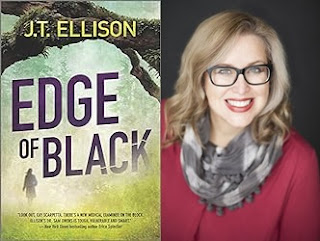
J.T. Ellison, Edge of Black

Because law enforcement is heavily systematized, for good reason, and crime is often banal, mystery fiction tends toward repetition. If you’ve ever screamed at a novel, wondering why the hero can’t see the widow’s lies, that’s why. Good authors beat this curb through innovative characterization—like Charles Todd and Stef Penney. JT Ellison handles this by cribbing technique from romance, another repetitive genre, with, let’s say, predictable results.

A biological attack on the DC subway paralyzes America’s government and kills three, including a congressman. ME Samantha Owens accepted a Georgetown teaching gig to escape such drama, but the DCPD and State Department need her experience and insight. When her boyfriend goes vigilante to pursue the attacker, whom he may know from his Army hitch, Sam finds herself caught between the law she’s sworn to uphold, and America’s greater good.

Presumably, Ellison wants to court the same audience that loves authors like Patricia Cornwell and Kathy Reichs. She uses much the same style: an alternation between wonky technical investigation, breakneck police work, and slow character exposition. But instead of creating taut, multifaceted character mysteries like Cornwell and Reichs, Ellison sprawls all over the map—literally, as the investigation caroms from DC to Denver and all points between.

I can’t identify which egregious mistakes bother me most. I began to get a sinking feeling when Sam Owens’ boyfriend, Xander, destroyed evidence and went off in pursuit of Lone Ranger justice. Does Sam, the career civil servant, recognize this vigilantism for the reckless endangerment it is? Nope, she considers it manful, assertive, and “the right thing.” When her DCPD contact is understandably angered, she stops barely short of calling him fascist.

Likewise, supposed professionals make such novice mistakes, I suspect they misunderstood the job questionnaire. Surely an ME with disaster training knows to volunteer her services at the perimeter of a biological attack, not to the men in the Tyvek moon suits. Police tracking a high-stakes witness should ping his cell phone now, not after he calls his girlfriend. Checking a victim’s Facebook page is victimology SOP; getting blindsided a day late is inexcusable.

J.T. Ellison
But perhaps the characters are distracted. They’re busy calibrating attractiveness: in each other, peers, bosses, and peripheral characters. Sam is deeply in love with Xander, but has to fend off romantic advances from her DCPD contact, Fletch. Meanwhile, Fletch seems to have crushes on his assistant, his boss, and a buxom vice cop. Shouldn’t skilled professionals in a national security crisis postpone the sexual byplay until happy hour?

Nor is it just the core ensemble. Ellison introduces new characters, not by name, action, or dialog, but by appearance. No character is permitted to speak, perform in-scene action, or advance the plot until Ellison establishes them as good-looking. No character who says or does anything in this book is less than ravishingly beautiful, man or woman, except one victim’s mousy mother and, in the final reveal, the culprit. Beauty equals virtue, evidently.

Between flashes of incipient sexcapades, Ellison cantilevers so many potential storylines into the book that she can’t resolve them all. Because it happens in an early chapter, it spoils nothing to say the DCPD pull Sam into the investigation because it appears the subway attack was targeted at the congressman alone. Tenuous prodding reveals that Peter Leighton may have sordid hobbies, unseemly connections, and a Moriarty-like double life.

Yet this, and several other byzantine subplots, disappear from the story for dozens of pages at once. Ellison has so many balls that she can’t juggle them together, and I kept forgetting she’d introduced something important. Then the investigation happens off-stage. Ellison introduces a possible serial rapist voyeur druggie congressman, then sends his DNA to a lab, and in the denouement, has her cop character basically shrug and say, “That was a red herring.”

BORRR-ring!

Ellison’s press biography claims she has worked with police, FBI, and other agencies to ensure the realism of her stories. After reading the slipshod techniques and outright illegalities of this story, I suspect she may have law officers asking to have their names redacted from her acknowledgments page. Her theatrics belong in a Vin Diesel movie, not in a police procedural with aspirations of verisimilitude.

This is not a serious novel. This is a mixed-genre slumgullion to fall asleep under on a beach or on a plane. Anybody who reads mysteries seriously will recognize it for a Rube Goldberg narrative, which might have worked as a parody, but is too earnest for its own good.