Showing posts with label class. Show all posts

Friday, April 27, 2018

The America that CNN and Washington DC Forgot

Sarah Kendzior, The View From Flyover Country: Dispatches From the Forgotten America

Why, in the midst of Barack Obama’s celebrated middle class resurgence, did so many working-class Americans get trapped in jobs with no future? If the 2010s saw such a storied economic resurgence, why are people with graduate degrees accepting service industry jobs? Has anyone else noticed that the Internet Revolution has made it harder, not easier, to break into meritocratic jobs like entertainment and finance? Somebody needed to write about it.

Sarah Kendzior has a doctorate in anthropology, and a cold familiarity with authoritarian states. She made her initial career translating news from Central Asia into language English-speaking audiences could understand. She never intended to become a journalist but, living in St. Louis, one of America’s most chronically impoverished cities, she began seeing chilling similarities between the post-Soviet “Stans” and the Midwest. So she wrote about it.

With a scholar’s eye and an urban mother’s sensibilities, Kendzior quickly established a reputation for explaining America to itself. Writing mainly in Al Jazeera English, she gained a cult following online for saying, with journalistic precision, what many Americans believed intuitively, that the recovery hadn’t benefited everyone. Dwindling jobs, stagnant schools, racial intolerance, a tone-deaf media… Kendzior calls out all of them.

First published between 2012 and 2014, Kendzior’s essays expressed what many people, regardless of political party, felt during the middle Obama years: left out, broke, and voiceless. As she describes it, though, her publisher wanted more mainstream acceptance, and she found herself without a venue. So she compiled thirty-six essays into a book and published it herself. It became a surprise bestseller during and after the 2016 election.

As millions of Americans with only a high school diploma or less abandoned the last vestiges of hope for economic mobility in the 2010s, college graduates realized that their degrees weren’t worth much either—”a promise the economy does not keep,” in Kendzior’s words. Unpaid internships and adjunct teaching positions became the norm. In other words, people worked without pay, or mostly so, in hopes of getting a paying job eventually, someday.

Sarah Kendzior
This doesn’t just influence jobs, though. It’s almost impossible to get into policy-making jobs, journalism, and other fields without an unpaid internship. This means the people making our laws, and the other people reporting on those other people and supposedly holding them to account, could only get into their fields because their parents could support them while they worked for free. Poor people’s children can’t get into those fields.

Meanwhile, the people who dominate our discourse paint others with a broad brush. They describe working mothers in language that might have made sense in 1975, but reveals our politicians and pundits don’t understand how much child care costs. They use terms like “the Muslim world” to create the impression of monolithic forces out there, somewhere, looming. They use words like “paranoid” to condemn anyone who questions their consensus.

As stories mount up, Kendzior guides us to realize these problems don’t exist in isolation. Tragedies like Trayvon Martin’s death aren’t separate from, say, the disappearance of scholarship behind a paywall; dying American malls go hand-in-hand with America’s overwhelmingly male policy establishment. Cynical proclamations from American newspapers get echoed in international leaders’ war speeches. We’ve created a system that keeps most of us quiet, confused, and left out.

Kendzior’s essays about these interconnected problems feel too massive to comprehend.  Indeed, she doesn’t include several ongoing issues: no mention of President Obama’s massively expanded drone warfare, only one mention of the Iraq war. Even with her scientific scrutiny, it’s easy to believe she’s just scratched the surface. Defenders of the status quo will certainly bring their most common complaint against her, that she names problems without presenting a solution.

But works like this are never about presenting the solution. They allow citizens suffering under the problem to understand that their pain, their dislocation, has been heard. We know we don’t suffer alone, because Kendzior acknowledges us, even shows us others suffering likewise. As she writes in “In Defense of Complaining,” simply naming the problem gives people power to organize and resist the forces keeping us down.

This collection, first privately published in 2015, has been republished for a mass audience, with a new introduction and epilogue, which put the essays into a Trump-era context. These problems, as Kendzior acknowledges, haven’t gotten better. They fueled the outrage that brought us 2016’s two biggest outliers, Donald Trump and Bernie Sanders. We must fix these problems soon, or the rule of law, already fraying, may snap altogether.

Monday, October 30, 2017

How Often Should You (Yes You) Shower?


The tease on The Atlantic’s Facebook page was simultaneously tempting and disgusting: “What Happens When You Quit Showering?” It’s just one more that’s trickled out through the years, including Chip Bergh, CEO of Levi Strauss & Company, telling people never to wash their jeans, or Buzzfeed citing that beloved go-to, “science,” to tell Americans we shower too often. A real cottage industry has developed recently selling the idea that we just don’t need to bathe frequently.

I understand the mindset behind this thinking. Where Americans once bathed about weekly, unless they carried an absolute reek, major corporate products like Ivory soap and Listerine mouthwash have convinced us our bodies are petri dishes of disgusting microorganisms, and we need to confront BO and “halitosis” daily, if not more. Nor is it just Americans. Per The Atlantic again, the global average includes a shower or bath daily, and a shampoo every other day.

Besides the health concerns of ordinary people washing necessary, symbiotic organisms off their bodies, this anti-bathing trend also reflects a pushback against advertisers who profit from our insecurities. I certainly don’t mind seeing corporate profiteers getting a firm public comeuppance for peddling self-loathing to the public. But I spot an unexamined class-based assumption in these articles. They implicitly believe typical Americans don’t get dirty and sweaty enough to even require that much bathing and laundry.

Since I reluctantly accepted my move down society’s economic ladder, and got a blue-collar job, I’ve come to understand that sweat and dirt delineate American social class. When I worked in the factory, indoor temperature often approached eighty degrees Fahrenheit even in the dead of winter; in summer, temperatures nearing a hundred degrees weren’t uncommon. And that’s nothing beside conditions working construction, where we’re expected to work in blazing summer sun and Arctic winter chill.


If I don’t shower daily, I smell like somebody left bologna on the kitchen counter for about a week. Sweat pours off me in quantities you’d not believe without seeing it. Many joggers, cyclists, or  other high-impact aerobic workout fanatics think they sweat; I certainly did when I worked white-collar and biked regularly. But I didn’t discover what sweat meant until it bucketed off me for eight hours or longer like wringing a kitchen sponge.

Showering isn’t optional for people who work like that. Since humans expel nearly a third of our bodily waste through our skin, the exceptionally moist environment of a sweaty construction worker creates a thriving breeding ground for microorganisms that, yes, produce an odor. Many of these microbes are necessary for human health… in limited quantities. But my sweat-soaked body creates conditions where my otherwise healthful, necessary microbiome makes me stinky, and could unbalance my health.

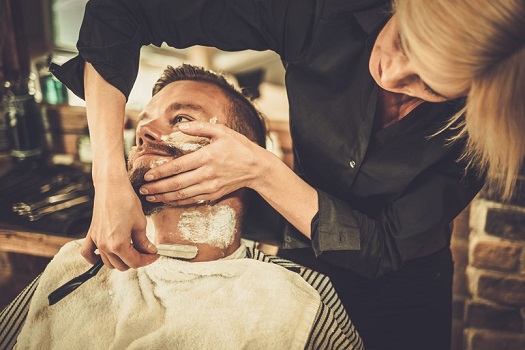
And that’s saying nothing about other class markers. I remember watching Star Trek years ago; Dr. Crusher complained to some hirsute crewmates that, since the invention of the razor, having facial hair was an affectation. I wondered then why the hair growing naturally from men’s faces was affected, while barbering it daily was not. Now I realize something deeper: facial hair keeps hostile conditions, like wind and precipitation, off my skin. Shaving jeopardizes my safety.

Considering that Levi Strauss invented his heavyweight dungarees specifically to withstand the punishment gold miners put their britches through, Chip Bergh’s whine that washing your jeans seems remarkably obtuse. My jeans get battered, torn, grease-stained, and worse, daily. If, atop that, I had to slip them on without thoroughly washing my microbiome off (remember what we said about bodily waste above), that would be like wearing the same tattered, shit-stained BVDs, every day, for years.


So when The Atlantic and Buzzfeed insist I should stop showering, they clearly think people like me don’t read their content. They occupy a rarefied world where pundits in suits scold one another about internalizing commercial hype and selling their self-esteem to our corporate overlords. If they realize people like me exist, they certainly don’t give us further thought. They accept the hierarchy, where building structures and making stuff is too menial for their audience.

Maybe bankers and attorneys could afford showering every two or three days. Many probably should. But audiences are diverse, and many haven’t achieved the lofty standards high-gloss magazines promised us in college. These one-size-fits-all hygiene tips innately assume wealth, and indoor work, are normal. And they exclude the people who build their offices, maintain their server farms, and cook their cafeteria dinners. People like, well, me. Do I need to explain why that’s a problem?