Monday, March 12, 2012

How Star Wars Let One True Believer Down

Cleaning out my closet recently, I uncovered my reserve of Star Wars novels. I boxed them up prior to the last time I moved house, in 2007, and never bothered to unpack them. For a guy who grew up in the amniotic fluid of the Force, realizing I stepped away from that major influence without even thinking about it is humbling. That boxful of books forced me to reevaluate why I fell into the Star Wars fold, and more important, what drove me out again.

I was three years old, too young to understand what the first movie was, when it hit theaters in 1977. It initially became a success without my participation, or that of my family, who remain assertively outside pop culture to this day. Only after I started school, and my friends brought their action figures and movie quotes to the playground with them, did I finally see it in the 1981 re-release. Getting on board that train was a key to schoolyard acceptance.

That’s part of why, when Star Wars’ initial hipness gave way to The Transformers, and the action figures disappeared from store shelves, I felt disappointed: not because a cultural marker I grew up with had diminished in importance, but because I couldn’t purchase my way to acceptance any longer. Only when I was older did I understand Lucas’ mythic significance. As a kid, I just wanted to get on the bandwagon.

Rather than get on the constant rotating selection of bandwagons, which would require investments of energy I’d rather spend elsewhere, I chose to change tacks. Instead of being a mass movement, Star Wars became a cult. Instead of a way to get on the inside, I and my friends treated it as a shibboleth, separating the mass of ignorati from we few in the know. We started guarding our secrets from the muggles, who we kept unaware.

Then Lucas changed the game again. With the 1992 release of Timothy Zahn’s Heir to the Empire, the franchise crept back into a sense of currency. Books are a different business than movies, with a mindset that lets the industry float a shot in the dark in a way that movies can’t. If Zahn’s novel, and its sequels, had died, it would have been a quiet death, unlike the original movie, which came perilously close to euthanizing its studio before becoming a hit.

I wish I could say I was glad that Zahn breathed new life into the franchise. I at least didn’t have to deal with scorn from the cool table full of people reminding me how retro I’d become. I was au courant again. Yet because books, in this pre-Harry Potter world, did not create mass movements, Star Wars was suddenly in a knife edge. Lucas could only maintain the sense of cool by pushing out new books, peaking at a rate of over one per month.

When the books became a success, they did more than just revitalize the franchise. They proved a decades-old story could still communicate with the audience. This paved the way for the prequels, beginning in 1999. But they also diluted the arc begun in the original movies. If Luke Skywalker’s “hero’s journey” did not culminate in a galaxy truly changed, what had he fought for? And, more important, why should we care?

Neal Stephenson, writing in the New York Times, blames the prequels’ diffuse inscrutability on Star Wars’ transition from movie franchise to multimedia extravaganza. You can’t understand the stories if you haven’t read the novels and comics, watched the cartoons, and played the video games. Star Wars had become oriented toward moving product rather than telling the best possible story.

But I find John Perlich’s explanation in Sith, Slayers, Stargates, + Cyborgs more satisfying. The story fell not because it became too diffuse, but because it lost its mythology. Though Perlich makes a complex, multifaceted argument, I can compress my salient points into one sentence. Rather than tapping into the roots of human psychological need, the franchise fell into the desire to titillate with rote action scenes that could come from any film.

I started buying Star Wars novels in 1992, stopped in 2001, and boxed them up in 2007. Standing over the box now, I realized I didn’t miss them. Star Wars taught me some goals were worth striving for. One such goal is Star Wars itself. Like Tolkein or King Arthur, Star Wars should stand for something. If it doesn’t, I can’t stand for it.

Friday, March 9, 2012

Ben Marcus and the Disease of Incomprehension

Nobody wants to admit that the thing they most love is the thing that will destroy them. But in Ben Marcus’ The Flame Alphabet, parents can no longer deny that their children’s speech is the source of the illness slowly stripping the life from their flesh. Samuel and Claire still love their daughter, Esther, even as her language pushes them to the brink of death. So perhaps the only way to survive together is to find a new and revolutionary communication.

Literary postmodernism has proven a tough sell for general audiences, partly because any definition of the concept inevitably turns circular. The principle starts with an agreement that gaps exist between sign and signified. Therefore all information is provisional, and individuals can never agree wholly on meaning. Concepts like linear narrative and clear action become transient. Reading becomes not an action but an immersive experience.

Ben Marcus explores the parameters of this concept by taking it to the next logical step: if understanding is optional, it’s also perilous. Particularly, the communication between the generations, between those who most need to hear each other, becomes a vector for serious illness and death. That which we most long for and depend on, our children’s voices, becomes a voyage in uncharted waters. Here there be dragons, indeed.

The result, as with all literary postmodernism, depends on the audience. When conventions of structure become impediments to experience, readers accustomed to being led by the hand will get lost. Marcus demands readers willing to fill in the gaps for themselves. In essence, we become his co-authors. Not everyone will appreciate this.

But it does lend an intimacy to the story. As Samuel, Marcus’ viewpoint protagonist, struggles to love the daughter who is killing him, we glimpse a level of introspection more conventional storytelling would deny us. Even this has its murky depths: the writing becomes so personal that we wonder if Samuel really is Marcus. And as Samuel both is and is not Marcus, he also both is and is not us.

Samuel perseveres in the face of illness, as his wife courts listless death. Their daughter takes apparent pleasure in the pain she causes, even using her words on strangers with malice. Esther’s complete inability to bond with her parents, and her lack of sympathy with others’ pain, suggests autism. (In an NPR interview, Marcus reveals he has kids, but no teenagers. With this level of intimacy, one wonders if he’s admitting a fear of the future.)

In tandem with the “speech fever,” Marcus also expounds a future vision of dark Judaism. The Jews are the first victims of this spoken illness, and speculation abounds that this may be a dark Hebrew conspiracy. The Jews are not helped by the fact that they no longer worship in the shul, but in grim solitary enclaves, secret not only from the world, but from each other. It’s an arrangement almost customized to breed anti-Semitic paranoia.
But as Samuel holds forth on his own Judaism, parallels develop. His descriptions of speech fever symptoms—blood-encrusted lips, listless shuffling gait, protruding ribs—sound eerily familiar. It feels like the sins of the past are revisited, turned outward, projected onto the world. But because we are yoked to Samuel’s viewpoint, intensely introspective but not well attuned to the outside world, we are left to draw our own conclusions.

And herein lies the problem most readers will have with this book. Marcus gives us no guidance whatsoever. Though he has a story, with action and character, he does not give us any signs of what we can trust. Is Samuel the author’s voicebox, or an unreliable narrator? Is the speech fever a legitimate fear, or a fervid speculation? We don’t know. Marcus leaves it all up to us.

Marcus seems to dare us to ask whether a book must make any sense. One of his characters, a dark, enigmatic rabbi, answers explicitly: no. Meaning comes not from the words we use, but from the interstitial ambiguities between the words. But in this, as in the rest of the work, Marcus keeps his hands off, letting us decide how much to believe. We have to tell his story for ourselves.

Many people unschooled in literary theory use the word “postmodern” as a synonym for “incomprehensible.” That’s not unfair, since postmodernism regards comprehension as an accident of form. But in publishing a book, presumably author and publisher think an audience exists. Presumably. If comprehension is optional, maybe the book is its own justification.

Wednesday, March 7, 2012

Operation Ajax—America's First Battle With Iran

Shah Mohammed Reza Pahlavi
As this year’s presidential challengers hold forth that America should attack Iran, backed by Israeli Prime Minister Benjamin Netanyahu, Americans deserve to pause and recollect history. As bad as the current Iranian regime has behaved, and as much of a threat as it poses to American interests in the Persian Gulf, it is a legitimate world power, and deserves respect enough for us to understand how we reached this impasse.

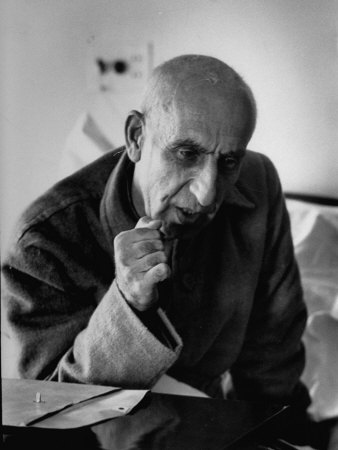
In 1953, the state of Iran essentially had a ceremonial government, under Shah Mohammad Reza Pahlavi, and an elected government, under Prime Minister Mohammad Mosaddegh. The Shah wore a European-style army uniform, performed ceaseless ineffectual military reviews, and lived a secular bohemian lifestyle. The devout Mosaddegh lived humbly, dedicated himself to the people, and wanted to use Iran’s resources for the Iranian people.

That last issue alienated Mosaddegh from the west, because Iranian oil was, for all practical purposes, a wholly owned franchise of the Anglo-Iranian Oil Company. Think you haven’t heard of the AIOC? After 1953, this company reorganized as British Petroleum, then, as it went multinational, as BP. And in 1951, Mohammad Mosaddegh, Iran’s democratically elected head of state, wanted to nationalize his country’s oil reserves.

This outraged the British, who, in the wake of World War II, had too little international clout left to act on it. In the post-war alignment moving into the Cold War, however, Britain had an ally in the United States, and an untested but powerful weapon in their arsenal. Britain’s legendary international intelligence agency, MI5, whispered to America’s sister agency, the CIA, that Mosaddegh had fallen into the pocket of the Soviet Union.

Prime Minister Mohammad Mosaddegh
This was palpably ridiculous to anyone who paid attention to that region. Though economically liberal, Mosaddegh was conservative in his social and religious values, and had no patience for the atheist Soviets. He also, like other Middle East leaders, was weary of European intervention in his country’s affairs, after two world wars and countless proxy conflicts. But America, up to that point, paid little attention to Iran.

In the early Eisenhower years, America was prosperous, but war-weary. The army was desperate to put a bow on the increasingly unpopular Korean conflict, and deeply divided over whether to join the post-colonial Vietnam conflict. The nation would not have supported an overt war in a country few knew anything about. But a covert operation was not beyond the pale. The CIA dispatched Kermit Roosevelt, grandson of Theodore, to organize a coup.

What followed has the white-knuckle pace and structural intricacy of a James Bond thriller. Why no one has made a movie of this baffles me, because America’s bloodless overthrow of a democratically elected government makes both enlightening history and an exciting story. The story is too complex to recount in this short space, but I recommend Stephen Kinzer’s eminently readable Overthrow. The CIA codenamed this action Operation Ajax.

In short, by the end of August 1953, the Shah, who made lopsided alliances with the NATO powers and ruled with draconian military force, governed Iran. He organized a kangaroo court that convicted Mosaddegh of treason. The legitimately elected Prime Minister spent three years in prison, and finished his life under house arrest, reputedly dying a broken and enfeebled man in 1967.

Americans generally do not recall Operation Ajax. It’s unclear how many have ever known about it. Iranians, however, remember. When Iran calls America the “Great Satan,” it is not because of our opinions on the Islamic Republic today; it’s because the people remember the events of 1953. But under the Shah’s harsh regime, populists and leftists could not organize openly. Revolutionary attempts to modernize the country were preemptively quashed.

President Mahmoud Ahmadinejad
Revolutions could only foment in the one place the Shah refused to interfere: mosques. Though secular and westernized himself, the Shah knew his dynasty had relied for generations on clerical support, and he assumed he would have it as long as he spoke Farsi and left imams alone. He discovered in 1979 just how wrong he could be when, out of the country for medical treatment, a league of ayatollahs seized his seat of power.

Nearly sixty years after America overthrew one Iranian government, we hear calls from within and without to do it again. But this time, we have the perspective of history to predict the consequences of our actions. We can only say we have not learned from history if we have not learned about history. If we repeat Twentieth Century mistakes, we cannot proclaim ignorance a second time.

Monday, March 5, 2012

Publisher Spotlight—Crossway

In a crowded Christian publishing industry, Crossway Books of Wheaton, Illinois, has recently positioned itself as the thinking Christian’s resource. I really appreciate this effort, because Christian literature has of late become inexcusably emotive. But for all the good they do, Crossway takes a terrible risk. In religion, as in politics, the more specific your statements, the more you give opponents a chance to object to.

Prolific Baptist theologian John Piper, with his assistant David Mathis, has edited the slim but rich Thinking. Loving. Doing. Utilizing Piper’s own densely scholastic but life-affirming ecclesiology, this volume unifies five celebrity Christians in a panel presentation on what it means to love God in thought, emotion, and action. Though perhaps incomplete, I predict this book will spark overdue debates in many Protestant congregations.

Rick Warren, Albert Mohler, and RC Sproul argue—in bold and diverse ways, from Socratic argument to dense academic lecture—that Christianity demands intellectual intensity. Unless we truly know Christ and His Word, we cannot act in keeping with His mission. Francis Chan and Thabiti Anyabwile say all earthly knowledge helps little if we lack a committed heart spurring us to action. After all, “the greatest of these is love.”

Piper himself advocates that knowledge and feeling matter little if they do not urge us to act. Of this book’s themes, I fear action is the most necessary in today’s rarefied Christian discourse, but the least discussed in this book. Protestants often descend into calls for civic action versus warnings against “works righteousness.” We need a sober discussion of what Christians should do. Perhaps this book will start that conversation.

Kevin DeYoung and Greg Gilbert try to close that gap in What Is the Mission of the Church? They believe that many emerging Christian leaders have promoted civic engagement over preaching the word. The church, they say, should reclaim its former emphasis on witness and evangelism, taking its cues from Christ’s public ministry, and those of the apostles. I find myself agreeing with these authors to a point.

That point comes when they apply appalling sophistry to dismantle the scriptural readings supporting liberation theology. This form of Christianity arose in Latin American Catholicism, but has found a recent toehold in African American Protestantism. DeYoung and Gilbert insist that Christ’s promise of “good news to the poor” and “release [to] the captives” is only spiritual, and political involvement cheapens the Gospel.

This lopsided gospel only makes sense to anyone who has never been poor or oppressed. Early Christianity gained ground specifically because it gave people hope—and not just that they would go to heaven when they die. These authors’ call for renewed evangelism is timely, as American Christians have grown timid about speaking Christ’s truth. But their relegation of any other mission to the chosen few is, I fear, dangerous.

Splitting the difference between the above books, Bill Clem’s Disciple summons professing Christians to look at where we derive our identity. Too often, we want to call the shots for God, deciding what God wants us to do. We have a therapeutic view of Christianity, expecting God to fix our hurts and work on our schedule. But Christ calls us to give ourselves over to God’s will; only then will we find the completion we seek.

Our identity, our community, and our mission—in short, the topics Piper et al. discuss—must come ultimately from Christ revealed. Our common complaints about God (why is there evil? why do my desires conflict with Scripture?) set us up as our own small gods. When we live as disciples to Christ, rather than slaves to our own short-term goals, we have a life full of meaning, and a mission stuffed with purpose.

I do have a problem with Clem’s vision of discipleship. Though authority comes ultimately from Christ, we do not apprentice directly to Him. Barnabas had Paul. Aquinas had Albertus Magnus. Martin Luther King had Howard Thurman. We learn to see our Heavenly Father through an earthly father (or mother) figure. I wish Clem addressed this topic more directly in his otherwise excellent guide to theology.

All three of these books have problems. All three miss the question behind the question at least once. But they also attempt to advance the Christian discussion. Too many publishers today seem content to speak the obvious or tell us what we already know. That’s why I like Crossway: when they fail, it’s because they take bold chances that would frighten most other current Christian publishers.

Prior reviews of Crossway titles:
Larry Woiwode, Words Made Fresh
Tom Nelson, Work Matters

Friday, March 2, 2012

An American Vision of Caribbean Fiction

As his tropical homeland descends into abjection and tyranny, Alexandre takes a job managing a lush but decaying estate. He struggles to maintain a normal life, avoiding politics, and striving to join the white elites who employ him. But despite his best efforts, “normal” proves a moving target. Circumstances conspire to remind him that he remains forever black. And the violence inevitably encroaches on his secluded paradise.

I’m of two minds about Christopher Hebert’s debut novel, The Boiling Season. Behind the thicket of language lies an interesting story about the gap between aspiration and reality. Alexandre tries to shed his impoverished past and become something more urbane, but he cannot escape the forces that shape him. This keeps him blind to his own tragic flaw, but also to his nation’s continuing struggle, right up to the moment he can deny neither any more.

But to reach that story, one must first penetrate Hebert’s strange storytelling choices. He hits us with the one-two punch of an unreliable narrator and a sweeping range, continually reminding us that we cannot take anything we read at face value. This makes sense when we have the tools to sort reality from fantasy, like we get from Joseph Conrad. But Hebert seems to deliberately alienate us from any outside referents.

We have no dates for events in this story—a problem compounded by the scope of the story. Alexandre, narrating his life, will casually say things like “in the spring of our second year” or “four years had passed.” As these mount up, he’ll suddenly dip into flashbacks and reminiscences, making it harder to keep events in sequence as the book goes on.

Along with time, Hebert also withholds a sense of place. Alexandre’s homeland is merely “the island,” ruled from “the capitol.” Without such a vague location, he has to describe imagery so aggressively that it threatens to overwhelm readers. Those who study history will recognize Hebert’s setting, but the verbal gymnastics he undertakes to avoid saying the word “Haiti” become pointed.

This evasion distracts from what ought to be an otherwise engaging story. The contrast between Alexandre’s elegant aspirations and the entropy around him find an excellent mirror in the estate he oversees. His struggles to turn the estate first into a suitable home for a jet-setting international businesswoman, then a world class resort, externalize the ways in which he tries to be seen by others, especially by wealthy whites.

When Alexandre first encounters the estate, it has stood derelict for decades. As the starving population has picked the rest of the island down to the roots, the estate’s walls shelter all that remains of the original rain forest. Like the woman who hires him, he is initially drawn to its pristine state. Its lush edenic qualities, interrupted only briefly by a colonial plantation house, resist the decay beyond the walls.

But he can only preserve the property he loves by turning it into a commodity. When it proves too costly for his employer to keep the large estate as a second home, she and Alexandre begin transforming it into a resort hotel. Virgin jungle gradually gives way to swimming pools, casinos, and discotheques. They have to sell their pocket paradise incrementally to pay the high cost of staving off native entropy.

Hebert tells this gripping story of alienation and identity with a strangely dry, undifferentiated style. Moments of great psychological impact spill forth in the same tone he uses to describe the weather, which he does a great deal. I had to reread several chapters to understand what happened, not because Hebert is opaque, but because his language style never varies.

And his characternyms are just too precise. Many characters’ names reflect how Hebert wants us to see the characters. Some names only make sense if you know the code, like Rossignol and Guinee, while others, like Swallows and Freeman, are so overt that they take readers out of the moment. The characters live up to their names, and no higher. Sadly, these aspects aren’t smoothly integrated.

Which is a crying shame. If Hebert did something to differentiate his writing, something to really take us on Aleandre’s emotional journey rather than just tell us about it, this would be a great book. It stands as a good story. Unfortunately, as a debut novelist, I fear he got caught up in the idea of his book as “important,” and didn’t take it nearly far enough. This book is good, but falls short of great.