Matt Taibbi, Griftopia: A Story of Bankers, Politicians, and the Most Audacious Power Grab in American History, and Michael Lewis, Boomerang: Travels in the New Third World

Matt Taibbi writes: “We live in an economy that is immensely complex and we are completely at the mercy of the small group of people who understand it—who incidentally often happen to be the same people who built these wildly complex economic systems. We have to trust these people to do the right thing, but we can't, because, well, they're scum. Which is kind of a big problem, when you think about it."
From the home mortgage bubble to the commodity run to the investment bank bailout to the health care reform cock-up, Taibbi examines the ways money has permeated all corners of public life, lifting the rock and watching the cockroaches scurry. This is an angry book for angry people, which in the wake of the TARP mess we all were. Years later, we must ask, does enough of that anger remain that politicians will fear the people?

This story is not without controversy. Taibbi admits that the Rolling Stone magazine article which spawned this book drew brutal criticism. Financial journalists excoriated this outsider for calling jerks what they are, right up until the moment they joined the chorus. Taibbi's thesis (minus, perhaps, the cuss words) now represents the mainstream of American financial commentary. But still, Taibbi puts it forthrightly, without prettifying the hideous.
Disaster journalist Michael Lewis concurs: "Everywhere you turn you see Americans sacrifice their long-term interests for a short-term reward." But where he writes that, he's just spent an entire book proving how that describes the entire developed world, gulled by promises of free money and cheap prestige. Us Yanquis can clean our own house, but the world remains awash in filth left by the receding housing tide of 2008.
 Lewis travels to five countries that took the biggest bath in the 2008 financial crisis. Iceland had money lying around, got into investing, and created pretty paper billionaires, but very real liabilities. Greece wanted the respectability of Eurozone membership, but not the responsibility. Ireland turned cheap bank deposits into a housing boom nobody wanted. Germans played by the rules, but their banks didn't, and left the state holding all Europe's bag.
Finally, Lewis unpacks America. For the most part, he unpacks California, which he clearly regards as a microcosm of what went wrong nationwide. Citizens want everything under the sun from the state, but refuse to pay for it. Big entities fob their liabilities onto subordinates, then plead helplessness when cities hit the wall. And time and again, we know exactly who caused the problem, but refuse to call their bluff.
Lewis describes the circular circumstances that created this mess. Though he has separate chapters for the five countries he examines, their entanglements transcend mere borders. The almost balletic movement of money on a global scale reveals that the financial folderol, America-centric though much coverage has been, makes geographically bound nation-states look creaky in light of transnational supply lines.
When everything went kaput, the megaquadzillionaires who created the problem claimed, with some justification, that if they suffered the consequences of their irresponsibility, the entire economy would burn with them. States rushed to buffer the people who bet staggering sums on lame horses. Modest operators, who trusted their bosses and elected leaders, took it on the chin. The result, as Lewis puts it: capitalism for everybody but the capitalists.
The impact from the 2008 crisis still creates shockwaves in politics and society. Yet few of us can truly comprehend what happened. Taibbi and Lewis translate that meltdown into plain English, and they demonstrate how close we now are to permitting another catastrophic crash.


 Some of the most interesting suggest that something bigger is happening behind the scenes of Baum’s original novel. Rachel Swirsky’s “Beyond the Naked Eye” reveals that Dorothy’s quest was really part of a rigged reality TV show, while Dale Bailey’s “City So Bright” tells the tale of the nameless workers who keep the Emerald City looking so pretty. Both declare that, below the shiny surface, long-unspoken desires threaten to boil over into insurrection.
 My friend Deanna was murdered this weekend.
 We
have a real sickness in American society, one that manifests in
serious, concrete ways, but which we will not address seriously because
we believe doing so will violate... what? What will it violate to take
serious steps to curb gun violence? Certainly, in writing the Second
Amendment, the Founders did not mean we could do nothing to save my
friend. They did not mean for us to stand powerless in the face of
violence destroying our communities.
We
have a real sickness in American society, one that manifests in
serious, concrete ways, but which we will not address seriously because
we believe doing so will violate... what? What will it violate to take
serious steps to curb gun violence? Certainly, in writing the Second
Amendment, the Founders did not mean we could do nothing to save my
friend. They did not mean for us to stand powerless in the face of
violence destroying our communities. So
let me say it: I’ve never owned a gun. I’ve never knowingly permitted a
firearm into my house. I do not hunt, shoot skeet, or target shoot.
I’ve gone range shooting with a rented gun, once. But like nearly
two-thirds of Americans, I am not a gun owner or sport shooter. I
consider myself a regular guy, but will not prove it through Freudian
strutting.
So
let me say it: I’ve never owned a gun. I’ve never knowingly permitted a
firearm into my house. I do not hunt, shoot skeet, or target shoot.
I’ve gone range shooting with a rented gun, once. But like nearly
two-thirds of Americans, I am not a gun owner or sport shooter. I
consider myself a regular guy, but will not prove it through Freudian
strutting.


 Creeds,
confessions, and catechisms connect us with the Christian tradition
between the Apostolic era and the present. They provide a context for
our beliefs, such that we do not need to reinvent the wheel every
generation, or every Sunday. They let us define and explain our beliefs
without having to fumble through disparate Scriptural passages that may
sprawl across hundreds of pages. In short, they give Christians a shared
public vocabulary.
Creeds,
confessions, and catechisms connect us with the Christian tradition
between the Apostolic era and the present. They provide a context for
our beliefs, such that we do not need to reinvent the wheel every
generation, or every Sunday. They let us define and explain our beliefs
without having to fumble through disparate Scriptural passages that may
sprawl across hundreds of pages. In short, they give Christians a shared
public vocabulary.
 The story divides in three parts: in the first, we learn of the Sithe’s elaborate system of prestation, honor, and power. Queen Kate is absolutely reliant on her subjects, and does not have absolute power; but she is the lawbringer, and as such, has the power to set the tone for any discussion. The careful balance between the bold queen and the powerful MacGregors drives the novel. She is not necessarily “in charge,” in the autocratic sense, but she certainly runs the show.
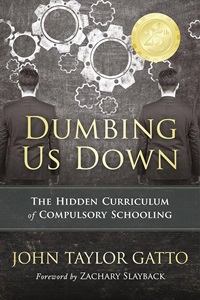
 But such abstruse theorizing doesn’t hold Gatto’s interest very long. He’s a practical-minded man, devoted to his students as individuals, apart from their statistical valuation. And in his most anthologized essay, “The Seven-Lesson Schoolteacher,” he unpacks the classroom experience as it’s actually lived by the mass of students. School, he contends, does not teach its nominal subjects; it teaches subordination, confusion, and nihilistic despair.
 This is emphasized by Barnes’ inclusion, in this book, of the entire Heidelberg Catechism. Not only does the Catechism unpack the entire Lord’s Prayer, Decalogue, and Apostles’ Creed; it’s also thoroughly annotated, underlining scriptural passages written centuries apart, but which work in tandem to convey important beliefs. No one should mistake this document as a replacement for the Bible, but a key to help us understand it, here and now.
 While keeping brown people comfortably incarcerated, American drug laws also
keep criminal enterprises flush with cash. Forget the Crips and Bloods; America’s appetite for narcotics, and the massive undocumented network necessary to supply it, sustain massive money pipelines for Hamas, Hezbollah, and the Afghan Taliban. Our drug habit is also subsidizing Mexico’s ongoing civil violence, and threatens the stability of the European Union.
While keeping brown people comfortably incarcerated, American drug laws also
keep criminal enterprises flush with cash. Forget the Crips and Bloods; America’s appetite for narcotics, and the massive undocumented network necessary to supply it, sustain massive money pipelines for Hamas, Hezbollah, and the Afghan Taliban. Our drug habit is also subsidizing Mexico’s ongoing civil violence, and threatens the stability of the European Union.
 These reversals often arise out of improvisational morality. Public paranoia surrounding alcohol, drugs, and white slavery resulted in comically disproportionate responses, even if the scare (as with white slavery) was almost entirely fictional. This has often been coupled with baffled responses from public moralists, who apparently assume the population will stop drinking, toking, or paying for sex simply because the law says we should.