
Duane Pesice is a writer, musician, and self-taught expert on Cephalopods. He blogs regularly at PlanetModeran.net.
I got to thinking about the subject of "the book that has most influenced me" and kind of surprised myself. Had to go back a really long way, back to 1966, to find the one book that set me on the path to tomorrow. It wasn't even a book. It was a comic book.
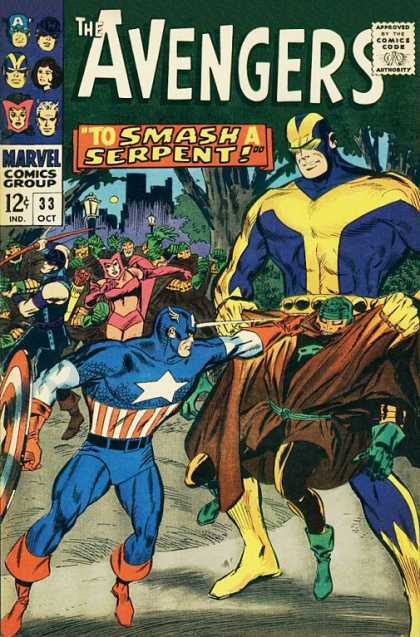
More specifially, it was an issue of Marvel's The Avengers-#33, to be precise. It had most of the recognizable Avengers crew (Thor, Cap, Iron Man), a lot of movement and color, and it had some vaguely scientific stuff that filled my five-year-old brain with wonder (The Serpent Squad, I seem to recall, were the villain). I remember just being "opened up" by that comic in a way that has only happened a couple of times since. I read it in the little drugstore at the corner of 55th and Kildare, southside Chicago. I had allowance left and blew that on the same month's issue of the Fantastic Four (don't remember which).
That led to a seventy-issue run of the Avengers for me (I missed #104 because I was sick for a couple of days. It took me twenty years to find out what happened to Hawkeye.), and a 200-issue run of the FF. The writing, the art, everything just clicked. The stories led me to real stories. I was naturally attracted to Bradbury and was able to collect that first round of Tolkien Ballantine paperbacks. I, Robot was in my bookcase by the time I was eight, the same year I discovered Lovecraft through reading Dr. Strange (who I found out about by reading the current issues list in the middle of each mag, under the fan mail).
 My first piece of writing, in 1967, was a comic book. I remember distinctly reacting badly to Gene Colan's art and the villain Stilt-Man in an issue of Daredevil and deciding that I could do better. I had only drawn boats and things before, very childish renderings. I remember drawing the people from TV Guide over and over to get the relative sizes of facial features right, and the development of my villain (an antihero named Chevron after the gas station two blocks away). My first short story starred Cthulhu and Randolph Carter.
Stan Lee name-dropping Harlan Ellison in the letters column provided the last kick into today. I recognized the name and spent my allowance for two weeks on the two-volume paperback copy of Dangerous Visions. On the way home from buying that set, I found a copy of The Magazine of Fantasy and Science Fiction lying on the sidewalk. It had Cordwainer Smith in it.
By the time I was twelve, I had somewhere around 200 books, having discovered used-book shops, piles and piles of comics (nearly all Marvel with some Gardner Fox stuff), and had written my first novel (fanfic starring Black Bolt and the Inhumans).
It's possible that I haven't grown up much since then, or maybe the circle remains unbroken. Comics and HPL and SF are still my comforts both for reading and writing, and I've just begun work on a webcomic/graphic novel containing all of the above and Hunter Thompson and Elvis to boot. And Groff Conklin and James Baen and Bernie Wrightson and especially Jack "King" Kirby, and Roy Thomas and Stan "The Man" Lee-I can't thank you enough.


 To break the monotony, I pull completed fuel managers from the seam setter and put them in various locations on the conveyor belt. Previously, I’ve placed largely at random—now I set them in specific locations. All along the far edge of the conveyor, for instance. Along the near edge. Along the middle. And wherever I place them, when they reach the overflow guard at the end, they cluster in the same pattern.
 The fuel managers don’t just sit there, absorbing their three inputs, however. They are tall and cylindrical, with smooth metal shells. As the conveyor’s momentum builds tension with the unmoving guard arm, the fuel managers rotate, accumulating friction that turns into surface heat. Good thing another worker will soon remove these fuel managers from the line, or they might overheat, become warped, then... what?
 Therefore I propose that, if we really want students to learn, we need to get them out of school. Not that we should abolish institutions of learning, but that we should take them outside the inflexible, controlled classroom, and let them see the world around them. Guided opportunities to make discoveries like the one I made on the factory line would inspire growing curiosity and a love of learning.


 At work a couple of nights ago, some co-workers were reminiscing about the difficulties they had with math class back in the day. Like many people, these colleagues, one in her forties, evaluated the class in retrospect based on whether she had put the learned skills to use. And of course, they have scarcely used any math beyond basic arithmetic to balance their checkbooks.
 Thinking back, I cannot recall even one teacher saying I needed to learn higher math, science, or the humanities because I would ever use the skills. My algebra teacher admitted we were in her class for idealistic purposes. My literature teachers asked us to please see past supposed utility, and embrace our studies to expand our minds. Yet I recall struggling to understand why I should spend time on such useless pursuits.


 People don't always say what they mean. Times get rough. Emotions can make us hurt and do stupid things.


 Mikalatos won’t have it. This life has to pass away when Christ gives us the new life. But to achieve that, we need to place our trust in Him, not in human leaders or displays of public piety. Such exhibitions are meant for this world. Remember, we are called not to be conformed to this world, but to transform it by the power of our faith. We are not reanimated; we are resurrected.


 When Sarah started watching MTV’s Teen Mom recently, I questioned why she would reward such blatantly unbalanced characters. Though the show debuted with benevolent aims, to let young women see teen motherhood’s actual lack of glamour, it also provides a national, even global, audience for its stars. Considering the twisted, histrionic tendencies they’ve shown, these young women don’t need the reward of anyone paying attention.
 Such is not the case anymore. Portwood, with the rest of her cast, has been renewed for a fourth season. The E! Network refuses to divest itself of the increasingly embarrassing Kardashian franchise, even after Kim’s record-setting multimedia extravaganza wedding ended in divorce barely two months later. High-profile flame-outs are a license to print money for the networks that own distribution rights. Controversy sells.
 Amber Portwood, however, has a baby. As twisted as she’s become, she makes a contribution to society. Presumably, she and her child will want to reintegrate into the American mainstream, hold jobs, and pass a legacy on to the next generation. Amber certainly put hard constraints around herself when her pregnancy ended her party girl lifestyle, but she and her child still have a future, however limited.

 Perhaps more telling, in the midst of the overly outrageous scenes, are the realistic emotions of Charlie. His wife was the love of his life, and her absence prevents “death” from becoming too lighthearted in the novel. As much as Charlie changes in the story, he genuinely grieves her passing the entire time. Also grounding the reader is his attachment to Sophie. He shows his best characteristics when working at fatherhood.
 My favorite comparison is table service. Victorians of means loved to invent new pieces of flatware so they could boast in being the only one who knew how to use them “correctly.” Thus, Victorian formal dinners could involve place settings larger than some central London flats. The looks of disdain at people who couldn’t use a demitasse spoon, or couldn’t distinguish a stemmed from a stemless wine goblet, are legend.
 Bennett doesn’t just toss out advice, though. He takes the time to explain what it really means, backing it up with evidence from well-known films—acclaimed successes and notorious flops alike. He writes with a dry humor and the voice of experience, like someone who has seen it all, and has plenty of war stories to share. He reminds me of a best friend who wants to help you achieve your dreams while avoiding the pitfalls he’s already endured along the same path.


 Many churches, particularly evangelical congregations, mistakenly divide labors into “higher” work, meaning the pastorate or missions, and “lower” work, done in secular settings. This leads many ordinary parishioners to think they let God down if they stick with their workaday jobs. But Nelson reminds us that the Apostle Paul encouraged Christians to continue their work, and be Christ’s eyes and hands where people actually are.