Monday, August 12, 2013

Godless Dogma

PZ Myers, The Happy Atheist

With this title, I expected perhaps somebody enjoying a half-drunken night of sacred cow-tipping, somebody more like Billy Connolly, Dave Barry, or John Cleese perhaps. But this guy isn’t remotely happy. He’s chastising everybody who ever raised his hackles, an apparently long list (though he’s squishy with actual names). I once sat beside a guy excoriating his ex-wives at a bar. Myers reminds me of that.

In his first chapter, Myers promises not to regurgitate “the common atheist line” and claims that, confronted with religious absurdities, he has only one reasonable reaction: “I have to laugh.” These pledges don’t even reach page thirty before he starts painting everybody with one broad brush, and reciting laundry lists of grievances. Even his grievances have a numbingly familiar timbre. C’mon, PZ, don’t just paraphrase Richard Dawkins!

Myers seemingly promises one book and delivers another. He offers an irreverent, playful critique of America’s facile religious discourse, something even many True Believers would welcome today. But once you start reading, Myers repeatedly works himself into demonstrative indignation and starts reciting predictable adjectives about how awful theists, particularly Christians, really are. He doesn’t distinguish moderate theists from outliers, nor respect his opposition enough to even lob new or innovative accusations.

Around the one-third mark, I realized Myers doesn’t have many proper nouns in most essays. Myers confronts a rolling panoply of opponents, mostly vague (“Christians say...” or “Some have accused me...”). Sometimes he names his opponent, like British religious writer Karen Armstrong or “burn-a-Koran” nut Terry Jones. But in most of his thirty-four short essays, he rails against abstract, nebulous foes making weird anti-intellectual statements.

The only opponent he quotes at any length is Albert Mohler, President of the Southern Baptist Convention. He cites Bible verses out of context, a technique beloved by atheists and evangelicals alike to make the Bible say something it doesn’t say. He offers artfully trimmed excerpts from blog comments and e-mails he received while trying to inflame controversy. (If you do something provocative to bait religious nuts, can you really claim victory because religious nuts act provoked?)

But overall, Myers doesn’t quote those he refutes. He presents straw-man arguments about some conveniently nameless theist, or he caricatures specific opponents’ beliefs. It’s like watching Fox News misrepresent the Democratic Party, or hearing Fred Phelps mock gays and secularists. Audiences wonder: why would anybody believe such claptrap? Reality replies, nobody really believes that burlesque. Nobody worth your energy, anyway.

Therein lies the trap. If you don’t know your opponents, you needn’t address them where they are now. Myers makes the same mistake as evangelists like Bob Larson and Brother Jed, drawing sweeping conclusions about people he hasn’t met and understands in only one context. These conclusions justify long, rambling invectives claiming that those who disagree with him are “irrational,” “infantile,” “smug,” or his particular favorite, “stupid.” After the first chapter, he makes no distinctions, applying his labels with giddy abandon.

I blame the format. These essays began life as entries on Myers’ blog, where intrepid readers can find many of them verbatim. But Internet writing rewards short attention spans, surface-level reading, and pat answers. Blogs, including this one, attract audiences that share the author’s core suppositions, and reward writing that whips ideological fellow-travelers into high dudgeon. They don’t much encourage deep investigation or intellectual diversity.

Myers repeatedly starts to address some important topic, something deserving of his time, that theists have historically elided or failed to explicate. Sometimes, he raises questions I’ve seen in authors as disparate as Albert Camus, Isaac Asimov, and Cynthia Ozick; other times, his questions come seemingly from nowhere and take me by surprise. I nod vigorously, thinking: yes, this will surely justify this entire book.

Then Myers consistently stops. Perhaps he gets tired. Perhaps he thinks his point proven by dint of having raised it. More likely, because he’s courting an Internet audience that already agrees with him, the topic requires no further unpacking. But I want more from a book! I want the ramifications, the caveats, the full extension of Myers’ argument. Myers makes intriguing promises, but I just feel ripped off.

Science and philosophy give us good reasons to treat atheism seriously. Christopher Hitchens, Bertrand Russell, and Sigmund Freud offer very good criticisms that theists have preponderantly failed to answer. They made fun, enlightening reading, too. But Myers resembles the Archie Bunker of atheist dogma, berating anybody who doesn’t agree and claiming victory when they stop fighting. This atheist isn’t happy, and he isn’t enlightening either.

Friday, August 9, 2013

Tonto Speaks Tonto-Speak. Deal With It.

Hollywood cast a Honky as Tonto; why act
surprised that he's played as a Stage Indian?
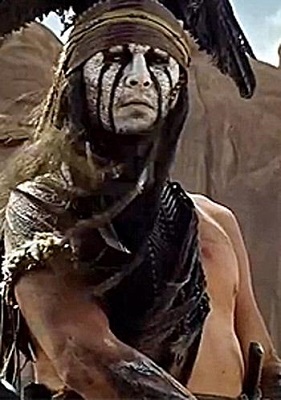
Much ink has gotten spilled in recent weeks by commentators distressed over Johnny Depp’s insensitive, broadly comedic portrayal of Tonto in Disney’s Lone Ranger reboot. Everything about the role, from Depp’s stone-faced slapstick to his costume to his Pidgin English has come in for criticism. But all these criticisms miss one important fact: nobody should have expected better from today’s creatively bankrupt film factories.

Director Gore Verbinski and producer Jerry Bruckheimer definitely imbued their story with good visuals. Armie Hammer’s black vest and matching duster look more plausible than Clayton Moore’s weird grey jumpsuit. The sweeping landscapes have a more unified look than the classic TV show’s set-bound appearance. Yet the creative team spent so much time and money on graphics that they forgot to care whether the characters made any damn sense.

When The Lone Ranger debuted on radio in 1922, a succession of white actors played Tonto. During the Depression, nobody flinched to hear white men grunting a supposedly Indian pidgin. But when the show graduated to TV, Native actor Jay Silverheels took especial pride in assuming the role. Silverheels represented not only a serious role model for the show’s child fans, but a step forward in how Hollywood treated Indians and Native concerns.

So when Disney announced a new Lone Ranger with a white actor as Tonto, audiences should have frankly expected blatant backsliding. This decision recalls years when studios trowelled “yellow” makeup on Anglo actors to create Charlie Chan. Studios love such characters, who require little thought or imagination. This blatant appeal to musty racial cliché, name-checking stereotypes as opposed to genuinely creating a character, signifies less racism than plain intellectual laziness.

Clayton Moore as the Lone Ranger;
Jay Silverheels as Tonto
Not that actors can’t play across races. Puerto Rican actor Raúl Juliá’s portrayal of Hamlet, which he nurtured and improved over thirty years, remains a benchmark of recent Shakespeare. Johnny Depp, who asserts distant Native ancestry, could have imbued gravitas to Tonto like he gave Edward Scissorhands or George Jung, had he shown the role appropriate respect. Instead, he selected the broad, stereotypical comedy of Captain Jack Sparrow.

Movies have suffered recently. Since The Sopranos lent panache to TV, visionary writers and directors have favored the small screen’s ability to build characters over an arc of years. Hardly the domain any longer of the priggish Standards and Practices prudes whose blue noses got bent if married couples slept in the same bed, TV now permits adventurous artists a chance to take bold risks on a years-long canvas.

This leaves the former Hollywood Dream Factories dominated by actors, whose bloated salary demands require studios to churn out blockbusters with factory regularity. No longer can Hollywood take risks on marginal properties like Casablanca or The Big Chill. Focus groups and market studies have incrementally neutered studios’ penchant for adventure. Anything lacking the requisite minimum share of explosions and CGI spectacles can’t justify its share of studios’ shrinking budget pie.

The audacious spirit that motivated movie entrepreneurs from Orson Welles to George Lucas has migrated to what filmmakers once called “the idiot box.” Thus, while TV nurtures smart, understated, psychologically diverse serial dramas like Orphan Black and True Blood, Hollywood mass-manufactures reboots, sequels, franchises, and adaptations. Comic books and discontinued TV properties rule. Disney openly speculates on Star Wars Episode VII, and true fans cringe.

Johnny Depp, once acknowledged for his constantly evolving range and emotional depth, has lapsed into a repetitive portrayal at least since 2005’s Charlie and the Chocolate Factory, if not earlier. The clownish mugging that characterizes his recent Tim Burton films pleases audiences and draws huge revenue, that justifies his obscene salaries. The quiet depth he once demonstrated just doesn’t pay as well, not for him or the studios.

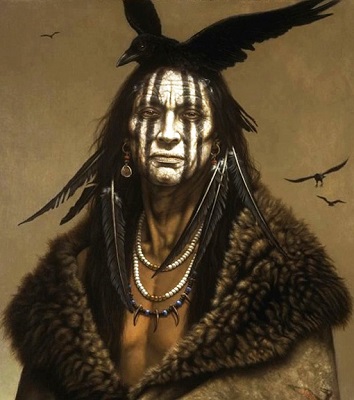
Kirby Sattler's I Am Crow,
the painting that inspired Tonto's new look
The Lone Ranger just looks like the product of floating market tests, and its naked appeal to others’ prior success leaves it dirty with artistic fingerprints. Combining low risk and high spectacle, it should have offered Disney a license to print money, if received industry wisdom had any foundation in reality. Sadly, it proves that audiences want something bold and reckless; filmgoers know when studios are speaking down to them.

We film buffs admire creative innovators, from Michael Curtiz to Kathryn Bigelow, who coax ensembles to achieve new, profound portrayals of complex situations. But Depp has joined the ranks of Hollywood personalities who must be appeased. Depp’s Tonto represents a studio system no longer interested in telling good stories for ambitious audiences. Disney’s Lone Ranger is the inevitable result of studios’ essential artistic exhaustion.

Wednesday, August 7, 2013

The Living Girl on the Dying Earth

1001 Books To Read Before Your Kindle Battery Dies, Part 18
Moira Young, Blood Red Road


When armed horsemen kill her father and kidnap her brother, teenage Saba must abandon the only home she’s known to rescue her surviving kin from an unknown fate. But she quickly learns that Pa wasn’t keeping her isolated, he was protecting her from a world grown bleak and savage. Now, among the ruins of skyscrapers and demolished flying machines, Saba must seize her adult identity to reclaim her family.

Audiences can read Moira Young’s debut novel as an exciting, packed apocalyptic teen adventure where nothing is certain and adversity tests youth to their limits. Or we can unpack it like literature. Like Harry Potter or Katniss Everdeen, Young’s Saba gets adulthood thrust upon her, with the choices adults face: will she prefer the easy passivity of violence and power, or become truly human, with the sacrifices humanity entails?

Too often, grown-ups isolate their young ’uns from the real world, as Pa does, protecting his children from violence, while they grow increasingly antsy about independent, adult vocations. Childhood becomes an albatross on the cusp of adulthood. Only when real life intrudes—when representatives of adulthood ride in guns a-blazin, and (literally or figuratively) kill the parents—do youth have the opportunity to discover what they’re for.

Everything that happens to Saba thereafter embodies adulthood’s encroachment on the peace of youth. Eventually, we find we have to trust people, even when people don’t always prove themselves trustworthy. We have to fight our way out of situations, no matter how deeply we believe in peace and harmony. And people who would exercise power over us, people who would proclaim themselves King, somehow interrupt our common humanity.

Young forces Saba into an intriguing duality. Sold into the slavery of failing humanity’s glatiatorial bloodsports, she must have Nietzsche's “will to power,” and persevere when others will bring her down. Her willingness to fight, even when others will suffer for her victory, even when she knows her preservation inevitably means others’ downfall, makes her into a true dark antihero, a person of the modern age.

But modernity contains the seeds of its own downfall: it’s built on flimsy foundations that will burn bright when the right people strike the spark. As Saba becomes the leader she needs to be, she finds that power means setting aside her own prerogatives. Hostility gives way to trust, and trust paves the road to revolution. If Saba wants to free the slaves and challenge the King in his domain, she cannot do so alone.

So perhaps she’s not the true Nietzschean hero after all. Perhaps she really represents how chest-thumping modernists build a house predicated on rules and order, assuming they can shackle nature and control the elements. When Saba and her heroines overcome that false promise, when they assert the natural freedom of all people, they reclaim humanity’s true identity, with all the anarchic unpredictability that entails.

Mercifully, Young doesn’t attempt to resolve this duality. To become herself, Saba must confront the impediments and embrace the opportunities we all have, unshackled by religion or culture that have grown bloated in their seniority. She presents adulthood as an essentially agnostic domain, free from the author’s quasi-divine intervention. Not for nothing do Young’s supporting characters have pre-Christian names like Lugh, Epona, and Maev.

Saba also learns that she cannot fight her wars alone. Repeatedly, she dismisses others and tries to stand alone, an übermensch bestriding the earth, but others bring skills, vision and encouragement that she needs. She finds wholeness not as some lone beacon, immune to human influence; she becomes whole, becomes a leader, and has strength to rescue her brother only when she learns to integrate herself with the larger system.

Power, then, derives not from Saba’s will to dominate. She doesn’t lead so she can rule; she leads so she can accomplish something worthwhile. Whether that means rescuing her brother, or challenging the King whose means of rule have subjugated the land, she has the choice: she can dominate others, or she can lead them. She chooses to lead. And this book makes it clear that this isn’t the easy choice.

Hemingway wrote that we come of age not by our birthdays, but when we accept life’s challenges. In Saba, Young externalizes the struggles of adulthood. Unburdened and unguided, our heroine faces heightened versions of the provocations everyone endures, and must, like us, choose her mature identity. Whether we’re Young’s intended teen audience, or adults crushed by modernity, this book invites us to make our choices with her.

Monday, August 5, 2013

D.P. Lyle's Frenetic Forensic Roulette

D.P. Lyle, Run To Ground: a Dub Walker Thriller

Everyone knows Walter Whitiker killed young Steven Foster. But when an Alabama judge excludes damning evidence on a technicality, Whitiker gets three years on an ancillary charge, and gets out after nineteen months. When an assassin’s bullet fells Whitiker as he exits prison, forensic consultant Dub Walker knows he has a real whodunit. But he regrets taking the case when Steven’s grieving parents become prime suspects.

Doug Lyle’s third Dub Walker novel begins with an engaging reversal: an execrable victim and touchingly sympathetic suspects. Lyle quickly establishes Whitiker as a man of low character, bad associations, and revolting habits. Tim and Martha Foster, however, prove willing to bend conventions and break laws to see justice for their son. Frustratingly, that premise doesn’t translate into a plausible story.

Lyle creates interesting characters with sympathetic motivations. Dub Lyle has multiple specialties and boatloads of guilt. His closest allies are his best friend, homicide detective Thomas “T-Tommy” Tortelli, and his ex-wife, ace TV journalist Claire McBride. This trio brings their diverse skills and connections to bear on a case so emotionally loaded that nobody could possibly emerge unscathed.

But having created such worthwhile characters, Lyle forces them into a story of such surpassing silliness that I wonder if the author was perhaps sleepy. Lyle, a cardiologist and forensic consultant, has worked with police and Hollywood. Surely an author so skilled and experienced realizes his audience reads crime thrillers every day, and knows enough to call bullhockey when the story parts company with reality.

From page one, this book relies on readers’ willingness to believe that two suburban civilians with no criminal history could not only organize an assassination, but their own subsequent disappearance, without anyone noticing. They could somehow teach themselves sniper shooting from the Internet. They could launder $500,000 into cash without ringing bells at the FDIC, DEA, or the Fed. And they could do it in absolute secret.

Not only must readers believe this, so must the cops. Because they believe such unbelievable precepts, they permit their prime suspects one full day’s head start. When Dub and T-Tommy finally decide to pursue their real quarry, they grasp at straws so desperately that they lay themselves open to barefaced manipulation. Their investigation quickly devolves into a comedy of errors.

For instance, early in the investigation, Dub squanders valuable time interviewing Whitiker’s potential prison enemies while the real trail goes cold. Wait, they let an accused pedophile walk the yard openly? Maybe it’s different in Alabama, but in most states, “short eyes” go straight to Keepaway for their own protection. In GenPop, they’d have very short life expectancy.

Then, what PD would allow a consultant they haven’t formally hired yet to take point on a high-profile investigation, essentially using his cop buddy as armed muscle? Dub shows remarkable autonomy in opening doors, conducting semi-legal searches, directing interviews, and handling evidence. It almost looks like T-Tommy wants his case ejected on some technicality. Considering his open sympathy for his suspects, maybe he does.

I repeatedly wanted to grab Dub’s lapels and shout “Pull your head out!” He transcribes multiple circumstantial interviews in which people who knew the suspects say exactly the same things—exactly, sometimes verbatim. He could afford to paraphrase for us. Meanwhile, Dub and T-Tommy ignore a red herring campaign so blatant that I remember it from an episode of Law & Order: SVU. What academy did these guys graduate from?

If this weren’t bad enough, Lyle’s prejudices dribble through his prose. Police may follow false paths occasionally, he says, but they never arrest the innocent. Cops are justified in pushing, or covertly ignoring, the bounds of legality, because criminals have no rights. Defense attorneys deserve to be shot. Any judge who doesn’t carry water for the prosecution is “corrupt.”

This might have made me less squeamish before Edward Snowden pantsed the NSA.

Dub’s confluence of weird actions, amateurish oversights, and excessive narration make this book feel really, really long. Seasoned mystery readers will recognize what Dub misses and wonder why he appears so lackadaisical about a case that could inflame public sentiment. Sporadic readers will just wonder why he recounts every single interview, even the useless ones

I wanted to like this book. I continued despite its implausible story. I persevered even when lifting the book became a Sisyphean effort. Lyle crafted a narrator and ensemble who made me care about them. But that doesn’t offset a story so implausible that it would make me laugh if it didn’t make me cry.

Friday, August 2, 2013

Daniel Quinn on the Art of Waking Up

Daniel Quinn, Dreamer

Chicago freelance writer Greg Donner has chase dreams. Who doesn’t? But when he meets a beautiful, vivacious, terrified woman in his dreams, he wants more chase dreams. When he meets that real woman, Ginny Winters, in real life, he finds the boundary between wake and dream blurring. And when he awakens in a sanatorium, informed that Greg Donner was a dream, he can’t tell the difference any longer.

Daniel Quinn’s first novel appeared twenty-five years ago, won critics’ hearts, awakened buzz in science fiction circles—and vanished without a second printing. In the intervening years, it developed a simmering Internet following, and original paperbacks can fetch $300 on eBay, but no mainstream publisher would reprint it. So Quinn, now a guru to environmentalist and alternative spirituality circles, has brought his debut back himself.

Long before Inception or The Matrix, Quinn questioned reality’s frequently dreamlike qualities, and the frustratingly realistic nature of dreams. Greg Donner’s dreams are so realistic that parts of them become more desirable than his waking life. When the woman he knows in his dreams becomes appears in his workaday life, he has to wonder how effect could precede cause. Then a third reality intrudes, contradicting everything that came before.

Greg Donner is an iconic everyman, a workaday dude living one step removed from his aspirations. Writing has become an assembly line drudge, romance a trifling distraction. (It bears note that, in 1988, freelancing kept writers much more geographically chained: you can’t venture far from your most important tools, your landline phone and the public library.) His decent, undistinguished life offers security, but has long since lost its luster.

Ginny Winters, very beautiful and intensely passionate, offers to close the gap between Greg’s life and his ambitions. But when the initial whirlwind cools, Ginny’s passions prove to conceal truly epic baggage. You know how, in your dreams, every situation seems urgent, every choice carries world-shattering consequences, and everything turns on you? Ginny doesn’t have to fall asleep to visit that world. The Ginny Greg loves may not even exist.

Dreamer counts as science fiction only in the broadest possible sense, a speculation on the nature of comprehensible reality and the evidence of our senses. The contrast between the banality of Greg’s life and the excitement of his dreams, and the possibility that some outside force has upended this equilibrium, makes for darkly hypothetical philosophy. And Quinn dares ask: why do we just assume we’re awake?

Quinn’s protagonists occupy a twinned world, where dramatic dreams and banal reality quickly become fungible. Reality becomes a pass-through between two universes, and excessive autonomy in one earns harsh payback in the other, a dark karma of futility. As Greg and Ginny invest everything in increasingly precarious gambles, unsure which will pay off, readers become increasingly anxious to see how many layers of dream conceal reality.

Despite the science fiction veneer, Quinn raises very real questions. Greg passes between his freewheeling, freelancing life, and his imprisonment in a sanatorium, increasingly unable to tell which reality is “real.” In each state, he assumes the testimony of his senses has some external basis: that is, I know this world is real because I see it with my eyes. In each reality, he assumes the other is a dream.

Two years before Quinn published this, his first novel, American psychologist Charles Tart coined the term “consensus trance” in his book Waking Up. Each of us, Tart says, shuffles through live in a dreamlike state, little better than automatons programmed by society to behave in acceptable ways. Even when we are bodily awake, a dreaming fugue dominates our thoughts; we don’t question we’re awake because, fundamentally, we’re not.

Whether Quinn read Tart’s theories I cannot say. But this book embodies the fear that we cannot distinguish reality from a well-constructed simulacrum. Greg Donner’s spiral into powerlessness, and his struggle to pierce the façade and resist the forces blurring his reality, represent the struggle all of us should undertake, though too few do. We want Greg to defeat his rampaging dreams because, fundamentally, we want to wake up too.

Quinn offers a taut thriller questioning whether we truly know reality. He blends serious philosophy with a peculiar quest epic, a variant on Campbell’s heroic journey where the whole adventure occurs in one place. He successfully keeps readers guessing which reality owns Greg and Ginny, while asking whether we own our dreams, or they own us. He suggests no easy answers, but challenges us to ask better questions of ourselves.